
Determine the necessary mass, volume, or concentration for preparing a solution.
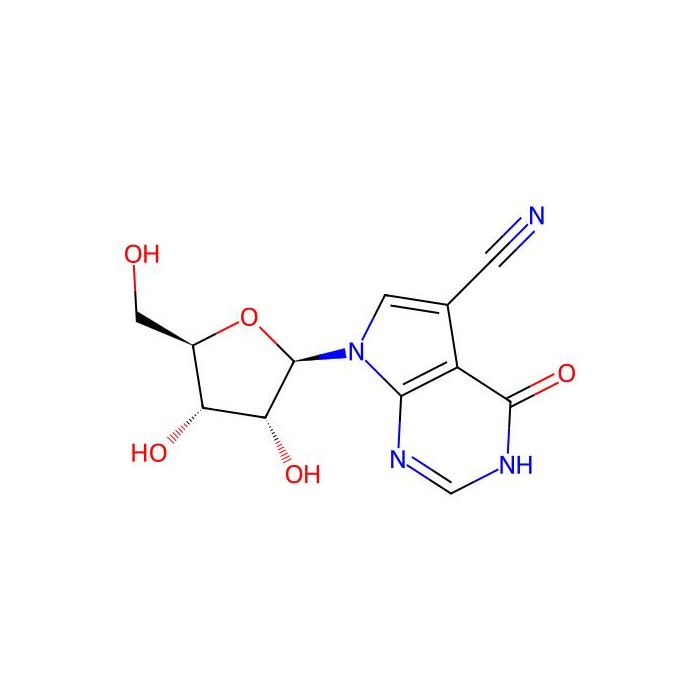
Jaspamycin - ≥98% , CAS No.22242-96-2
注文可能
グレード&純度 ≥98%
Storage
Store at -20°C
Shipped In
Ice chest + Ice pads
Jaspamycin (7-CN-7-C-Ino) is a potent activator of PKA , binding to the R site (PKAR), with an EC 50 of 6.5 nM and K d of 8 nM in Trypanosoma brucei . Jaspamycin (7-CN-7-C-Ino) does not bind with purified human PKARIα. Anti-parasite activity
Form:Solid
IC50& Target:Trypanosoma brucei PKAR(199-499) 6.5 nM (EC 50 ) Trypanosoma Trypanosoma brucei PKA holoenzyme 8 nM (Kd)
Taxonomy Tree
| Kingdom | Organic compounds |
|---|---|
| Superclass | Nucleosides, nucleotides, and analogues |
| 分類 | Pyrrolopyrimidine nucleosides and nucleotides |
| Subclass | Not available |
| Intermediate Tree Nodes | Not available |
| Direct Parent | Pyrrolopyrimidine nucleosides and nucleotides |
| Alternative Parents | Glycosylamines Pentoses Pyrrolo[2,3-d]pyrimidines Pyrimidones Substituted pyrroles Vinylogous amides Heteroaromatic compounds Oxolanes 1,2-diols Secondary alcohols Oxacyclic compounds Nitriles Azacyclic compounds Organic oxides Hydrocarbon derivatives Primary alcohols |
| Molecular Framework | Aromatic heteropolycyclic compounds |
| Substituents | Pyrrolopyrimidine ribonucleoside - Glycosyl compound - N-glycosyl compound - Pentose monosaccharide - Pyrrolo[2,3-d]pyrimidine - Pyrrolopyrimidine - Pyrimidone - Monosaccharide - Pyrimidine - Substituted pyrrole - Oxolane - Heteroaromatic compound - Vinylogous amide - Pyrrole - 1,2-diol - Secondary alcohol - Carbonitrile - Nitrile - Oxacycle - Azacycle - Organoheterocyclic compound - Organooxygen compound - Organonitrogen compound - Alcohol - Organic nitrogen compound - Organic oxide - Hydrocarbon derivative - Primary alcohol - Organic oxygen compound - Cyanide - Aromatic heteropolycyclic compound |
| 説明 | This compound belongs to the class of organic compounds known as pyrrolopyrimidine nucleosides and nucleotides. These are nucleoside derivatives containing a ribose derivative which is n-glycosylated to a pyrrolopyrimidine. Also called deazapurine nucleosides, they are analogs of purine nucleosides with the N atom of the purine being replaced by a C atom at position 7. |
| External Descriptors | Not available |
| 溶解度 | DMSO : 41.67 mg/mL (142.58 mM; Need ultrasonic) |
|---|
No validated application protocols are provided in the Product Data for this item.
Item-specific (Product Data)
General guidance for small-molecule use in assays
For detailed, validated protocols, consult primary publications for CAS 22242-96-2 or contact technical support with your application details.
Context: Specific biological targets or pathways for this item are not provided in the Product Data. The following remarks are general to small-molecule natural products used in research and are not item-specific claims.
Item-specific (Product Data)
Literature/general context
Practical guidance
Note: For research use only. No medical or clinical claims are made or implied. Consult primary literature for validated biological roles tied to CAS 22242-96-2.
Applicability: This section is generally not applicable. Jaspamycin is a discrete small molecule and not a buffering agent.
Item-specific (Product Data)
Guidance (general)
For buffer recipes and pH ranges, refer to standard buffering agents; Jaspamycin itself is not used to prepare buffers.
Relevance: Green-chemistry substitution typically applies to solvents, reagents, or auxiliaries. As a discrete bioactive small molecule, Jaspamycin is not generally subject to “green alternative” replacement the way a solvent would be.
When this section matters
Greener handling strategies (general)
Comparison (solvent focus; general)
Conclusion: Green alternatives are best pursued in the process/assay environment (solvent choice, scale, waste minimization) rather than substituting the compound.
Scope: No pharmacopeial status or excipient role is provided in the Product Data. This product is supplied strictly for research use.
Item-specific (Product Data)
General (non-clinical) context
No therapeutic or clinical claims are made or implied for this item.
Summary: No item-specific physico-chemical specifications were provided in the Product Data for this catalog entry. Values below are placeholders indicating the absence of specifications for this item.
Item-specific (Product Data)
Literature/general (not item-specific; verify against CoA before use)
Practical guidance (general)
Note: Treat any literature values as guidance only; do not construe them as specifications for SKU J647143.
Quality overview: The Product Data do not list a grade or purity for this item. Use the guidance below to plan QC and fitness-for-use assessments.
Item-specific (Product Data)
Interpreting common grades (general guidance)
Recommended incoming QC (general)
Stabilizers/additives
Note: When grade/purity are critical (e.g., screening vs. mechanistic biochemistry), reference the lot-specific CoA/Spec Sheet for acceptance criteria.
Scope: Jaspamycin, as listed, is a bioactive small molecule for research. It is not typically used as a synthetic reagent or catalyst. Accordingly, reaction chemistry content focuses on usage in discovery workflows rather than as a building block.
Item-specific (Product Data)
Research usage (general guidance)
Not a general reagent
Note: For specific bioassay protocols or target classes, please consult primary publications tied to CAS 22242-96-2 or request additional documentation.
Not typically applicable. Jaspamycin is not supplied as a reagent for chemical reactions; therefore, standard reaction-condition guidance (solvent, temperature, catalysts) is not relevant.
No item-specific reaction data are available for this catalog entry.
Safety summary: Hazard classification for this specific item is not provided in the Product Data. Apply prudent laboratory safety practices typical for bioactive small molecules and defer to the SDS for authoritative information.
Item-specific (Product Data)
General laboratory precautions (literature/general guidance)
Always consult the product SDS (most current version) for definitive hazard, exposure limits, and response measures.
Applicability: As a small-molecule screening compound with unspecified solubility, solvent selection should be empirical and guided by your downstream application (biochemical, cell-based, or analytical).
Item-specific (Product Data)
General guidance for small-molecule natural products
Practical tips
Comparison snapshot (general)
Item-specific storage conditions are provided; reconstitution guidance is offered as general best practice for small molecules.
Item-specific (Product Data)
General reconstitution guidance (not item-specific; verify with CoA/SDS)
Note: If the CoA/Spec Sheet specifies different conditions (e.g., desiccation, inert atmosphere, light protection), follow those instructions preferentially.
Brief overview: Jaspamycin (SKU J647143) is listed as a small-molecule research compound in Aladdin’s small-molecule/compound library category. Limited item-specific identifiers are available in the Product Data for this entry.
Item-specific (Product Data)
Literature/general identity notes (context; not item-specific specs)
Structural description (2D, qualitative)
Relevance: Jaspamycin is provided as a finished small molecule for research and is not typically employed as a reagent, catalyst, or common building block in synthetic chemistry.
Item-specific (Product Data)
General considerations (literature/context)
Conclusion: Without item-specific structural data, Jaspamycin should be treated as a terminal compound for bioassay rather than a synthetic intermediate.
Item-specific targeting data are not provided for this entry.
Item-specific (Product Data)
Guidance (general)