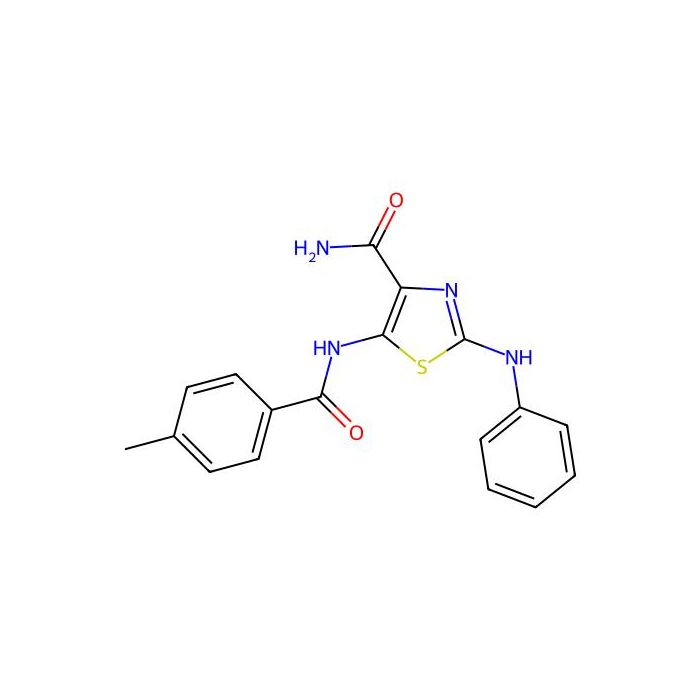
KY-05009 - ≥99% , CAS No.1228280-29-2

CAS: 1228280-29-2 Cat. No.: K651390 分子式: C18H16N4O2S 分子量: 352.41 PubChem CID: 46234348
注文可能
GRADE & PURITY ≥99%
Storage
Store at -20°C
Shipped In
Ice chest + Ice pads
★
Size
USA
ドイツ (EU)*
Price
Qty
5mg
K651390-5mg
受注生産 · 8~12週間
$180.90
25mg
K651390-25mg
受注生産 · 8~12週間
$720.90
100mg
K651390-100mg
受注生産 · 8~12週間
$1,500.90
Enter a quantity for the sizes you want to add.
🧪
Why this grade

≥99% for sensitive chromatographic and analytical workflows requiring minimal baseline interference.

🌡

Storage & shipping

Store at -20°C Ships Ice chest + Ice pads Check lot-specific COA for exact specifications.

📋

Quality documents

SDS, COA, datasheet, and spec sheet available for download. Lot-specific COA accessible via lot number lookup.

📚

Literature proof

Cited in 0 peer-reviewed publications across chromatography, organic synthesis, and cross-coupling reactions.

概要

KY-05009 is an ATP-competitive Traf2- and Nck-interacting kinase (TNIK) inhibitor with a K i of 100 nM. KY-05009 pharmacologically inhibits TGF-β1-induced epithelial-to-mesenchymal transition (EMT) in human lung adenocarcinoma cells. KY-05009 inhibits the protein expression of TNIK and transcriptional activity of Wnt target genes and induces apoptosis in cancer cells. KY-05009 exerts anti-cancer activity

In Vitro

KY-05009 (0.1-30 μM; 24 hours; RPMI8226 cells) treatment inhibits the proliferation of RPMI8226 cells in a dose-dependent manner. KY-05009 (1-3 μM; 48-72 hours; RPMI8226 cells) treatment induces caspase-dependent apoptosis in RPMI8226 cells in a dose-dependent manner. KY-05009 (3 μM; 1 hour; RPMI8226 cells) treatment suppresses the transcriptional activity of Wnt signaling-related genes, including TNIK, CTNNB1, TCF7, and TCF4. .\nKY-05009 (3 μM; 9 hours; RPMI8226 cells) treatment inhibits the IL-6-induced interaction between TCF4 and β-catenin and the phosphorylation of TCF4. MCE has not independently confirmed the accuracy of these methods. They are for reference only. Cell Proliferation AssayCell Line: RPMI8226 cells Concentration: 0.1 μM, 0.3 μM, 1 μM, 3 μM, 10 μM, 30 μM Incubation Time: 24 hours Result: Inhibited the proliferation of RPMI8226 cells. Apoptosis AnalysisCell Line: RPMI8226 cells Concentration: 1 μM, 3 μM, 10 μM Incubation Time: 48 hours, 72 hours Result: Induced the binding of fluorescent Annexin V and 7-amino-actinomycin D (7-AAD) uptake. RT-PCRCell Line: RPMI8226 cells Concentration: 3 μM Incubation Time: 1 hour Result: Suppressed the transcriptional activity of Wnt signaling-related genes, including TNIK, CTNNB1, TCF7, and TCF4. Western Blot AnalysisCell Line: RPMI8226 cells Concentration: 3 μM Incubation Time: 9 hours Result: The IL-6-induced interaction between TCF4 and β-catenin and the phosphorylation of TCF4 were inhibited.

Form:Solid

IC50& Target:TNIK 100 nM (Ki)

Specifications

仕様と純度
≥99%
生化学的・生理学的メカニズム
KY-05009 is an ATP-competitive Traf2- and Nck-interacting kinase (TNIK) inhibitor with a K i of 100 nM. KY-05009 pharmacologically inhibits TGF-β1-induced epithelial-to-mesenchymal transition (EMT) in human lung adenocarcinoma cells. KY-05009 inhibits the
保管条件
Store at -20°C
入荷
Ice chest + Ice pads
この製品は冷冷この冷このこの製品の運送が必要です。地上およびその他の経済サービスは利用できません。
アクションタイプ
INHIBITOR
純度
≥99%
名前と識別子
カノニカル・スマイル
CC1=CC=C(C=C1)C(=O)NC2=C(N=C(S2)NC3=CC=CC=C3)C(=O)N
IUPAC Name
2-anilino-5-[(4-methylbenzoyl)amino]-1,3-thiazole-4-carboxamide
InChIKey
WCEDGRTWDSHZHF-UHFFFAOYSA-N
INCHI
1S/C18H16N4O2S/c1-11-7-9-12(10-8-11)16(24)22-17-14(15(19)23)21-18(25-17)20-13-5-3-2-4-6-13/h2-10H,1H3,(H2,19,23)(H,20,21)(H,22,24)
異性体SMILES
CC1=CC=C(C=C1)C(=O)NC2=C(N=C(S2)NC3=CC=CC=C3)C(=O)N
PubChem CID
46234348
分子量
352.41

Documentation

📋 Safety Data Sheet (SDS)

Comprehensive hazard, handling, storage, and regulatory compliance document.

Download SDS →

✅ Certificate of Analysis (COA)

Lot-specific quality data. Enter your lot number to retrieve the exact COA.

Look up COA →

📊 Datasheet

Quick-reference summary of product specifications and applications.

View datasheet →

🔬 Specification Sheet

Full quality attributes and acceptance criteria for this grade.

View spec sheet →

Advanced Data

Taxonomic Classification

Taxonomy Tree

KingdomOrganic compounds
SuperclassBenzenoids
分類Benzene and substituted derivatives
SubclassBenzoic acids and derivatives
Intermediate Tree Nodes Not available
Direct ParentBenzamides
Alternative Parents p-Toluamides  Thiazolecarboxamides  2,4,5-trisubstituted thiazoles  2-heteroaryl carboxamides  Benzoyl derivatives  Aniline and substituted anilines  2-amino-1,3-thiazoles  Vinylogous amides  Heteroaromatic compounds  Secondary carboxylic acid amides  Primary carboxylic acid amides  Amino acids and derivatives  Secondary amines  Azacyclic compounds  Organic oxides  Hydrocarbon derivatives  Organooxygen compounds  
Molecular FrameworkAromatic heteromonocyclic compounds
Substituents Benzamide - P-toluamide - Toluamide - 2-heteroaryl carboxamide - 2,4,5-trisubstituted 1,3-thiazole - Benzoyl - Thiazolecarboxamide - Aniline or substituted anilines - Thiazolecarboxylic acid or derivatives - Toluene - 1,3-thiazol-2-amine - Azole - Heteroaromatic compound - Vinylogous amide - Thiazole - Amino acid or derivatives - Carboxamide group - Primary carboxylic acid amide - Secondary carboxylic acid amide - Carboxylic acid derivative - Secondary amine - Azacycle - Organoheterocyclic compound - Organic nitrogen compound - Organooxygen compound - Organonitrogen compound - Amine - Hydrocarbon derivative - Organic oxide - Organic oxygen compound - Aromatic heteromonocyclic compound
説明This compound belongs to the class of organic compounds known as benzamides. These are organic compounds containing a carboxamido substituent attached to a benzene ring.
External Descriptors Not available
3 D構造
インタラクティブ化学構造モデル


作用メカニズム
証明書(CoA、COO、BSE/TSEと分析図)
C of A & Other Certificates(BSE/TSE, COO):
Analytical Chart:
化学的性質と物理的性質
溶解度DMSO : 83.33 mg/mL (236.46 mM; Need ultrasonic)
分子量352.400 g/mol
XLogP34.100
Hydrogen Bond Donor Count3
Hydrogen Bond Acceptor Count5
Rotatable Bond Count5
Exact Mass352.099 Da
Monoisotopic Mass352.099 Da
Topological Polar Surface Area125.000 Ų
Heavy Atom Count25
Formal Charge0
Complexity476.000
Isotope Atom Count0
Defined Atom Stereocenter Count0
Undefined Atom Stereocenter Count0
Defined Bond Stereocenter Count0
Undefined Bond Stereocenter Count0
The total count of all stereochemical bonds0
Covalently-Bonded Unit Count1
ソリューション計算機
レビュー

顧客レビュー

Application Protocols

Validated, product-specific application protocols are not provided in the Product Data.

  • Item-specific protocols

    • Not specified for this item; refer to CoA/Spec Sheet.
  • General small-molecule handling protocol (for screening)

    • Prepare a 10–50 mM stock in anhydrous DMSO; vortex and, if needed, sonicate briefly to dissolve. Filter through 0.2 µm PTFE.
    • Aliquot into low-bind tubes or 96-well plates to avoid repeated freeze–thaw cycles.
    • For biochemical/cellular assays, dilute stock into assay buffer/media to the desired final concentration keeping DMSO ≤1% v/v (typical 0.1–0.5%).
    • Include vehicle controls and, if available, a positive control compound. Confirm test-article concentration by LC–MS or UV–vis when feasible.
    • Record batch number and analytical data for traceability.
  • Analytical reference use (general)

    • Establish LC–MS conditions (column, gradient, ionization mode) and document retention time and mass spectrum for this batch for future comparability.
Biological Roles

No structural or mechanistic information is provided for KY-05009; therefore, specific biological roles cannot be assigned for this item.

  • Item-specific biological function

    • Not specified for this item; refer to CoA/Spec Sheet.
  • General considerations for small-molecule library members (research use only)

    • Such compounds are commonly screened against enzymes, receptors, or phenotypic readouts to identify hits. Any observed activity should be treated as preliminary until validated with orthogonal assays and counter-screens (e.g., aggregation, redox cycling, PAINS motifs if applicable).
    • Establish compound integrity in assay buffers (solubility, non-specific binding to plastic/protein, stability vs. hydrolysis/oxidation).
    • Determine basic ADME-relevant attributes experimentally (solubility in assay media, logD7.4, chemical stability) if biological testing is planned.
  • Caution

    • No pharmacological or therapeutic claims are made or implied. All uses are for research purposes only. Mechanistic annotations must be derived from primary literature specific to this compound once structure and targets are known.
Buffer Applications

Buffer formulation guidance is not typically applicable to an undefined small-molecule library compound.

  • Item-specific buffer roles

    • Not specified for this item; refer to CoA/Spec Sheet.
  • Practical note (general)

    • If used in biological assays, dissolve in DMSO to prepare a concentrated stock and dilute into the chosen assay buffer (e.g., PBS, HEPES, Tris) ensuring the final DMSO content (commonly 0.1–1% v/v) does not perturb assay performance.
    • Assess precipitation upon dilution and consider co-solvents or surfactants (e.g., 0.01–0.05% Tween 20) if compatible with the assay.
Green Alternatives

Because the structure and functional class of KY-05009 are not specified, green chemistry discussion focuses on handling and solvent choices around its use rather than the compound itself.

  • Greener handling strategies

    • Minimize solvent volumes by preparing concentrated DMSO stocks and diluting at point-of-use.
    • Use microscale assays and high-throughput formats to reduce material consumption and waste.
  • Solvent selection (general, greener options)

    • Prefer water, ethanol, isopropanol, ethyl acetate, and 2-MeTHF when compatible with solubility and stability.
    • Limit use of chlorinated solvents (DCM, chloroform) and dipolar aprotics (DMF, DMAc, NMP) unless necessary.
  • Comparison of common solvent choices (general)

    • Water/EtOH: low hazard, renewable; constrained by solubility of hydrophobic analytes.
    • 2-MeTHF/EtOAc: bio-based options for extractions and chromatography; flammable and peroxidizable—monitor peroxide levels if stored long term.
    • MeCN: excellent for LC–MS; toxicity and waste burden higher than alcohols.
  • Waste management

    • Segregate halogenated and non-halogenated waste streams; consider solvent recycling for non-halogenated streams.
  • Note

    • Compound-specific greener alternatives (e.g., benign structural analogs) cannot be proposed without structural information for KY-05009.
Pharmaceutical Uses

No pharmacopeial status, excipient role, or formulation data are provided for KY-05009.

  • Item-specific pharmaceutical context

    • Not specified for this item; refer to CoA/Spec Sheet.
  • General note

    • Compounds in research libraries are not approved excipients and are not intended for human or veterinary use. If used in pre-formulation research, standard characterization (polymorph screening, hygroscopicity, pKa, logD, intrinsic solubility, and stability) should be performed, but no therapeutic claims are made or implied.
Physical Properties

Item-specific physicochemical data are not provided in the Product Data. Use the following as guidance on how to determine or locate them.

  • Item-specific values

    • Appearance: Not specified for this item; refer to CoA/Spec Sheet.
    • Melting point (MP): Not specified for this item; refer to CoA/Spec Sheet.
    • Boiling point (BP): Not specified for this item; refer to CoA/Spec Sheet.
    • Density: Not specified for this item; refer to CoA/Spec Sheet.
    • Refractive index: Not specified for this item; refer to CoA/Spec Sheet.
    • Solubility profile: Not specified for this item; refer to CoA/Spec Sheet.
    • LogP/logD, pKa: Not specified for this item; refer to CoA/Spec Sheet.
  • Practical characterization workflow (general literature guidance)

    • If solid: determine MP (capillary) and assess hygroscopicity by mass change under controlled RH.
    • If liquid: measure refractive index and density at 20–25 °C; check for miscibility with water, MeOH, MeCN, DCM, and hexanes.
    • Generate a preliminary solubility map (mg/mL) in common solvents for method development and formulation.
    • LC–MS: establish retention time windows in aqueous (0.1% formic acid) and basic (10 mM NH4HCO3) gradients; record MS1 isotope envelope for rapid ID.
    • Spectroscopy: IR (ATR) for functional-group survey; UV–vis if chromophores suspected—report λmax only if measured.
  • Note on specifications

    • Any numerical property required for QC release (e.g., water by Karl Fischer, residue on ignition) is Not specified for this item; refer to CoA/Spec Sheet.
Quality and Grades

The Product Data do not specify a grade or purity for KY-05009.

  • Item-specific grade/purity

    • Grade/Purity: Not specified for this item; refer to CoA/Spec Sheet.
  • How to interpret grades (general guidance)

    • Research grade: typical for screening libraries; purity often reported by HPLC/UPLC area % with MS confirmation.
    • Analytical (AR) or Reagent grade: tighter limits on common inorganic/organic impurities; trace metals sometimes controlled.
    • HPLC grade solvents/reagents: optimized for low UV absorbance and particle content for chromatography.
    • BioUltra/biological grades: endotoxin/bioburden controlled; not usually applicable to small-molecule hit compounds.
  • Purity analytics (recommended QC for this item)

    • Provide HPLC/UPLC chromatograms (multiple wavelengths), LC–MS purity, and, if solid, 1H/13C NMR with integrals.
    • If chirality is relevant, include enantiomeric excess by chiral HPLC/SFC.
    • Report residual solvents (GC), water (KF), and identity confirmation (HRMS). Any specific numeric thresholds are Not specified for this item; refer to CoA/Spec Sheet.
  • Stabilizers and additives

    • None stated. If stability is a concern at ambient temperature, addition of an inert diluent or formulation into a DMSO stock may be considered per SDS/CoA guidance.
Reaction and Applications

The Product Data categorize KY-05009 under “small molecules and compound libraries,” suggesting intended use as a screening or reference compound rather than as a reagent or building block. No manufacturer application text is provided beyond the category.

  • Item-specific applications

    • Manufacturer applications: Not specified for this item; refer to CoA/Spec Sheet.
  • General laboratory uses for library compounds

    • Biochemical or cell-based screening as a test article to probe pathways or phenotypes (research use only). Develop dose–response curves from DMSO stocks; confirm identity/purity by LC–MS before critical studies.
    • Analytical reference standard for method development (LC–MS retention, fragmentation). Create stability-indicating methods to monitor degradation.
  • If synthetic use is intended (general)

    • Without known functional groups, do not assume reactivity. If repurposed as a building block, first acquire a comprehensive spectroscopic data package.
    • Evaluate stability under acids/bases, oxidants/reductants via micro-scale stress tests (e.g., pH 2/10, 40–60 °C, 24–48 h) and analyze by LC–MS to map liabilities.
  • Practical tips

    • Maintain frozen aliquots to minimize freeze–thaw; protect from light until photostability is established.
    • Document exact batch identifiers and analytical data when correlating biological or analytical outcomes.
Reaction Conditions

No reaction conditions are specified for KY-05009 in the Product Data. If this material is to be used in a chemical transformation, establish conditions empirically after defining its functional groups.

  • Item-specific conditions

    • Not specified for this item; refer to CoA/Spec Sheet.
  • General condition-setting workflow

    • Solvent: begin with broadly compatible media (MeCN, THF, toluene, DCM, DMF) depending on solubility and intended transformation; consider greener alternatives when possible.
    • Temperature: screen 0 °C to 80 °C (or to solvent reflux) while monitoring by TLC/LC–MS.
    • Atmosphere: default to inert gas (N2/Ar) until air/moisture sensitivity is excluded by testing.
    • Catalysts/additives: select based on functional groups (e.g., bases for alkylations, acids for acylations, Pd catalysts for cross-coupling). Avoid strong bases/acids until stability is known.
    • Time/yield expectations: Not specified; optimize by time-course sampling.
  • Analytical control

    • Use in-process LC–MS to track conversion and detect decomposition; confirm product identity with NMR and HRMS.
Safety and Handling

Safety details specific to this item are not provided in the Product Data. Handle as a research chemical of unknown acute toxicity under prudent laboratory practices.

  • Item-specific safety

    • GHS classification: Not specified for this item; refer to SDS.
    • Signal word / H-statements / pictograms: Not specified for this item; refer to SDS.
    • Research use note: For research use only.
    • Storage condition (from Product Data): Store at −20 °C.
  • General precautions (defer to SDS for authoritative guidance)

    • PPE: lab coat, safety glasses or face shield, and appropriate chemically resistant gloves (e.g., nitrile). Work in a certified fume hood.
    • Avoid inhalation, ingestion, and skin contact; prevent aerosolization and dust formation.
    • Incompatibilities: Until functional groups are known, segregate from strong oxidizers, acids/bases, and reducing agents. Keep away from ignition sources.
    • First aid (general): Inhalation—move to fresh air; Skin—wash with soap and water; Eyes—rinse with water for 15 minutes; Ingestion—seek medical attention. Provide SDS to responders.
  • Spill and disposal

    • Small spills: absorb with inert material; collect in suitable waste.
    • Disposal: Treat as hazardous organic waste; follow institutional and local regulations.
  • Transport notes

    • Shipped in: Ice chest + ice pads (from Product Data) to maintain cold chain and minimize degradation risk.
Solvent Selection

Item-specific solubility and polarity data are not provided. The following framework can help you select solvents for KY-05009 once a small solubility screen is performed.

  • Start with a tiered solubility screen (general guidance)

    • Polar protic: water, methanol, ethanol, isopropanol.
    • Polar aprotic: DMSO, DMF, DMAc, acetonitrile.
    • Moderately polar: ethyl acetate, acetone.
    • Nonpolar: dichloromethane, toluene, MTBE, hexanes.
  • Working stocks for screening

    • For small-molecule libraries, 10–50 mM stocks in anhydrous DMSO are common; filter (0.2 µm PTFE) and store at −20 °C. Actual solubility for this item: Not specified; determine experimentally.
  • Chromatography considerations (general)

    • If UV-active, choose eluents with low baseline at λmax; for normal phase, hexanes/EtOAc gradients; for reverse phase, water/MeCN or water/MeOH with 0.1% acid/base as needed.
  • Comparison to alternatives

    • Without a structure, it is not possible to recommend a single optimal solvent. Begin with DMSO for stock solutions and adjust based on observed solubility and stability.
Storage and Reconstitution
  • Item-specific storage (from Product Data)

    • Storage Conditions: Store at −20 °C.
    • Shipped In: Ice chest + ice pads.
  • Long-term storage guidance (general)

    • Keep tightly sealed under inert gas (e.g., nitrogen/argon) if the compound is air/moisture sensitive; sensitivity is Not specified for this item; refer to CoA/Spec Sheet.
    • Protect from light until photostability is established. Use amber vials where appropriate.
    • For solutions, prepare single-use aliquots to minimize freeze–thaw cycles. DMSO or MeCN stocks commonly stored at −20 °C; verify stability experimentally.
  • Reconstitution (general)

    • Solvent choice: Begin with anhydrous DMSO; if insoluble, test DMF, MeOH, or MeCN. Actual solubility for this item is Not specified; determine empirically.
    • Concentration: Typical screening stocks are 10–50 mM; filter (0.2 µm PTFE) after dissolution.
  • Stability notes

    • No stabilizers or specific degradation pathways are provided. For quality-sensitive work, assess stability by LC–MS after 1–2 weeks at storage temperature and after 24–48 h at room temperature.
  • Specifications not provided

    • Appearance, water content, purity, and other release criteria: Not specified for this item; refer to CoA/Spec Sheet.
Structure and Identity

Brief item-specific identifiers are limited for this catalog entry. Where values are missing, consult the CoA/Spec Sheet or SDS.

  • Item-specific (from Product Data)

    • Product Name: KY-05009 (catalog research compound)
    • SKU: K651390
    • CAS: 1228280-29-2
    • PubChem CID: 46234348
    • InChIKey: 394548 (as provided; note: atypical/truncated format in source)
    • SMILES: Not specified for this item; refer to CoA/Spec Sheet.
    • Molecular formula: Not specified for this item; refer to CoA/Spec Sheet.
    • Molecular weight: Not specified for this item; refer to CoA/Spec Sheet.
  • Structural features (descriptive)

    • Not specified for this item; refer to CoA/Spec Sheet.
  • Notes on identity confirmation (general best practice)

    • Verify identity by orthogonal methods: 1H/13C NMR, HRMS (ESI/APCI), and, where applicable, IR and LC–MS.
    • If stereochemistry is relevant, use chiral HPLC or VCD/ORD as appropriate.
    • Cross-reference the CAS and CID with spectral libraries (literature) to correlate retention time and fragmentation patterns.
  • 2D structure in words (general)

    • Not specified for this item; no functional-group or ring-system annotation can be provided without a structure. Please consult the CoA/Spec Sheet for structural depiction.
Synthetic Utility

Without structural information, specific synthetic transformations for KY-05009 cannot be recommended. The following outlines a general approach should one consider using this material in synthesis.

  • Item-specific reactivity

    • Not specified for this item; refer to CoA/Spec Sheet.
  • General guidance

    • Determine functional-group inventory via spectroscopy (NMR, IR, HRMS) and small-scale derivatization tests (e.g., acetylation for alcohols/amines, methylation for acids/phenols) to probe reactivity.
    • If halogens or pseudohalides are present, cross-coupling (Suzuki–Miyaura, Buchwald–Hartwig, Sonogashira) may be viable; if carbonyl groups are present, consider reductions (NaBH4, catalytic hydrogenation) or condensations (Schiff base formation).
    • For heterocycles, evaluate stability under acidic/basic conditions prior to electrophilic/nucleophilic substitutions.
  • Retrosynthetic perspective

    • Map potential disconnections only after confirming the core scaffold. Protecting-group strategies and chemoselectivity considerations hinge on verified functionality.
Target Specificity

Target information (e.g., enzyme/receptor, species reactivity, binding constants) is not provided for KY-05009.

  • Item-specific targeting

    • Not specified for this item; refer to CoA/Spec Sheet.
  • General note

    • For screening compounds, target specificity must be established experimentally via primary assays, counter-screens, selectivity panels, and, where applicable, mechanism-of-action studies. Until such data are available, no claims regarding specificity can be made.

Shall we send you a message when we have discounts available?

Remind me later

Thank you! Please check your email inbox to confirm.

Oops! Notifications are disabled.