
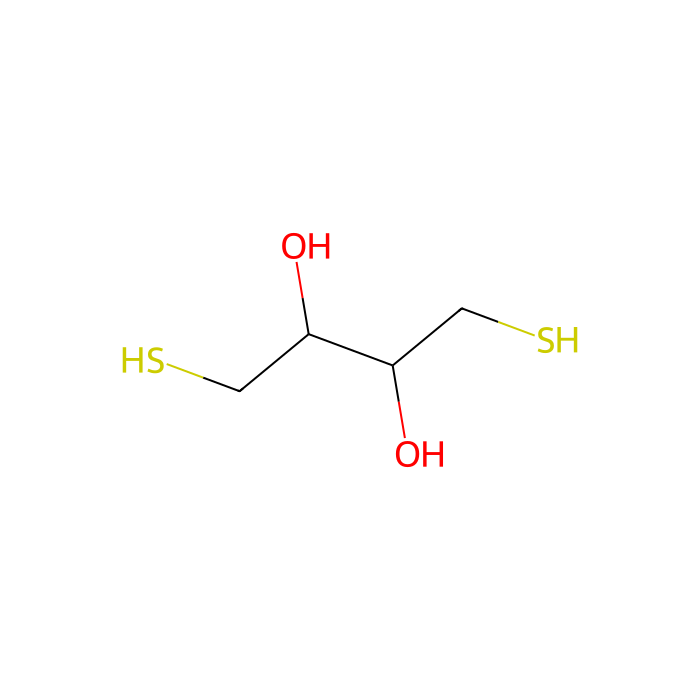
Determine the necessary mass, volume, or concentration for preparing a solution.
| Activity Type | Relation | Activity value | Units | Action Type | Journal | PubMed Id | doi | Assay Aladdin ID |
|---|
複雑な分子中のジスルフィド橋の立体選択的還元剤として提案。
Taxonomy Tree
| Kingdom | Organic compounds |
|---|---|
| Superclass | Organic oxygen compounds |
| 分類 | Organooxygen compounds |
| Subclass | Alcohols and polyols |
| Intermediate Tree Nodes | Polyols |
| Direct Parent | 1,2-diols |
| Alternative Parents | Secondary alcohols Alkylthiols Hydrocarbon derivatives |
| Molecular Framework | Aliphatic acyclic compounds |
| Substituents | Secondary alcohol - 1,2-diol - Alkylthiol - Hydrocarbon derivative - Organosulfur compound - Aliphatic acyclic compound |
| 説明 | This compound belongs to the class of organic compounds known as 1,2-diols. These are polyols containing an alcohol group at two adjacent positions. |
| External Descriptors | 1,4-dithiothreitol |
| Activity Type | Relation | Activity value | Units | Action Type | Journal | PubMed Id | doi | Assay Aladdin ID |
|---|
| Activity Type | Relation | Activity value | Units | Action Type | Journal | PubMed Id | doi | Assay Aladdin ID |
|---|
Find and download the COA for your product by matching the lot number on the packaging.
| Lot Number | Certificate Type | 日付 | 商品 |
|---|---|---|---|
 K2104016 | Certificate of Analysis | Aug 11, 2025 | D121076 |
| B2528414 | Certificate of Analysis | Feb 18, 2025 | D121076 |
| H2504106 | Certificate of Analysis | Feb 18, 2025 | D121076 |
| E2326627 | Certificate of Analysis | May 09, 2023 | D121076 |
| E2326630 | Certificate of Analysis | May 09, 2023 | D121076 |
| E2326631 | Certificate of Analysis | May 09, 2023 | D121076 |
| E2326632 | Certificate of Analysis | May 09, 2023 | D121076 |
| F2202181 | Certificate of Analysis | Mar 14, 2022 | D121076 |
| F2202182 | Certificate of Analysis | Mar 14, 2022 | D121076 |
| J2416236 | Certificate of Analysis | Mar 14, 2022 | D121076 |
| 感度 | heat & air & Moisture sensitive |
|---|---|
| 比旋光度[α] | 26° (C=2.5,MeOH) |
| 引火点(°C) | 110 °C |
| 融点(°C) | 51°C |
| 分子量 | 154.3 |
| XLogP3 | -0.400 |
| Hydrogen Bond Donor Count | 4 |
| Hydrogen Bond Acceptor Count | 4 |
| Rotatable Bond Count | 3 |
| Exact Mass | 154.012 Da |
| Monoisotopic Mass | 154.012 Da |
| Topological Polar Surface Area | 42.500 Ų |
| Heavy Atom Count | 8 |
| Formal Charge | 0 |
| Complexity | 52.000 |
| Isotope Atom Count | 0 |
| Defined Atom Stereocenter Count | 2 |
| Undefined Atom Stereocenter Count | 0 |
| Defined Bond Stereocenter Count | 0 |
| Undefined Bond Stereocenter Count | 0 |
| The total count of all stereochemical bonds | 0 |
| Covalently-Bonded Unit Count | 1 |
H302:Harmful if swallowed
H315:Causes skin irritation
H318:Causes serious eye damage
H319:Causes serious eye irritation
H335:May cause respiratory irritation
P261:Avoid breathing dust/fume/gas/mist/vapors/spray.
P264:Wash hands [and …] thoroughly after handling.
P270:Do not eat, drink or smoke when using this product.
P271:Use only outdoors or in a well-ventilated area.
P280:Wear protective gloves/protective clothing/eye protection/face protection.
P321:Specific treatment (see ... on this label).
P330:Rinse mouth.
P302+P352:IF ON SKIN: wash with plenty of water.
P304+P340:IF INHALED: Remove person to fresh air and keep comfortable for breathing.
P305+P351+P338:IF IN EYES: Rinse cautiously with water for several minutes. Remove contact lenses if present and easy to do - continue rinsing.
P362+P364:Take off contaminated clothing and wash it before reuse.
P405:Store locked up.
P403+P233:Store in a well-ventilated place. Keep container tightly closed.
P501:Dispose of contents/container to an approved waste disposal plant.
P264+P265:Wash hands [and …] thoroughly after handling. Do not touch eyes.
P301+P317:IF SWALLOWED: Get medical help.
P305+P354+P338:IF IN EYES: Immediately rinse with water for several minutes. Remove contact lenses if present and easy to do. Continue rinsing.
P317:Get emergency medical help.
P337+P317:If eye irritation persists: Get medical help.
P332+P317:If skin irritation occurs: Get medical help.
P319:Get medical help if you feel unwell.
The following are general literature protocols for DTT use; they are not item-specific validated methods. Optimize for your system.
1 M DTT stock solution (aqueous)
Proteomics sample reduction
SDS-PAGE reducing sample buffer
Enzyme storage buffer
RNase-sensitive workflows
Note: Dispose of thiol-containing waste per institutional EHS procedures.
Applicability note: DTT is a synthetic laboratory reagent and not an endogenous metabolite. The following describes its roles in biological research systems (literature/general), not physiological function.
Reductive environment mimicry
Enzyme protection and activation
Nucleic acid workflows
Redox biochemistry and proteostasis research
Cautions in biological systems
Not a drug/therapeutic
DTT is routinely incorporated into biochemical buffers to maintain reducing conditions (literature/general guidance). Optimize concentration and pH for your target system.
Typical buffer systems
SDS-PAGE sample buffers (reducing)
Proteomics prep
Redox buffers
Practical tips
Perspective: DTT is effective but thiol-based reductants raise concerns about odor, aquatic toxicity, and air oxidation leading to waste. Alternatives can be greener depending on context.
Comparison (literature/general)
Practical guidance
Scope note: No therapeutic or clinical claims. DTT is primarily a research reagent. Item-specific pharmacopeial status or excipient grade is not provided for this product.
Item-specific grade/purity: Not specified for this item; refer to CoA/Spec Sheet.
Formulation/manufacturing context (literature/general)
Considerations
Alternatives
Note: No item-specific specifications were provided. Values below are typical literature data for L-dithiothreitol and should be used as general guidance only (not lot specifications).
Item-specific grade/purity: Not specified for this item; refer to CoA/Spec Sheet.
Interpreting common grades for DTT (general guidance)
Stabilizer content
What to check on arrival (practical tips)
Batch-to-batch consistency
Core function (general)
Biochemical applications (expandable use cases)
Chemical/synthetic contexts (general)
Practical tips
General literature guidance for common DTT-mediated reductions (not item-specific specifications):
Disulfide reduction in proteins/peptides
SDS-PAGE sample preparation
Small-molecule disulfide reduction
Notes and controls
Item-specific hazard fields (GHS, H-statements, pictograms) were not provided. Always consult the product SDS for authoritative safety information.
Relevance: DTT is a solid reagent typically used by dissolving in aqueous buffers. Solvent selection pertains to preparing stock and working solutions.
Polarity and miscibility (literature)
Practical choices
When to choose DTT vs alternatives
Small comparison (general)
Item-specific conditions (from Product Data)
Additional practical guidance (literature/general)
Research Use Note
Brief: L-Dithiothreitol (DTT; Cleland’s reagent) is a small-molecule vicinal dithiol reducing agent widely used in biochemistry to maintain sulfhydryl groups in the reduced state.
Item-specific (from Product Data)
Literature/General identity (for reference; not item-specific)
2D structural description (general)
Functional group profile
Key uses (literature/general)
Selectivity advantages
Practical guidance
Not applicable. This product is a small-molecule reducing agent, not an antibody, enzyme, or affinity reagent. There are no targets, epitopes, or species reactivity parameters associated with this item.