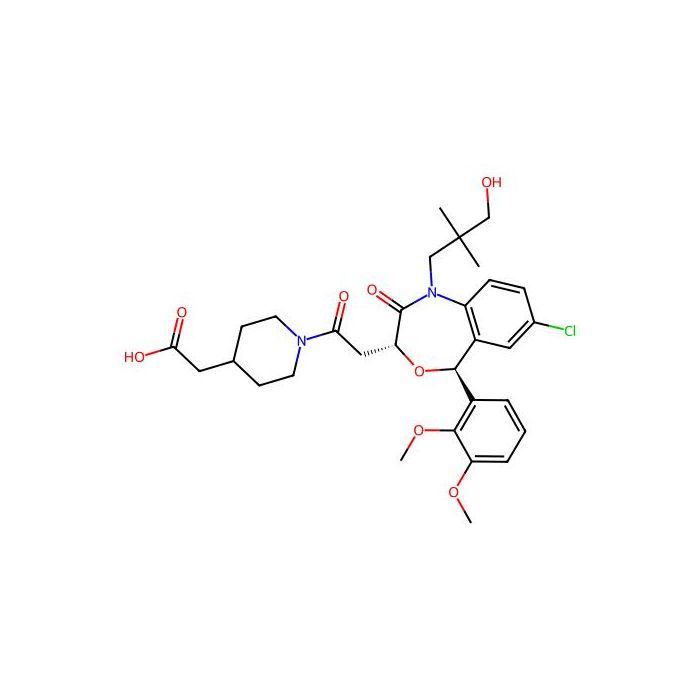
Lapaquistat (T-91485), a cholesterol biosynthesis inhibitor, is the active metabolite of Lapaquistat acetate . Lapaquistat can decrease statin-induced myotoxicity in lipid-lowering therapy
In Vitro
Lapaquistat inhibits cholesterol biosynthesis in differentiated RD (rhabdomyosarcoma) cells, with an IC 50 of 36 nM. Lapaquistat potently inhibits cholesterol synthesis in RD cells, with an IC 25 exceeded 100 μM. Lapaquistat concentration-dependently inhibits cholesterol biosynthesis in human skeletal myocytes, with an IC 50 of 45 nM. MCE has not independently confirmed the accuracy of these methods. They are for reference only.
In Vivo
After oral administration to rats, Lapaquistat acetate is absorbed and rapidly hydrolyzed into a pharmacological active metabolite, Lapaquistat . MCE has not independently confirmed the accuracy of these methods. They are for reference only.
Lapaquistat (T-91485), a cholesterol biosynthesis inhibitor, is the active metabolite of Lapaquistat acetate ( HY-16274 ). Lapaquistat can decrease statin-induced myotoxicity in lipid-lowering therapy.
This compound belongs to the class of organic compounds known as benzoxazepines. These are organic compounds containing a benzene fused to an oxazepine ring (a seven-membered ring with four carbon atoms, one oxygen atom, and a nitrogen atom).
External Descriptors
Not available
1. Djoumbou Feunang Y, Eisner R, Knox C, Chepelev L, Hastings J, Owen G, Fahy E, Steinbeck C, Subramanian S, Bolton E, Greiner R, and Wishart DS. ClassyFire: Automated Chemical Classification With A Comprehensive, Computable Taxonomy. Journal of Cheminformatics, 2016, 8:61.
Determine the necessary mass, volume, or concentration for preparing a solution.
Dilution Calculator
Determine the dilution needed to prepare a stock solution.
Reconstitution Calculator
レビュー
顧客レビュー
Application Protocols
Application data specific to this SKU are not provided in the Product Data. The following guidance is general and should be verified experimentally.
Not specified for this item; refer to CoA/Spec Sheet for any validated internal methods.
General laboratory use (illustrative guidance, not item-specific specifications):
Stock preparation: Dissolve the compound in anhydrous DMSO to a convenient concentration (e.g., 10 mM) based on verified solubility. Vortex/sonicate briefly if needed. Filter if required for sterile applications.
Storage of stocks: Aliquot and store at −20 °C to avoid repeated freeze–thaw cycles. Protect from light and moisture as warranted.
Assay setup: Include vehicle controls matching the highest solvent percentage used. Confirm absence of precipitation upon dilution into aqueous buffers.
Because formal, tested applications (e.g., WB, IHC, IF, FC) are not applicable to small-molecule inhibitors, adapt protocols to your specific enzymology or cell-based assay format.
Biological Roles
General literature context (for research/lab use only; no clinical claims):
Mechanistic role:
Lapaquistat (TAK-475) is reported as a selective inhibitor of squalene synthase (also known as farnesyl-diphosphate farnesyltransferase), a key enzyme in the cholesterol/isoprenoid biosynthesis (mevalonate) pathway. By modulating this enzymatic step, it is used as a tool to probe flux through sterol and non-sterol branches of the pathway.
Systems and pathways:
Impacts on cellular lipid metabolism can be monitored via changes in squalene, sterol intermediates, and cholesterol levels using LC–MS-based lipidomics.
May influence protein prenylation indirectly by altering isoprenoid pools; such effects must be experimentally verified in the relevant model.
Experimental readouts (examples):
Biochemical assays of squalene synthase activity using radiometric or LC–MS endpoints.
Cellular assays assessing sterol content, SREBP pathway activation, or gene expression markers of cholesterol homeostasis.
Selectivity considerations:
Literature emphasizes selectivity for squalene synthase over upstream HMG-CoA reductase; however, off-target profiling should be considered and verified for your system.
Notes:
These are general, literature-based roles and do not constitute item-specific specifications. Potency, selectivity, and cellular activity may vary with assay conditions, cell type, and formulation.
Buffer Applications
This product is not a buffer reagent. It is a hydrophobic small-molecule research compound typically used in biochemical or cellular assays.
Practical notes for assay buffers (general guidance):
Use standard physiological buffers (e.g., PBS, HEPES-buffered saline) compatible with your target assay.
Include a small percentage of co-solvent (commonly 0.1–0.5% DMSO or ethanol) to aid solubilization when diluting from concentrated stock, if assay tolerance permits.
Pre-warm and mix thoroughly during dilution to minimize microprecipitation; verify by visual inspection and, if critical, by light scattering or filtration.
For actual buffer recipes, pH ranges, or osmolarity specifications, consult protocols specific to your biological system; no buffer-specific parameters are provided for this item.
Green Alternatives
This product is a bioactive research compound used at small scale in biochemical/cellular assays; concepts of green solvent replacement are therefore less central than for bulk reaction solvents. Nevertheless, sustainable practices can still be applied.
Use the minimum effective volume of DMSO or other organic solvents for stock solutions.
Prefer aqueous assay buffers with low co-solvent fractions when compatible with solubility and assay performance.
Consolidate experiments to reduce repeated thawing and aliquot preparation, minimizing solvent waste.
Solvent considerations (general):
If DMSO is not required, ethanol or isopropanol may be considered when compatible with your assay and compound stability; these have more favorable environmental profiles than DMF.
Avoid chlorinated solvents during any optional reprocessing or analytical sample prep unless strictly necessary.
Waste management:
Collect organic solvent waste and any compound-containing solutions as hazardous waste; do not dispose to drain. Apply institutional waste segregation to enable optimized treatment.
Because Lapaquistat is not used as a reaction solvent or bulk reagent, there are no direct “drop-in green alternatives” to the compound itself.
Pharmaceutical Uses
No formulation grade or pharmacopeial status is provided for this item; it is supplied strictly for research use only.
Research/formulation context (general):
Lapaquistat has been described in the literature as a squalene synthase inhibitor investigated historically as a cholesterol pathway modulator. For laboratory research, it may serve as a reference standard or tool compound in analytical, biochemical, or cellular experiments.
If used in formulation research (preclinical, in vitro), typical vehicles include DMSO-based stocks with subsequent dilution into aqueous media. Solid dispersion or lipid-based vehicles can be explored for in vivo model development work; such applications are outside the scope of this catalog listing and require institutional approvals.
Regulatory note:
This product is not labeled for therapeutic, diagnostic, or human/animal consumption. No claims are made regarding safety or efficacy.
Documentation:
For any quality attributes relevant to formulation R&D (e.g., purity, residual solvents, solid form), consult the lot-specific CoA.
Item-specific pharmaceutical grade, excipient status, or compendial monographs: Not specified for this item; refer to CoA/Spec Sheet.
Appearance: Not specified for this item; refer to CoA/Spec Sheet.
Grade/Purity: Not specified for this item; refer to CoA/Spec Sheet.
Molecular Weight: Not specified for this item; refer to CoA/Spec Sheet.
Commonly consulted properties (literature/general; verify before use):
Melting point (literature): Not specified here; consult primary literature or PubChem for reported values.
Solubility (typical practice): Many research-grade hydrophobic inhibitors are soluble in DMSO and sparingly soluble in water. Confirm actual solubility of this item from CoA/SDS before preparing stocks.
LogP/cLogP (literature): Not specified here; consult cheminformatics sources for computed values.
pKa (literature/computed): Not specified here; check QSAR/computation if needed for formulation.
Refractive index, density, UV cutoff: Not specified for this item; refer to CoA/Spec Sheet.
Practical notes (general guidance for small-molecule bioactives):
Prepare small-scale trial dissolutions (e.g., 1–10 mg/mL) in dry DMSO, ethanol, or DMF, then dilute into assay buffer immediately before use to minimize precipitation.
Filter sterilization (0.22 µm) may be used for cell-based work if compound is sufficiently soluble and chemically stable; verify compound stability under chosen conditions.
Avoid extended exposure to light and moisture if aromatic or hydrolytically labile functionalities are present (confirm for this item via SDS/CoA).
Quality and Grades
Item-specific quality information (from Product Data):
Grade/Purity: Not specified for this item; refer to CoA/Spec Sheet for batch-specific purity, residual solvents, and related substance limits.
Context for professional use:
Research-grade small molecules are typically qualified by HPLC/UPLC purity, identity (NMR, MS), and sometimes water content (KF) and residual solvents (GC). Because no explicit specifications are provided here, consult the CoA associated with your lot for the acceptance criteria used.
What the grade typically implies (general guidance):
Research use only: Material is intended exclusively for laboratory research. It is not for human or veterinary use, clinical diagnostics, or as a drug substance.
Chromatographic purity: When reported (e.g., ≥98% HPLC), indicates minimal co-impurities in the main peak under stated analytical conditions; actual percentages and methods must be confirmed on the CoA.
Identity confirmation: Commonly supported by 1H NMR, LC–MS/HRMS, and/or elemental composition; verify the techniques used on the supplied documentation.
Stabilizers and form:
Stabilizer/Counterion/Polymorph: Not specified for this item; refer to CoA/Spec Sheet. If multiple forms exist (free base, salt, solvate), ensure your documentation matches the intended use.
Recommendation:
Request CoA and, if needed, additional analytical data (chromatograms, spectra) to align the material specifications with your experimental requirements.
Reaction and Applications
This product is primarily a bioactive small-molecule research tool rather than a synthetic reagent. Accordingly, its most relevant laboratory applications are in biochemical and cellular studies.
Research uses (general, no clinical claims):
Probe compound for interrogating the mevalonate–cholesterol biosynthesis pathway in cell culture or biochemical systems.
Tool for studying squalene synthase activity, regulation, and downstream lipidomics.
Benchmark/positive-control inhibitor in enzymology screens related to isoprenoid/sterol metabolism.
Experimental considerations (general guidance):
Prepare concentrated DMSO stocks (e.g., 1–10 mM) based on verified solubility; store aliquots at −20 °C to reduce freeze–thaw cycles.
For enzyme inhibition assays, pre-incubation with target enzyme may improve apparent potency if time-dependent binding is reported in literature for this chemotype.
Monitor potential compound precipitation upon dilution into aqueous buffers; include solvent-only controls to account for vehicle effects.
Not typically applicable:
Named organic reactions (e.g., cross-couplings, Grignard) are not relevant to the use of this finished bioactive as a reagent. If chemical modification is intended, consult primary synthetic literature for routes to analogs.
Note: Specific potency values, kinetics, and assay conditions vary by system and are not item specifications; consult the literature and your CoA for definitive details.
Reaction Conditions
This section is generally not applicable: Lapaquistat is a bioactive research compound, not a reagent used to promote or undergo standard organic reactions in the course of a synthesis.
If you are performing biochemical inhibition assays (general guidance, not item-specific specs):
Solvent: DMSO stock solutions; dilute into assay buffer to ≤0.1–0.5% final DMSO as tolerated by the system.
Temperature: Conduct enzyme assays at the temperature recommended for your enzyme (often 25–37 °C); equilibrate solutions to avoid solubility artifacts.
Incubation: Pre-incubate inhibitor with enzyme/substrate when time-dependent effects are suspected.
Controls: Include vehicle controls and, where possible, orthogonal readouts (e.g., LC–MS quantification of squalene) to confirm on-target effects.
Yields, catalysts, and synthetic conditions: Not applicable.
Refer to primary literature for detailed assay protocols specific to squalene synthase and related pathways.
Safety and Handling
Authoritative safety information is provided in the Safety Data Sheet (SDS). The following summarizes available product data and general best practices.
Product-specific hazard data (from Product Data):
Signal Word: Not specified for this item; refer to SDS.
H-Statements: Not specified for this item; refer to SDS.
GHS Classification: Not specified for this item; refer to SDS.
GHS Pictograms: Not specified for this item; refer to SDS.
Storage conditions (from Product Data):
Store at −20 °C. Shipments are sent in an ice chest with ice pads to maintain a cold chain.
General laboratory precautions (best practice for small-molecule bioactives):
Handle in a fume hood; avoid inhalation of dust/aerosols.
Wear appropriate PPE: lab coat, safety glasses, and nitrile gloves.
Prevent contact with skin, eyes, and clothing. Wash thoroughly after handling.
Avoid incompatibilities typical of organic compounds (strong oxidizers, strong acids/bases) unless verified compatible by SDS.
Spill/Exposure (general guidance):
Small spill: Absorb with inert material, collect in suitable waste container. Ventilate area.
Skin/eye contact: Rinse with water for at least 15 minutes; seek medical attention if irritation persists.
Inhalation: Move to fresh air; obtain medical attention if symptoms occur.
Waste disposal:
Collect as organic hazardous waste in accordance with institutional and regional regulations.
Always defer to the current SDS for definitive hazard classification and first-aid measures.
Solvent Selection
Item-specific solubility profile is not provided. The following offers general decision-making guidance for hydrophobic small-molecule inhibitors like Lapaquistat.
Primary stock solvent (general practice):
DMSO: Often the first-choice solvent for bioactive small molecules due to broad solvating power and compatibility with biological assays at low final % (≤0.1–0.5%).
DMF or Ethanol: Alternatives when DMSO is unsuitable; verify assay tolerance and compound stability.
Aqueous workup/assay media:
Prepare concentrated stock in anhydrous organic solvent, then dilute into buffered media immediately before use to minimize precipitation.
Use co-solvent strategies (0.1–1% DMSO or ethanol) if aqueous solubility is limited; confirm cell/assay compatibility.
Polarity considerations (general):
Drug-like squalene synthase inhibitors are typically moderately lipophilic (literature); expect reduced water solubility and potential adsorption to plastics—use low-binding labware.
Practical comparisons:
DMSO vs ethanol: DMSO offers higher solvency and lower volatility; ethanol may be preferred for certain enzymatic assays sensitive to DMSO.
Buffers: Phosphate- or HEPES-based buffers (physiological pH) are commonly used for biochemical assays; pre-warm and vortex to reduce microprecipitation upon dilution.
Important: Because exact solubility and stability for this specific item are not specified, perform a small-scale solubility/stability check and refer to the CoA/SDS for any solvent restrictions.
Storage and Reconstitution
Product-specific storage (from Product Data):
Store at −20 °C.
Shipped in an ice chest with ice pads to maintain a cold chain during transit.
Reconstitution (general guidance for bioactive small molecules; verify with CoA/SDS):
Preferred solvents: Anhydrous DMSO is commonly used for initial stock solutions; DMF or ethanol may be alternatives if compatible with your application.
Suggested approach:
Allow vial to equilibrate to room temperature in a desiccator before opening to minimize moisture condensation.
Weigh quickly, then dissolve to a convenient concentration (e.g., 1–10 mM) based on confirmed solubility.
Mix thoroughly (vortex or brief sonication). If necessary, warm gently (≤37 °C) to aid dissolution, avoiding prolonged heating.
Aliquoting and storage of solutions:
Dispense into single-use aliquots to avoid repeated freeze–thaw.
Store aliquots at −20 °C (or below) and protect from light if the compound contains photosensitive chromophores (confirm via CoA/SDS).
Stability notes:
Solution stability varies by solvent and concentration; perform small-scale stability checks (e.g., LC–MS at time 0 and after storage) to verify integrity.
Always consult the lot-specific CoA/SDS for definitive instructions on reconstitution, compatibility, and stability.
Structure and Identity
Brief overview: Lapaquistat (TAK-475) is a small-molecule research compound supplied for laboratory use.
Item-specific identifiers (from Product Data):
SKU: L648651
Product Name: Lapaquistat
CAS: 189059-71-0
PubChem CID: 9960389
InChIKey: Not specified for this item; refer to CoA/Spec Sheet. (Note: provided value appears incomplete.)
SMILES: Not specified for this item; refer to CoA/Spec Sheet.
Molecular Formula: Not specified for this item; refer to CoA/Spec Sheet.
Molecular Weight: Not specified for this item; refer to CoA/Spec Sheet.
Structural features (general literature context, not item-specific specifications):
Lapaquistat is reported in the literature as a synthetic, drug-like organic molecule developed as a selective inhibitor of squalene synthase in the cholesterol biosynthesis pathway.
Typical structural motifs for this chemotype include multiple aromatic/heteroaromatic rings and amide/urea-type linkages; exact features should be confirmed against primary references or the CoA.
2D structure (descriptive, literature):
The 2D depiction reported in public databases shows a multi-ring scaffold with polar functional groups enabling target engagement; consult primary references for definitive structure.
Notes:
Where exact structure descriptors (SMILES, InChIKey) are required for informatics, obtain them directly from the current Certificate of Analysis (CoA) or authoritative databases for the precise batch supplied.
Synthetic Utility
As supplied, Lapaquistat is a finished bioactive small molecule and is not typically employed as a general synthetic reagent or building block.
Not typically applicable:
It does not serve as a catalyst, ligand, or stoichiometric reagent in common named organic reactions.
Use as a synthetic intermediate is uncommon; functionalization without compromising the pharmacophore would require bespoke medicinal chemistry.
When modification is intended (general medicinal chemistry perspective):
Structure–activity relationship (SAR) studies on squalene synthase inhibitors often explore variations on aromatic/heteroaromatic cores and polar linker motifs. Derivatization requires access to route-specific intermediates reported in the primary literature rather than transforming the final inhibitor itself.
Prodrug or salt forms may be prepared to alter solubility or permeability; selection depends on available functional groups (confirm exact structure from CoA/literature before planning).
Conclusion: For bench chemistry, treat this compound as a reference standard/tool molecule rather than a synthetic handle.
Target Specificity
Only item-specific target data should be listed here; none are provided in the Product Data for this SKU.
Item-specific details: Not specified for this item; refer to CoA/Spec Sheet.
Note: While literature sources describe Lapaquistat as a squalene synthase inhibitor, target specificity parameters (e.g., Ki, IC50, off-targets, species selectivity) are not specified for this catalog item and should be confirmed from primary references and your own validation assays.
よくある質問
How should this product be stored?
Store at ?20 °C. Freezer storage is required to maintain the specified shelf life.
How is this product shipped?
This product ships in an insulated container with ice pads. Unpack on arrival and transfer it to the storage condition stated above.
What are the CAS number, molecular formula and molecular weight?
The CAS Number is 189059-71-0, the molecular formula is C31H39ClN2O8, and the molecular weight is 603.10 g/mol. InChIKey HDGUKVZPMPJBFK-LEAFIULHSA-N.
What documentation is provided?
Available product documentation, including Certificates of Analysis (COA), Safety Data Sheets (SDS), and specification sheets, is shown in the product document area. Document availability and access follow the current site policy.
Products are supplied to verified businesses, institutions, and qualified professionals for research and development use only. Not for use in humans, animals, diagnosis, or therapy.