
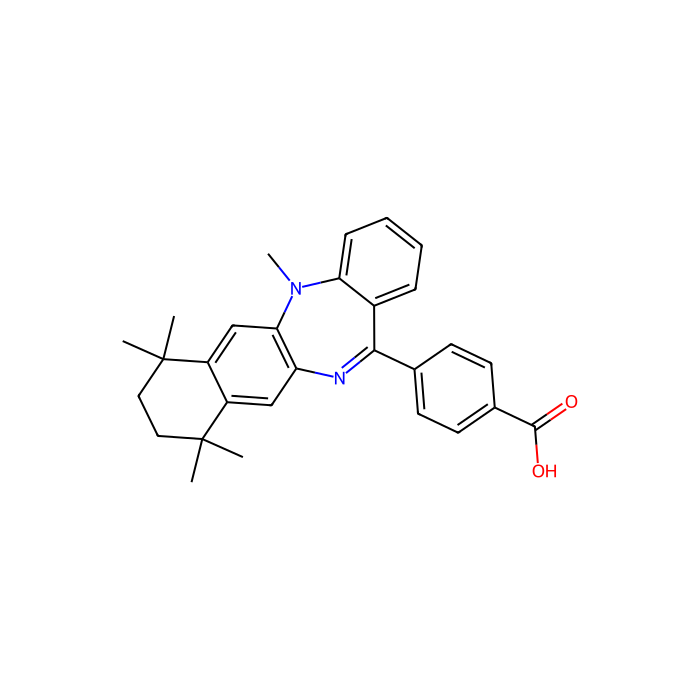
Determine the necessary mass, volume, or concentration for preparing a solution.
| Activity Type | Relation | Activity value | Units | Action Type | Journal | PubMed Id | doi | Assay Aladdin ID |
|---|
Application:
LE 135 has been used for in vitro islet treatment.
Taxonomy Tree
| Kingdom | Organic compounds |
|---|---|
| Superclass | Organoheterocyclic compounds |
| 分類 | Benzodiazepines |
| Subclass | Dibenzodiazepines |
| Intermediate Tree Nodes | Not available |
| Direct Parent | Dibenzodiazepines |
| Alternative Parents | Alkyldiarylamines 1,4-benzodiazepines Tetralins Benzoic acids Benzoyl derivatives Ketimines Amino acids Propargyl-type 1,3-dipolar organic compounds Monocarboxylic acids and derivatives Carboxylic acids Azacyclic compounds Organopnictogen compounds Organooxygen compounds Organic oxides Hydrocarbon derivatives |
| Molecular Framework | Aromatic heteropolycyclic compounds |
| Substituents | Dibenzodiazepine - Alkyldiarylamine - 1,4-benzodiazepine - Tetralin - Benzoic acid or derivatives - Benzoic acid - Benzoyl - Tertiary aliphatic/aromatic amine - Monocyclic benzene moiety - Benzenoid - Amino acid - Ketimine - Amino acid or derivatives - Tertiary amine - Monocarboxylic acid or derivatives - Carboxylic acid - Carboxylic acid derivative - Azacycle - Organic 1,3-dipolar compound - Propargyl-type 1,3-dipolar organic compound - Organooxygen compound - Organonitrogen compound - Hydrocarbon derivative - Imine - Organopnictogen compound - Amine - Organic oxygen compound - Organic nitrogen compound - Organic oxide - Aromatic heteropolycyclic compound |
| 説明 | This compound belongs to the class of organic compounds known as dibenzodiazepines. These are compounds containing a dibenzodiazepine moiety, which consists of two benzene connected by diazepine ring. |
| External Descriptors | Not available |
| Activity Type | Relation | Activity value | Units | Action Type | Journal | PubMed Id | doi | Assay Aladdin ID |
|---|
| Activity Type | Relation | Activity value | Units | Action Type | Journal | PubMed Id | doi | Assay Aladdin ID |
|---|
| Activity Type | Relation | Activity value | Units | Action Type | Journal | PubMed Id | doi | Assay Aladdin ID |
|---|
| Activity Type | Relation | Activity value | Units | Action Type | Journal | PubMed Id | doi | Assay Aladdin ID |
|---|
| Activity Type | Relation | Activity value | Units | Action Type | Journal | PubMed Id | doi | Assay Aladdin ID |
|---|
| Activity Type | Relation | Activity value | Units | Action Type | Journal | PubMed Id | doi | Assay Aladdin ID |
|---|
| Activity Type | Relation | Activity value | Units | Action Type | Journal | PubMed Id | doi | Assay Aladdin ID |
|---|
| Activity Type | Relation | Activity value | Units | Action Type | Journal | PubMed Id | doi | Assay Aladdin ID |
|---|
| Activity Type | Relation | Activity value | Units | Action Type | Journal | PubMed Id | doi | Assay Aladdin ID |
|---|
| Activity Type | Relation | Activity value | Units | Action Type | Journal | PubMed Id | doi | Assay Aladdin ID |
|---|
| Activity Type | Relation | Activity value | Units | Action Type | Journal | PubMed Id | doi | Assay Aladdin ID |
|---|
| Activity Type | Relation | Activity value | Units | Action Type | Journal | PubMed Id | doi | Assay Aladdin ID |
|---|
| Activity Type | Relation | Activity value | Units | Action Type | Journal | PubMed Id | doi | Assay Aladdin ID |
|---|
| Activity Type | Relation | Activity value | Units | Action Type | Journal | PubMed Id | doi | Assay Aladdin ID |
|---|
| Activity Type | Relation | Activity value | Units | Action Type | Journal | PubMed Id | doi | Assay Aladdin ID |
|---|
| Activity Type | Relation | Activity value | Units | Action Type | Journal | PubMed Id | doi | Assay Aladdin ID |
|---|
| Activity Type | Relation | Activity value | Units | Action Type | Journal | PubMed Id | doi | Assay Aladdin ID |
|---|
| Activity Type | Relation | Activity value | Units | Action Type | Journal | PubMed Id | doi | Assay Aladdin ID |
|---|
| Activity Type | Relation | Activity value | Units | Action Type | Journal | PubMed Id | doi | Assay Aladdin ID |
|---|
| Activity Type | Relation | Activity value | Units | Action Type | Journal | PubMed Id | doi | Assay Aladdin ID |
|---|
Find and download the COA for your product by matching the lot number on the packaging.
| Lot Number | Certificate Type | 日付 | 商品 |
|---|---|---|---|
 C2618128 | Certificate of Analysis | Mar 31, 2026 | L287663 |
| C23181364 | Certificate of Analysis | Jan 19, 2026 | L287663 |
| C23181365 | Certificate of Analysis | Jan 19, 2026 | L287663 |
| C23181377 | Certificate of Analysis | Jan 19, 2026 | L287663 |
| C23181378 | Certificate of Analysis | Jan 19, 2026 | L287663 |
| C23181379 | Certificate of Analysis | Jan 19, 2026 | L287663 |
| C23181380 | Certificate of Analysis | Jan 19, 2026 | L287663 |
| C23181381 | Certificate of Analysis | Jan 19, 2026 | L287663 |
| C23181382 | Certificate of Analysis | Jan 19, 2026 | L287663 |
| C23181384 | Certificate of Analysis | Jan 19, 2026 | L287663 |
| C23181385 | Certificate of Analysis | Jan 19, 2026 | L287663 |
| 溶解度 | Solvent:DMSO, Max Conc. mg/mL: 43.86, Max Conc. mM: 100 |
|---|---|
| 分子量 | 438.600 g/mol |
| XLogP3 | 7.400 |
| Hydrogen Bond Donor Count | 1 |
| Hydrogen Bond Acceptor Count | 4 |
| Rotatable Bond Count | 2 |
| Exact Mass | 438.231 Da |
| Monoisotopic Mass | 438.231 Da |
| Topological Polar Surface Area | 52.900 Ų |
| Heavy Atom Count | 33 |
| Formal Charge | 0 |
| Complexity | 778.000 |
| Isotope Atom Count | 0 |
| Defined Atom Stereocenter Count | 0 |
| Undefined Atom Stereocenter Count | 0 |
| Defined Bond Stereocenter Count | 0 |
| Undefined Bond Stereocenter Count | 0 |
| The total count of all stereochemical bonds | 0 |
| Covalently-Bonded Unit Count | 1 |
No manufacturer-validated application protocols are provided in the Product Data for SKU L287663.
General, non-item-specific guidance for small-molecule ligands in cell-based or biochemical assays
Researchers must adapt these steps to their specific systems. For any validated, product-specific protocol, refer to future updates of the CoA/Spec Sheet.
Scope: The following summarizes commonly reported roles for LE 135 in research literature. These are not product-specific performance claims. For research use only.
General function (literature)
Mechanistic context (literature/generic)
Typical experimental applications
Practical considerations
Data quality notes
LE 135 is not a buffering reagent and is not typically used to prepare buffer systems.
Practical guidance for assay buffers (general)
For actual buffer recipes, pH ranges, and ionic strengths, refer to the buffer’s own documentation; LE 135 does not provide buffering capacity.
Given LE 135 is used primarily as a bioactive reference ligand, “green alternatives” pertain more to solvent and handling choices rather than substituting the active itself.
Greener solvent strategies (general guidance)
Comparison (general)
Limitations
This catalog item is supplied strictly for research use only; no clinical or therapeutic use is intended or implied.
Formulation-related context (general, non-clinical)
Compendial status
Manufacturing/excipient role
Item-specific specs
Literature/general expectations (verify prior to method development)
Practical notes (general)
Item-specific grade (from Product Data): Moligand™
What this typically means (general guidance; check CoA for specifics)
Stabilizers/additives
Fit-for-purpose notes
This product is primarily a bioactive small-molecule ligand for research assays and screening, not a general-purpose synthetic reagent. Consequently, classic synthetic reaction applications (e.g., cross-couplings, Grignard, oxidations) are not the typical use case for LE 135.
Not typically applicable
Where it is relevant (general, literature)
Practical notes for assay applications (general)
If you require a synthetic building block related to this scaffold (e.g., for SAR elaboration), consider ordering intermediate analogs with declared functional handles; this listing is intended for bioactivity studies rather than preparative chemistry.
Classical synthetic “reaction conditions” (solvent, catalysts, temperatures, yields) are not typically applicable to LE 135 as sold, because it is intended for use as a bioactive reference ligand rather than as a reagent or substrate.
General handling conditions for bioassays (practical, non-item-specific)
If you require chemical transformation conditions for scaffold synthesis or analog preparation, consult the primary literature on retinoid-mimetic synthesis (e.g., Wittig/HWE olefinations, Pd-catalyzed couplings). Such conditions are outside the scope of this catalog item.
Item-specific hazard details
General laboratory precautions (for small-molecule screening ligands)
Special risks and handling advice (general, literature-based for conjugated/aromatic acids)
Authoritative source: Always consult the product-specific SDS and CoA for definitive safety, hazard, and disposal guidance.
Context: LE 135 is supplied as a research ligand. No item-specific solubility data are provided; the guidance below reflects general practice for hydrophobic, retinoid-like small molecules.
Comparison (general)
Item-specific conditions (from Product Data)
General best practices for this compound class
Reconstitution guidance (general; not a specification)
Expiration and specifications
For research use only.
Brief overview: LE 135 is supplied as a Moligand-class small molecule for research screening. Detailed structural identifiers are not provided in the item’s Product Data; consult CoA/Spec Sheet for definitive identifiers.
Item-specific (from Product Data)
Literature/general chemistry (for context; verify against CoA before use)
Structural features (general description based on literature)
2D structural description in words (general, literature): a conjugated aryl–alkenyl framework terminating in a benzoic or pyridyl carboxylate motif is commonly depicted for LE-series retinoid modulators; confirm exact ring system and substitution from CoA.
LE 135 is offered as a bioactive ligand for screening and mechanism studies rather than as a synthetic intermediate. Therefore, its direct utility as a building block is limited.
Not typically used as a reagent
General retrosynthetic perspective (literature-based, conceptual)
If derivatization is desired
Conclusion: Treat LE 135 primarily as a reference ligand rather than a synthetic synthon; use it to benchmark biological responses and reserve synthetic campaigns for separately sourced, purpose-designed intermediates.
Only product-data-sourced target attributes may be listed here. For this item:
Note: While the literature discusses LE 135 as a retinoid-pathway modulator, Aladdin provides no item-specific target certification in the Product Data. Users should perform their own target validation under their assay conditions.
当社のグレード選定ガイドでは、カタログ内のすべてのバリエーションについて、純度、安定剤の状態、用途への適合性を網羅しています。
Moligand™ グレードガイドを見る →