≥99.995% metals basis for sensitive chromatographic and analytical workflows requiring minimal baseline interference.
🌡
Storage & shipping
Room temperature Ships Normal Check lot-specific COA for exact specifications.
📋
Quality documents
SDS, COA, datasheet, and spec sheet available for download. Lot-specific COA accessible via lot number lookup.
📚
Literature proof
Cited in 0 peer-reviewed publications across chromatography, organic synthesis, and cross-coupling reactions.
概要
Reagent for ester cleavage and decarboxylation; C-C bond forming reactions; used as source of nucleophilic iodide; used as mild Lewis acid; epoxide opening; used as an additive for organometallic-mediated transformations.
Alkali metal iodide - Inorganic lithium salt - Inorganic salt
説明
This compound belongs to the class of inorganic compounds known as alkali metal iodides. These are inorganic compounds in which the largest halogen atom is Iodine, and the heaviest metal atom is an alkali metal.
External Descriptors
Not available
1. Djoumbou Feunang Y, Eisner R, Knox C, Chepelev L, Hastings J, Owen G, Fahy E, Steinbeck C, Subramanian S, Bolton E, Greiner R, and Wishart DS. ClassyFire: Automated Chemical Classification With A Comprehensive, Computable Taxonomy. Journal of Cheminformatics, 2016, 8:61.
Determine the necessary mass, volume, or concentration for preparing a solution.
Dilution Calculator
Determine the dilution needed to prepare a stock solution.
Reconstitution Calculator
レビュー
顧客レビュー
Application Protocols
No assay-specific protocols are provided for this inorganic reagent. Typical uses are as a stoichiometric or catalytic additive in synthetic reactions or as a component in electrolyte formulations. For practical guidance, see the Reaction Conditions, Synthetic Utility, and Solvent Selection sections.
If preparing electrolyte solutions or test formulations, record solvent, concentration, water content, and temperature; filter through 0.2 µm if particulate-free solutions are required for device fabrication.
Biological Roles
This product is intended for research use only. Item-specific biological data are not provided.
General background (literature; not product-specific, not for clinical use):
Iodide (I–) is an essential micronutrient in many organisms, serving as the substrate for biosynthesis of iodinated compounds (e.g., thyroid hormones in vertebrates). In biochemical assays, iodide is often used as a reducing agent within the I–/I3–/I2 redox couple and as a quencher in photochemical systems.
Lithium ions (Li+) can modulate the activity of certain enzymes and signaling pathways in vitro at millimolar concentrations, and are used experimentally to probe cation effects on catalysis and transport. However, lithium iodide is not typically used as a biological buffer or cell culture reagent due to its halide-specific reactivity and osmotic effects.
In bioelectrochemistry and materials-biology interfaces, iodide-containing electrolytes (including LiI) are studied for redox mediation and photochemical energy conversion.
Practical notes for lab biochemistry:
Avoid introducing iodide into peroxidase-based assays or systems sensitive to halides, as iodide can act as a competitive substrate or scavenger.
For protein work, high concentrations of iodide may cause salting-in effects and can perturb tertiary structure. Validate concentration dependencies and dialyzability if used as a chaotrope in test experiments.
No biological safety, toxicity, or exposure guidance is provided here; consult the SDS and institutional biosafety protocols.
Buffer Applications
Lithium iodide hydrate is not a buffering reagent and is not typically used to prepare pH-stabilizing buffer systems.
If an iodide-containing medium is required, iodide salts are added as simple electrolytes to an existing buffer (e.g., phosphate, acetate, Tris) rather than serving as the buffer itself.
Note that iodide can participate in redox chemistry (I–/I2/I3–) and may interfere with oxidase/peroxidase assays; confirm compatibility prior to use.
For practical buffer preparation, refer instead to dedicated buffering agents with defined pKa values in the target pH range.
Green Alternatives
Choosing greener options depends on the transformation and performance requirements. Consider the following when evaluating lithium iodide hydrate versus alternatives (literature-based guidance):
Halide exchange (alkyl halides → alkyl iodides):
Greener halide source: Sodium iodide (NaI) or potassium iodide (KI) in acetone is widely regarded as a greener system due to lower toxicity concerns and easier salt handling. These avoid lithium mining impacts and often enable salt precipitation driving equilibrium.
Solvent alternatives: Replace DMF/DMSO with bio-derived solvents such as 2-methyltetrahydrofuran (2-MeTHF) or Cyrene in some SN2 reactions, though iodide solubility/kinetics must be validated.
Epoxide openings and iodinations:
Use catalytic iodide with an in situ iodinating protocol (e.g., I2 with benign reducing agents) to lower iodide salt loadings.
Phase-transfer catalysis (PTC) with KI in green solvents (ethanol, water/ethanol) can reduce reliance on high-boiling aprotics.
Materials applications:
Where feasible, replace LiI with NaI/KI in redox mediator research to reduce critical metal use, recognizing electrochemical properties will differ.
Trade-offs:
Performance: LiI can provide superior rates/selectivity in polar aprotic media due to Li+ coordination; switching to NaI/KI may require higher temperature or longer times.
Purity and stability: Hydrated LiI introduces water; greener alternatives may simplify drying demands.
Summary comparison (qualitative):
LiI: High reactivity; critical metal concerns; often requires dry polar aprotics.
NaI/KI: Greener and widely available; excellent in acetone; sometimes less reactive in difficult substrates.
Pharmaceutical Uses
No pharmacopeial or excipient status is provided for this item; this product is for research use only.
General context (literature; not product-specific, no therapeutic claims):
Iodide salts (e.g., KI, NaI) have historical roles in pharmaceutical formulations and as sources of iodide; lithium iodide is not commonly used as an excipient.
In drug substance synthesis, LiI is sometimes employed as a halide-exchange reagent to produce alkyl iodides or to activate acylation steps. Such uses are confined to process development and route scouting.
For formulation research, iodide salts can influence ionic strength and redox behavior; however, LiI’s strong hygroscopicity and potential for iodine generation under oxidizing conditions limit its excipient utility.
If considering LiI in process chemistry, ensure material specifications (assay, residual metals/halides, water content) are defined on a lot-specific CoA and that residual iodide is controlled per ICH impurity guidelines. This catalog entry does not provide such specifications.
Physical Properties
Item-specific specifications (this catalog lot):
Appearance: Not specified for this item; refer to CoA/Spec Sheet.
Molecular formula: Not specified for this item; refer to CoA/Spec Sheet.
Molecular weight: Not specified for this item; refer to CoA/Spec Sheet.
General/literature properties (for context; values vary with hydration state):
Anhydrous LiI: melting point ~469 °C; boiling point ~1,178 °C; density ~4.08 g/cm³ at 25 °C (literature). Highly hygroscopic and deliquescent.
Solubility (literature): Very soluble in water; also soluble in methanol, ethanol, acetone, acetonitrile, DMF, and DMSO. Hydrates dissolve readily in water and polar solvents; exact solubility varies with x.
Thermal behavior of hydrates (literature): Stepwise dehydration below ~150 °C (temperature depends on hydrate), often accompanied by mass loss plateaus corresponding to water removal; prolonged heating can yield anhydrous LiI.
Conductivity (aqueous, literature): LiI forms strongly conducting solutions; iodide is a soft nucleophile with high polarizability, influencing solution properties.
Hygroscopicity: Both anhydrous and hydrated LiI readily absorb moisture; hydrates may be stable at ambient humidity but will exchange water depending on relative humidity.
Important: Do not treat the above as item specifications. Exact BP/MP, density, water content, and UV cutoff for this specific hydrate are not specified for this item; refer to the CoA/SDS for definitive data.
Quality and Grades
Grade/Purity (item-specific): Not specified for this item; refer to CoA/Spec Sheet.
Guidance on grades for lithium iodide (general):
Research grade: Suitable for most synthetic and materials-science applications. Water content and trace metal levels may vary; hydrates inherently contain bound water.
Anhydrous/anhydrous-low-water grades: Supplied with controlled water content and often packaged under inert atmosphere. Selected for moisture-sensitive reactions (e.g., halide exchange in dry polar aprotics). Not applicable here unless specified.
Electronic/battery grade: Emphasis on low metal/halide impurities and low particulates for electrochemical use; stringent specifications for moisture and contaminants. Not specified for this item.
Stabilizers/anticoagulants: Typically not used for inorganic salts like LiI; any anti-caking agents or desiccants would be listed on the CoA (not specified here).
How grade impacts use:
Water of crystallization in hydrates must be accounted for when preparing stoichiometric solutions or charging solid to a reaction—calculate on the basis of assay (LiI content) or measured loss on drying. If the hydrate level is unspecified, titrimetric or thermogravimetric determination may be required for precise stoichiometry.
For spectroscopy or chromatography-sensitive work, choose lots with documented low UV absorbance and low trace metals (if relevant). For electrochemistry, confirm halide purity and moisture via Karl Fischer (if provided).
Conclusion: Consult the lot-specific CoA for water content, assay (LiI %), and impurity profile before critical applications.
Reaction and Applications
Lithium iodide (LiI) is a versatile iodide source and Lewis acid-like activator. The hydrate can be used directly in many reactions, though bound water may influence rates/selectivity.
Synthetic/organic chemistry (literature):
Halide exchange (Finkelstein-type): Conversion of alkyl chlorides/bromides to iodides, often in polar aprotic solvents (DMF, DMSO, MeCN). LiI can outperform NaI in challenging substrates due to better cation–substrate interactions and solvation.
Epoxide ring opening: LiI promotes nucleophilic opening to give iodo-alcohols; regioselectivity typically follows SN2 preferences. Conditions: MeCN/DMF, 25–80 °C.
Activation of acylations and amidations: Catalytic or stoichiometric LiI can accelerate formation of amides/esters from acid chlorides/anhydrides by enhancing leaving-group departure.
Ether/acetals cleavage and iodination: Combinations such as LiI with TMSCl or acetic anhydride effect cleavage/iodination of ethers and acetals (literature).
Carbohydrate/glycosyl chemistry: LiI is used to assist glycosyl halide formation or promote neighboring-group participation in specific protocols.
Materials science (literature; aligns with category):
Electrolyte/additive: LiI is used in redox mediators for dye-sensitized solar cells (I–/I3– systems) and as an additive in solid-state/polymer electrolytes.
Perovskite and halide optoelectronics: Employed as a dopant or process additive to tune film morphology and ionic transport.
Practical tips:
Drying: If water is detrimental, pre-dry in vacuo at mild temperature recognizing that hydration state will change; record mass before/after.
Stoichiometry: Correct for hydrate water by using assay (LiI %). If unknown, determine by KF or TGA.
Avoid acids/oxidants to prevent HI/I2 formation.
Reaction Conditions
The following are general, literature-based conditions for common uses of LiI. They are not specifications for this item.
Halide exchange (R–Cl/R–Br → R–I):
Solvent: DMF, DMSO, or MeCN (dry). Concentration 0.1–1.0 M in substrate.
Reagent loading: 1.5–3.0 equiv LiI.
Temperature/time: 50–120 °C (substrate dependent), 2–24 h.
Notes: Exclude water to maximize iodide nucleophilicity. Monitor by GC/LC; quench with aqueous Na2S2O3 to remove iodine coloration if formed.
Epoxide opening to iodo-alcohols:
Solvent: MeCN or DMF.
Reagent loading: 1.2–2.0 equiv LiI.
Temperature/time: 20–80 °C, 1–8 h.
Notes: Regioselectivity typically SN2 (less substituted carbon). Addition of catalytic Lewis acids (e.g., BF3·OEt2) can accelerate, but verify compatibility.
Ether/acetals cleavage (LiI/TMSCl system):
Solvent: CH2Cl2 or MeCN.
Typical: 2–4 equiv LiI, 2–3 equiv TMSCl, 0–25 °C to reflux, 1–16 h.
Notes: Generates silyl intermediates; careful quench to avoid HI release; inert atmosphere preferred.
Amidation/esterification acceleration:
Solvent: DMF or toluene with coupling agents.
Loading: 10–100 mol% LiI as promoter.
Notes: Mechanistic role often attributed to halide exchange on acyl intermediates; optimize empirically.
Workup/purification tips:
Iodide removal via aqueous washes containing Na2S2O3 or NaHSO3; silica gel chromatography acceptable for many organoiodides but minimize exposure to light/air to reduce I2 formation.
Always confirm compatibility with the hydrate’s water content; for water-sensitive reactions, pre-drying or using anhydrous LiI is recommended.
Safety and Handling
Authoritative safety details (GHS/CLP) for this item are not specified; refer to the SDS for SKU L118835.
General safety considerations for lithium iodide salts (literature/standard practice):
Classification: Not specified for this item; refer to SDS. Many iodide salts are classified as irritants; avoid assumptions without SDS.
Primary hazards: Hygroscopic/deliquescent solid; may cause eye/skin/respiratory irritation. Iodide salts can release hydrogen iodide under strong acid conditions and iodine upon strong oxidation.
Incompatibilities: Strong oxidizers (risk of iodine formation), strong acids (HI release), and moisture (changes hydration state). Avoid contact with halogens, nitrosating agents, and peroxides.
PPE: Wear safety glasses or face shield, lab coat, and appropriate chemical-resistant gloves (e.g., nitrile). Use in a fume hood when handling powders, heating, or preparing concentrated solutions.
Handling tips: Minimize exposure to air to limit water uptake; recap promptly. For weighing, use a dry, clean spatula and close in a desiccated environment if possible.
First aid (overview; follow SDS/site protocols): Eye/skin contact—rinse with water for at least 15 minutes and remove contaminated clothing. Inhalation—move to fresh air. Ingestion—rinse mouth; seek medical attention in all cases.
Fire: Noncombustible salt; use extinguishing media appropriate for surrounding materials. Thermal decomposition may release iodine/HI—use SCBA if involved in fire.
Spills: Avoid dust; collect mechanically and transfer to dry, labeled container. Wash area with water while preventing environmental release; iodide-containing solutions should be disposed per local regulations.
Solvent Selection
Lithium iodide (including hydrates) is a polar, ionic compound with excellent solubility in water and many polar organic solvents. Solvent choice depends on the target application.
Polarity/miscibility (literature):
Water: Freely soluble; rapid dissolution.
Alcohols (MeOH, EtOH): Soluble; good for preparing stock solutions where protic media are acceptable.
Polar aprotics (DMF, DMSO, acetonitrile, NMP): Highly soluble; favored in organic halide exchange, epoxide openings, and SN2 chemistry where strong nucleophilicity of I– is desired.
Acetone: Moderately soluble; widely used as a medium for halide exchange (Finkelstein-type) due to precipitation of NaCl/KCl. LiI is often employed in DMF/MeCN for higher reactivity.
Selection guidance (general):
For halide exchange on less reactive substrates (e.g., secondary chlorides), choose high-boiling polar aprotics (DMF, DMSO) and minimize water content to enhance iodide nucleophilicity.
For epoxide ring opening to iodo-alcohols, MeCN or DMF at ambient to moderate temperatures provides good rates; buffers are unnecessary.
For materials applications (electrolytes, mediators), solvents like acetonitrile, propylene carbonate, or ionic liquids are common; ensure water content is controlled for reproducibility.
Comparison (literature context):
NaI/KI vs LiI: NaI/KI perform well in acetone (salting-out of NaCl/KCl), whereas LiI frequently excels in DMF/DMSO because Li+ can better solvate and activate substrates, enhancing I– nucleophilicity.
Note: The hydrate introduces bound water; for strictly anhydrous conditions, either pre-dry under controlled conditions (recognizing this alters hydration) or select an anhydrous grade.
General handling and storage advice (literature/Best Practice; not a replacement for CoA/SDS):
Hygroscopic/deliquescent: Keep container tightly closed to limit moisture uptake and changes in hydration state. Store in a dry location; a desiccator is recommended once opened.
Light/air: Protect from prolonged exposure to air and strong light to minimize incidental iodine formation if oxidants are present.
Container: Use corrosion-resistant, airtight bottles with intact seals. Purge with dry inert gas after use if stringent dryness is required.
Reconstitution/preparation of solutions:
Solvents: Readily dissolves in water and polar organic solvents (MeOH, EtOH, MeCN, DMF, DMSO). Use high-purity, low-water solvents when moisture-sensitive chemistry is planned.
Concentration: Prepare stock solutions gravimetrically. If exact LiI concentration is critical, correct for hydrate water using the lot’s assay (if provided). If unknown, determine water by Karl Fischer or TGA.
Filtration: For device or analytical work, filter solutions (0.20–0.45 µm) to remove particulates.
Drying note: Heating under vacuum will reduce water content but alters the hydration state; document any pre-treatment.
Stability:
Stable under recommended conditions. Avoid strong acids/oxidizers. Dispose of waste solutions per institutional and local regulations.
Research use only.
Structure and Identity
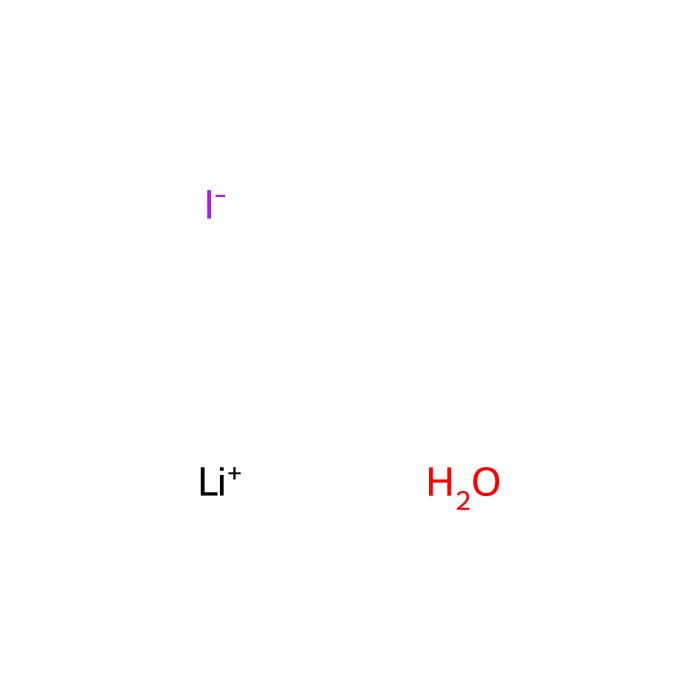
Lithium iodide hydrate is an inorganic ionic salt comprising lithium cations (Li+) and iodide anions (I–) with coordinated water of crystallization (xH2O).
SKU: L118835
Product name: Lithium iodide hydrate
CAS: 85017-80-7 (hydrate)
PubChem CID: 23688290 (hydrate entry)
InChIKey: 393641 (as provided in Product Data)
SMILES: Not specified for this item; refer to CoA/Spec Sheet.
Molecular formula (item-specific): Not specified for this item; refer to CoA/Spec Sheet. Note: Hydrate stoichiometry (x) varies and determines the exact formula (LiI·xH2O).
Molecular weight (item-specific): Not specified for this item; refer to CoA/Spec Sheet. Note: MW depends on hydration number x.
Structural features (general chemistry/literature):
Ionic lattice of Li+ and I–; in hydrates, Li+ is typically octahedrally or tetrahedrally coordinated by water molecules and iodide, forming extended hydrogen-bonded networks.
2D depiction: a discrete Li+ cation surrounded by water ligands (H2O→Li+ coordination) and counterbalanced by a large, soft iodide anion I–; no covalent Li–I bonds (predominantly ionic character).
No stereocenters; no aromaticity; inorganic binary halide with coordinated water.
Notes:
Hydrate form profoundly influences crystal structure, water content, and thermal behavior; common hydrates include monohydrate and trihydrate (literature), but the exact form for this item is not specified and should be confirmed on the CoA.
Synthetic Utility
Key reactive features (literature):
Iodide as a soft, highly nucleophilic anion promotes SN2 substitutions, especially on primary substrates and activated secondary centers. The large, polarizable I– stabilizes transition states and forms superior leaving groups (alkyl iodides) for subsequent transformations.
Lithium cation effects: Li+ coordinates to heteroatoms (O, N), increasing electrophile activation and, in polar aprotic media, enhances iodide activity compared to Na+/K+ analogs.
Representative transformations:
Finkelstein-type conversions: R–Cl/R–Br → R–I using LiI in DMF/DMSO/MeCN; often faster than NaI in challenging cases.
Epoxide openings: Formation of iodo-alcohols with regioselective anti-attack; useful intermediates for further substitution or elimination to alkenes.
Acetal/ether cleavage and iodination: LiI with TMSCl (or Ac2O) generates conditions for C–O bond cleavage, affording iodides or deprotected substrates.
Carbonyl activation: LiI can accelerate amidations/esterifications by stabilizing leaving groups and shifting equilibria.
Carbohydrate chemistry: Promotes glycosyl iodide formation and can modulate neighboring group participation.
Retrosynthetic value:
Using LiI enables convergent routes via iodide handles that can undergo metal–halogen exchange (e.g., with Mg, Li) or cross-couplings after conversion to other halides/triflates.
Practical notes:
Hydrate consideration: Bound water can quench reactive intermediates; for moisture-sensitive steps, dry or choose an anhydrous grade. Correct for assay when charging solid.
Workup: Excess iodide can color reaction mixtures (I2/I3–). Sodium thiosulfate washes or reductive workups help remove iodine coloration.
Target Specificity
Not applicable. This product is an inorganic salt, not a biological targeting reagent (e.g., antibody, ligand, or probe). No antigen/epitope, species reactivity, clone, or isotype information applies.
We use cookies to ensure the website functions properly and, where permitted, to improve your experience. You can manage your preferences at any time in Settings. Learn more in our Cookie Policy.
Shall we send you a message when we have discounts available?
Remind me later
Thank you! Please check your email inbox to confirm.
Products are supplied to verified businesses, institutions, and qualified professionals for research and development use only. Not for use in humans, animals, diagnosis, or therapy.