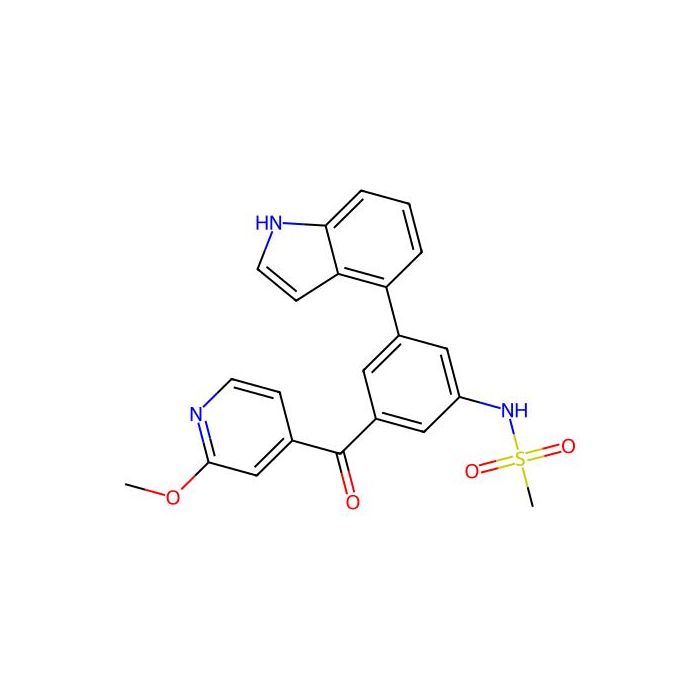
LP-261 is a potent and orally active anti-mitotic agent and shows an inhibition of in vitro tubulin polymerization with an EC 50 of 3.2 μM LP-261 inhibits growth of a human non-small-cell lung tumor (NCI-H522) in vivo and can be used for cancer research
In Vitro
LP-261 shows potent G2/M block activity in multiple cell lines and exhibits a range of activity from 0.01μM to 0.38 μM across the tested cell lines, the IC 50 values for MCF-7, H522, Jurkat, SW-620, BXPC-3, and PC-3 values are 0.01 μM, 0.01 μM, 0.02 μM, 0.05 μM, 0.05μM and 0.07 μM, respectively. LP-261 exhibits low micromolar potency in the tubulin polymerization assay, the EC 50 value of LP-261 is 5.0 μM. LP-261 has the ability to compete with colchicine for binding to tubulin in a [ 3 H]colchicine competition binding assay, the EC 50 (3.2 μM) for LP-261 to inhibit the binding with a potency similar to that of colchicine itself, and it exhibits a 79% inhibition at a conctration of 30 μM. MCE has not independently confirmed the accuracy of these methods. They are for reference only.
In Vivo
LP-261 (oral gavage; 4 mg/kg; single dose) displays rapid adsorption by the oral route (T max =2.0 h), the terminal half-life of 1.4 h ( 0.2 h indicated a moderate rate of elimination in rat, and the volume of distribution (V ss ) is 1.25 L/kg . LP-261 (oral gavage; 15 or 50 mg/kg; twice daily; 28 days) at 50mg/kg results in an approximately tumor volume of 130 mm 3 versus 3769 mm 3 in the vehicle treated group, this represents a 96% reduction in mean tumor volume. Meanwhile, LP-261 at 15 mg/kg leads to a 41% inhibition after 28 days in this mouse model . MCE has not independently confirmed the accuracy of these methods. They are for reference only. Animal Model: Human tumor xenograft model (Injected with NCI-H522 human non-small-cell) in NC r-nu mice Dosage: 15 or 50 mg/kg Administration: Oral gavage; 15 or 50 mg/kg; twice daily; 28 days Result: Had potent anti-tumor efficacy at high dosage and exhibited no significant changes in body weights.
LP-261 is a potent and orally active anti-mitotic agent and shows an inhibition of in vitro tubulin polymerization with an EC 50 of 3.2 μM. LP-261 inhibits growth of a human non-small-cell lung tumor (NCI-H522) in vivo and can be used for cancer rese
This compound belongs to the class of organic compounds known as aryl-phenylketones. These are aromatic compounds containing a ketone substituted by one aryl group, and a phenyl group.
External Descriptors
Not available
1. Djoumbou Feunang Y, Eisner R, Knox C, Chepelev L, Hastings J, Owen G, Fahy E, Steinbeck C, Subramanian S, Bolton E, Greiner R, and Wishart DS. ClassyFire: Automated Chemical Classification With A Comprehensive, Computable Taxonomy. Journal of Cheminformatics, 2016, 8:61.
Determine the necessary mass, volume, or concentration for preparing a solution.
Dilution Calculator
Determine the dilution needed to prepare a stock solution.
Reconstitution Calculator
レビュー
顧客レビュー
Application Protocols
Item-specific (from Product Data)
No tested application protocols are provided for this item.
General protocols for handling small-molecule screening compounds (not item-specific)
Stock preparation
Accurately weigh the solid (or use vendor-stated concentration if supplied as solution). Prepare a 10–50 mM stock in anhydrous DMSO. Vortex to dissolve completely; sonicate briefly if needed. Optionally, sterile-filter through 0.22 µm PTFE/PES if compatible.
Aliquoting and storage
Dispense into low-bind microtubes or 96/384-well source plates (e.g., 10–50 µL per well) to avoid repeated freeze–thaw. Seal with foil or heat seals for plate storage. Store at −20 °C, desiccated and protected from light when relevant.
Working solution preparation
Immediately before use, perform serial dilutions in DMSO to create intermediate stocks, then dilute into assay buffer or media to achieve the final concentration with acceptable DMSO percentage (commonly ≤0.1–0.5% v/v). Mix thoroughly and inspect for clarity.
Controls and QC
Include vehicle controls and, when available, positive/negative reference compounds. Verify final concentration by UV (if ε known) or LC–MS/qNMR. Monitor for precipitation over the assay window and discard compromised solutions.
Disposal
Dispose of unused solutions and consumables as organic chemical waste per institutional guidelines.
Biological Roles
Item-specific (from Product Data)
No target, pathway, or MoA annotations are provided for this listing.
Literature/knowledge note (caution)
This catalog entry does not include a structure or curated target annotation. Users should consult primary literature and trusted databases using the CAS (915412-67-8) and PubChem CID (15603282) to identify any reported biological roles or mechanism-of-action details. Verify that external information matches the exact form (base/salt, stereochemistry) of the material received.
General considerations for small-molecule library members (not item-specific)
Library compounds are often evaluated as chemical probes in biochemical assays (enzyme inhibition/activation), binding assays (SPR/ITC/MST), cellular phenotypic screens, or omics-guided studies.
When using a compound as a putative probe, assess selectivity across related targets, off-target liability (e.g., PAINS/IMPACTS/ALARM NMR), redox activity, aggregation propensity (evaluate with detergent controls), and interference with assay detection modalities (fluorescence/absorbance quenching).
Establish control experiments: include vehicle controls, inactive analogs (if available), and orthogonal assays to confirm on-target effects. Time-dependence and reversibility tests can distinguish covalent/slow-binding behavior from nonspecific effects.
For cell-based work, profile cytotoxicity and measure intracellular exposure (e.g., LC–MS of cell lysates) to link nominal dose to actual cellular concentration.
Buffer Applications
This section is not typically applicable. LP-261 is a discrete small molecule rather than a buffering agent.
Practical guidance (general; not item-specific)
If the compound must be delivered in buffered systems, choose biologically compatible buffers (e.g., HEPES, PBS) validated not to react with the compound. Maintain final DMSO or cosolvent content at assay-compatible levels (commonly ≤0.1–0.5% v/v).
Confirm compound stability in the chosen buffer over the assay time course (monitor by UPLC–MS). Avoid buffers containing nucleophiles or strong oxidants that could degrade sensitive functionalities.
Filter-sterilize working solutions (0.22 µm) when sterility is required and the compound is stable to filtration and does not adsorb significantly to membranes (PTFE or PES are typical choices for organic-containing solutions).
Green Alternatives
Green chemistry substitution is generally applied to reagents and solvents rather than to defined screening compounds.
Applicability note
LP-261 is a discrete small molecule; there is no direct “green alternative” to the compound itself without altering the research hypothesis. Therefore, substitution typically targets the formulation and process around its use (solvents, workup, waste minimization).
Greener handling strategies (general; not item-specific)
Prefer aqueous-compatible assay conditions where feasible; minimize DMSO final concentration and total organic solvent usage.
When preparing stocks or doing analytical work, choose greener solvents where compatible: ethanol over acetonitrile/DMF when performance allows; water-rich mobile phases in LC with volatile buffers (ammonium acetate/formate) to reduce hazardous waste.
Scale minimization: conduct microplate-scale assays (384/1536 well) to reduce per-experiment solvent consumption and waste generation.
Waste management: segregate halogenated from non-halogenated wastes; implement on-bench solvent capture for small volumes. Use closed-waste systems to limit VOC emissions.
Comparative considerations (general)
If multiple tool compounds with similar MoA exist, selection can weigh environmental, safety, and supply-chain factors alongside scientific fit; however, such substitution changes the probe and may affect biological readouts.
Pharmaceutical Uses
No pharmaceutical or clinical use is claimed or supported for this catalog item. It is supplied strictly for research use only.
Item-specific (from Product Data)
Research Use Note: For research use only.
General formulation context for research compounds (not item-specific; no therapeutic claims)
In preclinical research, small molecules may be formulated for in vitro/in vivo studies using excipients such as PEG 300/400, Captisol (sulfobutylether-β-cyclodextrin), cremophor alternatives (e.g., Kolliphor EL-free systems), or co-solvent blends (DMA/PEG/saline). Such practices are study-specific and require compound-specific stability and compatibility assessments.
For in vitro dosing, DMSO stock solutions diluted into media are common; verify that the final solvent fraction is tolerated by the biological system and that the compound does not precipitate.
If conducting non-clinical animal studies, ensure IACUC/ethical approvals and prepare formulations according to institution SOPs. Determine pH, osmolality, and stability prior to dosing. None of these constitute approved medical use and are the researcher’s responsibility.
Physical Properties
Item-specific (from Product Data)
Appearance: Not specified for this item; refer to CoA/Spec Sheet.
Molecular weight: Not specified for this item; refer to CoA/Spec Sheet.
Not specified for this item; refer to CoA/Spec Sheet
Melting point, boiling point, density, refractive index, optical rotation, water content, residual solvents, elemental analysis.
Solubility profile in common solvents (e.g., DMSO, DMF, MeOH, water) and partition data (logP/logD) are not provided for this catalog entry.
General guidance (literature/practice; not item-specific)
Many library-grade small molecules are formulated as solids or concentrated DMSO solutions. If supplied as a solid, typical practice is to prepare a 10–50 mM DMSO stock for screening, then dilute into assay buffer/media keeping final DMSO ≤0.1–0.5% v/v as compatible with the assay.
If aqueous use is required, assess solubility via cosolvent approaches (DMSO → buffer), pH adjustment when chemically permissible, or cyclodextrin inclusion. Verify absence of precipitation visually and by light scattering or UPLC.
For unknown hygroscopicity, handle in a dry box or quickly cap after weighing; record mass promptly to minimize buoyancy/humidity error.
If volatility is unknown, avoid warm open-vessel operations; use sealed containers for heating or drying, and confirm mass constancy before preparing standard solutions.
Quality and Grades
Item-specific (from Product Data)
Grade/Purity: Not specified for this item; refer to CoA/Spec Sheet.
How to interpret grade for small-molecule library items (general guidance)
In the absence of a declared grade (e.g., ≥98% purity, HPLC-grade solvent, bioX-grade), users should rely on the Certificate of Analysis (CoA) for batch-specific purity, analytical method (HPLC/UPLC/GC), and identity confirmation (NMR, MS, HRMS).
For screening compounds, vendors typically target high chemical purity (often ≥95% by HPLC/UPLC), low residual solvents, and identity confirmed by MS/NMR. These are typical literature/market practices, not specifications for this item.
If chirality is relevant, the CoA should indicate enantiomeric ratio or optical rotation; if multiple polymorphs/salt forms exist, the exact form (free base/acid, salt, solvate) should be stated on the CoA.
UV-Vis background and fluorescence can affect assay readouts; when critical (e.g., photoassays), request spectral background data or perform blank corrections.
Practical tips to qualify the material in-house (general)
Perform an incoming quality check: appearance, HPLC/UPLC purity with orthogonal column if needed, LC–MS for mass confirmation, and water content by KF if stability to KF is expected.
Archive the CoA and SDS with the lot number in your ELN/LIMS; affix internal barcodes to maintain sample chain-of-custody.
Reaction and Applications
This product is supplied as a small-molecule library compound intended for screening and research; it is not typically used as a synthetic reagent or catalyst.
Item-specific (from Product Data)
Manufacturer application text: Not provided for this item.
Applicability note
As a finished small molecule, “reaction” use cases (e.g., as a building block, ligand, or solvent) are not generally applicable. Instead, its value is in biochemical or phenotypic studies where the compound is tested for activity, binding, or cellular effects. See Application Protocols for practical handling in assays.
General experimental uses for library compounds (not item-specific)
Primary and secondary screening in biochemical/biophysical assays (e.g., enzyme activity, thermal shift, DSF, MST), cellular assays (viability, reporter, imaging), and target deconvolution workflows (chemoproteomics when suitable functional handles exist).
Analytical characterization under your lab conditions (UPLC retention time, MS response) to build internal reference libraries.
Physicochemical assessment: solubility, stability (pH/light), lipophilicity, and permeability models (PAMPA/MDCK) to inform assay design.
Practical tips
Validate concentration by quantitative NMR (qNMR) or UV with extinction coefficient if known; avoid relying solely on gravimetry for hygroscopic/solvated materials.
Include vehicle controls and perform serial dilutions immediately before use to mitigate adsorption and degradation.
Reaction Conditions
Not applicable in the conventional sense. LP-261 is supplied as a research compound, not as a reagent for promoting or undergoing specific named reactions within this catalog context.
Practical laboratory handling conditions (general; not item-specific)
Solution preparation: Prepare concentrated DMSO stocks (e.g., 10–50 mM) under dry, ambient conditions unless the compound is moisture/light sensitive (verify by CoA or small-scale tests). Filter if sterility is required.
Stability checks: Assess stability at room temperature and 37 °C in relevant media over the experimental timeframe using UPLC–MS or HPLC with PDA detection. Include light protection if aromatic chromophores are suspected.
Adsorption mitigation: Use low-bind plasticware or silanized glass for low-nanomolar assays; include carrier protein (e.g., 0.1% BSA) only if compatible with the readout and the compound does not bind nonspecifically to protein.
Storage during use: Keep working solutions on ice or at 4 °C for the duration of the experiment when feasible; discard if precipitation or discoloration occurs.
Safety and Handling
Item-specific (from Product Data)
Storage conditions: Store at −20 °C.
Shipping: Ice chest + ice pads.
Research use: For research use only.
GHS/SDS details (signal word, hazard statements, pictograms, classification): Not specified for this item; refer to SDS.
General safety guidance (not item-specific; defer to SDS)
Until specific hazards are known, handle as a potentially harmful organic research chemical in a fume hood with appropriate PPE: lab coat, safety glasses, and nitrile gloves. Avoid inhalation of dust/vapors and skin/eye contact.
Incompatibilities commonly relevant to organic small molecules include strong oxidizers, strong acids/bases (risk of degradation), and ignition sources if solvent is flammable. Segregate from foodstuffs and incompatible reagents.
First-aid overview: In case of skin contact, wash with soap and water. For eye exposure, rinse cautiously with water for several minutes and seek medical attention. If inhaled, move to fresh air; if ingested, rinse mouth and seek medical advice. Provide SDS to medical personnel.
Spill response: For solids, gently cover and collect using dampened disposable towels or a HEPA vacuum; avoid dust generation. For solutions, contain with inert absorbent. Dispose according to institutional and local regulations.
Fire-fighting: Use CO2, dry chemical, or alcohol-resistant foam appropriate to surrounding materials. Combustion may produce CO/CO2 and irritant fumes.
Always consult the batch-specific SDS for authoritative hazard and response information.
Solvent Selection
Item-specific (from Product Data)
No solubility or solvent recommendations are provided for this listing; refer to CoA/Spec Sheet.
General solvent strategy for bioactive small molecules (literature/practice; not item-specific)
Primary stock solvent: DMSO is the default due to broad solvating power and biological compatibility at ≤0.1–0.5% v/v in most assays. Typical stocks: 10–50 mM, filtered through 0.22 µm PTFE/RC when sterility is required.
Alternative solvents: DMF or ethanol can be used when DMSO is unsuitable; pretest assay tolerance. For aqueous delivery, cosolvent strategies (DMSO→buffer), pH adjustment (if ionizable), or cyclodextrin (e.g., HP-β-CD 5–20% w/v) may help.
Miscibility and polarity: Without a defined structure, treat as an unknown neutral/weakly polar organic. Start with DMSO, then evaluate MeOH, EtOH, MeCN for analytical work. Use buffered aqueous systems only after confirming solubility and stability.
Analytical solvents: For LC–MS, 50:50 MeCN/H2O + 0.1% formic acid (or NH4OAc for neutral conditions) is broadly applicable. Avoid phosphate in MS workflows.
Practical tips
Minimize freeze–thaw of DMSO stocks; prepare aliquots. Verify clarity after dilution into assay media; if opalescence or precipitate appears, reduce working concentration or increase cosolvent fraction within assay limits.
Record solvent lot and water content when conducting stability-sensitive experiments.
Storage and Reconstitution
Item-specific (from Product Data)
Storage conditions: Store at −20 °C.
Shipping: Ice chest + ice pads.
Reconstitution (general guidance; not item-specific)
If supplied as a solid: Allow the container to equilibrate to room temperature in a desiccator before opening to prevent moisture condensation. Weigh quickly and prepare a concentrated DMSO stock (e.g., 10–50 mM). Record exact concentration based on mass and purity from the CoA.
If supplied as a solution: Verify concentration on the label/CoA. Mix gently after thawing; avoid vigorous shaking that can introduce bubbles and adsorption to vessel walls.
Handling and aliquoting
Prepare single-use aliquots in low-bind vials or sealed microplates to minimize freeze–thaw cycles. Label aliquots with compound ID (LP-261), lot, concentration, solvent, and date.
Protect from prolonged light exposure unless stability has been confirmed; wrap vials in foil if needed.
Stability and shelf life
Batch-specific stability data are not provided for this item; refer to CoA/Spec Sheet. As a general practice, maintain frozen stocks at −20 °C (or below) in a non-frost-free freezer. Avoid repeated thawing; discard aliquots showing precipitation, discoloration, or decreased assay activity.
Research use only
Not for human or veterinary use. Follow institutional SOPs for storage, labeling, and disposal.
Structure and Identity
Brief overview: LP-261 (SKU L647531) is listed in our small-molecule/compound library category and supplied for research use only.
Item-specific (from Product Data)
Product name: LP-261
SKU: L647531
CAS: 915412-67-8
PubChem CID: 15603282
InChIKey: 447539 (as provided; note this is not the standard 27-character InChIKey format; consult CoA/SDS for the definitive identifier)
Category path: 全部 / 可售 / 小分子和化合物库
Not specified for this item; refer to CoA/Spec Sheet
Molecular formula: Not specified for this item; refer to CoA/Spec Sheet.
Molecular weight: Not specified for this item; refer to CoA/Spec Sheet.
SMILES: Not specified for this item; refer to CoA/Spec Sheet.
General notes (identity/structure)
This listing does not include a structural drawing or line notation. Users should verify structural identity using the CAS or CID in authoritative databases and cross-check against the batch Certificate of Analysis (CoA).
If performing analytical confirmation, typical orthogonal methods include high-resolution mass spectrometry (HRMS), 1H/13C NMR, and HPLC/UPLC purity profiling; retain the batch lot number for traceability.
For inventory and ELN records, link the compound record to the CAS (915412-67-8) and internal SKU (L647531) to avoid ambiguity across suppliers and lots.
Synthetic Utility
This product is intended as a finished small-molecule library member, not as a general synthetic reagent or building block.
Applicability note
Without a disclosed structure, providing reaction-specific synthetic roles (e.g., as a nucleophile/electrophile, ligand, or catalyst) would be speculative and is not appropriate for this listing.
General considerations (not item-specific)
If derivatization is desired for probe development (e.g., biotinylation, photoaffinity tags), obtain the full structure (from CoA or literature) and design modifications at positions that retain activity. Common workflows include installing linkers via amide coupling, click chemistry (azide–alkyne), or carbonate/urethane formation if suitable handles exist.
For analytical enrichment or imaging, analogs bearing alkyne/azide handles or fluorophores are often prepared. SAR should be re-established after modification to ensure the probe reflects the parent compound’s activity profile.
Maintain rigorous documentation of any transformations performed in-house, including spectra and purity data, as properties may deviate from the parent material.
Target Specificity
Item-specific (from Product Data)
Target, selectivity, and binding data: Not specified for this item; refer to primary literature using CAS 915412-67-8 or PubChem CID 15603282.
Guidance for researchers (general; not item-specific)
To establish specificity, perform orthogonal assays (biochemical vs cellular), counterscreen against related targets, and include off-target panels appropriate to the hypothesized MoA.
Use biophysical methods (SPR, ITC, DSF, MST) to confirm direct binding when applicable, and determine basic kinetic/thermodynamic parameters.
Evaluate interference risks: intrinsic fluorescence/absorbance, redox activity, aggregation (detectable via detergent controls and dynamic light scattering), and reactivity toward thiols/amines if functional alerts exist.
When available from literature, compare reported potencies with your internal data under matched conditions to detect matrix effects or solubility/adsorption artifacts.
Products are supplied to verified businesses, institutions, and qualified professionals for research and development use only. Not for use in humans, animals, diagnosis, or therapy.