Determine the necessary mass, volume, or concentration for preparing a solution.
Dilution Calculator
Determine the dilution needed to prepare a stock solution.
Reconstitution Calculator
レビュー
顧客レビュー
Application Protocols
Protocols below are general literature-style guidance for PEG–lipoamide ligands; adjust to your system. They are not product specifications.
A. Forming a SAM on gold-coated substrates:
Clean Au substrates (e.g., UV–ozone or plasma). Rinse with ethanol.
Prepare 1 mM m-dPEG8-Lipoamide in absolute ethanol.
Immerse substrates 12–24 h at room temperature in the dark.
Rinse thoroughly with ethanol, then water; dry under N2.
Characterize by contact angle and XPS/ellipsometry as needed.
B. Ligand exchange on citrate-capped AuNPs (20–60 nm):
Prepare AuNPs in water; measure baseline DLS/ζ-potential.
Add ligand stock (10 mM in water/ethanol or DMSO) to achieve 50–200 µM final.
Gently mix; incubate 12–24 h at room temperature.
Salt-aging: Increase NaCl stepwise to 50–150 mM over several hours while monitoring DLS; avoid aggregation.
Purify by centrifugation or diafiltration; resuspend in HEPES or PBS (thiol-free).
C. Optional pre-reduction of lipoamide:
Mix ligand with equimolar TCEP in water (pH ~7) for 15–30 min.
Remove excess TCEP (spin column/desalting) prior to exposure to gold to prevent competition.
Buffer caution: Do not use DTT, β-mercaptoethanol, or cysteine-containing buffers during adsorption steps.
Documentation: Record ligand:surface ratios, incubation time, and purification method for reproducibility.
Biological Roles
General background (biochemistry, literature context):
Lipoic acid/lipoamide: α-Lipoic acid is a naturally occurring cofactor covalently attached (as lipoamide) to lysine residues in key enzyme complexes (e.g., pyruvate dehydrogenase). The oxidized form features a 1,2-dithiolane ring that can undergo reversible reduction to dihydrolipoamide, shuttling acyl groups and electrons.
PEG segment: Poly(ethylene glycol) is widely used in biomaterials for its hydrophilicity, protein-repellent behavior, and low immunogenicity compared to many alternatives.
Relevance to this product:
m-dPEG8-Lipoamide is a synthetic conjugate that leverages the lipoamide motif for surface anchoring and the methoxy-PEG8 chain for antifouling hydration layers. It does not serve as a metabolic cofactor.
In biointerfaces, surfaces coated with methoxy-terminated PEG generally reduce protein adsorption and cell adhesion, providing inert backgrounds for biosensors and diagnostic platforms.
Notes and limitations:
No biological activity or therapeutic function is claimed or implied for this product. It is intended for laboratory research and materials applications such as nanoparticle stabilization and surface passivation.
If deploying in biological media, ensure buffers are thiol-free to prevent unintended reduction of the dithiolane ring, which could alter surface attachment kinetics and stability.
Buffer Applications
Applicability:
As a nonreactive, methoxy-terminated PEG–lipoamide ligand, this product is not a buffering agent. However, buffer choice critically impacts its use in surface functionalization and colloidal stabilization.
Practical guidance (general/literature):
Recommended buffers: Use neutral, thiol-free buffers such as HEPES (10–50 mM), PBS (1×), or Tris (note: Tris can weakly coordinate metals; HEPES/PBS often preferred for AuNP work). Maintain pH 6.8–7.6 to avoid amide hydrolysis and minimize side reactions.
Avoid: Reducing buffers/additives (DTT, TCEP, β-mercaptoethanol, cysteine) which can reduce the 1,2-dithiolane, altering adsorption kinetics and potentially causing undesired crosslinking.
Ionic strength: Moderate salt (e.g., 50–150 mM NaCl) can help screen charges and densify ligand shells on nanoparticles via salt-aging protocols. Increase gradually to prevent aggregation.
Co-solvents: For initial ligand exchange, 5–30% ethanol or small amounts of DMSO can improve wetting/solubility; dilute back into buffer post-adsorption.
Recipes (examples; general guidance only):
HEPES 10 mM, NaCl 50–100 mM, pH 7.4; filter-sterilize (0.22 µm) prior to nanoparticle work.
PBS 1× (no magnesium/calcium) for routine handling of PEGylated nanoparticles.
Always verify compatibility with your specific nanoparticles and avoid any buffer components that compete for gold binding (e.g., thiols, strong sulfur-containing additives).
Green Alternatives
Solvent and process considerations:
Preference for water/ethanol systems: m-dPEG8-Lipoamide typically dissolves in ethanol and aqueous buffers, enabling avoidance of higher-toxicity solvents (DMF, NMP). Start with EtOH, water, or mixtures; escalate to DMSO/DMF only if required.
Room-temperature assembly: SAM formation and ligand exchange on gold can proceed at ambient temperature, reducing energy input.
Anchor chemistry comparison (general/literature):
Lipoamide vs monothiols: Lipoamide (dithiolane) provides chelating Au–S interactions that improve monolayer stability, potentially lowering ligand consumption and replacement frequency compared to monothiol PEGs.
Lipoamide vs multidentate catechols (for oxides): On gold and other soft metals, lipoamide is preferred; for TiO2/Fe3O4, catechols/phosphonates are greener alternatives. Match anchor to substrate to avoid excess reagents.
Small comparison (general, not specifications):
Lipoamide–PEG8–OCH3: Water/EtOH compatible; strong Au binding; low fouling.
PEG–monothiol: Similar solubility; weaker binding; potentially higher leaching.
Alkyl thiols: Often require nonpolar solvents; higher VOC footprint; poorer biocompatibility vs PEGylated ligands.
Waste minimization tips:
Use minimal organic co-solvent volume; recover EtOH by distillation where permitted.
Prepare concentrated stock solutions to reduce packaging and transport impacts.
Avoid thiol-excess protocols when not needed; employ salt-aging to densify shells instead of repeated ligand additions.
Pharmaceutical Uses
Scope and intent:
This item is supplied for research use only. No medical, diagnostic, or therapeutic uses are claimed.
Formulation and process relevance (general/literature context):
Excipients for nanomedicine R&D: Methoxy-terminated PEG–lipoamide ligands are frequently explored in research settings to confer colloidal stability and stealth behavior to gold and other metallic nanoparticles. They can reduce nonspecific protein adsorption and aggregation during in vitro studies.
Surface passivation in device prototyping: In biosensor and diagnostic prototype development, PEG–lipoamide monolayers serve as antifouling coatings on gold electrodes and microfluidic channel surfaces.
Regulatory status: No pharmacopeial monograph is associated with this specific discrete PEG conjugate. Any use in regulated products would require comprehensive qualification and supplier documentation.
Manufacturing considerations:
Analytical control: Lot-specific characterization (exact mass for dPEG8 conjugate, residual solvents, related substances) is essential to ensure reproducibility in formulation studies; consult CoA/Spec Sheet.
Process solvents: Favor ethanol/water systems where feasible to align with green chemistry and reduce residual solvent concerns.
Limitations:
The methoxy terminus provides no reactive handle for covalent drug attachment; it is best suited as a passive stabilizer or in mixed-ligand shells with separate functional PEGs for conjugation chemistry.
Physical Properties
Item-specific (Product Data):
Appearance: Not specified for this item; refer to CoA/Spec Sheet.
Molecular Weight: Not specified for this item; refer to CoA/Spec Sheet.
General/literature expectations for m-dPEG8-lipoamide–type materials (for context only; not product specifications):
Physical state: Typically a white to off-white solid or waxy solid at ambient temperature for PEG8 conjugates.
Solubility profile: High solubility in polar organic solvents (DMSO, DMF, methanol, ethanol); miscible to highly soluble in water due to PEG chain; low solubility in nonpolar solvents (hexane, toluene).
Optical: No strong chromophores; low UV absorbance above ~230 nm typical of PEGylated compounds.
Stability: Cyclic disulfide stable to air/neutral conditions; reduced by strong thiols (e.g., DTT, TCEP) to dihydrolipoamide.
Not specified for this item; refer to CoA/Spec Sheet:
Melting point, boiling point, density, refractive index, pKa, logP/logD, water content, residual solvents, metal content, and UV cutoffs.
Note: Values above labeled as “general/literature expectations” are provided to guide solvent choice and handling in method development and should not be treated as specifications for SKU M486625.
Quality and Grades
Item-specific (Product Data):
Grade/Purity: Not specified for this item; refer to CoA/Spec Sheet.
Research Use Note: For research use only.
Context and implications:
Discrete PEG (dPEG) vs conventional PEG: dPEG reagents are monodisperse (single PEG length) rather than polydisperse. This improves batch-to-batch reproducibility, analytical characterization (exact mass), and performance in surface engineering and nanomaterials where ligand density and hydrodynamic size are critical.
Purity considerations: For surface functionalization and bioconjugation, common quality attributes include: low residual metals/solvents, minimal free PEG/anchoring impurities, and narrow related-substance profiles. Exact acceptance criteria are product-specific and must be verified on the CoA.
UV/fluorescence background: Methoxy-terminated PEGs have minimal UV absorbance above ~230 nm and are typically suitable for UV-based monitoring with low background; however, low-UV/HPLC grades (if offered) are preferred for analytical chromatography. Not specified for this item; refer to CoA/Spec Sheet.
Stabilizers: None are typically required for PEG–lipoamide solids; any use of antioxidants or desiccants would be documented on the CoA/Spec Sheet. Not specified for this item.
Documentation:
For regulated or QA-critical work, reference the lot-specific CoA/Spec Sheet for exact purity, assay method, residual solvents, water content, and recommended analytical tests.
Reaction and Applications
Core use-cases (materials and nanoscience):
Gold surface modification: Lipoamide (1,2-dithiolane) reduces to a dithiol that forms bidentate Au–S bonds, enabling robust self-assembled monolayers (SAMs) on Au films, electrodes, and nanoparticles. The methoxy-PEG8 terminus imparts hydrophilicity and antifouling character.
Mixed-ligand shells: Combine with functional dPEG ligands (e.g., carboxyl-, amine-, azide-terminated) to tune surface charge and provide orthogonal handles while maintaining stealth background from m-dPEG8 units.
Colloidal stabilization: PEG corona reduces van der Waals-driven aggregation and protein adsorption, stabilizing colloids in saline and serum-mimicking media.
Reduction/activation: The 1,2-dithiolane can be gently opened with reducing agents (TCEP, DTT) immediately prior to adsorption when stronger Au–S chelation is needed; alternatively, spontaneous exchange on gold can occur without prior reduction in some protocols.
Layer formation: Typical ligand exchange on citrate-capped AuNPs proceeds by adding a concentrated ligand solution (water/EtOH) and aging at room temperature with salt-aging steps to densify the shell.
Protein-resistant coatings: The methoxy terminus lacks reactive groups, minimizing nonspecific adsorption and fouling; useful as a background in biosensor surfaces.
Additional applications:
Electrochemical interfaces: Stable SAMs for impedance spectroscopy and biosensing.
Micro- and nanofabrication: Patterned passivation layers via microcontact printing or photolithographic masking combined with SAM formation.
All points above are general/literature guidance to expand practical use; tailor conditions to your system.
Reaction Conditions
General/literature guidance for common use-cases (not product specifications):
Self-assembled monolayers (SAMs) on evaporated Au:
Solvent: Absolute ethanol (or ethanol:water 1:1).
Concentration: 0.1–2 mM ligand solutions are commonly reported for SAM formation.
Temperature/time: Ambient temperature; 2–24 h immersion; longer times can improve order/density.
Notes: Degas solvent to minimize oxidative byproducts; keep thiols out unless intentional reduction is planned.
Gold nanoparticle (AuNP) ligand exchange:
Solvent/buffer: Water or HEPES/PBS (thiol-free); up to 10–30% ethanol or small DMSO as co-solvent for solubilization.
Protocol: Add concentrated ligand stock to AuNP dispersion (final 10–200 µM), gently agitate; age for 12–48 h. Employ gradual salt-aging (NaCl to 50–200 mM) while monitoring hydrodynamic size (DLS) to compact the shell.
Optional activation: Pre-reduce lipoamide with stoichiometric TCEP immediately before use to expose dithiol; remove excess reductant (desalting) to avoid competition for Au binding.
Competing ligands: Avoid thiolated additives, sulfides, and high concentrations of amines that can coordinate metal surfaces.
Characterization:
Monitor assembly by contact angle (SAMs), XPS, IRRAS, ellipsometry (films), or DLS and ζ-potential (nanoparticles). Thermogravimetric analysis (TGA) can estimate grafting density.
Adjust conditions to substrate, particle size, and desired grafting density.
Safety and Handling
Item-specific (Product Data):
Storage Conditions: Store at -20°C.
Shipped In: Ice chest + Ice pads.
GHS Classification / Signal word / H-statements / Pictograms: Not specified for this item; refer to SDS.
General safety guidance (defer to SDS for authoritative details):
Expected hazards: PEGylated lipoamide conjugates are generally of low acute toxicity; avoid inhalation of dusts and contact with eyes/skin. The lipoamide disulfide can be reduced by thiols—avoid unintended exposure to strong reducing agents.
PPE: Laboratory coat, safety glasses, and appropriate chemical-resistant gloves (e.g., nitrile). Use in a fume hood to minimize dust/aerosol exposure.
Incompatibilities: Strong reducing agents (e.g., DTT, TCEP, NaBH4) if preservation of the 1,2-dithiolane ring is desired; strong oxidizers; strong acids/bases that can hydrolyze the amide or induce PEG degradation under forcing conditions.
First aid (overview):
Skin/eye contact: Rinse with water for at least 15 minutes; remove contaminated clothing. Seek medical attention if irritation persists.
Inhalation: Move to fresh air; seek medical attention if symptoms occur.
Ingestion: Rinse mouth; do not induce vomiting; seek medical attention.
Spill response: Avoid dust formation; collect solids by gentle sweeping or HEPA vacuum; wash area with water/ethanol.
Waste: Dispose of according to institutional and local regulations for organic laboratory chemicals.
Note: Always consult the product’s SDS for specific hazard and response information.
Solvent Selection
Compound type and polarity:
Amphiphilic ligand: Hydrophilic PEG8 chain with a hydrophobic lipoamide headgroup; overall behavior is polar/protic-compatible.
General/literature solubility and miscibility (not product specifications):
Water: Typically soluble at mg–tens of mg/mL with gentle agitation.
Polar organics: Fully miscible/soluble in DMSO, DMF, NMP, methanol, ethanol, isopropanol, and acetonitrile.
Moderately polar/aprotic: Acetone, ethyl acetate—solubility varies; sonication may help.
Nonpolar: Poor in hexanes/toluene; co-solvents (EtOH, THF) can assist.
Practical selection by application:
Nanoparticle functionalization (gold, AuNPs/Au surfaces): Water, ethanol, or water/ethanol mixtures are typical; inclusion of a mild base (e.g., 1–10 mM ammonium bicarbonate) can aid deprotonation of any adventitious acids without reducing the disulfide.
Thin films/SAMs on evaporated gold: Ethanol (absolute) is common for self-assembled monolayers; avoid thiol-containing solvents/additives unless intentional reduction is desired.
Bioconjugation/passivation in buffers: Use oxygenated, thiol-free buffers (HEPES, PBS) at neutral pH; avoid DTT, TCEP, cysteine, or β-mercaptoethanol.
Comparison notes:
Lipoamide anchors form stronger, more stable Au–S chelates than mono-thiols, often improving monolayer robustness.
For very hydrophobic surfaces, consider a co-solvent system (e.g., ethanol/THF/water) to enhance wetting while maintaining PEG presentation.
Storage and Reconstitution
Item-specific (Product Data):
Storage Conditions: Store at -20°C.
Shipped In: Ice chest + Ice pads.
General handling guidance:
Protect from light and moisture. Store tightly capped under inert gas or with desiccant to limit hydrolysis/oxidation of sensitive moieties.
Avoid repeated freeze–thaw: Prepare single-use aliquots upon first opening.
Reconstitution (general suggestions; not specifications):
Solvents: Water, ethanol, or anhydrous DMSO/DMF are typical. Begin with ethanol or water; use small DMSO amounts if needed to aid dissolution before diluting into buffer.
Concentrated stocks: 10–50 mM stocks are commonly prepared for convenience; filter (0.22 µm) if using in nanoparticle formulations.
Buffer compatibility: Use thiol-free buffers (HEPES, PBS). Avoid reducing agents (TCEP, DTT) unless intentional reduction of the dithiolane is required immediately before surface binding.
Stability notes:
The 1,2-dithiolane ring is stable to air at neutral pH; prolonged exposure to strong bases/acids or reductants can degrade or reduce it.
If precipitate forms on cold storage, warm gently to room temperature and vortex/sonicate to redissolve.
Documentation:
For lot-specific shelf life, impurity limits, and any stabilizers, consult the CoA/Spec Sheet. Maintain usage logs (opening date, aliquoting history) for QA in reproducible applications.
Structure and Identity
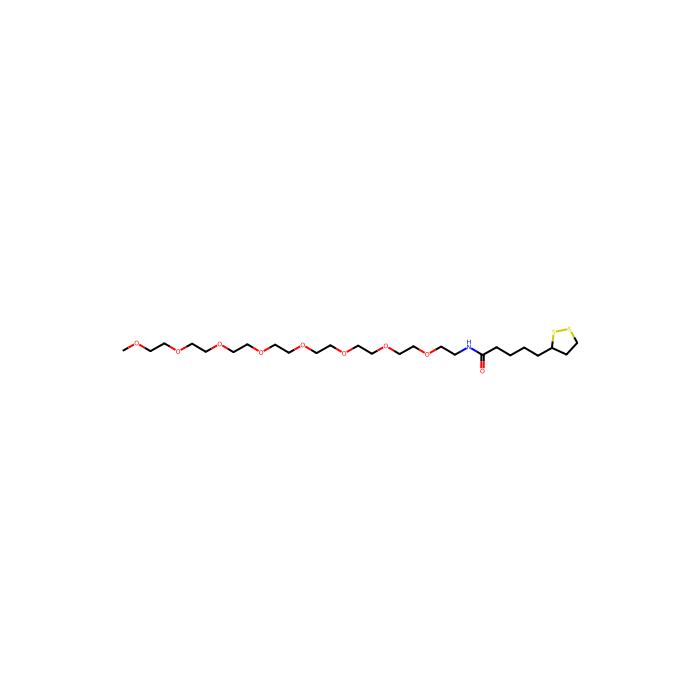
Brief: m-dPEG8-Lipoamide is a monodisperse, methoxy-terminated poly(ethylene glycol) (PEG8) conjugated to a lipoamide anchoring group (1,2-dithiolane ring). It functions as a hydrophilic, nonfouling surface ligand with a strong metal-binding headgroup.
Item-specific (Product Data):
Product Name: m-dPEG®₈-Lipoamide (SKU: M486625)
CAS: 1334172-67-6
InChIKey: 389512 (as provided)
SMILES: Not specified for this item; refer to CoA/Spec Sheet.
Molecular Formula: Not specified for this item; refer to CoA/Spec Sheet.
Molecular Weight: Not specified for this item; refer to CoA/Spec Sheet.
Structural features (general description):
Discrete PEG segment: “dPEG8” denotes eight ethylene glycol repeat units, monodisperse (single, exact n), terminated with a nonreactive methoxy cap (m-).
Lipoamide terminus: Amide of α-lipoic acid bearing a five-membered 1,2-dithiolane ring; upon reduction, yields a vicinal dithiol capable of strong, chelating Au–S (and other soft metal–sulfur) interactions.
Stereochemistry: Lipoic acid is chiral at C6, but the product is typically supplied as racemate unless otherwise specified (not specified here).
2D description in words:
A linear PEG chain of eight –CH2–CH2–O– units capped by –O–CH3 on one end and joined via –C(O)NH– to a pentyl spacer terminating in a 1,2-dithiolane ring (five-membered cyclic disulfide).
Synthetic Utility
Role in synthesis and materials construction (general/literature):
Surface anchor and spacer: The lipoamide provides a bidentate sulfur anchor to metallic substrates (especially Au), while the PEG8 segment serves as a defined-length hydrophilic spacer terminating in a nonreactive methoxy group.
Retrosynthetic value: Useful as a “blocking/passivating” component when building mixed monolayers or mixed polymer brushes that require inert background spacing between functional ligands.
Reaction classes and uses:
Self-assembly: Formation of SAMs on gold via adsorption of the (reduced) dithiol motif; can proceed without catalysts under ambient conditions.
Ligand exchange: Displacement of weakly bound stabilizers (e.g., citrate) from AuNPs by the lipoamide/dithiol, yielding robust PEG coronas.
Microfabrication: Enables patterning strategies where reactive ligands are spatially confined and methoxy-PEG provides nonfouling regions.
Complementary reagents:
Pair with functional dPEG analogs (e.g., azide-, alkyne-, NHS-, carboxyl-, maleimide-terminated) to introduce chemistry while maintaining m-dPEG8 as an inert diluent controlling density and spacing.
Advantages of discrete PEG8:
Exact chain length yields reproducible interfacial thickness and hydrodynamic size; facilitates quantitative structure–property studies and consistent device performance.
Note: This product is not typically used as a solution-phase coupling reagent; its principal utility is in interfacial chemistry and nanostructure assembly.
Target Specificity
This product is a small-molecule/ligand reagent, not an antibody or affinity probe. Target specificity data (antigen, epitope, clone, isotype, species reactivity) are not applicable.
Item-specific (Product Data): Not applicable.
Guidance: For selective biological targeting, use mixed monolayers incorporating functional ligands (e.g., biotin-, peptide-, or antibody-conjugated PEGs) alongside m-dPEG8-Lipoamide as an inert diluent.
よくある質問
How should this product be stored?
Store at ?20 °C. Freezer storage is required to maintain the specified shelf life.
How is this product shipped?
This product ships in an insulated container with ice pads. Unpack on arrival and transfer it to the storage condition stated above.
What are the CAS number, molecular formula and molecular weight?
The CAS Number is 1334172-67-6, the molecular formula is C25H49NO9S2, and the molecular weight is 571.79 g/mol. InChIKey VVNHZYDOJLEDPZ-UHFFFAOYSA-N.
What documentation is provided?
Available product documentation, including Certificates of Analysis (COA), Safety Data Sheets (SDS), and specification sheets, is shown in the product document area. Document availability and access follow the current site policy.
We use cookies to ensure the website functions properly and, where permitted, to improve your experience. You can manage your preferences at any time in Settings. Learn more in our Cookie Policy.
Shall we send you a message when we have discounts available?
Remind me later
Thank you! Please check your email inbox to confirm.
Products are supplied to verified businesses, institutions, and qualified professionals for research and development use only. Not for use in humans, animals, diagnosis, or therapy.