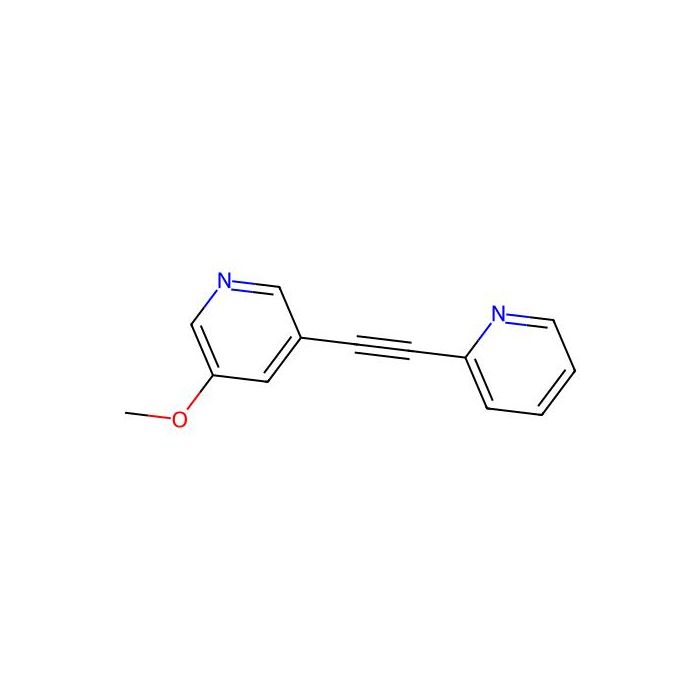
Methoxy-PEPy is a potent and highly selective mGlu5 receptor antagonist with IC50 of 1 nM.IC50 value: 1 nM Target: mGlu5R inhibitorAdministration of [3H]methoxy-PEPy (50 microCi/kg i.v.) to mGlu5 receptor-deficient mice revealed binding at background levels in forebrain, whereas wild-type mice exhibited 14-fold higher binding in forebrain relative to cerebellum. The calcium transients stimulated by these agonists were potently inhibited by reference allosteric mGlu5 antagonists - 2-methyl-6-(phenylethynyl)pyridine (MPEP), 3-[(2-methyl-1,3-thiazol-4-yl)ethynyl]pyridine (MTEP) and 3-methoxy-5-(pyridine-2-ylethynyl)pyridine (methoxy-PEPy) (IC(50) ranges: 0.8-66 nM)
Form:Solid
IC50& Target:mGlu5 Receptor 1 nM (IC 50 )
仕様
仕様と純度
≥98%
生化学的・生理学的メカニズム
Methoxy-PEPy is a potent and highly selective mGlu5 receptor antagonist with IC50 of 1 nM.\nIC50 value: 1 nM \nTarget: mGlu5R inhibitor\nAdministration of [3H]methoxy-PEPy (50 microCi/kg i.v.) to mGlu5 receptor-deficient mice revealed binding at backgr
保管条件
Store at -20°C
入荷
Ice chest + Ice pads
この製品は冷冷この冷このこの製品の運送が必要です。地上およびその他の経済サービスは利用できません。
アクションタイプ
ANTAGONIST
純度
≥98%
名前と識別子
異性体SMILES
COC1=CN=CC(=C1)C#CC2=CC=CC=N2
PubChem CID
10081842
分子量
210.23
詳細データ
証明書(CoA、COO、BSE/TSEと分析図)
C of A & Other Certificates(BSE/TSE, COO):
Analytical Chart:
化学的性質と物理的性質
溶解度
DMSO : 100 mg/mL (475.67 mM; Need ultrasonic)
分子量
210.23
XLogP3
1.800
Hydrogen Bond Donor Count
0
Hydrogen Bond Acceptor Count
3
Rotatable Bond Count
3
Exact Mass
210.079 Da
Monoisotopic Mass
210.079 Da
Topological Polar Surface Area
35.000 Ų
Heavy Atom Count
16
Formal Charge
0
Complexity
278.000
Isotope Atom Count
0
Defined Atom Stereocenter Count
0
Undefined Atom Stereocenter Count
0
Defined Bond Stereocenter Count
0
Undefined Bond Stereocenter Count
0
The total count of all stereochemical bonds
0
Covalently-Bonded Unit Count
1
ソリューション計算機
Molarity Calculator
Determine the necessary mass, volume, or concentration for preparing a solution.
Dilution Calculator
Determine the dilution needed to prepare a stock solution.
Reconstitution Calculator
レビュー
顧客レビュー
Application Protocols
No vendor-validated application protocols are provided for this SKU. The following general procedures are offered as starting points and must be optimized for your system.
General stock solution preparation:
Allow vial to warm in a desiccator to room temperature before opening to avoid moisture condensation.
Dissolve in anhydrous DMSO to 10–50 mM. Vortex and, if needed, sonicate briefly. Filter through 0.2 µm PTFE.
Aliquot into amber vials; store at -20°C. Avoid repeated freeze–thaw.
Plate-based assay dosing (general):
Prepare intermediate DMSO dilutions to achieve a constant final DMSO fraction (e.g., 0.5%) in assay wells.
Mix thoroughly and inspect for precipitation; if observed, increase dilution steps or add a small amount of compatible co-solvent/surfactant.
Exploratory spectral scan (if photophysical evaluation is intended; not item-specific):
Record UV–Vis spectrum (200–800 nm) in a non-absorbing solvent (e.g., MeCN) to identify absorption maxima.
Acquire fluorescence excitation/emission maps at multiple concentrations to check linearity and inner-filter effects; include blanks for solvent baseline.
Documentation:
Log lot number, solvent, concentration, and handling conditions alongside raw data to support reproducibility.
Note: These are generic starting points. For item-specific methods, consult the CoA/Spec Sheet and SDS.
Biological Roles
No endogenous biological role or target specificity is provided for this item.
General notes for research-only small molecules:
Synthetic heteroaromatic compounds often serve as tool molecules to perturb, report on, or mimic biological processes in vitro or in cell-based assays. Any such use must be validated experimentally for this SKU.
If the scaffold is conjugated and aromatic, photophysical properties may allow exploration as an environmental or binding probe; however, excitation/emission behavior, binding partners, and cell permeability are not specified and must be determined empirically.
Off-target effects and assay interference (e.g., fluorescence, redox activity, aggregation) can confound screening data. Implement control assays (e.g., detergent-based counterscreens, redox interference panels) to de-risk false positives.
ADME-relevant parameters (permeability, efflux liability, microsomal stability, plasma protein binding, solubility) are not provided and should be measured if the compound is advanced beyond primary screening.
Compliance reminder:
Research Use Note: For research use only. Not for human or veterinary use, diagnostic procedures, or clinical applications.
Buffer Applications
This product is not a buffering agent, and no buffer system specifications are provided.
If used in aqueous assays, select a buffer appropriate to the biological/chemical target (e.g., PBS, HEPES, Tris) and verify the compound’s solubility and stability at the working pH and ionic strength.
Maintain a consistent final organic cosolvent percentage across samples to avoid apparent activity shifts due to solvent effects.
For item-specific buffering capacities, pKa values, or recommended buffer formulations: Not specified for this item; refer to CoA/Spec Sheet.
Green Alternatives
Green chemistry considerations here pertain primarily to handling and formulation, since the compound itself is a research target rather than a commodity reagent.
Greener solvent choices (general guidance):
Where feasible, replace DMF/NMP with safer polar aprotics such as Cyrene or propylene carbonate for processing or crystallization, acknowledging differences in solvency and viscosity.
Prefer ethanol or isopropanol over acetonitrile for routine cleaning or low-level co-solvent applications when assay-compatible.
Use water-rich media with minimal DMSO (≤1–2%) if the compound remains soluble and the assay tolerates it.
Small comparison (general, not item-specific):
DMSO: excellent solvency; moderate environmental impact; broadly accepted in screening. Tradeoff: can affect biological readouts above ~1–2%.
Cyrene: bio-based dipolar aprotic; good for some aromatics; higher viscosity may impede handling.
2-MeTHF/EtOAc (workup/purification): often greener than chlorinated solvents; ensure solubility and stability.
Operational choices:
Minimize stock concentrations to what is necessary for assay logistics to reduce solvent use and potential hazards.
Use microscale analytics (UPLC, microplate UV–Vis/fluorescence) to cut down on waste.
Capture solvent vapors with appropriate hoods and maintain closed-transfer practices.
Note: No item-specific degradation or life-cycle data are available. Evaluate greener options in the context of your performance requirements and safety profile.
Pharmaceutical Uses
No pharmacopeial status, excipient role, or clinical/formulation use is provided for this item.
Context: As supplied, Methoxy-PEPy (SKU M649904) is designated for research use only and is not intended for human or veterinary use.
If employed in preclinical discovery workflows, typical roles might include tool compound in in vitro assays or exploratory screening. Any progression into regulated stages would require comprehensive CMC characterization, impurity profiling, and compliance with applicable guidelines.
Item-specific notes:
Grade/Purity: Not specified for this item; refer to CoA/Spec Sheet.
Residual solvent limits, heavy metals, elemental impurities, and microbiological criteria: Not specified for this item; refer to CoA/Spec Sheet.
Practical guidance (general, non-clinical):
For formulation screening, determine solubility in biocompatible vehicles (e.g., PEG-400, Captisol, polysorbate-containing systems) and evaluate stability under storage and dosing conditions relevant to your model system.
Avoid making any therapeutic or diagnostic claims without appropriate validation and regulatory clearance.
Physical Properties
Item-specific specifications are not provided in the current data.
Appearance: Not specified for this item; refer to CoA/Spec Sheet.
Melting/boiling point: Not specified for this item; refer to CoA/Spec Sheet.
Density, refractive index: Not specified for this item; refer to CoA/Spec Sheet.
Solubility: Not specified for this item; refer to CoA/Spec Sheet.
LogP, pKa: Not specified for this item; refer to CoA/Spec Sheet.
General/literature guidance for PEPy-like small molecules (not item-specific):
Many conjugated heteroaromatic small molecules are solids at ambient temperature and may exhibit coloration due to extended π-conjugation.
Solubility often improves in polar aprotic organic solvents (e.g., DMSO, DMF, acetonitrile). Aqueous solubility can vary widely and may require co-solvent or surfactant.
If the scaffold is a pyridinium (cationic) dye, water miscibility may increase, and salts/hydrates may be encountered; neutral pyridyl analogs are typically less water-soluble.
Photophysical behavior (absorption/emission) is highly substitution- and environment-dependent; do not assume excitation/emission maxima without measuring your lot under intended conditions.
Practical notes (general):
For stock preparation, begin with anhydrous DMSO and determine working solubility empirically (nephelometry or visual inspection). Filter (0.2 µm PTFE) if needed.
Record lot-specific properties (color, mp, UV–Vis/fluorescence spectra) for reproducibility. For authoritative values, consult the item’s CoA/Spec Sheet and SDS.
Quality and Grades
Grade/Purity: Not specified for this item; refer to CoA/Spec Sheet.
Stabilizers/inhibitors: Not specified for this item; refer to CoA/Spec Sheet.
How to interpret grade (general guidance):
Research grade denotes suitability for laboratory research; it is not intended for human or veterinary use, diagnostics, or clinical applications.
When stated, high-purity grades typically minimize assay interference (e.g., from residual metals, salts, or byproducts). In the absence of a declared grade, evaluate your application’s sensitivity (bioassays, photophysics, catalysis) and consider pre-use purification if needed (e.g., preparative HPLC or recrystallization).
What is specific to this item:
Research Use Note: For research use only.
Storage: Store at -20°C. Shipped on ice packs in an insulated shipper to maintain a cool chain.
Best practices for quality assurance:
Confirm identity/purity by orthogonal methods suitable for your application: LC–MS, HRMS, 1H/13C NMR, and HPLC/UPLC purity profiling.
For photoactive molecules, record UV–Vis and fluorescence spectra for each lot and check for photodegradation over time.
If your assay is sensitive to trace water or protic impurities, dry the material under high vacuum (room temp) and prepare solutions with anhydrous solvents. Always defer to the CoA/Spec Sheet for any item-specific limits.
Reaction and Applications
This product is supplied as a small-molecule library member for research use. No specific synthetic-reagent role is provided in the product data.
Potential application contexts (general research use, not item-specific):
Chemical biology and screening: evaluate as a small-molecule probe or hit candidate in binding, enzymatic, or phenotypic assays, subject to your target and assay design.
Optical characterization: if the scaffold is conjugated, one may explore environmental sensitivity, solvatochromism, or photophysics; establish spectra and fluorescence quantum yield for your medium.
Materials/analytics: conjugated heteroaromatics can be tested in thin films, sensors, or as analytical standards, pending verified identity and purity.
If used in synthesis (general, literature context for PEPy-like scaffolds):
Derivatization strategies can include electrophilic aromatic substitution (on electron-rich rings), cross-coupling from suitably halogenated precursors (Suzuki, Sonogashira), or condensation strategies (e.g., forming styryl linkages via Knoevenagel/aldol-type reactions) to adjust electronics.
Practical tips:
Establish compound integrity by LC–MS and NMR before use in data-critical assays.
For bioassays, maintain constant final % of organic cosolvent (e.g., 0.1–1% DMSO) across wells; pre-dilute high-concentration stocks to minimize precipitation.
For optical tests, work under subdued light and use amberware to mitigate photobleaching until photosensitivity is known.
Note: Specific, validated applications for Methoxy-PEPy are not provided; users should develop and validate protocols suitable for their systems.
Reaction Conditions
Item-specific reaction conditions are not applicable, as the product is offered as a finished small molecule rather than a reagent. The following general guidance may help in handling during assays or in derivative synthesis (literature context):
Assay solution preparation (general):
Prepare a concentrated anhydrous DMSO stock (e.g., 10–50 mM), confirm clarity, then serially dilute into assay buffer to a consistent final DMSO percentage (typically 0.1–1%).
Equilibrate solutions to assay temperature (e.g., 20–25°C or 37°C) and check for precipitation over time; gentle sonication can aid dissolution.
If derivatization is pursued (general PEPy-like chemistry):
Condensation to form styryl linkages: mix an activated methyl/aldehyde component with a pyridyl/pyridinium partner under basic or acidic catalysis (e.g., piperidine/acetic anhydride; ammonium acetate/AcOH), 0–80°C, hours. Monitor by TLC/LC–MS. Yields vary widely with electronics and sterics.
Cross-coupling: Pd-catalyzed Suzuki (aryl/vinyl boronates) in polar aprotic solvent/water mixtures, base (K2CO3, Cs2CO3), 25–100°C. Ensure compatibility with any quaternary nitrogen if present.
Stability checks (general):
Light sensitivity: evaluate under ambient vs amber conditions.
pH dependence: test in buffers spanning pH 4–8 for hydrolytic stability and spectral shifts.
Note: None of the above are item-specific specifications. For this SKU, authoritative handling and any validated procedures should be taken from the CoA/Spec Sheet and SDS, and developed empirically for your application.
Safety and Handling
Authoritative safety information should be taken from the SDS for this SKU.
GHS classification: Not specified for this item; refer to SDS.
Signal word / H-statements / pictograms: Not specified for this item; refer to SDS.
General laboratory precautions for small, aromatic/heteroaromatic molecules:
PPE: safety glasses, lab coat, and appropriate chemical-resistant gloves (e.g., nitrile). Avoid inhalation of dust or aerosols; handle powders in a fume hood.
Avoid skin/eye contact and ingestion. Wash thoroughly after handling. Do not pipette by mouth.
Storage incompatibilities: Keep separate from strong oxidizers and strong acids/bases unless compatibility is known. Protect from light if the compound is chromophoric or reported light-sensitive (store in amber containers when possible).
Thermal sensitivity: Follow product storage guidance (Store at -20°C). Avoid repeated freeze–thaw; aliquot upon first opening.
Environmental precautions: Prevent release to the environment; collect waste in appropriate organic waste streams.
First-aid overview (general):
Skin/eye contact: Rinse with water for ≥15 min; remove contaminated clothing; seek medical attention if irritation persists.
Inhalation: Move to fresh air; seek medical attention if symptoms occur.
Ingestion: Rinse mouth; seek medical attention.
Note: Some conjugated heteroaromatic dyes can be photosensitizers or show acute aquatic toxicity; consult the item-specific SDS for definitive hazard statements and response measures.
Solvent Selection
Solvent choice should be guided by your target application and the compound’s measured solubility for your lot.
Primary recommendation (general for conjugated small molecules):
Acetonitrile: good for analytics and some assays; miscible with water.
Ethanol/IPA: may work for moderate concentrations; compatible with many bioassays up to low %.
Aqueous buffers: often require co-solvent (1–5% DMSO/MeCN/EtOH) and slow addition with mixing. Surfactants (e.g., 0.01–0.1% Tween-20) can help if compatible with assay.
Polarity and miscibility (general knowledge):
Conjugated heteroaromatics with methoxy substitution frequently show limited water solubility unless ionized; polar aprotic solvents typically perform best.
Practical guidance:
Start with a small-scale solubility screen (DMSO, DMF, MeCN, EtOH, buffer + 2% DMSO). Inspect visually and/or by nephelometry at intended working concentrations.
Filter solution stocks through 0.2 µm PTFE to remove particulates before analytical use.
For long-term stocks, prefer anhydrous DMSO or MeCN in amber vials; avoid plasticizers by using glass vials with PTFE-lined caps.
Note: No item-specific solubility or partition data are provided; confirm with your lot under your conditions.
Storage and Reconstitution
Storage conditions (item-specific):
Store at -20°C.
Shipped in an ice chest with ice pads to maintain a cool chain during transit.
Reconstitution and handling (general best practices):
Before first opening, allow the sealed container to reach room temperature in a desiccated environment to prevent moisture condensation on the solid.
If moisture/light sensitivity is suspected, handle rapidly under low light; consider using a dry box or inert atmosphere for weighing.
Dissolve in anhydrous solvent (commonly DMSO for screening stocks) to prepare a concentrated solution. Verify clarity and stability.
Aliquot solutions into amber, airtight vials (glass with PTFE-lined caps). Label with concentration, solvent, date, and lot.
Avoid repeated freeze–thaw cycles. For frequent use, maintain working aliquots at 2–8°C for up to several days, with long-term stocks at -20°C or below. Validate stability empirically.
Shelf-life and specifications:
Retest/expiry dating, water content, and impurity limits: Not specified for this item; refer to CoA/Spec Sheet.
Disposal:
Dispose of unused material and solutions as organic chemical waste per institutional and local regulations.
Research Use Note: For research use only.
Structure and Identity
Brief overview: Methoxy-PEPy (SKU M649904) is listed in our Small Molecules & Compound Library category. Detailed structural identifiers are not provided in the current product data; please consult the CoA/Spec Sheet for definitive identity details.
CAS: 524924-76-3
CID: 10081842
InChIKey: Not specified for this item; refer to CoA/Spec Sheet.
SMILES: Not specified for this item; refer to CoA/Spec Sheet.
Molecular formula: Not specified for this item; refer to CoA/Spec Sheet.
Molecular weight: Not specified for this item; refer to CoA/Spec Sheet.
Structural features (general chemistry knowledge):
The trivial name “Methoxy-PEPy” suggests a methoxy-substituted PEPy scaffold. In the literature, “PEPy” often abbreviates phenyl–ethenyl–pyridyl/pyridinium-type styryl systems or related heteroaromatic push–pull chromophores; however, the exact substitution pattern and charge state for this specific SKU are not provided here.
Typical motifs for PEPy-class scaffolds (literature context) may include: one or more aromatic rings, a vinylene linker (–CH=CH–) forming a conjugated system, and a heteroaromatic nitrogen (neutral pyridine or cationic pyridinium). The presence and position of the methoxy group(s) can modulate electronics and solubility.
2D description (general):
Likely a conjugated aryl–vinyl–heteroaryl framework with at least one methoxy substituent; precise regiochemistry, ring system count, and ionization state are not specified for this item and must be confirmed from the certificate of analysis/specification sheet.
Synthetic Utility
No specific use as a synthetic reagent or building block is provided for this SKU. The following are general considerations for PEPy-like heteroaromatic/conjugated scaffolds (literature context), not item-specific claims:
Functional group landscape: Aromatic rings, potential vinylene linkages, heteroaromatic nitrogen (pyridine or pyridinium), and methoxy substituent(s) offer handles for tuning electronics and solubility.
Typical transformations:
Cross-coupling on aryl/vinyl halides (Suzuki–Miyaura, Sonogashira, Heck) to elaborate π-systems.
Knoevenagel/aldol-type condensations to build styryl linkages between heteroaryl/aryl units.
N-alkylation or quaternization of pyridines to access pyridinium salts (if applicable), altering solubility/photophysics.
Electrophilic aromatic substitutions (on activated/methoxy rings) for further functionalization.
Retrosynthetic value: Conjugated donor–acceptor motifs can be modular, enabling systematic SAR studies by swapping donors (e.g., MeO–aryl) or acceptors (e.g., pyridyl/pyridinium) and the vinyl bridge length.
Analytical/processing tips:
Conjugated dyes can show aggregation; use mixed solvent systems (e.g., DCM/MeOH or MeCN/H2O with modifiers) for chromatography.
Track photo- and acid/base-sensitivity; avoid silica overexposure if acid-labile. Neutral alumina or buffered silica can improve recoveries.
Note: For this item, no reactive assay role (e.g., catalyst, electrophile, nucleophile) is specified. Any synthetic use should be validated with small-scale trials.
Target Specificity
No target, epitope, or binding specificity is provided for this product.
Target/Pathway: Not specified for this item; refer to CoA/Spec Sheet or primary literature if available for this exact CAS/structure.
Species reactivity, clone, isotype: Not applicable; this is a small molecule, not an antibody or protein reagent.
Recommendation:
If used as a tool compound, establish target engagement with orthogonal assays (e.g., biophysical binding, enzymatic inhibition kinetics, cellular readouts) and include appropriate negative/positive controls.
よくある質問
What is the purity of this product?
This product is supplied at ≥98% purity (chemical assay). Lot-specific values are stated on the Certificate of Analysis.
How should this product be stored?
Store at ?20 °C. Freezer storage is required to maintain the specified shelf life.
How is this product shipped?
This product ships in an insulated container with ice pads. Unpack on arrival and transfer it to the storage condition stated above.
What are the CAS number, molecular formula and molecular weight?
The CAS Number is 524924-76-3, the molecular formula is C13H10N2O, and the molecular weight is 210.23 g/mol.
What documentation is provided?
Available product documentation, including Certificates of Analysis (COA), Safety Data Sheets (SDS), and specification sheets, is shown in the product document area. Document availability and access follow the current site policy.
Products are supplied to verified businesses, institutions, and qualified professionals for research and development use only. Not for use in humans, animals, diagnosis, or therapy.