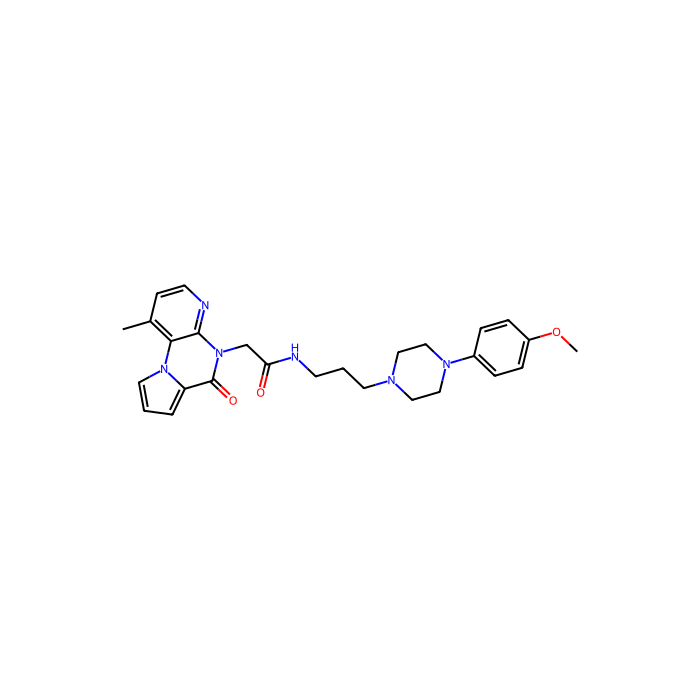
This compound belongs to the class of organic compounds known as phenylpiperazines. These are compounds containing a phenylpiperazine skeleton, which consists of a piperazine bound to a phenyl group.
External Descriptors
Not available
1. Djoumbou Feunang Y, Eisner R, Knox C, Chepelev L, Hastings J, Owen G, Fahy E, Steinbeck C, Subramanian S, Bolton E, Greiner R, and Wishart DS. ClassyFire: Automated Chemical Classification With A Comprehensive, Computable Taxonomy. Journal of Cheminformatics, 2016, 8:61.
Determine the necessary mass, volume, or concentration for preparing a solution.
Dilution Calculator
Determine the dilution needed to prepare a stock solution.
Reconstitution Calculator
レビュー
顧客レビュー
Application Protocols
No tested application protocols are provided in the Product Data for this item.
General, non–item-specific guidance for small-molecule use in assays:
Prepare a sterile-filtered DMSO stock (e.g., 10 mM). Confirm concentration by qNMR or UV–Vis if the extinction coefficient is known.
For cell-based assays, dilute into pre-warmed media to the desired working concentration, maintaining final DMSO typically ≤0.1–0.5% v/v (assay-dependent). Include vehicle controls matched for DMSO content.
For biochemical assays, titrate across at least 10–12 half-log dilutions to capture full dose–response; replicate across independent days.
Store aliquots to minimize freeze–thaw cycles; document lot number and preparation details in ELN/LIMS.
Biological Roles
Item-specific biological targets, pathways, and mechanisms are not provided in the Product Data. Therefore, no claims are made about this compound’s biological activity or selectivity.
General considerations for research small molecules:
Many screening compounds are investigated as chemical probes to perturb a specific protein, pathway, or phenotype in vitro. Prior to such use, confirm identity, purity, and solubility, and establish a concentration–response relationship with proper controls.
Off-target assessment can be important; consider profiling in orthogonal assays or a counterscreen panel if selectivity is critical to your study.
For biochemical assays, verify absence of assay-interfering behavior (e.g., aggregation, fluorescence quenching/inner-filter effects, redox cycling). Techniques include detergent-sensitive activity checks, dynamic light scattering, or using control reporter assays.
Note: This product is supplied strictly for research use only and is not intended for human or veterinary applications.
Buffer Applications
This product is not a buffer reagent. It is a small-molecule research compound and does not constitute a defined buffering system.
Practical guidance (general):
When preparing assay solutions, use a validated buffer (e.g., PBS, HEPES, Tris) appropriate to your biological system, and dissolve the compound first in a miscible organic solvent (often DMSO) before dilution into buffer.
Maintain final organic co-solvent concentrations (commonly ≤0.1–1% v/v) that are compatible with your assay and cell system, if applicable.
Green Alternatives
In the absence of item-specific solubility/compatibility data, solvent choices offer the main leverage for greener practice when preparing and handling small-molecule stocks.
Comparison of common solvents (general guidance):
DMSO
Pros: High solvency power; widely assay-compatible at ≤1% v/v.
Cons: High boiling point; challenging removal; potential to carry water.
Use the minimum organic co-solvent necessary to maintain compound in true solution at working concentration.
Prefer EtOH or aqueous buffer with small DMSO fractions when assay-tolerable.
Consolidate analyses to reduce replicate injections; employ micro-scale preparations to cut solvent use.
Validate stability to enable refrigerated, long-lived stocks and reduce remake frequency.
Pharmaceutical Uses
No pharmacopeial status, excipient role, or manufacturing utility is provided for this item. It is supplied exclusively for research use.
General notes:
Small molecules like this may be evaluated in preclinical research settings as reference compounds or controls, but such use is distinct from any pharmaceutical application. No clinical, therapeutic, or diagnostic claims are made or implied.
If formulating for in vivo research (where permitted by local regulations), establish vehicle compatibility and stability empirically (e.g., DMSO/PEG400/saline mixtures), and document all composition details. This is general guidance only and not item-specific.
Physical Properties
Item-specific physical constants are not provided in the Product Data. Where values are required for method development, please consult the CoA/Spec Sheet or measure experimentally under your lab conditions.
Appearance: Not specified for this item; refer to CoA/Spec Sheet.
Melting point (MP): Not specified for this item; refer to CoA/Spec Sheet. (Literature/measured values, if available, should be cited in internal records.)
Boiling point (BP): Not applicable/rarely reported for research solids; Not specified for this item.
Density: Not specified for this item; refer to CoA/Spec Sheet.
Refractive index: Not applicable unless liquid; Not specified for this item.
pKa/logP/logD: Not specified for this item; consider computing with in silico tools for method planning.
Solubility guidance (general, not item-specific):
Many screening compounds are soluble at 10–50 mM in anhydrous DMSO; aqueous solubility often requires co-solvent (DMSO 0.1–1% v/v) or surfactant (0.01–0.1% w/v).
Evaluate solubility in DMF, MeCN, EtOH, or 1:1 DMSO:water for stock preparation; filter through 0.22 μm prior to use for assay work.
Practical characterization tips (general):
Use DSC for thermal profile; TGA to assess residual solvent/water.
Determine kinetic solubility by incremental dilution into assay buffer; monitor by nephelometry or UV–Vis (provided the compound has chromophores).
Quality and Grades
Grade/Purity: Not specified for this item; refer to CoA/Spec Sheet.
Interpreting grade (general guidance):
“Screening” or “library” grade materials are typically suitable for discovery research, in vitro assays, and method development, with purity often confirmed by LC–MS/UPLC and 1H NMR. If you require high stringency (e.g., bioassay IC50 determination or crystallography), request a recent CoA with detailed chromatographic purity and residual solvent data.
If an HPLC or LC–MS purity is reported on the CoA, note detection wavelength(s) and method—aromatic probes can underreport impurities if only a single UV wavelength is used.
Stabilizers/inhibitors: Not specified for this item. If stability is a concern, ask for inhibitor-free material or evaluate stability by LC–MS after storage.
Batch-specific documentation: We recommend linking experimental results to the batch number on the CoA; retain raw chromatograms/spectra for regulatory or publication support.
Suitability:
Discovery biology/biochemistry assays: verify purity and solubility in assay media.
Analytical reference: confirm identity with orthogonal techniques (MS + NMR) prior to quantitative use.
Reaction and Applications
This product is supplied as a research small molecule standard rather than a synthetic reagent. No manufacturer application notes beyond “For research use only” are provided.
Potential research applications (general, non–item-specific):
Chemical biology assays: Use as a reference compound or hit/control in biochemical or cell-based screening, after confirming identity and purity from the CoA.
Analytical methods: System suitability or retention time marker in LC–MS method development tailored to the compound’s polarity (to be determined experimentally).
Physicochemical profiling: Determine solubility, stability, logD, and permeability to support assay design.
If you intend to use this compound in synthesis:
Without structural information, specific reactivity cannot be advised. Obtain the SMILES/InChI from the CoA and review functional groups to plan protecting-group strategy, chemoselectivity, and stability (acid/base/oxidant sensitivity).
Good practices:
Confirm DMSO stock concentration by quantitative 1H NMR (qNMR) or UV–Vis if the molar absorptivity is known.
Track freeze–thaw cycles; aliquot to minimize variability in bioassays.
Reaction Conditions
No item-specific reaction conditions are applicable because this product is not designated as a reagent for a specific transformation and its structure is not provided in the Product Data.
General notes if transformations are attempted after structure confirmation:
Choose solvent and temperature according to the functional groups identified (e.g., polar aprotic for SNAr on electron-poor heteroaryls; alcoholic solvents for transesterifications; Pd-catalyzed conditions for cross-couplings).
Start with microscale screens (0.01–0.05 mmol) to preserve material while mapping reactivity.
Monitor reactions by LC–MS to detect partial conversions and side products; confirm product identity with MS/NMR.
Prevent dust/aerosol formation; use weigh boats with antistatic precautions for fine powders.
First-aid overview (general):
Inhalation: Move to fresh air; seek medical attention if symptoms occur.
Skin/eyes: Rinse with water for at least 15 minutes; remove contaminated clothing; obtain medical advice as needed.
Ingestion: Rinse mouth; do not induce vomiting; seek medical attention.
Incompatibilities (general): Strong oxidizers and strong acids/bases may cause decomposition for many organics; segregate accordingly.
Environmental precautions: Avoid release to the environment; collect waste in properly labeled organic waste containers.
Research Use Note: For research use only; not for human or veterinary use.
Always defer to the SDS and your institutional EHS requirements for storage, spill response, and disposal procedures.
Solvent Selection
Item-specific solvent compatibility and solubility are not provided. The following is general, assay-focused guidance for small-molecule library compounds:
Primary stock solvent: Anhydrous DMSO is the default for many hydrophobic research compounds. Start with 10 mM stock; adjust up to 50–100 mM if fully soluble and chemically stable.
Secondary solvents for method development:
Polar aprotic: DMF, NMP, MeCN can improve solubility; verify assay compatibility and cytotoxicity if used in biological systems.
Protic: EtOH or i-PrOH can aid co-solubilization with aqueous media.
Aqueous work: Use co-solvent strategies (0.1–1% DMSO v/v) or solubilization aids (0.01–0.1% Tween 80 or Pluronic F-127) as permitted by your assay.
Chromatography: For preparative/analytical LC, gradient mixes of MeCN/H2O or MeOH/H2O with 0.1% formic acid (or ammonium formate/acetate for MS) are typical. Optimize based on observed retention and peak shape.
Decision tips:
Choose DMSO when maximum solubility and chemical stability are priorities.
Choose MeCN for LC–MS-friendly methods with low viscosity and volatility advantages.
Prefer MeOH/H2O when UV transparency and benign toxicity profile are desired.
Note: Verify compound stability in chosen solvent by short- and mid-term LC–MS checks (0 h, 24 h, 1 week at intended storage temperature).
Storage and Reconstitution
Storage Conditions (from Product Data): Store at 2–8°C.
Shipping: Shipped on wet ice (from Product Data).
Stability: Item-specific stability data are not provided; refer to CoA/Spec Sheet and SDS. As a general practice, protect from light and moisture to minimize degradation.
General reconstitution guidance (not item-specific):
Allow the container to equilibrate to room temperature in a desiccator before opening to prevent moisture condensation.
Prepare concentrated stocks in dry DMSO (e.g., 10–50 mM) unless otherwise indicated by the CoA. Vortex and, if needed, sonicate briefly to aid dissolution.
If particulate remains, warm gently (≤40°C) and/or filter through a 0.22 μm PTFE or PVDF syringe filter.
Aliquot stocks into low-bind microtubes to avoid repeated freeze–thaw; store refrigerated (2–8°C) for short term or frozen (−20 to −80°C) if stability permits (verify by LC–MS over time).
Document preparation date, solvent, and concentration on the vial label and in your ELN/LIMS.
Note: For any deviations (e.g., aqueous-only solubility, light sensitivity), follow the specific instructions on the CoA/Spec Sheet for this lot.
Structure and Identity
A research-use small molecule reference standard from Aladdin Scientific.
Product Name (Aladdin): ML 190
SKU: M287902
CAS: 1355244-02-8
PubChem CID: 44665680
InChIKey (from Product Data): 281610
SMILES: Not specified for this item; refer to CoA/Spec Sheet.
Molecular Formula: Not specified for this item; refer to CoA/Spec Sheet.
Molecular Weight: Not specified for this item; refer to CoA/Spec Sheet.
Structural description (general):
Item-specific structural features are not provided in the Product Data. For definitive atom connectivity, functional groups, and stereochemistry, please consult the Certificate of Analysis (CoA), Spec Sheet, or primary database entry linked to the CAS/CID above.
As supplied, this listing is part of a small-molecule/compound library category; such entities typically comprise heteroatom-containing scaffolds (e.g., aryl/heteroaryl cores, amide/urea/carbamate linkages, or saturated rings). This is general background, not item-specific.
Verify by high-resolution MS (exact mass), 1H/13C NMR, and, if needed, 2D NMR (HSQC/HMBC) after obtaining structural data from the CoA/Spec Sheet.
Orthogonal checks: LC–MS retention time versus internal standard; IR functional group survey; melting behavior (if solid).
Synthetic Utility
This product is intended as a research-standard small molecule rather than a synthetic building block. Without an item-specific structure, detailed retrosynthetic or functional-group guidance cannot be provided.
General strategy if derivative synthesis is planned (after obtaining structure from CoA/Spec Sheet):
Map reactive handles (e.g., halides, aryl nitro, anilides, amides, sulfonamides, heteroaryl positions) for diversification via cross-coupling or nucleophilic substitution.
Assess stability to acid/base, oxidants/reductants, and hydrogenation to plan protection/deprotection.
Consider late-stage functionalization tactics (C–H activation, photoredox) if aromatic or heteroaromatic cores are present.
Use LC–MS-guided parallel synthesis for rapid SAR around the parent scaffold once the structure is confirmed.
Analytical best practices:
Track by UPLC with photodiode array (PDA) and MS; retain time-aligned MS spectra for impurity assignment.
Confirm structures of key derivatives by 2D NMR and HRMS.
Target Specificity
No target, epitope, or binding specificity is provided in the Product Data for this item. Therefore, no claims are made regarding molecular targets, potency, or selectivity.
For users requiring target information:
Consult the CoA/Spec Sheet and primary literature associated with the CAS or PubChem CID listed.
Independently verify any reported activity with orthogonal assays and appropriate positive/negative controls.
よくある質問
What is the purity of this product, and how is it determined?
This product is supplied at ≥98% purity, determined by HPLC. Lot-specific values are stated on the Certificate of Analysis.
How should this product be stored?
Store at 2–8 °C. Refrigerated storage is required to maintain the specified shelf life.
How is this product shipped?
This product ships chilled on wet ice. Unpack on arrival and transfer it to the storage condition stated above.
What are the CAS number, molecular formula and molecular weight?
The CAS Number is 1355244-02-8, the molecular formula is C27H32N6O3, and the molecular weight is 488.58 g/mol. InChIKey PMTIWRPLQBVEMR-UHFFFAOYSA-N.
What documentation is provided?
Available product documentation, including Certificates of Analysis (COA), Safety Data Sheets (SDS), and specification sheets, is shown in the product document area. Document availability and access follow the current site policy.
Products are supplied to verified businesses, institutions, and qualified professionals for research and development use only. Not for use in humans, animals, diagnosis, or therapy.