This compound belongs to the class of organic compounds known as phenylmethylamines. These are compounds containing a phenylmethtylamine moiety, which consists of a phenyl group substituted by an methanamine.
External Descriptors
Not available
1. Djoumbou Feunang Y, Eisner R, Knox C, Chepelev L, Hastings J, Owen G, Fahy E, Steinbeck C, Subramanian S, Bolton E, Greiner R, and Wishart DS. ClassyFire: Automated Chemical Classification With A Comprehensive, Computable Taxonomy. Journal of Cheminformatics, 2016, 8:61.
Determine the necessary mass, volume, or concentration for preparing a solution.
Dilution Calculator
Determine the dilution needed to prepare a stock solution.
Reconstitution Calculator
レビュー
顧客レビュー
Application Protocols
No biology assay protocols (WB, IHC, IF, FC) are applicable to this small-molecule reagent. For synthetic applications, see the Reaction Conditions and Synthetic Utility sections for step-by-step guidance.
Biological Roles
This product is supplied for research use only and is primarily a synthetic building block. No specific biological role is assigned.
General considerations (literature, not item-specific):
Protonated secondary amines behave as cationic species at physiological pH and can engage in ionic interactions with biomolecules (e.g., carboxylates, phosphates). The benzyl group can facilitate hydrophobic interactions, while the cyclohexyl ring increases lipophilicity.
Such cationic amphiphiles are sometimes used as reference amines in studies of membrane partitioning, micelle formation, or ion-pair chromatography; however, N-benzylcyclohexanamine HCl is not a recognized endogenous metabolite or cofactor.
If biological assays are planned (e.g., as a comparator in binding/partitioning studies), confirm purity, counterion content, and pH of working solutions; avoid interpreting outcomes as therapeutic effects.
Buffer Applications
Not typically used as a buffering agent. Secondary amine hydrochlorides do not constitute defined buffer systems over a broad pH range. If a buffered aqueous solution is needed (e.g., to maintain pH while dissolving the salt), use a conventional buffer (phosphate, acetate, HEPES) and add the compound as a solute.
Green Alternatives
Opportunities to improve the sustainability profile center on solvent/base choices and process design rather than changing the amine itself.
Greener choices (literature/general):
Liberation of free base:
Prefer aqueous NaHCO3/Na2CO3 over NaOH to minimize corrosivity and heat generation; extract with greener ethers (MTBE) instead of DCM/Et2O when feasible.
Acylation/alkylation media:
Replace chlorinated solvents (DCM) with 2-methyltetrahydrofuran (2-MeTHF), cyclopentyl methyl ether (CPME), or toluene when compatible.
Consider MeCN or ethanol for SN2 alkylations; MeCN offers good polarity with manageable environmental profile.
Reductive amination:
Use NaBH(OAc)3 in acetic acid/EtOH or catalytic hydrogenation in EtOH/MeOH as alternatives to cyanoborohydride in aprotic solvents.
Workup/waste:
Salt-switch crystallizations (e.g., formate/acetate) can avoid halogenated solvent extractions.
Comparison (general guidance):
DCM vs 2-MeTHF/CPME:
2-MeTHF/CPME: lower environmental impact, higher boiling points (useful for process), but can retain peroxides—monitor as per SOP.
DCM: excellent selectivity and handling, but chlorinated and higher EHS burden.
Et2O vs MTBE:
MTBE: safer flash point, lower peroxide rate than ethers like THF; good for basification extractions.
Trade-offs: Greener solvents may change reaction rates/solubilities. Conduct small-scale screens to confirm performance before scale-up.
Pharmaceutical Uses
No pharmacopeial grade or excipient role is specified for this item; refer to CoA/Spec Sheet.
General process-chemistry context (literature):
Secondary amines are common intermediates in API synthesis and salt screening. The hydrochloride salt is often selected for stability, crystallinity, and manageable handling (reduced volatility/odor vs. the free base).
In medicinal chemistry workflows, the HCl salt can facilitate purification (ion-exchange, crystallization) and enable precise dosing in structure–activity studies; however, this product is not offered for clinical use.
Note: For any GMP or clinical manufacturing, dedicated qualification, impurity profiling (including residual chloride, solvents, metals), and regulatory-grade documentation are required; this listing is for research use only.
Physical Properties
Item-specific specifications are not provided in the Product Data; values below are general/literature guidance for the hydrochloride salt and should not be treated as product specifications.
Appearance: Not specified for this item; refer to CoA/Spec Sheet. (Amines as HCl salts are commonly crystalline solids in literature.)
Melting point (literature, analogous benzylamine HCl salts): often high-melting solids; specific MP for this salt not located in standard compilations. Not specified for this item; refer to CoA/Spec Sheet.
Boiling point: Not applicable to the hydrochloride salt (decomposes before boiling); the free base would be distillable. Not specified for this item; refer to CoA/Spec Sheet.
Density: Not specified for this item; refer to CoA/Spec Sheet.
Solubility (literature, general):
Water: typically freely soluble for secondary amine hydrochlorides due to ionic character.
Alcohols (MeOH, EtOH), polar aprotic (DMF, DMSO): generally soluble.
Nonpolar solvents (hexanes, toluene): poorly soluble as the salt; free base is more soluble.
pKa (literature, general): conjugate acid (R2NH2+) of benzylic secondary amines pKa ~10–11 in water; exact pKa for this salt not specified.
LogP/logD (literature, general trends): ionized HCl salt exhibits low logD in water; the neutral free base would have higher lipophilicity due to cyclohexyl and benzyl groups.
Refractive index: Not applicable to salt in solid state; not specified for this item.
Always verify application-critical parameters on the actual CoA/Spec Sheet for SKU N770818.
Quality and Grades
Grade/Purity: Not specified for this item; refer to CoA/Spec Sheet.
Appearance: Not specified for this item; refer to CoA/Spec Sheet.
Interpretation and practical guidance (general):
Amines are frequently supplied as hydrochloride salts to improve stability, reduce odor/volatility, and afford accurate weighing. The HCl form typically has lower residual free base than the corresponding neat amine and is less prone to oxidative discoloration.
If HPLC/LC-MS use is intended, verify UV cut-off, residual inorganic content (e.g., chloride), and amine-related background on the CoA; low-UV or LC-MS grades are optimized for chromatographic baselines and ionization performance.
For synthesis, typical acceptance criteria include identity (1H/13C NMR of the free base after basification or of the salt), assay/w% by titration or qNMR, and limits on water (KF) and inorganic chloride if relevant to downstream steps. Because none of these are specified here, consult the batch-specific CoA.
Stabilizers: None stated for this item. If stabilizers are a concern (e.g., to suppress oxidation), confirm “additive-free” status on the CoA.
Trace metals/UV cutoff/peroxide: Not specified for this item; refer to CoA/Spec Sheet.
Tip: When exact stoichiometry is critical, base-equivalent calculations should use the free-base content from the CoA (salt-to-base conversion for C13H20NCl → C13H19N).
Reaction and Applications
This secondary amine (provided as its HCl salt) is a versatile building block. Common research uses (literature/general for N-benzyl secondary amines):
Salt-to-base interconversion: The HCl salt is a stable, weighable form. Prior to use in most organic reactions, liberate the free base with aqueous base and extract into an organic solvent. Quantify free-base content for accurate stoichiometry.
N-Acylation and carbamoylation: The free base reacts with acyl chlorides/anhydrides or chloroformates to form amides or carbamates. Use non-nucleophilic bases (Et3N, DIPEA) in CH2Cl2 or THF; add acylating agent slowly to control exotherm.
Reductive amination partner: Useful as the amine component to form tertiary amines via imine/enamine formation followed by reduction (e.g., NaBH3CN, NaBH(OAc)3, or catalytic H2). The benzyl and cyclohexyl groups impart lipophilicity to resulting scaffolds.
Alkylation (tertiary amine formation): SN2 alkylation with alkyl halides/tosylates in MeCN/DMF and K2CO3 or Cs2CO3 affords tertiary amines; avoid overalkylation to quaternary ammonium unless desired.
Quaternization: Reaction with methyl iodide or benzyl bromide generates quaternary ammonium salts; useful for PTC-like applications or as intermediates.
Hydrogenolysis/debenzylation: Secondary N–benzyl bonds can sometimes be cleaved under forcing catalytic hydrogenation (Pd/C, H2), though selectivity and feasibility are substrate-dependent; this is more challenging than for N-benzyl primary amines—evaluate literature precedents before planning.
Coordination/templating: As a bident lipophilic cation (upon protonation), it may be leveraged in phase-transfer or ion-pair strategies (general concept).
Practical tips:
Keep reactions anhydrous once the free base is generated; dry glassware and solvents.
Monitor by TLC or LC-MS; amines show strong response with mass-spec ESI (+) and UV at low wavelengths (if aromatic).
Reaction Conditions
General literature guidance for transforming N-benzylcyclohexanamine (generated from the HCl salt). Adjust to your substrate and scale; these are not product specifications.
Liberating the free base:
Dissolve the HCl salt in water (or 1:1 MeOH/H2O), cool if necessary, and add saturated NaHCO3 or 1 M Na2CO3 until pH > 10. Extract 3× with MTBE or Et2O, dry (Na2SO4), concentrate under reduced pressure. Typical recovery: near quantitative for small scale.
N-Acylation (amide formation):
Solvent: CH2Cl2 or THF (anhydrous). Base: Et3N or DIPEA (2–3 equiv). Temperature: 0 °C to rt. Time: 0.5–4 h. Monitor by TLC/LC-MS. Workup: aqueous NH4Cl then bicarbonate wash.
Conditions B: Catalytic hydrogenation (Pd/C, 5–10 wt%, 1–5 bar H2) in EtOH/MeOH at rt–40 °C, 2–8 h, for preformed imines.
Alkylation to tertiary amines:
Solvent: MeCN or DMF; base: K2CO3 or Cs2CO3 (2–3 equiv); electrophile: primary alkyl halide (1.1–1.5 equiv); temp: rt–60 °C; time: 2–24 h.
Quaternization:
Solvent: MeCN/acetone/toluene; alkyl halide (e.g., MeI, BnBr, 1.1–2.0 equiv); temp: rt–50 °C; time: 1–24 h. Product may precipitate.
Notes:
Drying: Thoroughly dry the free base and solvents; amines can sequester water and CO2.
Stoichiometry: If using the HCl salt directly in biphasic reactions, add a base (Na2CO3/Et3N) in situ to neutralize and free the amine.
Analytical: ESI(+)-MS readily detects [M+H]+ of the free base (m/z ~190, literature).
Safety and Handling
GHS classification, signal word, H-statements, pictograms: Not specified for this item; refer to the product SDS for authoritative hazard classification.
General hazards (literature/generic for amine hydrochlorides):
May cause skin and eye irritation; dust can irritate respiratory tract.
Being an ammonium salt, it is non-volatile compared to the free base, reducing inhalation of vapors but increasing dust exposure potential.
Recommended PPE and controls (good laboratory practice):
Handle powders in a fume hood or ventilated enclosure to minimize dust; avoid inhalation.
Incompatibilities and reactive hazards (general):
Strong bases liberate the free amine and HCl; exotherm possible on neutralization.
Avoid contact with strong oxidizers. Amines can undergo N-oxidation under harsh conditions.
For salt formation/cleavage steps, control pH to avoid over-acidification or excessive basicity.
First-aid overview (consult SDS for details):
Inhalation: move to fresh air; seek medical attention if symptoms persist.
Skin/eye contact: rinse with water for several minutes; remove contaminated clothing; seek medical advice for persistent irritation.
Ingestion: rinse mouth; do not induce vomiting; seek medical attention.
Fire safety (general):
Organic salts are combustible; use water spray, CO2, dry chemical, or foam. Thermal decomposition can release HCl and nitrogen oxides.
Always defer to the SDS for SKU N770818 for definitive hazard and response information.
Solvent Selection
N-Benzylcyclohexanamine hydrochloride is an ionic organic salt; solvent choice depends on whether you use the salt directly or first liberate the free base.
Polarity/miscibility (literature, general):
Salt form: readily soluble in water and polar protic solvents (MeOH, EtOH); soluble in highly polar aprotic solvents (DMSO, DMF); sparingly soluble in nonpolar media.
Free base: far more soluble in nonpolar/aprotic organic solvents (Et2O, MTBE, toluene, CH2Cl2, THF) and less soluble in water at neutral pH.
Typical workflows:
Aqueous-phase use: dissolve the HCl salt in water or MeOH/H2O mixtures; adjust pH as needed.
Organic-phase synthesis: basify an aqueous solution of the salt (NaHCO3/Na2CO3/NaOH), extract the free base into an organic solvent, dry, and use in situ.
Selection guidance (practical):
For acylations/carbamoylations: CH2Cl2, THF, or toluene with a base (Et3N, DIPEA) after generating the free base.
For SN2 alkylation to tertiary amines: polar aprotic solvents (MeCN, DMF) with mild inorganic base (K2CO3) and the free base.
For quaternization: MeCN, acetone, or toluene with alkyl halides; monitor for salt precipitation.
Small comparison (literature/general):
Water/MeOH: best for handling the salt; easy cleanup; ideal for salt–free base interconversion.
DCM/THF/toluene: preferred once the free base is generated for many organic reactions.
DMSO/DMF: maximize solubility for challenging couplings but harder workup.
Storage and Reconstitution
Storage conditions (from Product Data): Room temperature. Store tightly closed in a dry environment, protected from excessive humidity.
Shipping (from Product Data): Shipped under normal conditions.
Stability (general): Amines as HCl salts are typically stable solids at ambient temperature. Avoid prolonged exposure to air and moisture to prevent caking and variable water content.
Aqueous: Dissolve directly in deionized water to make stock solutions; adjust pH if necessary. Filter sterilize (0.22 µm) for biological assays (research use only).
Organic: Readily soluble in MeOH, EtOH, and polar aprotic solvents (DMSO, DMF). For nonpolar solvents, first convert to the free base.
Typical lab stock concentrations: 10–100 mg/mL (verify solubility in chosen solvent). Prepare fresh as needed or store aliquots to minimize freeze–thaw/evaporation cycles.
Container and handling: Use glass or compatible plastic. For hygroscopic behavior (possible for amine HCl salts), promptly recap after use and, if needed, store with desiccant.
Disposal: Follow institutional and local regulations for amine-containing organic salts; neutralize acids/bases in a controlled manner prior to disposal if performing salt/base conversions.
Note: For any application-sensitive parameters (water content, residual solvents, assay), consult the batch-specific CoA/Spec Sheet for SKU N770818.
Structure and Identity
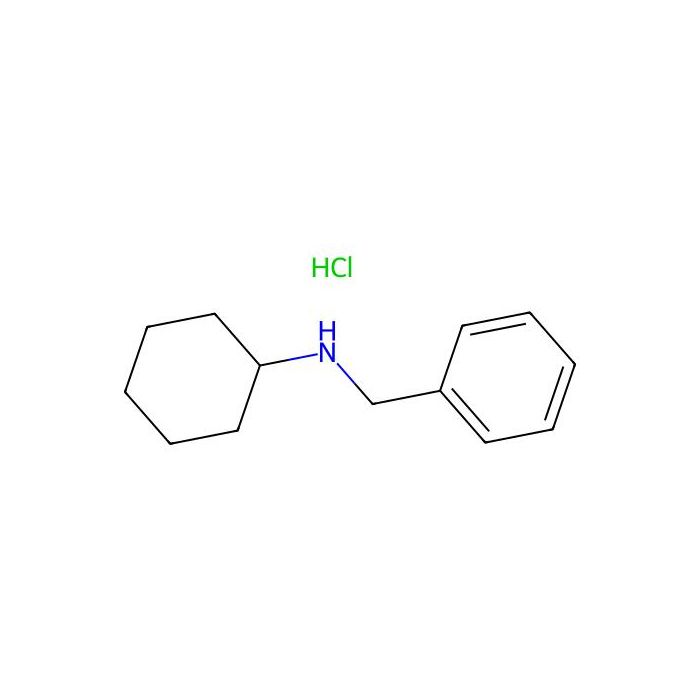
N-Benzylcyclohexanamine hydrochloride is the protonated hydrochloride salt of the secondary amine N-benzylcyclohexanamine.
Item-specific identifiers (from Product Data):
CAS: 16350-96-2
CID: 204462
InChIKey: 172592 (format atypical; consult CoA/SDS for the canonical identifier)
SMILES: Not specified for this item; refer to CoA/Spec Sheet.
Molecular formula and mass (literature, for the HCl salt):
A secondary amine nitrogen bearing two substituents: a benzyl group (–CH2–C6H5) and a cyclohexyl group (–C6H11), plus one N–H. In the hydrochloride, the amine is protonated (ammonium), paired with Cl−.
Aromatic ring: monosubstituted phenyl (benzyl) providing a benzylic methylene adjacent to nitrogen.
No stereogenic centers; the compound is achiral as a salt of an achiral secondary amine.
2D structure in words: A central ammonium nitrogen [NH2+ in the salt] connected to (i) a methylene that leads to a phenyl ring and (ii) a cyclohexyl ring, with chloride as counterion.
Notes: Where precise identifiers (e.g., standardized InChI/SMILES) are required for registration or cheminformatics, consult the product CoA/SDS or regenerate from authoritative databases for CAS 16350-96-2.
Synthetic Utility
Functional group: secondary amine (benzylic). Key reactivity and value in synthesis (literature/general):
As a nucleophile: Reacts with acyl electrophiles (acid chlorides/anhydrides) to deliver amides; with chloroformates to give carbamates/urethanes.
As a base: Mild Brønsted base in non-aqueous media; can catalyze certain condensations (though tertiary amines are more common).
Reductive amination: Serves as the amine coupling partner to generate tertiary amines with tailored lipophilicity; benzylic character can enhance reactivity in iminium formation.
SN2 alkylation: Formation of tertiary amines with primary alkyl halides/tosylates; careful control to avoid quaternization unless desired.
Quaternary ammonium synthesis: Access to permanent cations for surfactant-like materials or PTCs by alkylation.
Protecting-group logic: While N-benzyl groups on primary amines are classically hydrogenolyzed, N–benzyl on secondary amines is more resistant; nonetheless, strategic hydrogenolysis or oxidative cleavage can sometimes deprotect to cyclohexylamine under forcing conditions—plan with literature precedent.
Retrosynthetic utility: The N-benzylcyclohexyl motif appears in diverse scaffolds; the amine HCl enables convergent assembly via coupling of benzyl electrophiles with cyclohexylamine or via reductive amination of benzaldehyde with cyclohexylamine, followed by salt formation.
Advantages of the HCl salt: solid handling, accurate weighing, and improved shelf stability versus the free base; straightforward conversion to other salts (acetate, sulfate) if needed for crystallization engineering.
Target Specificity
Not an antibody, enzyme, or affinity reagent. No target specificity information applies to this small-molecule building block.
よくある質問
What is the purity of this product?
This product is supplied at ≥95% purity (chemical assay). Lot-specific values are stated on the Certificate of Analysis.
How should this product be stored?
Store at room temperature.
How is this product shipped?
This product ships under standard ambient conditions. No temperature-controlled packaging is required.
What are the CAS number, molecular formula and molecular weight?
The CAS Number is 16350-96-2, the molecular formula is C13H20ClN, and the molecular weight is 225.76 g/mol. InChIKey JXIRAQIPRWLSTD-UHFFFAOYSA-N.
What documentation is provided?
Available product documentation, including Certificates of Analysis (COA), Safety Data Sheets (SDS), and specification sheets, is shown in the product document area. Document availability and access follow the current site policy.
Products are supplied to verified businesses, institutions, and qualified professionals for research and development use only. Not for use in humans, animals, diagnosis, or therapy.

 J2608669