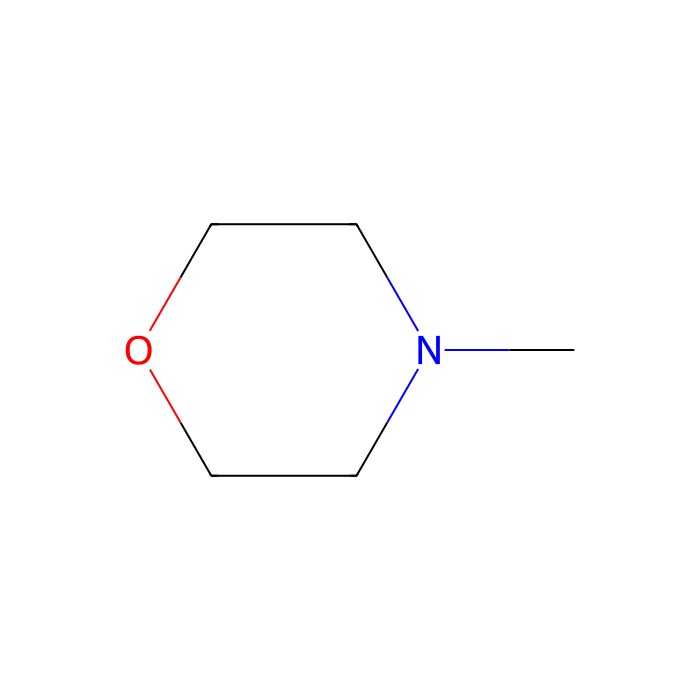
N-Methyl morpholine - Distillation grade, ≥99.5% , CAS No.109-02-4

CAS: 109-02-4 Cat. No.: M104643 分子式: C5H11NO 分子量: 101.15 Beilstein Registry Number: 102719 EC番号: 203-640-0
注文可能
GRADE & PURITY Distillation grade ? Distillation grade — purified by/for distillation with controlled volatile profile. Use where distillation behavior and low residue are important. ≥99.5%
Synonyms
4-Methylmorpholine, ReagentPlus(R), 99% | STL294217 | N-methyimorpholine | 4-methymorpholine | N-Methyl morphofine pound>>Morpholine, 4-methyl- | SCHEMBL4622 | 4-Methylmorpholine, BioXtra, suitable for protein sequencing, >=99.5% (GC) | N-methylmorphline
Storage
Protected from light,Room temperature
Shipped In
FedEx DG Service
★
Size
USA
ドイツ (EU)*
Price
Qty
100ml
M104643-100ml
5 在庫あり
—
$49.90
500ml
M104643-500ml
在庫あり ≥10
5 在庫あり

$141.90

$169.90
保存 $28.00 (16.48%)
Enter a quantity for the sizes you want to add.
🧪
Why this grade

Distillation grade, ≥99.5% Distillation grade for sensitive chromatographic and analytical workflows requiring minimal baseline interference.

🌡

Storage & shipping

Protected from light,Room temperature Ships FedEx DG Service Check lot-specific COA for exact specifications.

📋

Quality documents

SDS, COA, datasheet, and spec sheet available for download. Lot-specific COA accessible via lot number lookup.

📚

Literature proof

Cited in 69 peer-reviewed publications across chromatography, organic synthesis, and cross-coupling reactions.

概要

product describtion:

N-Methylmorpholine is a morpholine-containing compound used for protein sequencing analysis
4-Methylmorpholine is an economical cation useful for the preparation of morpholinium cation-based ionic liquids. The experimental FT-IR and FT-Raman spectra of 4-methylmorpholine has been recorded over the range 4000-400cm-1 and 3500-100cm-1 respectively. It undergoes fluorination with cobalt(III) fluoride to afford highly fluorinated morpholines, which were characterized by mass and NMR spectroscopy.


Product Application:
4-Methylmorpholine may be used in the preparation of N-ethyl-N-methylmorpholinium bis(trifluoromethanesulfonyl)imide.A morpholine-containing compound used for protein sequencing analysis

Specifications

同義語
4-Methylmorpholine, ReagentPlus(R), 99% | STL294217 | N-methyimorpholine | 4-methymorpholine | N-Methyl morphofine pound>>Morpholine, 4-methyl- | SCHEMBL4622 | 4-Methylmorpholine, BioXtra, suitable for protein sequencing, >=99.5% (GC) | N-methylmorphline
仕様と純度
Distillation grade, ≥99.5%
保管条件
Protected from light,Room temperature
入荷
FedEx DG Service
等級
Distillation grade
純度
≥99.5%
名前と識別子
パブケム・シド
カノニカル・スマイル
CN1CCOCC1
IUPAC Name
4-methylmorpholine
InChIKey
SJRJJKPEHAURKC-UHFFFAOYSA-N
INCHI
1S/C5H11NO/c1-6-2-4-7-5-3-6/h2-5H2,1H3
異性体SMILES
CN1CCOCC1
WGKドイツ
1
RTECS
QE5775000
UN番号
2535
包装グループ
II
分子量
101.15
Beilstein
102719
Reaxy-Rn
102719
Reaxys-RN_link_address
https://www.reaxys.com/reaxys/secured/hopinto.do?context=S&query=IDE.XRN=102719&ln=

Documentation

📋 Safety Data Sheet (SDS)

Comprehensive hazard, handling, storage, and regulatory compliance document.

Download SDS →

✅ Certificate of Analysis (COA)

Lot-specific quality data. Enter your lot number to retrieve the exact COA.

Look up COA →

📊 Datasheet

Quick-reference summary of product specifications and applications.

View datasheet →

🔬 Specification Sheet

Full quality attributes and acceptance criteria for this grade.

View spec sheet →

Advanced Data

Taxonomic Classification

Taxonomy Tree

KingdomOrganic compounds
SuperclassOrganoheterocyclic compounds
分類Oxazinanes
SubclassMorpholines
Intermediate Tree Nodes Not available
Direct ParentMorpholines
Alternative Parents Trialkylamines  Oxacyclic compounds  Dialkyl ethers  Azacyclic compounds  Organopnictogen compounds  Hydrocarbon derivatives  
Molecular FrameworkAliphatic heteromonocyclic compounds
Substituents Morpholine - Tertiary aliphatic amine - Tertiary amine - Oxacycle - Azacycle - Ether - Dialkyl ether - Organic nitrogen compound - Organic oxygen compound - Organopnictogen compound - Hydrocarbon derivative - Organooxygen compound - Organonitrogen compound - Amine - Aliphatic heteromonocyclic compound
説明This compound belongs to the class of organic compounds known as morpholines. These are organic compounds containing a morpholine moiety, which consists of a six-member aliphatic saturated ring with the formula C4H9NO, where the oxygen and nitrogen atoms lie at positions 1 and 4, respectively.
External Descriptors Not available
3 D構造
インタラクティブ化学構造モデル


作用メカニズム
証明書(CoA、COO、BSE/TSEと分析図)
C of A & Other Certificates(BSE/TSE, COO):
Analytical Chart:

Find and download the COA for your product by matching the lot number on the packaging.

14 results found

Lot NumberCertificate Type日付商品
D2602181Certificate of AnalysisMar 10, 2026 M104643
B2625061Certificate of AnalysisMar 04, 2026 M104643
L2122539Certificate of AnalysisOct 11, 2025 M104643
I2502215Certificate of AnalysisAug 04, 2025 M104643
L2417271Certificate of AnalysisDec 09, 2024 M104643
L2417272Certificate of AnalysisDec 09, 2024 M104643
G2321858Certificate of AnalysisJul 14, 2023 M104643
G2321875Certificate of AnalysisJul 14, 2023 M104643
G2321885Certificate of AnalysisJul 14, 2023 M104643
D23181238Certificate of AnalysisApr 10, 2023 M104643
D23181259Certificate of AnalysisApr 10, 2023 M104643
B1926128Certificate of AnalysisDec 12, 2022 M104643
K2216269Certificate of AnalysisJun 15, 2022 M104643
L2122533Certificate of AnalysisNov 30, 2021 M104643
化学的性質と物理的性質
溶解度Miscible with water, soluble in benzene.Dissolved in ether, methanol
感度Light sensitive.
屈折率1.4332
引火点(°C)12℃
沸点(°C)111-114°C
融点(°C)-65°C
分子量101.150 g/mol
XLogP3-0.300
Hydrogen Bond Donor Count0
Hydrogen Bond Acceptor Count2
Rotatable Bond Count0
Exact Mass101.084 Da
Monoisotopic Mass101.084 Da
Topological Polar Surface Area12.500 Ų
Heavy Atom Count7
Formal Charge0
Complexity50.000
Isotope Atom Count0
Defined Atom Stereocenter Count0
Undefined Atom Stereocenter Count0
Defined Bond Stereocenter Count0
Undefined Bond Stereocenter Count0
The total count of all stereochemical bonds0
Covalently-Bonded Unit Count1
よくある質問と記事
Distillation Grade Reagents: Definition, Quality Control and Representative Aladdin Products
Why Do So Many Molecules Incorporate an “Oxadiazole Ring”? A Stability-Oriented Design Guide from Structural Effects to Application Storylines (with Product Navigation Tables 1–3)
β-Acyloxy Alkenyl Amides (AAAs): A New Approach to Amide Bond and Peptide Bond Construction Worth Attention
Understanding ATD-DMAP: From Reagent Design to Esterification, Amidation, and Stereochemical Integrity
A New Balance in Coupling Reagents: How DMT-TU Balances Reactivity, Racemization Control, and Thermal Hazard
The Positioning of TBTU in Practice: Racemization Risk, Extended Uses, and Selection Criteria
The Methodological Value of HATU in Difficult Couplings: Reactivity Advantages, Stereochemical Retention, and Condition Management
The Methodological Value of Boc-Oxyma: Low-Racemization Coupling, Route Continuity, and Extended Applications
Low Racemization in Peptide Synthesis Is Not Just About Reagent Choice: Stereochemical Risk During the Activation Stage and Practical Strategies for Experimental Control
The Methodological Value of TCFH: Advantages in Challenging Amidation and the Switching Logic of Carboxylic Acid Activation Pathways
Decision Logic for Peptide Synthesis Routes: Applicability and Criteria for Choosing among SPPS, LPPS, and Recombinant Expression
Decision Logic for Selecting Coupling Reagents in Amide Bond Formation: Activation Pathways, Side Reactions, Epimerization, Workup, and Safety
Experimental Selection Logic for Carboxylic Acid Preactivation Pathways: Differences and Suitable Use Cases for Classical Mixed Anhydrides, CDI, Sulfonyl Chloride Systems, and the Yamaguchi System
Boc₂O Selection Cannot Be Judged by Protection Installation Alone: Experimental Decision-Making from Substrate Nucleophilicity and Medium Effects to Deprotection Pathways
DMAP Is More Than Just an Organic Base: Experimental Judgment from Nucleophilic Acyl Transfer to Esterification and Macrolactonization
Experimental Evaluation of Triphosgene in Organic Synthesis: Understanding Its Selection Logic Through Reaction Tasks
Experimental Judgment for TFPN in Carboxylic Acid Activation: Suitable Scenarios, Intermediate Distribution, and Nucleophile Compatibility
Selective Acylation of Less Reactive Amines in Complex Substrates: Strategies for N/O and N/N Selectivity Control This article draws on the work of Li et al. on the TCFH/catalytic Oxyma system and transient imine protection, and summarizes design strateg
How to Troubleshoot Abnormal Impurities in Peptide Synthesis? Locating Process Issues Through Amino-Related Side Reactions
Peptide Intermediates Difficult to Dissolve and Separate? Route Design and Workup Strategies for Tag-Assisted Liquid-Phase Peptide Synthesis (TAG-LPPS)
AITF-Mediated Carboxylic Acid Activation for the Synthesis of Amides, Peptides, and Esters: Activation Mechanism and Applicable Scenarios
Formation and Control of Carboxyl- and Hydroxyl-Related Impurities in Peptide Synthesis — Using Asp/Glu and Ser/Thr Residue Side Reactions as Examples
Logic for Selecting Amidation Reagents in Aqueous Media: Competing Reactions, Activated Intermediates, and Substrate Effects
How to Select Morpholine Intermediates: From Connection Sites and Target Bond Types to Synthetic Route Design
Citations of This Product
ソリューション計算機
レビュー

顧客レビュー

Shall we send you a message when we have discounts available?

Remind me later

Thank you! Please check your email inbox to confirm.

Oops! Notifications are disabled.