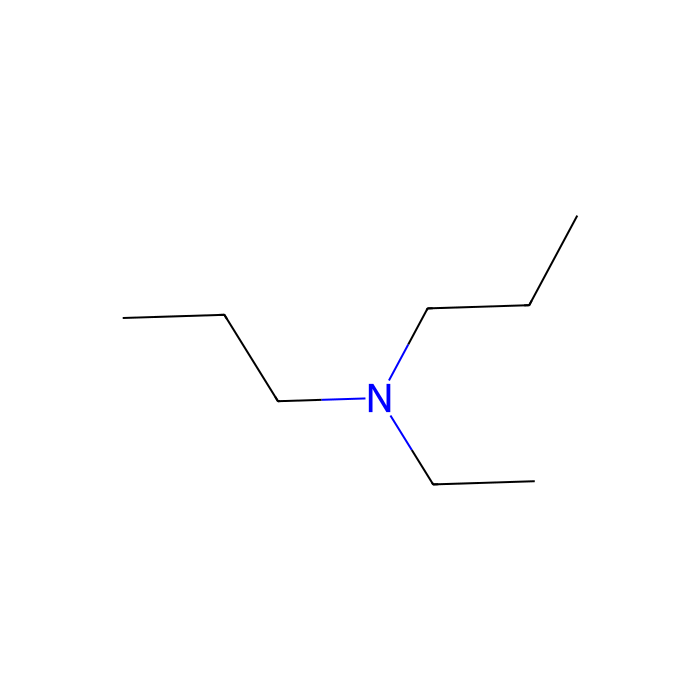
N,N-Dipropylethylamine - ≥98%(GC) , CAS No.20634-92-8

CAS: 20634-92-8 Cat. No.: N159018 分子式: C8H19N 分子量: 129.25 EC番号: 805-813-1
注文可能
グレード&純度 ≥98%(GC)
Synonyms
ethyl dipropylamine|EtNPr2|N-Ethyl-n-propyl-1-propanamine #|Ethyldi-n-propyl amine|Di-N-propylethylamine|n-ethyldipropylamine|1-Propanamine, N-ethyl-N-propyl-|N,N-Dipropylethylamine|dipropylethylamine|ethyl di-n-propyl amine|N-ethyl-N-propylpropan-1-amine
Storage
Argon charged,Room temperature
Shipped In
Normal
★
サイズ
USA
ドイツ (EU)*
価格
個数
1ml
N159018-1ml
5 在庫あり
3 在庫あり
$19.90
5ml
N159018-5ml
在庫あり ≥10
4 在庫あり
$75.90
25ml
N159018-25ml
5 在庫あり
—
$291.90
Enter a quantity for the sizes you want to add.

仕様

同義語
ethyl dipropylamine | EtNPr2 | N-Ethyl-n-propyl-1-propanamine # | Ethyldi-n-propyl amine | Di-N-propylethylamine | n-ethyldipropylamine | 1-Propanamine, N-ethyl-N-propyl- | N,N-Dipropylethylamine | dipropylethylamine | ethyl di-n-propyl amine | N-ethyl-N-propylpropan-1-amine
仕様と純度
≥98%(GC)
保管条件
Argon charged,Room temperature
入荷
Normal
純度
≥98%(GC)
名前と識別子
パブケム・シド
パブケム・シド・ウル
https://pubchem.ncbi.nlm.nih.gov/substance/504759044
SMILES
CCCN(CC)CCC
IUPAC Name
N-ethyl-N-propylpropan-1-amine
InChIKey
XWCCTMBMQUCLSI-UHFFFAOYSA-N
InChI
1S/C8H19N/c1-4-7-9(6-3)8-5-2/h4-8H2,1-3H3
異性体SMILES
CCCN(CC)CCC
分子量
129.25
Reaxys
1732733
Reaxys-RN_link_address
https://www.reaxys.com/reaxys/secured/hopinto.do?context=S&query=IDE.XRN=1732733&ln=

詳細データ

Taxonomic Classification

Taxonomy Tree

KingdomOrganic compounds
SuperclassOrganic nitrogen compounds
分類Organonitrogen compounds
SubclassAmines
Intermediate Tree Nodes Tertiary amines
Direct ParentTrialkylamines
Alternative Parents Organopnictogen compounds  Hydrocarbon derivatives  
Molecular FrameworkAliphatic acyclic compounds
Substituents Tertiary aliphatic amine - Organopnictogen compound - Hydrocarbon derivative - Aliphatic acyclic compound
説明This compound belongs to the class of organic compounds known as trialkylamines. These are organic compounds containing a trialkylamine group, characterized by exactly three alkyl groups bonded to the amino nitrogen.
External Descriptors Not available
3 D構造
インタラクティブ化学構造モデル


証明書(CoA、COO、BSE/TSEと分析図)
C of A & Other Certificates(BSE/TSE, COO):
Analytical Chart:

Find and download the COA for your product by matching the lot number on the packaging.

7 results found

Lot NumberCertificate Type日付商品
H2215228H2215228Certificate of AnalysisMay 20, 2026 N159018
H2215229H2215229Certificate of AnalysisMay 20, 2026 N159018
D2126312D2126312Certificate of AnalysisFeb 07, 2025 N159018
D2126313D2126313Certificate of AnalysisFeb 07, 2025 N159018
D2323494D2323494Certificate of AnalysisJun 18, 2022 N159018
B2215171B2215171Certificate of AnalysisMay 08, 2021 N159018
D2323840D2323840Certificate of AnalysisMay 08, 2021 N159018
化学的性質と物理的性質
感度Air Sensitive
屈折率1.41
引火点(°C)25 °C
沸点(°C)132°C(lit.)
分子量129.24
XLogP32.700
Hydrogen Bond Donor Count0
Hydrogen Bond Acceptor Count1
Rotatable Bond Count5
Exact Mass129.152 Da
Monoisotopic Mass129.152 Da
Topological Polar Surface Area3.200 Ų
Heavy Atom Count9
Formal Charge0
Complexity46.500
Isotope Atom Count0
Defined Atom Stereocenter Count0
Undefined Atom Stereocenter Count0
Defined Bond Stereocenter Count0
Undefined Bond Stereocenter Count0
The total count of all stereochemical bonds0
Covalently-Bonded Unit Count1
安全と危険(GHS)
ピクトグラム(s)
GHS02,   GHS05
信号
Danger
危険表示

H226:Flammable liquid and vapor

H314:Causes severe skin burns and eye damage

H318:Causes serious eye damage

注意表示

P210:Keep away from heat, hot surface, sparks, open flames and other ignition sources. - No smoking.

P233:Keep container tightly closed.

P240:Ground/bond container and receiving equipment.

P241:Use explosion-proof [electrical/ventilating/lighting/.../] equipment.

P242:Use only non-sparking tools.

P243:Take precautionary measures against static discharge.

P260:Do not breathe dust/fume/gas/mist/vapors/spray.

P264:Wash hands [and …] thoroughly after handling.

P280:Wear protective gloves/protective clothing/eye protection/face protection.

P321:Specific treatment (see ... on this label).

P363:Wash contaminated clothing before reuse.

P301+P330+P331:IF SWALLOWED: Rinse mouth. Do NOT induce vomiting.

P303+P361+P353:IF ON SKIN (or hair): Take off Immediately all contaminated clothing. Rinse SKIN with water [or shower].

P304+P340:IF INHALED: Remove person to fresh air and keep comfortable for breathing.

P370+P378:In case of fire: Use ... to extinguish.

P405:Store locked up.

P403+P235:Store in a well-ventilated place. Keep cool.

P501:Dispose of contents/container to an approved waste disposal plant.

P264+P265:Wash hands [and …] thoroughly after handling. Do not touch eyes.

P305+P354+P338:IF IN EYES: Immediately rinse with water for several minutes. Remove contact lenses if present and easy to do. Continue rinsing.

P317:Get emergency medical help.

P302+P361+P354:IF ON SKIN: Take off Immediately all contaminated clothing. Immediately rinse with water for several minutes.

P316:Get emergency medical help immediately.

Reaxys
1732733
Reaxys-RN_link_address
https://www.reaxys.com/reaxys/secured/hopinto.do?context=S&query=IDE.XRN=1732733&ln=
Citations of This Product
ソリューション計算機
レビュー

顧客レビュー

Application Protocols

Not applicable. No validated bioassay protocols (e.g., WB, IHC, IF, FC) pertain to this small-molecule reagent. For chemical synthesis, consult the Reaction & Applications and Reaction Conditions sections for practical guidance.

Biological Roles

This product is supplied strictly for research use; no clinical or diagnostic uses are intended.

  • General biochemical context (not item-specific claims):
    • Aliphatic tertiary amines are not typical biomolecules. However, tertiary amine functionality features in numerous bioactive natural products and metabolites (e.g., choline derivatives, betaines), though those species are usually quaternized or embedded in complex structures.
    • Trialkylamines can interact with biological membranes due to hydrophobic chains and protonatable nitrogen; quaternization of such amines yields cationic surfactants with antimicrobial properties (e.g., alkyltrimethylammonium salts). N,N-dipropylethylamine itself is a precursor to such quaternary ammonium compounds rather than a biological metabolite.
    • In analytical biochemistry, tertiary amines can act as ion-pairing reagents or as bases to adjust eluent pH in non-aqueous LC methods; volatility and odor often limit direct use in bioanalytical workflows.

Any biological interactions described here are general chemical knowledge and not specific applications for this catalog item.

Buffer Applications

Tertiary trialkylamines are not standard aqueous buffering agents for biochemical assays due to volatility, odor, and limited water miscibility at higher alkyl content.

  • General notes (literature):
    • Conjugate acid pKaH for tertiary C8 amines is typically ~10.5–11, placing any buffering range roughly in the alkaline region (~pH 9.5–11.5). Practical use is uncommon compared with dedicated buffers (e.g., Tris, CAPS, CHES), which offer better solubility and stability.
    • In non-aqueous or mixed-solvent organic syntheses, tertiary amines provide basic conditions rather than classical buffering.

Recommendation: For aqueous buffering, use established systems (Tris, carbonate, borate, CHES/CAPS) appropriate to your target pH range.

Green Alternatives

Consider the environmental and process-safety profile when selecting an organic base.

  • Context: N,N-dipropylethylamine is a volatile, odorous tertiary amine. While effective, alternatives may reduce VOC emissions, odor, or hazard classifications.

  • Potential alternatives (literature/practice):

    • N-Methylmorpholine (NMM): cyclic tertiary amine with lower odor persistence; good solubility in polar aprotic solvents; still volatile.
    • DIPEA (N,N-diisopropylethylamine): more hindered and often used as a “non-nucleophilic” base; similar MW but slightly lower water miscibility; odor typically less sharp than TEA, comparable handling.
    • Inorganic bases (K2CO3, Cs2CO3, NaOAc): non-volatile, lower odor; heterogeneous systems can simplify solvent recovery but may slow reactions or alter selectivity.
    • Solid-supported bases (polymer-bound tertiary amines): facilitate separation/recycling and reduce amine emissions.
    • Emerging greener solvents/bases: DBU/DBN in catalytic amounts with in situ base regeneration; bio-derived solvents (e.g., 2-MeTHF, Cyrene) used as co-solvents to reduce reliance on chlorinated media.
  • Comparison snapshot (general):

    • Volatility/odor: TEA > N,N-dipropylethylamine ≈ DIPEA > NMM (qualitative trend; facility-dependent).
    • Nucleophilicity: N,N-dipropylethylamine > DIPEA; choose DIPEA when nucleophilicity must be minimized (e.g., sensitive acylations).
    • Workup/recycling: inorganic or supported bases simplify phase separation and reduce VOCs but may require different conditions.

Trade-offs should be evaluated with respect to reaction rate, selectivity, safety, and waste minimization (E-factor).

Pharmaceutical Uses

No therapeutic or clinical claims are made for this material; for research use only.

  • Formulation/excipient context (general):
    • Tertiary amines like N,N-dipropylethylamine are primarily used as process aids or reagents in API synthesis, for example neutralizing mineral acids or activating coupling steps. They are typically not incorporated as excipients due to volatility, odor, and irritancy.
    • Quaternization of tertiary amines yields quaternary ammonium salts (e.g., with alkyl halides), which can function as phase-transfer catalysts or antimicrobial excipients; in such cases the final quaternary salt, not the free amine, is the regulated component.
    • In analytical/pharmaceutical development, tertiary amines may be employed in mobile phases for ion-pair chromatography or as pH modifiers in non-aqueous titrations—however, more common choices (e.g., triethylamine, diethylamine) are favored for established methods.

Regulatory status, pharmacopeial monographs, and residual limits must be established on a per-process basis; consult quality and regulatory teams.

Physical Properties
  • Item-specific specifications: Not specified for this item; refer to CoA/Spec Sheet.

  • Literature/general properties for tertiary trialkylamines of this size (C8 tertiary amine; for guidance only):

    • Physical state: colorless to pale yellow liquid with amine odor (typical for trialkylamines).
    • Boiling point: tertiary C8 trialkylamines typically boil in the ~125–155 °C range depending on branching; N,N-diisopropylethylamine (isomeric) boils ~126–127 °C (literature). A less branched di-n-propyl analogue generally exhibits a somewhat higher bp; consult primary data specific to N,N-dipropylethylamine.
    • Melting point: expected well below 0 °C (literature trend for trialkylamines).
    • Density (20–25 °C): typically around 0.72–0.78 g/mL for C6–C9 trialkylamines; check item CoA for exact value.
    • Refractive index (nD 20): commonly 1.40–1.43 for similar amines (literature).
    • Basicity: conjugate acid pKaH for tertiary trialkylamines commonly ~10.5–11.2 in water at 25 °C; N,N-diisopropylethylamine pKaH ≈ 10.8 (literature). The di-n-propyl ethyl isomer is expected to be similar.
    • Partitioning: hydrophobic tertiary amines of this size often show logP ≳ 2 (literature estimate; exact value should be measured).
    • Solubility: high miscibility with common organic solvents (ethers, esters, aromatics, hydrocarbons); water solubility decreases with carbon number and branching—C8 tertiary amines are typically only sparingly soluble (literature). Actual solubility for this isomer should be verified experimentally.

All quantitative values above are literature guidance only and not item specifications.

Quality and Grades
  • Item-specific grade/purity: Not specified for this item; refer to CoA/Spec Sheet.

  • General guidance on grades for tertiary amine bases (context):

    • Typical catalog offerings include technical, reagent (ACS/AR), and anhydrous grades. Anhydrous grades are dried to low water content and are recommended for moisture-sensitive transformations (e.g., acid chloride couplings, isocyanate chemistry).
    • Low-UV/HPLC grade bases are sometimes offered to minimize baseline drift in LC applications; such materials are controlled for UV-absorbing impurities and particulate content.
    • Stabilizers: Tertiary amines are not commonly stabilized with BHT/peroxide inhibitors (as ethers would be), but may be packaged under inert gas to minimize CO2 uptake and oxidation. This item is specified as Argon charged, consistent with best practices for air/moisture-sensitive handling.
    • Analytical release testing (typical for quality-controlled amines): identity by GC/MS or NMR, purity by GC, residual water by Karl Fischer, and assay for basic nitrogen content. Metals and specific trace organics may be controlled depending on intended application.

For exact acceptance criteria and batch-specific results, consult the product’s Certificate of Analysis.

Reaction and Applications

N,N-Dipropylethylamine is a tertiary aliphatic amine used primarily as a soluble organic base and acid scavenger.

  • Representative uses (literature/practice):

    • Acylation and esterification: neutralizes HX byproducts in acyl chloride/anhydride couplings, facilitating amide/ester formation.
    • Alkylations/Menshutkin reactions: serves as nucleophilic base or undergoes quaternization (for deliberate formation of quaternary ammonium salts and phase-transfer catalysts). As a base, it can promote S- and O-alkylations where non-nucleophilic bases are unnecessary.
    • Elimination reactions: promotes E2 eliminations for suitable substrates in polar aprotic solvents (e.g., DMSO, DMF, MeCN).
    • Carbodiimide-mediated couplings: scavenges HCl in EDCI/HOBt or DCC-based peptide fragment couplings when non-nucleophilic bases are not strictly required.
    • Formation of enolates/enamines: assists in generation of less acidic enolates where moderate basicity suffices; tertiary amine cannot form amides and is resistant to acylation at nitrogen.
    • Catalyst/ligand base: maintains basic media in transition-metal catalysis (e.g., Buchwald–Hartwig amination workups, Heck/Suzuki bases) when a soluble organic base is acceptable.
  • Practical tips:

    • Drying/conditioning: tertiary amines can be dried over KOH pellets, CaH2, or molecular sieves and distilled under inert atmosphere. The product is supplied Argon charged; maintain inert gas blanket to minimize CO2 uptake and oxidation.
    • Dosing: add base last to minimize premature neutralization of acid-sensitive catalysts or reagents. Control exotherms when neutralizing acid chlorides.
    • Monitoring: track quenching by GC for residual base; amine salts appear as late-eluting polar peaks or in the aqueous phase after acid wash.

All examples are general literature practices and may require optimization.

Reaction Conditions

The following parameters are general literature guidance for tertiary aliphatic amine bases and should be optimized per substrate.

  • Solvents: DCM, THF, EtOAc, MeCN, DMF, toluene, MTBE, and ethers commonly dissolve both base and substrates. Avoid protic solvents if competing protonation is problematic.

  • Temperatures: 0–25 °C for exothermic acylations/sulfonylations; 20–80 °C for eliminations or alkylations. Reflux conditions may be used in higher-boiling solvents when required.

  • Stoichiometry: 1.0–2.5 equiv as HX scavenger (acylations, sulfonylations); catalytic or sub-stoichiometric amounts sometimes suffice in transesterifications with azeotropic removal of alcohol byproducts.

  • Additives: Trace water scavengers (molecular sieves) improve yields with moisture-sensitive electrophiles. Halide salts can influence phase-transfer behavior in biphasic systems if quaternization is leveraged.

  • Times/Yields: Acylations often reach completion within 0.5–2 h at 0–25 °C; eliminations/alkylations may require 1–12 h depending on substrate and leaving group. Typical isolated yields in well-optimized systems are 70–95%.

  • Workup: Quench with aqueous acid (e.g., 1 M HCl) to transfer amine into aqueous phase; wash organics as needed. Re-basify aqueous layer to recover amine if desired, then extract with an immiscible organic solvent.

  • Drying: If water content is critical, dry the amine over KOH pellets or 3Å molecular sieves and distill under inert gas immediately prior to use.

All values are general literature ranges; they are not specifications for this item.

Safety and Handling
  • Item-specific hazard data (GHS, H-statements, pictograms): Not specified for this item; refer to the SDS for authoritative information.

  • General safety considerations for aliphatic tertiary amines (literature/practice):

    • Hazards: flammable liquid/vapor risk may apply; vapors can be irritating to skin, eyes, and respiratory tract; strong, persistent amine odor. Amines can cause chemical burns on prolonged contact and may form ammonium salts with acids generating heat.
    • Incompatibilities: strong oxidizers (risk of exotherm/oxidation to amine oxides), strong acids (rapid salt formation), acyl halides/anhydrides (may react at trace impurities or form ammonium salts during workup), carbon dioxide (can form carbamate/ammonium adducts on prolonged air exposure), and copper/brass (possible stress corrosion with some amines). Avoid contact with nitrosating agents (risk of N-nitrosamine formation).
    • PPE and handling: work in a fume hood; wear splash goggles, lab coat, and appropriate chemically resistant gloves (e.g., nitrile). Use grounded equipment and eliminate ignition sources when handling bulk quantities.
    • First aid (overview): move exposed person to fresh air for inhalation exposure; flush eyes/skin with water for ≥15 minutes; remove contaminated clothing; seek medical attention. If ingested, do not induce vomiting; rinse mouth and seek medical advice.
    • Spill/Fire: absorb small spills with inert material (vermiculite), dispose per regulations. For fire, use dry chemical, CO2, or foam; water spray may be used to cool containers.

Always consult the product’s SDS before use.

Solvent Selection

This compound is itself an organic base that often serves as a reagent/auxiliary rather than a primary reaction solvent. Selection advice focuses on co-solvent compatibility and process behavior.

  • Polarity and miscibility (literature/general):

    • Tertiary C8 trialkylamines are hydrophobic and typically mix well with common organic solvents (ethers, esters, chlorinated solvents, aromatics, and many hydrocarbons). Water miscibility is limited compared to lower amines; phase separation is often observed in aqueous workups, aiding extraction.
    • In polar aprotic media (e.g., THF, MeCN, DMF, DCM), the amine remains highly soluble and functions effectively as a base/acid scavenger.
  • When to choose N,N-dipropylethylamine vs alternatives:

    • Compared to triethylamine (TEA): higher boiling point and lower vapor pressure can reduce losses and odor but may complicate removal; slightly more steric bulk can decrease nucleophilicity in some cases.
    • Compared to N,N-diisopropylethylamine (DIPEA): less sterically hindered (two n-propyl vs two i-propyl groups), thus generally more nucleophilic and less “non-nucleophilic.” Choose it where stronger nucleophilicity or different volatility is desirable.
    • Compared to inorganic bases (K2CO3, Na2CO3): fully homogeneous in organic media and faster proton abstraction for many acylation/alkylation steps; lacks buffering capacity and may form soluble ammonium salts.
  • Workup considerations:

    • Amine salts typically partition into aqueous acid during quench; residual free base can be removed by aqueous acid wash followed by basification/extraction if recovery is needed.
    • For chromatographic separations, pre-treat silica with base or include 0.1–1% triethylamine to prevent streaking of basic products.
Storage and Reconstitution
  • Item-specific storage (from Product Data):

    • Storage Conditions: Room temperature, Argon charged.
    • Shipped In: Normal.
  • Practical handling guidance (general for tertiary amines):

    • Keep container tightly closed under an inert atmosphere (Ar or N2) to minimize CO2 uptake and oxidation to amine oxides. An argon headspace is already provided; maintain it after each use by purging.
    • Store in a cool, well-ventilated area away from acids and oxidizers. Secondary containment is recommended to control odor.
    • If dryness is critical: prior to moisture-sensitive reactions, dry over KOH pellets or 3Å molecular sieves, then distill under reduced pressure in an inert atmosphere.
    • Do not freeze; no reconstitution is required (neat liquid). If an ammonium salt form is intentionally prepared, follow salt-specific handling for dissolution.
    • Minimize repeated air exposure: use septum caps and syringe/needle transfer for small-scale work.
  • Stability notes:

    • Tertiary amines are generally stable when protected from air and light; slow formation of amine oxides or CO2 adducts may occur over extended exposure. Inspect periodically by GC or 1H NMR for purity.

For definitive shelf-life and retest period, refer to the lot-specific CoA/Spec Sheet.

Structure and Identity

Brief overview: N,N-Dipropylethylamine is a tertiary aliphatic amine bearing one ethyl and two n-propyl substituents on nitrogen. It is a non-protic, nucleophilic base and a common acid scavenger in organic synthesis.

  • Item-specific (from Product Data):

    • Product Name: N,N-Dipropylethylamine
    • CAS: 20634-92-8
    • InChIKey: 428841 (as provided)
    • Storage note: Room temperature, Argon charged; Shipped: Normal
  • Literature/Computed identifiers (for reference; not item specifications):

    • Preferred IUPAC-style name (literature): N-ethyl-N-propylpropan-1-amine (N-ethyl-di-n-propylamine)
    • Molecular formula (expected for this structure): C8H19N
    • Molecular weight (calculated): ~129.25 g/mol
    • SMILES (one possible representation): CCN(CC)CCC (note: canonical forms may vary). A clearer form for di-n-propyl ethylamine: CCN(CCC)CCC
    • InChI (generic, literature): InChI=1S/C8H19N/c1-4-6-9(7-5-2)8-3/h4-8H2,1-3H3
  • Structural features (general description):

    • Tertiary amine: nitrogen bound to three alkyl groups (one ethyl, two n-propyl); no N–H bonds.
    • Fully saturated (aliphatic), no rings, no heteroatoms besides nitrogen.
    • 2D depiction (in words): a central tertiary amine nitrogen with one –CH2CH3 substituent and two –CH2CH2CH3 substituents.

Notes: Where exact identifiers are critical for regulatory or analytical purposes, verify against the item’s CoA/Spec Sheet.

Synthetic Utility

Functional group profile: tertiary aliphatic amine (no N–H), moderately basic, nucleophilic, readily quaternized.

  • Key reactivity (literature/practice):

    • Base/acid scavenger: neutralizes HX in acylations, sulfonylations (e.g., tosyl chloride), silylations (e.g., TMSCl), and halogenations generating HCl/HBr.
    • Nucleophilic catalysis: can catalyze acyl transfer (e.g., in anhydride/alcohol systems) and promote formation of enolates/enamines under mild conditions.
    • Quaternization: clean conversion to quaternary ammonium salts with alkyl halides; products serve as PTCs or intermediates in surfactant synthesis.
    • Amine oxide formation: oxidation with m-CPBA or H2O2 affords amine oxides, useful as polar auxiliaries or surfactants.
    • Salt formation: forms ammonium salts with mineral/organic acids, often crystalline, enabling purification or temporary protection of basic sites.
  • Comparisons:

    • Versus DIPEA: more nucleophilic/less hindered; may lead to side reactions with strong electrophiles. Choose DIPEA when a non-nucleophilic base is required.
    • Versus TEA: higher bp reduces evaporative losses and can allow higher-temperature operations; workup may require stronger vacuum or aqueous acid washes.
  • Retrosynthetic value: serves as a convenient, recoverable base in multistep synthesis; quaternary ammonium derivatives expand to PTC-mediated alkylations and SN2 reactions in biphasic systems.

Target Specificity

Not applicable. This product is a small-molecule tertiary amine, not a biological macromolecule or antibody. No antigen/epitope or species reactivity is relevant.

Shall we send you a message when we have discounts available?

Remind me later

Thank you! Please check your email inbox to confirm.

Oops! Notifications are disabled.