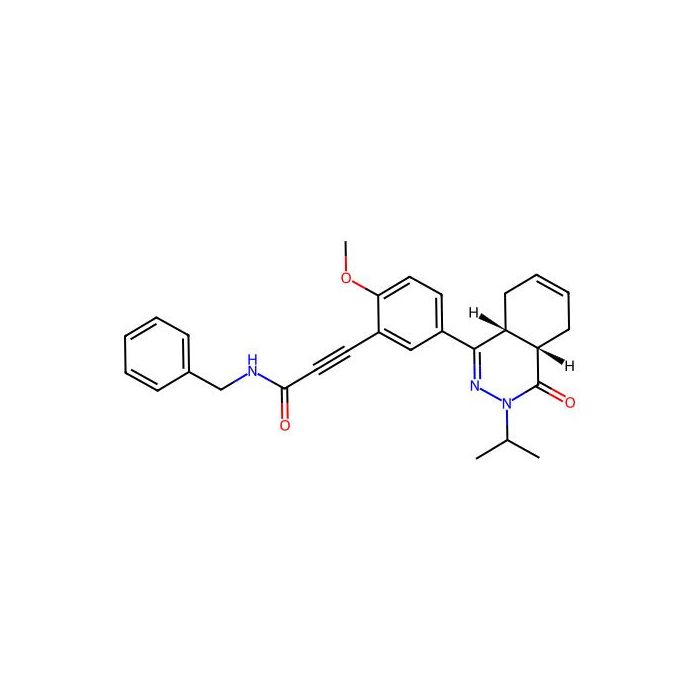
NPD1335 is a Trypanosoma brucei phosphodiesterase B1 ( TbrPDEB1 ) inhibitor with submicromolar activities against T. brucei parasites. NPD1335 displays a greatly improved cytotoxicity profile. NPD1335 increases intracellular cAMP levels and results in the distortion of the cell cycle and cell death
Form:Solid
IC50& Target:pKi: 6.9 (TbrPDEB1),pIC50: 6.2 (T. brucei) (NPD-1335)
仕様
仕様と純度
≥98%
生化学的・生理学的メカニズム
NPD1335 is a Trypanosoma brucei phosphodiesterase B1 ( TbrPDEB1 ) inhibitor with submicromolar activities against T. brucei parasites. NPD1335 displays a greatly improved cytotoxicity profile. NPD1335 increases intracellular cAMP levels and results in the
保管条件
Store at -20°C
入荷
Ice chest + Ice pads
この製品は冷冷この冷このこの製品の運送が必要です。地上およびその他の経済サービスは利用できません。
アクションタイプ
INHIBITOR
純度
≥98%
名前と識別子
分子量
455.55
詳細データ
証明書(CoA、COO、BSE/TSEと分析図)
C of A & Other Certificates(BSE/TSE, COO):
Analytical Chart:
ソリューション計算機
Molarity Calculator
Determine the necessary mass, volume, or concentration for preparing a solution.
Dilution Calculator
Determine the dilution needed to prepare a stock solution.
Reconstitution Calculator
レビュー
顧客レビュー
Application Protocols
The product data do not include validated application protocols specific to NPD-1335. The following generalized procedures reflect good practice for handling small-molecule library compounds in discovery assays. Adjust to your assay context and consult the CoA/SDS for any item-specific constraints.
Stock solution preparation:
Weigh the required amount quickly to minimize moisture uptake.
Dissolve in anhydrous DMSO to prepare a 10–50 mM stock. If insoluble, test MeOH/EtOH, then DMF/NMP cautiously.
Vortex and, if necessary, sonicate briefly; avoid prolonged heating.
Record exact concentration using MW from the CoA; if MW is unknown, defer molar calculations until provided.
Aliquoting and storage:
Dispense into small, single-use aliquots (e.g., 10–50 µL) in low-bind tubes or plates.
Flush headspace with inert gas (optional) and seal tightly. Store at −20°C (per product data).
Working solution and dosing:
Dilute DMSO stock into assay buffer to the desired final concentration, keeping DMSO ≤0.1–1% v/v.
Mix thoroughly to avoid precipitation; visually inspect wells or use nephelometry.
Include solvent-only controls and, where possible, positive/negative control compounds.
Identity/purity check:
Verify by LC–MS and analytical HPLC prior to critical studies. Re-check after extended storage or multiple freeze–thaw events.
Note: For research use only.
Biological Roles
Item-specific biological targets, modes of action, and pathway roles for NPD-1335 are not provided and cannot be inferred without structural information. No claims of biological efficacy or therapeutic relevance are made. For research use only.
General context for small-molecule screening compounds:
Potential roles: Tool candidates for probing enzyme active sites, receptors, transporters, or signaling pathways in biochemical or cell-based assays.
Screening paradigms: Compounds may be assessed in target-based HTS, phenotypic screens, chemical genetics approaches, or fragment-to-lead style campaigns (if MW and structure suit).
Off-target assessment: Once activity is observed, panel profiling (e.g., kinome scans, safety pharmacology panels) and counterscreens help map selectivity and reduce assay artifacts.
Physicochemical determinants: Solubility, lipophilicity, and ionization state strongly influence cellular uptake and apparent potency. These properties are unknown here; obtain them from the CoA/structure to inform assay design (e.g., serum binding, efflux susceptibility).
Aggregation/assay interference: Some scaffolds can act as aggregators, redox cyclers, or fluorescent/colored interferents. Apply orthogonal readouts and detergent controls to de-risk hits.
Recommendations:
Confirm identity/purity prior to biological testing (LC–MS, HPLC purity). Record final DMSO % and verify absence of precipitation in assay buffers.
If cellular assays are intended, evaluate basic cytotoxicity controls and compound stability (freeze–thaw resilience, light/moisture sensitivity if applicable).
Buffer Applications
NPD-1335 is a small-molecule library compound rather than a buffering agent. There are no item-specific pKa values or buffer recipes available.
Practical guidance for using small molecules in buffered assays (general, not item-specific):
Stock preparation: Dissolve in DMSO to 10–50 mM. For aqueous assays, dilute into pre-equilibrated buffer while mixing to maintain solubility. Aim for final DMSO ≤0.1–1% v/v, depending on assay tolerance.
Common assay buffers: HEPES (pH 7.0–7.5), Tris (pH 7.0–8.5), phosphate (pH 6.5–7.5), and acetate (pH 4.5–5.5). Choose based on biological target stability and any metal/cofactor requirements.
pH considerations: Unknown ionization profile necessitates empirical testing. If precipitation occurs on dilution, adjust pH, add 0.01–0.05% nonionic detergent (e.g., Tween-20), or modestly increase DMSO fraction within assay limits.
Adsorptive losses: Hydrophobic compounds may adsorb to plastics. Use low-bind tubes/plates or glass vials; include carrier protein (e.g., 0.1% BSA) if compatible with the assay to reduce nonspecific binding.
Light sensitivity: If the compound absorbs strongly in the near-UV/visible, protect from light during assay setup (use amberware/foil) until characterization is available.
Conclusion: While NPD-1335 does not function as a buffer, careful management of solvent percentage, pH, and surfactant can ensure reliable dosing and consistent exposure in buffered systems.
Green Alternatives
Green chemistry considerations for small-molecule screening compounds focus less on the compound itself (structure unknown here) and more on solvent choices, handling, and waste minimization.
Opportunities (general guidance):
Prefer greener solvents where compatible with solubility and assay performance: water > ethanol/isopropanol > acetone/EtOAc > MeCN/DMF/NMP. DMSO remains common for stocks; minimize final DMSO % in assays.
Use micro-volume handling (low-dead-volume tips, acoustic dispensing) to reduce solvent consumption and waste.
Opt for sealed plates to limit DMSO evaporation and reduce emissions.
Consolidate waste streams, segregating halogenated from non-halogenated solvents for optimized disposal.
Illustrative comparison (not item-specific):
DMSO: High solvency, relatively low hazard profile; viscous and hygroscopic; acceptable in many biological assays at ≤1% v/v.
2-Propanol/Ethanol: Renewable routes available; good miscibility; watch for assay interference at higher %.
MeCN: Excellent for LC; higher toxicity; consider ethanol/water gradients where technically feasible for prep.
DMF/NMP: Powerful dipolar aprotics but under regulatory scrutiny; reserve for challenging solubility cases and keep volumes minimal.
Process improvements:
Employ miniaturized assays (384/1536-well) to reduce per-well compound and solvent use.
For LC–MS, consider ammonium formate/acetate buffers and ethanol/water gradients when chromatographically viable.
Note: Specific greener synthetic routes to NPD-1335 cannot be proposed without the structure.
Pharmaceutical Uses
No pharmacopeial status, excipient role, or formulation function is provided for NPD-1335. This product is supplied strictly for research use only, with no clinical or therapeutic claims.
General considerations for small molecules in pre-formulation research (not item-specific):
Early characterization: Determine solubility across pH, intrinsic dissolution rate, chemical stability (hydrolysis/oxidation), and solid-state form (salt, polymorph) once the structure is available.
Reference material: Screening compounds can serve as internal standards or reference items in discovery workflows, provided identity/purity are verified and stability is adequate.
Vehicle selection for in vivo research is outside the scope of this listing and requires full safety and ethical review; this product is not supplied for clinical applications.
Documentation to request if formulation work is contemplated:
CoA detailing purity, counterion/salt form, residual solvents.
SDS for handling and hazard information.
Structural identifiers (SMILES/InChI) to support computational and analytical method development.
Reminder: For research use only. Not for human or veterinary use, medical diagnostics, or clinical applications.
Physical Properties
Item-specific physicochemical data have not been provided for NPD-1335. The following fields are therefore reported as not specified for this item; refer to CoA/Spec Sheet.
Appearance: Not specified for this item; refer to CoA/Spec Sheet.
Melting point (MP): Not specified for this item; refer to CoA/Spec Sheet.
Boiling point (BP): Not specified for this item; refer to CoA/Spec Sheet.
Density: Not specified for this item; refer to CoA/Spec Sheet.
Refractive index: Not specified for this item; refer to CoA/Spec Sheet.
Solubility: Not specified for this item; refer to CoA/Spec Sheet.
logP/logD: Not specified for this item; refer to CoA/Spec Sheet.
pKa(s): Not specified for this item; refer to CoA/Spec Sheet.
General laboratory guidance (literature/practice, not item-specific):
Solubility screening for library compounds commonly starts with DMSO at 10–50 mM; if insoluble, consider cosolvents (DMF, NMP) or salt formation for ionizable scaffolds.
For aqueous assays, prepare a DMSO stock and dilute into buffer to ≤0.1–1% v/v DMSO final, verifying compound remains in solution (visual check, Nephelometry, or UV/LC).
If the compound is crystalline, MP can aid identity and polymorph checks; however, micro-quantities in screening sets may preclude routine MP testing.
If LC–MS is used for intake QC, set a scouting gradient (e.g., 5–95% MeCN/H2O with 0.1% formic acid) and acquire ESI± to estimate ionization and detect major impurities.
Note: Obtain item-specific specs (e.g., MW and formula) from the CoA to configure exact MS acquisition (m/z) and to calculate accurate molar concentrations for stock solutions.
Quality and Grades
Item-specific grade and purity are not listed in the current product data.
Grade/purity: Not specified for this item; refer to CoA/Spec Sheet.
General guidance on quality for small-molecule library members:
Library compounds are often provided at high purity (commonly ≥95% by HPLC/LC–MS), but exact thresholds vary by supplier and by screening collection. Confirm by reviewing the CoA for this SKU.
Typical QC elements for discovery libraries include: HPLC/UPLC purity, LC–MS identity (correct [M±H]±), NMR spot-checks (1H, occasionally 13C), residual solvents, and salt/counterion identification if applicable.
UV characteristics: If using for assay optics or HPLC detection, low UV background and defined chromophore maxima are preferred. In the absence of a UV cutoff specification, use MS-based detection for intake QC.
Impurity considerations: Trace impurities may confound biochemical or cell-based assays. Consider re-purification or orthogonal confirmation of activity when hit signals are modest.
Stabilizers: None are indicated for this item. If the structure contains oxidation- or hydrolysis-prone motifs (unknown here), addition of inert atmosphere, desiccation, or acid/base-neutral excipients may be beneficial. Verify with CoA/SDS before adding any stabilizer.
Recommendation: Request the CoA to confirm purity, counterion/salt form, and any batch-specific notes relevant to storage or handling.
Reaction and Applications
This SKU represents a screening-library small molecule rather than a general-purpose synthetic reagent. Without structural information, specific reaction classes or named transformations involving NPD-1335 cannot be provided.
What is typically applicable for library compounds:
Assay deployment: Use as a test article in biochemical enzyme assays, binding assays (e.g., SPR, BLI), phenotypic cell assays, or target-based HTS.
Orthogonal confirmation: Follow-up any activity with counterscreens (e.g., aggregation checks, redox cycling assays, interference with detection reagents) to ensure signals are on-target.
Analytical support: Confirm identity/purity by LC–MS and, if possible, 1H NMR prior to biological testing.
Not typically applicable here:
Named organic reactions, catalysis scope, or reagent roles cannot be ascribed without knowing the functional groups present. If you intend to derivatize NPD-1335, request the structure to assess reactive handles (amines, acids, halides, boronates, etc.).
Practical notes for screening workflows:
Prepare concentrated DMSO stocks (e.g., 10–50 mM), aliquot, and store at −20°C to reduce freeze–thaw cycles.
Include detergent controls (e.g., 0.01–0.05% Tween-20) in aggregation-prone assay formats.
Use PAINS/REOS or substructure filters only after the structure is available; avoid premature triage without data.
Conclusion: The principal “application” for this item is as a research test compound within discovery assays rather than as a stoichiometric/catalytic reagent in synthetic methodology.
Reaction Conditions
Specific reaction conditions cannot be provided for NPD-1335 because its structure and functional groups are not disclosed. Consequently, no guidance on catalysts, bases, temperatures, or yields can be meaningfully given.
General experimental considerations relevant to small-molecule handling (not item-specific):
Solution preparation: Create concentrated DMSO stocks (e.g., 10–50 mM). Verify complete dissolution by visual inspection and, if feasible, by UV or LC at the intended working concentration.
Plate operations: For HTS, equilibrate compound plates to room temperature before opening to minimize DMSO water uptake and condensation. Use acoustic or low-volume dispensing to improve accuracy.
Stability checks: If the compound may be hydrolysis- or oxidation-prone (unknown here), perform a short-term stability study in assay buffer (0–24 h) at room temperature and 37°C to confirm exposure.
Adsorption and carryover: Rinse LC autosampler lines with strong solvent between injections (e.g., MeCN/IPA with 0.1% formic acid) when handling hydrophobic analytes to avoid cross-contamination.
If synthetic use is intended:
Obtain the structure to determine compatible conditions (e.g., cross-coupling solvents/bases, electrophile/nucleophile pairings). Proceed only after confirming functional group tolerance and protecting group strategy.
Safety and Handling
Authoritative safety information (GHS classification, pictograms, hazard statements) is not provided for this item. Treat as a research chemical of unknown toxicity and consult the SDS when available.
Item-specific safety data:
GHS classification: Not specified for this item; refer to CoA/Spec Sheet and SDS.
Signal word / H-statements / Pictograms: Not specified for this item; refer to SDS.
General laboratory precautions (good practice for small molecules):
PPE: Wear lab coat, safety glasses, and appropriate chemically resistant gloves (nitrile recommended). Avoid skin and eye contact; prevent inhalation of dust/aerosols.
Engineering controls: Handle in a fume hood; keep containers tightly closed. Use low-retention tips and sealed plates/vials for DMSO stocks to limit exposure and evaporation.
Incompatibilities: Unknown for this specific item; as a precaution, segregate from strong oxidizers and acids/bases until stability is known. Avoid moisture if the compound is hydrolytically or hygroscopically sensitive (verify on CoA/SDS).
First aid (overview): In case of skin contact, wash with soap and water; eye contact, rinse cautiously with water for several minutes and seek medical advice; inhalation, move to fresh air; ingestion, rinse mouth, do not induce vomiting—seek medical attention. Follow SDS guidance.
Spill/accident response: Contain and collect with inert absorbent, avoid dust formation, and dispose in accordance with institutional and local regulations.
Note: No medical or clinical uses are intended or implied. For research use only.
Solvent Selection
Because the chemical structure and ionization profile of NPD-1335 are not provided, solvent recommendations focus on broadly applicable practices for small-molecule screening compounds.
Primary stock solvent: DMSO is the de facto standard for discovery compounds due to broad solvency, low volatility, and assay compatibility at ≤0.1–1% v/v.
Alternative organic vehicles (when needed): DMF or NMP can dissolve highly polar/poorly soluble scaffolds; ethanol or isopropanol may suit moderately lipophilic compounds. Confirm downstream assay tolerance if these are used.
Aqueous compatibility: After preparing a DMSO stock (e.g., 10–50 mM), dilute into the target buffer while vortexing to prevent precipitation. For final DMSO ≤0.1% v/v, consider intermediate dilutions to maintain solubility.
pH and salts: If the molecule is ionizable (unknown here), buffering near the pKa (acid or base) can improve solubility in water via salt formation. Employ volatile buffers (e.g., ammonium bicarbonate) for MS workflows.
Comparison (general, not item-specific):
DMSO: highest solvency, hygroscopic; assay-compatible at low %.
Additional practical guidance (general, not item-specific):
Solid form (if supplied as solid; appearance not specified): Store in a desiccated environment with desiccant packs, protected from light. Warm to room temperature in a desiccator before opening to reduce moisture condensation.
DMSO stock solutions: Prepare 10–50 mM stocks in anhydrous DMSO. Dispense into single-use aliquots (e.g., 10–50 µL) in low-bind tubes or sealed plates. Minimize headspace; optional inert gas blanket. Store at −20°C.
Freeze–thaw management: Avoid repeated freeze–thaw cycles. Thaw aliquots at room temperature, mix gently, and promptly return unused portions to −20°C. Discard aliquots showing precipitation or discoloration if unresolved by gentle warming.
Aqueous working solutions: Prepare immediately before use. If stability is uncertain, limit exposure at room temperature and protect from light. Filter through 0.2 µm PTFE only if compatible and necessary to remove particulates.
Stability documentation: In the absence of item-specific stability data (t90, light/moisture sensitivity), conduct a brief stability check (e.g., LC–MS at 0 and 24 h in assay buffer) prior to critical experiments.
Notes:
Grade/purity, appearance, molecular formula, and MW are not specified for this item; refer to the CoA/Spec Sheet for batch-resolved details.
For research use only; not for human or veterinary use.
Structure and Identity
Brief overview: NPD-1335 is listed as a small-molecule library member intended for research screening. Detailed structural identifiers are not disclosed in the current product data.
Chemical name: Not specified for this item; refer to CoA/Spec Sheet.
CAS: 2376326-31-5 (item-specific)
Molecular formula: Not specified for this item; refer to CoA/Spec Sheet.
Molecular weight: Not specified for this item; refer to CoA/Spec Sheet.
SMILES: Not specified for this item; refer to CoA/Spec Sheet.
InChIKey: Not specified for this item; refer to CoA/Spec Sheet.
Other registry IDs (e.g., CID): Not specified for this item; refer to CoA/Spec Sheet.
Structural features (general guidance):
As a member of a small-molecule compound library, NPD-1335 is presumed to be an organic scaffold amenable to biochemical/phenotypic screening. Without the SMILES/InChI, specific functional groups, ring systems, stereochemistry, or heteroatom content cannot be described for this item.
How to interpret 2D structure (general):
For screening compounds, the 2D depiction usually highlights heteroatoms (N, O, S), aromatic/heteroaromatic systems, and any stereogenic centers. Confirm the presence/absence of ionizable groups (acidic/basic) to anticipate solubility, protonation state, and potential salt formation.
Action item:
Request the product CoA/Spec Sheet for a full structure record (SMILES/InChI, formula, MW) to enable accurate computational predictions, LC–MS method setup, and mass confirmation prior to screening.
Synthetic Utility
Without a disclosed structure, it is not possible to comment on functional groups, reactivity patterns, or named reactions in which NPD-1335 could participate. Many library compounds are final screening articles rather than intermediates intended for further synthetic elaboration.
What can be done once structure is available (general guidance):
Functional handle assessment: Identify nucleophiles (amines, alcohols, thiols), electrophiles (acyl halides, sulfonyls, activated esters), and cross-coupling handles (aryl/vinyl halides, boronates, stannanes) to plan derivative synthesis.
Late-stage diversification: If C–H activation handles or photoredox-amenable motifs are present, consider mild LSF to prepare SAR analogs rapidly.
Protecting group strategy: If multiple reactive sites exist, map orthogonal protection to enable selective transformations.
Analytical readiness: With MW and heteroatom count known, prepare LC–MS and NMR conditions to track reactions and purifications effectively.
Current recommendation:
Use NPD-1335 as received for screening and preliminary SAR hypotheses only after confirming analytical identity/purity. For synthetic campaigns, obtain the full structure and any available synthetic route notes from the supplier or literature before planning transformations.
Target Specificity
Item-specific target information for NPD-1335 (protein target, pathway, or phenotype association) is not provided in the product data.
Antigen/target name: Not specified for this item; refer to CoA/Spec Sheet.
Binding site/epitope: Not applicable/Not specified.
Species reactivity/selectivity: Not specified.
Assay-validated specificity: Not specified.
General note:
For small molecules, “target specificity” is typically established empirically via biochemical potency assays, cellular efficacy readouts, and orthogonal counterscreens followed by selectivity profiling across related target families. Until such data are disclosed, NPD-1335 should be treated as a research test compound with unknown specificity.
Products are supplied to verified businesses, institutions, and qualified professionals for research and development use only. Not for use in humans, animals, diagnosis, or therapy.