GRADE & PURITYMoligand™?Moligand™ — Aladdin's line of ligands and bioactive small molecules. Use for receptor, pathway, and binding studies needing defined small-molecule tools.10 mM in DMSO
Moligand™, 10 mM in DMSO Moligand™ for sensitive chromatographic and analytical workflows requiring minimal baseline interference.
🌡
Storage & shipping
Protected from light,Store at -80°C Ships Dry ice packs + Cold packs Check lot-specific COA for exact specifications.
📋
Quality documents
SDS, COA, datasheet, and spec sheet available for download. Lot-specific COA accessible via lot number lookup.
📚
Literature proof
Cited in 0 peer-reviewed publications across chromatography, organic synthesis, and cross-coupling reactions.
概要
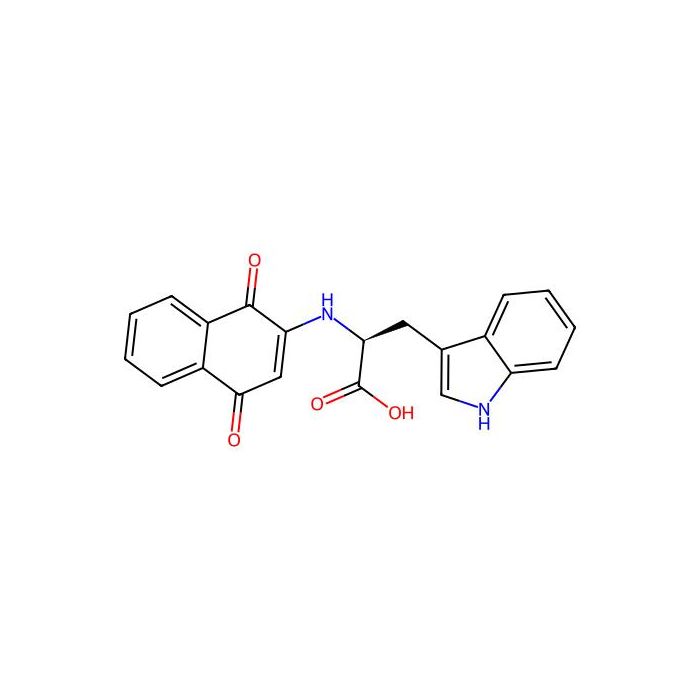
NQTrp, an aromatic naphthoquinone-tryptophan hybrid molecule, an inhibitor of the aggregation of the tau protein with generic anti-amyloidogenic effects. NQTrp inhibits the in vitro aggregation of hexapeptide ( 41 GCWMLY 46 within the N-terminus of γD-crystallin) as well as full-length γD-crystallin.
Determine the necessary mass, volume, or concentration for preparing a solution.
Dilution Calculator
Determine the dilution needed to prepare a stock solution.
Reconstitution Calculator
レビュー
顧客レビュー
Application Protocols
Not specified for this item; refer to any application notes or CoA/Spec Sheet that may accompany your lot.
General reminders
For screening use, standardize DMSO stock concentrations across your library, confirm solubility, and use plate-mapping with appropriate positive/negative controls.
Ensure light protection during handling and incubation, as indicated by the product’s storage guidance.
Biological Roles
Item-specific biological roles are not specified for this catalog entry; NQTrp is provided strictly for research use only.
Literature/general context
NQTrp-type quinone–indole hybrids have been investigated as research tools in studies of protein self‑assembly and aggregation pathways. The extended aromatic surface can enable π–π stacking with aromatic residues, while hydrogen-bond donors/acceptors may provide additional binding modes.
Quinone moieties can participate in redox chemistry, potentially influencing oxidative states in model systems. Such activity requires careful controls to distinguish specific binding from redox-mediated, nonspecific effects.
As a synthetic small molecule, NQTrp is not a natural metabolite and has no established physiological role. Any observed biological effects in experiments should be interpreted cautiously, with orthogonal assays to rule out assay interference.
Good practices
Verify that observed activity persists across detection modalities (e.g., fluorescence, light scattering, NMR) to avoid chromophore/quencher artifacts.
Maintain low co‑solvent levels and include appropriate vehicle controls.
Important
No clinical, diagnostic, or therapeutic claims are made or implied for this product. It is intended solely for laboratory research conducted by qualified professionals.
Buffer Applications
NQTrp is not a buffering agent and does not serve as a pH control component. Therefore, typical buffer recipes and pKa‑targeted formulations are not applicable.
Practical notes (general)
When dosing NQTrp into buffers for biochemical assays, maintain low DMSO content (≤0.5–1% v/v) and ensure the compound remains in solution after dilution.
If precipitation is observed, adjust ionic strength, include a nonionic surfactant at low levels where compatible, or explore alternative cosolvents. Always verify that modifications do not perturb the biological system under study.
Green Alternatives
Compound substitution is not typically applicable to library members; however, greener PRACTICES can be applied to solvent use and handling.
Greener solvent choices (general)
Prefer DMSO over DMF for stock solutions in biochemical assays due to lower toxicity and better biocompatibility.
For synthesis or purification, consider 2‑MeTHF or CPME instead of THF/diethyl ether when feasible; use EtOAc or MeTHF in place of DCM for normal‑phase chromatography where resolution allows.
Comparison (general)
DMSO vs DMF: DMSO offers lower volatility and better acute toxicity profile; DMF is a reproductive toxin and should be minimized.
2‑MeTHF vs THF: 2‑MeTHF is partially biorenewable and forms peroxides more slowly; water immiscibility can aid workups.
EtOAc vs DCM: EtOAc is less chlorinated/ozone-impacting; higher boiling point may lengthen evaporation times but reduces VOC emissions during handling.
Operational tips
Use minimal co‑solvent percentage in assays to reduce solvent burden.
Employ closed-transfer techniques and microscale purification to cut solvent usage.
Consolidate analytical runs (batch LC–MS) to lower overall solvent waste.
Note
These are general green chemistry considerations. They do not alter the identity or specifications of this item.
Pharmaceutical Uses
No pharmaceutical or excipient uses are specified for this product. NQTrp is supplied for research use only and is not intended for human or veterinary use, drug substance manufacturing, or clinical applications.
General context (non-clinical)
Small molecules with strong chromophores like quinone–indole hybrids are sometimes used as research probes in pre-formulation screening or mechanistic studies. Any such work should be confined to nonclinical, exploratory research settings.
Regulatory note
This product is not accompanied by pharmacopeial monograph status (e.g., USP/EP/JP) or GMP documentation. For regulated applications, users must source appropriate grade materials and documentation.
Physical Properties
Item-specific data
Appearance: Not specified for this item; refer to CoA/Spec Sheet.
Molecular weight: Not specified for this item; refer to CoA/Spec Sheet.
Other physico-chemical specifications (mp, bp, density, pKa, logP, solubility, refractive index): Not specified for this item; refer to CoA/Spec Sheet.
Literature/general expectations for NQTrp-type scaffolds
State: Typically isolated as a solid aromatic compound.
Solubility: Often poorly soluble in water; readily soluble in polar aprotic organic solvents such as DMSO and DMF; moderate solubility in MeOH/EtOH can be observed depending on substitution. Always verify experimentally for the specific batch.
UV–Vis: Quinone–indole conjugates commonly display strong π–π* absorption bands in the near‑UV/visible region due to extended conjugation (exact λmax is structure-dependent; consult CoA/SDS for this item if available).
Stability: Aromatic quinones can be light sensitive and may undergo redox processes; storage under inert atmosphere, desiccation, and light protection are advisable.
Practical notes
Prepare concentrated DMSO stock solutions (e.g., 10–50 mM) and dilute into assay buffers to the working concentration, maintaining final DMSO ≤0.5–1% v/v when biological assays are intended.
If precipitation occurs upon dilution into aqueous media, consider co-solvent strategies or pre-warming with gentle sonication. Validate concentration by UV–Vis only if an extinction coefficient for the exact item is available.
Quality and Grades
Grade: Moligand™
What Moligand™ implies
Moligand™ denotes a research-grade small-molecule suitable for ligand discovery, screening, and chemical biology workflows. Emphasis is placed on identity confirmation and suitability for stock-solution preparation in common screening solvents (e.g., DMSO).
Item-specific notes
Purity specification, residual solvent limits, and analytical controls (e.g., HPLC/LC–MS/NMR) are Not specified for this item; refer to CoA/Spec Sheet.
Stabilizers/inhibitors: Not specified for this item; refer to CoA/Spec Sheet. If none are present, users should consider antioxidant-free handling and light protection as indicated.
Analytical guidance (general)
Recommended incoming QC in screening campaigns: identity by ESI–MS, purity by HPLC (UV at multiple wavelengths to capture quinone/indole absorbance), and orthogonal purity by 1H NMR if required.
Low UV baseline is not a requirement for this compound, but awareness of strong chromophores is important when using UV-based detectors—expect high response factors around 254–300 nm.
Fit-for-purpose considerations
For biochemical assays, confirm solubility and absence of aggregate formation at working concentrations (use detergent controls or light scattering if aggregation is a concern). Document lot-specific purity and storage history to ensure reproducibility across screens.
Reaction and Applications
Manufacturer applications: Not specified; this product is listed as a Moligand™ small-molecule library member for research use.
General research applications (literature)
Chemical biology probes: Quinone–indole hybrids like NQTrp have been studied as modulators of protein self‑assembly and as ligands in biophysical assays (e.g., fluorescence-based aggregation assays). Such uses are strictly research-oriented and require rigorous control experiments.
Screening and SAR: Suitable for inclusion in small-molecule screening panels targeting protein–protein interactions, amyloid assembly pathways, or redox-sensitive targets. Structure–activity relationships may leverage the quinone’s electronics and the indole’s aromatic interactions.
Assay considerations
Aggregation/artifact controls: Use detergent controls, orthogonal readouts, and redox quenchers as appropriate to exclude PAINS-like behaviors (quinones can be redox active).
Photostability: Protect from light during assays to avoid photochemical changes affecting readouts.
Analytical applications
Strong UV chromophores facilitate HPLC–UV tracking; LC–MS readily confirms molecular ion and fragmentation of conjugated systems.
Note
No therapeutic or diagnostic use is implied. Users should validate concentration-response relationships and check for colloidal aggregation or redox interferences before mechanistic interpretations.
Reaction Conditions
This catalog item is not provided as a reagent for a specific named transformation; no item-specific reaction condition guidance is specified.
General considerations for handling in experiments
Stock solutions: Prepare in dry DMSO under subdued light. Typical screening stocks are 10–50 mM; confirm solubility for this specific lot.
Assay conditions: Many biochemical assays operate at ambient temperature in buffered aqueous media. Ensure the final co‑solvent level is compatible with the assay system and that the compound remains fully dissolved throughout the assay window.
If used in synthesis/derivatization (literature)
Protect quinone functionality from strong nucleophiles/bases to avoid Michael addition or over‑reduction unless desired.
Conduct amide coupling at low temperatures with carbodiimide or uronium reagents in anhydrous polar aprotic solvents; exclude light if the quinone is photosensitive.
Note
The above are general literature-based practices and are not item-specific specifications. Always validate on small scale and consult the primary literature relevant to your exact NQTrp analog.
Safety and Handling
Item-specific hazard information
Signal word: Not specified for this item; refer to SDS.
H-statements: Not specified for this item; refer to SDS.
GHS classification/pictograms: Not specified for this item; refer to SDS.
General safety considerations for quinone–indole small molecules (literature/general)
Potential hazards: Aromatic quinones may participate in redox cycling and can be irritants or sensitizers. Avoid inhalation/ingestion and skin/eye contact. Indole-containing compounds are typically low volatility solids but may cause irritation.
PPE: Use lab coat, safety glasses, and appropriate chemically resistant gloves (e.g., nitrile). Handle powders in a fume hood to minimize dust inhalation.
Light sensitivity: Product Data indicates “Protect from light.” Minimize exposure by using amber vials/foil wrapping.
Incompatibilities: Strong reducing or oxidizing agents may alter quinone functionality; avoid strong bases/acids unless required and validated.
Spill/first aid (overview): For small spills, avoid dust, collect with inert absorbent. Skin contact—wash with soap and water. Eye contact—rinse cautiously with water for several minutes and seek medical advice. Inhalation—move to fresh air. Ingestion—rinse mouth; seek medical attention. Always follow institutional SOPs.
Authoritative reference
For definitive hazard classification, permissible exposure limits, and transport information, consult the item-specific SDS and CoA prior to use.
Solvent Selection
Solubility and polarity (general guidance)
Likely solvent class: Polar aprotic organics. DMSO is typically preferred for preparing concentrated stocks of aromatic quinone–indole hybrids.
Aqueous solubility: Often limited; co-solvent strategies are commonly needed for biological assays.
Recommended solvents for preparation and handling (general)
Primary: DMSO (high solvating power, compatible with most screening assays when diluted to ≤1% v/v)
Alternatives: DMF (strong solvent but less preferred in biology), methanol or ethanol (moderate solubility; volatile), and acetonitrile for HPLC sample prep.
Small comparison (general)
DMSO: Excellent solubilizer; low volatility; broadly assay-compatible. Tradeoff: can affect some enzyme assays at higher percentages.
DMF: Similar solvency; more hygroscopic and less favored for biochemical work.
MeOH/EtOH: Easier evaporation; may precipitate upon aqueous dilution; protein-denaturing at modest percentages.
Practical tips
Filter or centrifuge stock solutions to remove particulates before dosing.
To minimize precipitation when dosing into buffers, add the DMSO stock slowly with vigorous mixing, or pre-mix with an equal volume of buffer-compatible solvent.
For analytical chromatography, acetonitrile/water with 0.1% formic acid is often effective for UV/LC–MS, but method development is advised.
Storage and Reconstitution
Item-specific instructions
Storage conditions: Store at −80°C, protected from light.
Shipping: Ships on dry ice packs + cold packs.
General guidance (literature/practice)
Upon receipt, keep frozen and protected from light. Allow the container to warm to room temperature in a desiccator before opening to avoid moisture condensation.
Reconstitution: If a solid, dissolve in anhydrous DMSO to prepare a concentrated stock (e.g., 10–50 mM) based on solubility; if supplied as solution, maintain frozen aliquots. The exact solvent and concentration for this item are Not specified; refer to CoA/Spec Sheet.
Aliquoting: Dispense single‑use aliquots in amber vials or foil‑wrapped tubes to minimize freeze–thaw and light exposure.
Stability: Working solutions in DMSO are often stable at −20°C for weeks when protected from light and moisture; verify by LC–MS/HPLC for your use case. Long‑term storage should follow the −80°C guidance.
Handling: Avoid prolonged exposure at room temperature. Use inert atmosphere when feasible to minimize oxidative degradation of quinone motifs.
Disclaimer
For definitive stability and reconstitution parameters for this specific product/lot, consult the CoA and SDS.
Structure and Identity
Product name: NQTrp (SKU: N1498924)
CAS: 185351-19-3
Category: Small-molecule/compound library member (Moligand grade)
Item-specific identifiers
Molecular formula: Not specified for this item; refer to CoA/Spec Sheet.
Molecular weight: Not specified for this item; refer to CoA/Spec Sheet.
SMILES: Not specified for this item; refer to CoA/Spec Sheet.
InChIKey: Not specified for this item; refer to CoA/Spec Sheet.
Structural description (literature/general)
NQTrp is referenced in the literature as a naphthoquinone–tryptophan hybrid/scaffold. Typical motifs include an electron‑deficient quinone ring conjugated or linked to an indole-containing amino acid fragment (tryptophan), producing an extended π system capable of π–π and H‑bond interactions.
Functional groups expected in such hybrids: quinone carbonyls (C=O), indole ring (heteroaromatic), amide linkage (if coupled to Trp), and possible carboxylate/ester termini depending on the exact variant.
2D description: fused aromatic quinone ring connected through an amide or other linker to an indole-bearing side chain; overall planar/aromatic-rich surface with polar carbonyl functionality.
Notes
Exact stereochemistry, counterions/salt form, and substitution pattern can vary across reported NQTrp analogs. For this catalog item, consult the CoA/Spec Sheet for definitive structural identifiers and stereochemical assignment.
Synthetic Utility
As supplied, NQTrp is a finished small molecule intended for screening and probe-type research rather than a general synthetic building block.
General synthetic perspective (literature)
Quinone–tryptophan hybrids are often constructed via amide coupling (e.g., activated ester/peptide coupling) between a quinone-containing acid/amine and protected tryptophan derivatives, followed by deprotection and purification.
Functional handles, if present in a given analog (e.g., free carboxylate, amine, or halogen), could in principle allow conjugation to tags (fluorophores, affinity handles) or incorporation into polymeric supports; however, the presence/absence of such handles in this specific item is Not specified; refer to CoA/Spec Sheet.
When to consider derivatization
If probe immobilization or fluorescence tagging is desired, confirm the exact substitution pattern to avoid disrupting key interaction motifs (indole and quinone rings). Orthogonal protecting groups and mild coupling strategies help maintain the quinone’s integrity.
Conclusion
Treat NQTrp primarily as a target molecule/probe candidate. For preparative chemistry, consult the literature for reaction compatibility with quinone functionality (sensitive to strong nucleophiles and reductants).
Target Specificity
No target specificity, binding constants, or selectivity data are provided for this item.
Notes
If employing NQTrp in target-based assays, determine specificity empirically using concentration–response profiling, competition controls, and orthogonal biophysical techniques (e.g., SPR, DSF, ITC, NMR). Include redox and aggregation controls to exclude nonspecific mechanisms.
よくある質問
What is Moligand??
Moligand? is one of Aladdin Scientific's premium product lines, formulated for high-purity applications across multiple workflows. Compared to standard grades in the same workflow, Moligand? products typically offer tighter specifications, more rigorous QC, and stronger lot-to-lot consistency.
How should this product be stored?
Store at ?80 °C, protected from light. The material is light-sensitive — keep it in its original opaque or amber container.
How is this product shipped?
This product ships frozen with dry ice and cold packs. Unpack on arrival and transfer it to the storage condition stated above; handle dry ice with insulated gloves in a ventilated area.
What are the CAS number, molecular formula and molecular weight?
The CAS Number is 185351-19-3, the molecular formula is C21H16N2O4, and the molecular weight is 360.36 g/mol.
What documentation is provided?
Available product documentation, including Certificates of Analysis (COA), Safety Data Sheets (SDS), and specification sheets, is shown in the product document area. Document availability and access follow the current site policy.
Need help choosing the grade?
Our grade selection guide covers purity, stabilizer status, and application suitability for all variants in our catalog.
We use cookies to ensure the website functions properly and, where permitted, to improve your experience. You can manage your preferences at any time in Settings. Learn more in our Cookie Policy.
Shall we send you a message when we have discounts available?
Remind me later
Thank you! Please check your email inbox to confirm.
Products are supplied to verified businesses, institutions, and qualified professionals for research and development use only. Not for use in humans, animals, diagnosis, or therapy.