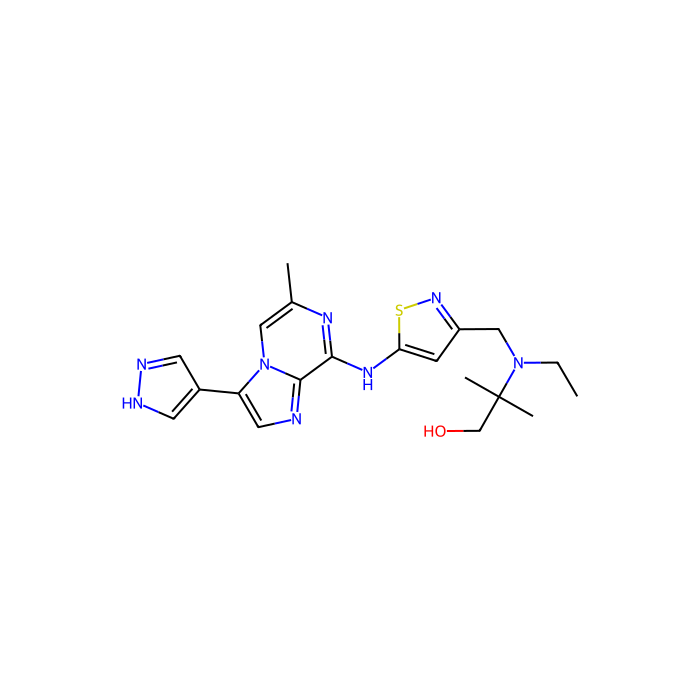
Description: IC50 Value: 4 nM (IC50) for Aurora A, and below or equal to 13 nM (IC50) for Aurora B [1]. SCH 1473759, a novel sub-nanomolar Aurora A/B inhibitor. Aurora kinases are required for orderly progression of cells through mitosis, and inhibition of these kinases by siRNA or small molecule inhibitors results in cell death [2]. in vitro: Asynchronous cells required 24-h exposure to SCH 1473759 for maximal induction of >4 N DNA content and inhibition of cell growth. However, following taxane- or KSP inhibitor-induced mitotic arrest, less than 4-h exposure induced >4 N DNA content. This finding correlated with the ability of SCH 1473759 to accelerate exit from mitosis in response to taxane- and KSP inhibitor-induced arrest [2]. in vivo: SCH-1473759 showed efficacy and target engagement in A2780 human tumor xenograft model in mouse, and also acceptable pharmacokinetic dosing in dog, monkey and rodents, on target efficacy, as well as a safety profile in dogs[1]. Clinical trial: N/A
This compound belongs to the class of organic compounds known as imidazopyrazines. These are organic heteropolycyclic compounds containing a pyrazine ring fused to an imidazole ring. These also include hydrogenated derivatives of the imidazopyrazine moiety. Imidazole is 5-membered ring consisting of three carbon atoms, and two nitrogen centers at the 1- and 3-positions. Pyrazine is a 6-membered ring consisting of six carbon atoms and two nitrogen centers at ring positions 1 and 4.
External Descriptors
Not available
1. Djoumbou Feunang Y, Eisner R, Knox C, Chepelev L, Hastings J, Owen G, Fahy E, Steinbeck C, Subramanian S, Bolton E, Greiner R, and Wishart DS. ClassyFire: Automated Chemical Classification With A Comprehensive, Computable Taxonomy. Journal of Cheminformatics, 2016, 8:61.
Products are supplied to verified businesses, institutions, and qualified professionals for research and development use only. Not for use in humans, animals, diagnosis, or therapy.