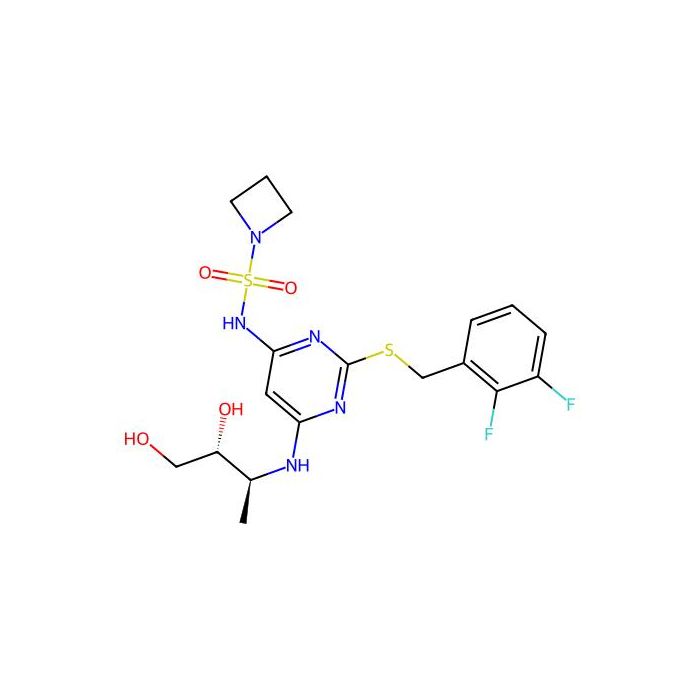
GRADE & PURITYMoligand™?Moligand™ — Aladdin's line of ligands and bioactive small molecules. Use for receptor, pathway, and binding studies needing defined small-molecule tools.10 mM in DMSO
Determine the necessary mass, volume, or concentration for preparing a solution.
Dilution Calculator
Determine the dilution needed to prepare a stock solution.
Reconstitution Calculator
レビュー
顧客レビュー
Application Protocols
Item-specific tested applications
Not specified for this item; no validated application protocols are provided. For research use only.
General protocols for small-molecule use in assays
Stock solution preparation
Allow vial to equilibrate to room temperature in a desiccator before opening to prevent moisture condensation.
Prepare 10–50 mM stock in anhydrous DMSO; vortex and, if needed, sonicate. Record exact concentration and solvent lot.
Sterile-filter through 0.2 µm PTFE if using in sterile cell-based assays and solubility permits.
Aliquoting and storage
Dispense single-use aliquots (10–50 µL) in low-bind tubes. Store at -80°C. Avoid repeated freeze–thaw; thaw on ice or at RT just before use.
Assay setup
Prepare serial dilutions in assay buffer maintaining constant DMSO across wells (e.g., 0.1% v/v). Include vehicle and positive/negative controls.
For fluorescence assays, measure compound absorbance/emission to check for inner-filter effects or autofluorescence.
Data quality controls
Include duplicates/triplicates, Z′-factor assessment for HTS, and orthogonal readouts for hit confirmation.
Documentation
Record SKU, lot number, dissolution date, storage history, and plate maps for traceability.
Biological Roles
Item-specific
No target or mode-of-action information is provided for this item. Any biological role should be established experimentally with appropriate controls. For research use only.
General context for small-molecule probes
Small molecules like SRT3190 are typically explored as ligands or modulators of proteins (enzymes, receptors, transporters) to dissect pathway function in vitro or in cells.
Establishing a biological role requires convergent evidence: direct binding (e.g., SPR, DSF), functional modulation in biochemical assays, and phenotypic readouts consistent with on-target effects.
Off-target assessment: counterscreens across related protein families and cytotoxicity profiling (e.g., resazurin/CTG assays) help distinguish specific activity from general stress responses.
Chemical liabilities: Evaluate for assay interference (intrinsic fluorescence, redox cycling, aggregation) and chemical stability in biological media (hydrolysis, oxidation, photolysis).
Good practices
Include time-course and washout experiments to differentiate reversible target engagement from irreversible or promiscuous effects.
Report exact lot number, stock solvent, and final solvent percentage to ensure reproducibility across labs.
Buffer Applications
Not typically applicable
SRT3190 is a small-molecule research compound, not a buffering agent. It is not used to set or maintain pH.
Practical guidance related to buffers (general)
Prepare working solutions by diluting DMSO stocks into assay buffers compatible with your biology (e.g., PBS pH 7.4, HEPES 20–50 mM). Maintain DMSO at ≤0.1–1% v/v depending on cell line/screening format.
Add compound solutions to buffers with vigorous mixing or plate shaking to minimize local supersaturation and precipitation.
If precipitation occurs, adjust ionic strength, include small amounts of non-ionic surfactant (e.g., 0.01% Tween-20), or raise temperature modestly (to 25–37°C) for dissolution tests.
Validate buffer composition does not react with the compound (e.g., avoid nucleophilic amines in buffers if the compound contains activated electrophiles; unknown here—confirm with structure/CoA).
Green Alternatives
Context
For small-molecule screening, the main environmental footprint arises from choice of solvents (stock preparation, washing, and analysis). Compound identity is fixed; greener practices center on solvent and workflow choices.
Greener solvent options (general guidance)
Prefer aqueous assay buffers with minimal DMSO (≤0.1–0.5% v/v) where biology permits.
Where organic stocks are required, ethanol can substitute for DMSO in select cases; verify solubility and assay tolerance.
For synthetic or analytical steps around the compound (if undertaken), consider greener solvents such as 2-MeTHF or CPME instead of THF/diethyl ether, and EtOAc/IPA instead of chlorinated solvents when compatible.
Ethanol: Renewable sources; higher volatility; limited solvency for lipophilic scaffolds; potential biological perturbation at >0.5–1%.
Aqueous buffers: Greenest carrier; limited by compound solubility and stability.
Operational sustainability
Use miniaturized assay volumes (1536/384-well) to reduce solvent use and waste.
Employ plate seals with low plasticizer migration; consolidate waste streams (DMSO/aqueous) for proper disposal.
Validate room-temperature robotic handling to reduce freezer door-open time and dry ice usage during plate prep.
Pharmaceutical Uses
Scope
This product is supplied strictly for research use and is not intended for human or veterinary applications, diagnostics, or as an excipient.
General formulation context for research compounds
For in vivo exploratory studies conducted under appropriate approvals, researchers often prepare dosing vehicles using aqueous buffered systems with cosolvents (e.g., DMSO, PEG300, Cremophor EL, Captisol). Any such use requires independent suitability and safety assessments; no formulation guidance is provided or implied for this specific item.
For in vitro studies, DMSO stocks are commonly used and diluted into media; keep final DMSO ≤0.1–0.5% for sensitive cell types.
Quality/regulatory note
No pharmacopeial monograph or excipient status is provided for this item. Do not use in GMP manufacturing or clinical settings.
Documentation
Record exact vehicle composition, pH, osmolality, and dosing schedule in research notebooks. Confirm compound stability in the chosen vehicle via LC–MS where critical.
Physical Properties
Item-specific (from Product Data)
Appearance: Not specified for this item; refer to CoA/Spec Sheet.
Molecular weight: Not specified for this item; refer to CoA/Spec Sheet.
Literature/general values (not item-specific)
Typical physical data (mp, solubility, logP, pKa, UV profile) for SRT3190 are not provided here. Consult primary literature or PubChem CID 59149652 for indicative values and confirm against the CoA before use in quantitative work.
Professional guidance
Solubility: For screening compounds of this class, initial dissolution in anhydrous DMSO at 10–50 mM is common; verify visual clarity and absence of particulates. Aqueous working solutions are often prepared by diluting DMSO stocks to ≤0.1–1% DMSO v/v in assay buffer to maintain compound in solution.
Hygroscopicity/photolability: Unknown for this item. Handle under low-moisture conditions and protect from light until properties are confirmed.
Solid-state form: If polymorph/salt form is relevant, refer to the CoA for the supplied form (free base vs. salt), as this affects massing and stock preparation.
Spectroscopy: If UV-Vis/fluorescence characteristics are required for readouts or interference checks, obtain spectra experimentally for the supplied lot.
Quality and Grades
Item-specific (from Product Data)
Grade: Moligand™
Research Use: For research use only
What Moligand™ implies (general description)
Moligand™ designates compounds curated for small-molecule discovery workflows (screening, hit validation, MoA exploration). While exact acceptance criteria vary, this typically emphasizes identity confirmation and suitability for biochemical/cellular assays rather than chromatographic or synthetic grades.
Practical quality considerations
Identity and Purity: Specific purity specification is not listed here. Confirm by CoA (e.g., HPLC/UPLC trace, MS) prior to critical experiments.
Counter-ion/solvate state: Verify free base vs. salt form and potential residual solvents, as these affect molar calculations and solubility. If unspecified, request the Spec Sheet.
Stabilizers: Not specified for this item; refer to CoA/Spec Sheet. If stabilizers are present, they may influence assay readouts or cellular responses.
Lot-to-lot consistency: For SAR or screening cascades, procure a single lot where possible and document lot number in ELNs and publications.
Orthogonal QC: Consider independent verification (NMR, HRMS) where critical; compare against supplier spectral data.
When to choose this grade
Select Moligand™ when you need small-quantity, assay-ready material for screening, target engagement studies, or preliminary SAR rather than synthetic elaboration or preparative purification.
Reaction and Applications
Applicability to this product type
This product is supplied as a research small molecule for screening/biological studies, not as a synthetic reagent. Classical reaction applications (e.g., as a catalyst/solvent/reagent) are typically not applicable.
Research applications (general, target-agnostic)
Primary use: Tool/ligand candidate in biochemical, biophysical, or cell-based assays for target engagement, pathway modulation, or phenotypic screening.
Hit validation: Employ concentration–response analysis, orthogonal assay formats, and counterscreens for pan-assay interference compounds (PAINS) and redox/aggregate artifacts.
Physicochemical assessment: Determine solubility limits, lipophilicity (cLogP), and stability in assay buffers to interpret potency shifts.
Metabolic stability (if pertinent): For advanced studies, use microsomes/S9 fractions to estimate intrinsic clearance; ensure no clinical extrapolation.
Practical tips
Prepare DMSO master stocks with aliquoting to minimize freeze–thaw. Confirm identity/purity by LC–MS against the CoA prior to SAR decisions.
Include vehicle controls matched to DMSO content; run detergent controls (e.g., 0.01% Tween-20) to diagnose aggregation artifacts.
If fluorescence readouts are used, collect compound emission/absorbance spectra to flag inner-filter effects.
Reaction Conditions
Not applicable to this product’s primary use
SRT3190 is not supplied as a reagent or catalyst, and no synthetic or catalytic reaction conditions are specified for this item.
Assay and handling conditions (general guidance)
Stock preparation: 10–50 mM in anhydrous DMSO; vortex/sonicate to ensure complete dissolution.
Working concentrations: Determine empirically via concentration–response curves; typical screening ranges span 0.1 nM to 100 µM depending on assay sensitivity.
Plate handling: Use low-bind polypropylene tubes/plates; pre-equilibrate to room temperature before dispensing to reduce condensation.
Stability checks: Assess short-term stability at room temperature and at 4°C in assay buffer; verify freeze–thaw tolerance by LC–MS.
Light and oxygen: Protect from light if chromophores are suspected; sparge buffers with inert gas if oxidation-sensitive motifs are present (unknown for this item—confirm with structure).
Safety and Handling
Item-specific (from Product Data)
GHS Classification: Not specified for this item; refer to SDS.
Signal Word: Not specified for this item; refer to SDS.
Hazard Statements (H-phrases): Not specified for this item; refer to SDS.
Pictograms: Not specified for this item; refer to SDS.
Storage: Store at -80°C. Shipped on dry ice + cold packs.
General laboratory safety (professional guidance; defer to SDS)
PPE: Wear lab coat, safety glasses, and appropriate chemically resistant gloves. Use in a fume hood when weighing or preparing stocks.
Avoid inhalation of dusts/aerosols. Prevent skin/eye contact. Wash thoroughly after handling.
Incompatibilities: Unknown for this specific item. As a conservative measure, avoid strong oxidizers and strong acids/bases until compatibility is known.
First aid overview: In case of contact, rinse affected area with water for at least 15 minutes and seek medical attention per SDS. If inhaled, move to fresh air; if ingested, do not induce vomiting and contact a physician.
Spill response: Avoid dust generation. Absorb small spills with inert material, place in chemical waste. Decontaminate surfaces according to institutional SOPs.
Waste: Dispose of according to local regulations and institutional hazardous waste procedures.
Risk of assay interference: Many small molecules can interfere with fluorescence or redox assays; include orthogonal readouts and counter-screens.
Solvent Selection
Item-specific
No item-specific solubility profile is provided. Start with anhydrous DMSO stocks and evaluate aqueous tolerance.
General guidance for small-molecule screening compounds
Primary solvent: DMSO is the default for 10–50 mM stocks due to broad solvating power and assay compatibility at ≤0.1–1% v/v.
Aqueous buffers: Dilute into assay buffers (e.g., PBS, HEPES) while maintaining DMSO below tolerance limits for the biology being tested; add compound last with mixing to minimize precipitation.
Alternative cosolvents: If solubility limits in DMSO are encountered, consider DMF or ethanol for intermediate concentrates, then back-dilute into DMSO to create master stocks; validate assay compatibility.
Avoid reactive media: Refrain from using nucleophilic or strongly basic solvents unless stability is known; hydrolysis/oxidation can occur for sensitive motifs.
Quick comparison (general)
DMSO: Highest success rate for diverse scaffolds; minimal volatility; potential to carry water—dry before use.
DMF: Similar solvency; higher toxicity; adsorbs water; harder to remove.
Ethanol: Green(er), but limited for highly lipophilic compounds and can perturb some assays.
Operational tips
Sonication and gentle heating (≤37°C) can aid dissolution; filter 0.2 µm if particulate persists. Record final solvent percentages in all assay plates.
Storage and Reconstitution
Item-specific (from Product Data)
Storage temperature: Store at -80°C.
Shipping: Dry ice packs + cold packs.
Appearance: Not specified for this item; refer to CoA/Spec Sheet.
Reconstitution guidance (general best practices)
Equilibration: Before opening, allow the sealed container to reach room temperature in a desiccator to minimize moisture ingress/condensation.
Solvent: Dissolve initially in anhydrous DMSO to prepare 10–50 mM stocks. If lower DMSO is required, back-dilute into compatible buffer immediately before use.
Filtration: If particulates persist, pass through 0.2 µm PTFE. Avoid cellulose-based filters if the compound is highly lipophilic.
Aliquoting: Prepare single-use aliquots in low-bind tubes; label with compound name, concentration, solvent, date, and lot.
Stability considerations
Freeze–thaw: Minimize cycles by aliquoting; typical recommendation is single thaw per aliquot. Track cumulative thaw time.
Light/air: Protect from light and limit air exposure until stability is known for this specific item.
Aqueous stability: Prepare working solutions fresh and use within the same day unless stability has been experimentally confirmed.
Documentation
Consult and retain the CoA and SDS for lot-specific stability and handling notes. Any deviations from this guidance should be justified by internal stability data.
Structure and Identity
Item-specific (from Product Data)
Product: SRT3190 (SKU S1496027)
CAS: 1204707-73-2
PubChem CID: 59149652
Grade: Moligand™
Storage: Store at -80°C
InChIKey: Not specified for this item; refer to CoA/Spec Sheet.
SMILES: Not specified for this item; refer to CoA/Spec Sheet.
Molecular formula: Not specified for this item; refer to CoA/Spec Sheet.
Molecular weight: Not specified for this item; refer to CoA/Spec Sheet.
Literature/general notes
SRT3190 is referenced in the literature as a small-molecule research probe candidate. However, exact structural descriptors (2D scaffold, functional groups, stereochemistry) should be confirmed against the current CoA/Spec Sheet for this specific catalog lot.
2D structural description (general guidance)
Without item-specific structure, detailed ring systems/functional groups cannot be asserted. When structure is available, document: core scaffold (e.g., heteroaromatic vs. carbocyclic), count/position of heteroatoms, ionizable centers, and any stereogenic elements. These features drive solubility, pKa, and assay handling.
Synthetic Utility
Not typically applicable
SRT3190 is offered as a screening/ligand candidate, not as a synthetic building block or reagent. Without a disclosed structure, its functional-group reactivity and compatibility in synthetic transformations cannot be asserted.
General considerations (if derivatization is contemplated by the researcher)
Confirm the full structure and substitution pattern from the CoA or primary literature before planning any derivatization or bioconjugation.
If analog generation is desired for SAR, identify vector positions tolerant to substitution (from literature or docking) and ensure the supplied scaffold offers handles amenable to orthogonal chemistry (e.g., aryl halide for cross-coupling, amine for acylation). None of these features are specified here.
Ensure rigorous analytical characterization (NMR, HRMS, LC–MS) after any chemical modification; compare against the unmodified reference.
Target Specificity
Item-specific
Not specified for this item; refer to CoA/Spec Sheet and primary literature if applicable.
General guidance
Establish target specificity by combining binding assays (SPR/BLI/ITC), biochemical activity assays, and selectivity panels against close homologs.
Use counterscreens to exclude artifacts (e.g., aggregation, redox cycling, membrane disruption). Validate cellular on-target effects via genetic knockdown/knockout or rescue experiments.
Report KD/IC50/EC50 with full assay conditions, including protein constructs, cofactors, and buffer composition, to ensure reproducibility.
Need help choosing the grade?
Our grade selection guide covers purity, stabilizer status, and application suitability for all variants in our catalog.
We use cookies to ensure the website functions properly and, where permitted, to improve your experience. You can manage your preferences at any time in Settings. Learn more in our Cookie Policy.
Shall we send you a message when we have discounts available?
Remind me later
Thank you! Please check your email inbox to confirm.
Products are supplied to verified businesses, institutions, and qualified professionals for research and development use only. Not for use in humans, animals, diagnosis, or therapy.