≥95% for sensitive chromatographic and analytical workflows requiring minimal baseline interference.
🌡
Storage & shipping
Store at -20°C,Desiccated Ships Ice chest + Ice pads Check lot-specific COA for exact specifications.
📋
Quality documents
SDS, COA, datasheet, and spec sheet available for download. Lot-specific COA accessible via lot number lookup.
📚
Literature proof
Cited in 4 peer-reviewed publications across chromatography, organic synthesis, and cross-coupling reactions.
Specifications
同義語
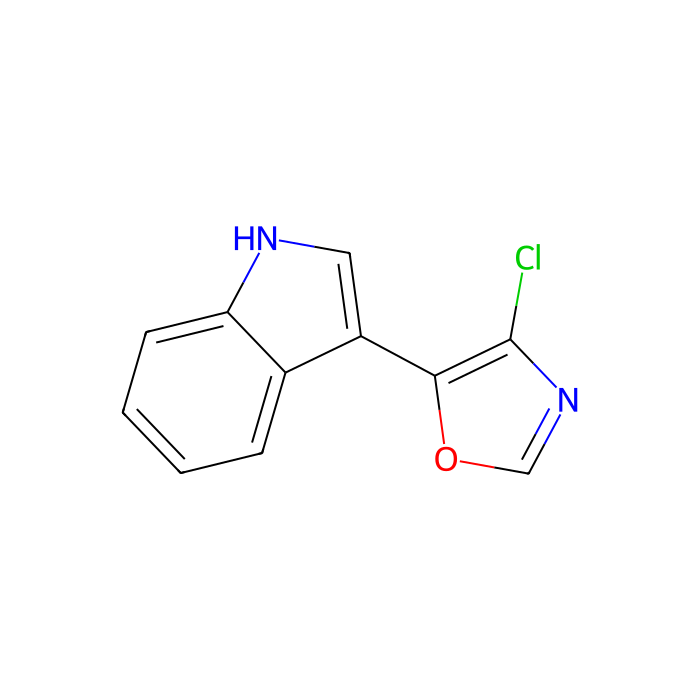
4-Chloro-5-(1H-indol-3-yl)-1,3-oxazole
仕様と純度
≥95%
生化学的・生理学的メカニズム
Potent antiangiogenic agent. Induces ROS-mediated apoptosis. Inhibits TNF-α-induced NF-κB activation. Shows selective cytotoxic effects against cancer cell lines. Inhibits mast cell degranulation. Shows potent anti-allergic effects in vivo.
保管条件
Store at -20°C,Desiccated
入荷
Ice chest + Ice pads
この製品は冷冷この冷このこの製品の運送が必要です。地上およびその他の経済サービスは利用できません。
注
Wherever possible, you should prepare and use solutions on the same day. However, if you need to make up stock solutions in advance, we recommend that you store the solution as aliquots in tightly sealed vials at -20°C. Generally, these will be useable for up to one month. Before use, and prior to opening the vial we recommend that you allow your product to equilibrate to room temperature for at least 1 hour. Need more advice on solubility, usage and handling? Please visit our frequently asked questions (FAQ) page for more details.
This compound belongs to the class of organic compounds known as indoles. These are compounds containing an indole moiety, which consists of pyrrole ring fused to benzene to form 2,3-benzopyrrole.
External Descriptors
Not available
1. Djoumbou Feunang Y, Eisner R, Knox C, Chepelev L, Hastings J, Owen G, Fahy E, Steinbeck C, Subramanian S, Bolton E, Greiner R, and Wishart DS. ClassyFire: Automated Chemical Classification With A Comprehensive, Computable Taxonomy. Journal of Cheminformatics, 2016, 8:61.
Determine the necessary mass, volume, or concentration for preparing a solution.
Dilution Calculator
Determine the dilution needed to prepare a stock solution.
Reconstitution Calculator
レビュー
顧客レビュー
Application Protocols
No tested application protocols are provided in the Product Data for this item.
General handling protocol for solution preparation (guidance only):
Warm the vial to ambient temperature in a desiccator before opening to prevent moisture condensation.
Accurately weigh the required amount quickly in a fume hood.
Prepare a concentrated stock in anhydrous DMSO (e.g., 10–50 mM). Vortex until fully dissolved; gentle sonication can assist dissolution.
For biological assays, dilute the DMSO stock into pre-warmed buffer or media with vigorous mixing to the desired final concentration, keeping DMSO ≤1% v/v unless otherwise validated.
Filter through a 0.22 µm PTFE or PVDF syringe filter if clarity is required.
LC–MS: C18 column, water–acetonitrile gradient (both with 0.1% formic acid), monitor the molecular ion exhibiting Cl isotopic pattern. Adjust gradient and wavelength based on your detector and compound behavior.
Always validate and document your in-house protocol for your specific application.
Biological Roles
Context (general literature; not a claim about this product’s performance):
Streptochlorin is reported as a microbial secondary metabolite from Streptomyces spp., representative of halogenated natural products produced via flavin-dependent halogenases.
Such metabolites are commonly investigated for ecological roles (competition, signaling) and as chemical probes in microbiology and natural products chemistry.
The chlorine substituent can modulate lipophilicity and metabolic stability of the scaffold, influencing membrane interactions and target binding in biochemical assays.
Research applications:
Reference compound in studies of biosynthetic gene clusters (BGCs), particularly halogenase-catalyzed steps and downstream tailoring enzymes.
Tool compound for dereplication and metabolomics workflows; the chlorine isotope pattern aids MS-based identification.
Substrate for semi-synthetic diversification to map structure–function relationships in enzymology or chemical biology.
Important note:
This product is supplied strictly for research use only (per Product Data). No clinical, diagnostic, or therapeutic claims are made. Any biological activity assessments should be performed under appropriate institutional approvals and using validated protocols.
Buffer Applications
This section is generally not applicable. Streptochlorin is a small-molecule natural product, not a buffering reagent. It does not serve as a pH buffer component in standard biochemical formulations.
Practical guidance:
If preparing assay solutions, use established biological buffers (e.g., PBS, HEPES, Tris) and dissolve streptochlorin first in a suitable co-solvent (commonly DMSO), then dilute into the buffer with vigorous mixing to avoid precipitation.
Confirm the final co-solvent percentage does not interfere with your assay system.
Green Alternatives
Greenness considerations focus on the solvents and processes used with streptochlorin rather than the molecule itself.
Opportunities for greener practice (general guidance):
Prefer greener solvents for chromatography and workup: Replace dichloromethane with EtOAc or 2-MeTHF where separation performance allows. Use heptane instead of hexane as the nonpolar partner.
Stock solutions and assays: If DMSO is required for solubility, minimize final assay concentration (≤1%) and validate precipitation risk. Where possible, evaluate ethanol as a greener alternative co-solvent.
Purification: Reverse-phase preparative HPLC using water–acetonitrile (or water–ethanol) can reduce halogenated solvent use compared to normal-phase methods.
Energy and stability: Store at −20°C as required, but reduce freeze–thaw cycling by aliquoting; this lowers waste from degraded material.
Illustrative comparison (process-level, not item-specific):
DCM vs EtOAc for extraction: EtOAc offers better environmental and safety profile, though selectivity may differ.
DMF vs Cyrene for certain transformations: If synthetic modification is planned, consider bio-based dipolar aprotics (e.g., Cyrene) where compatible with your catalyst system.
Always validate that greener substitutions do not compromise analytical integrity or material stability.
Pharmaceutical Uses
Not a pharmaceutical product. For research use only.
Relevant research-oriented context:
Natural products like streptochlorin may be used as analytical reference standards or internal standards during method development in discovery settings.
In pre-formulation research, investigators may explore solubility, stability, and excipient compatibility as part of physicochemical profiling. Such work is exploratory and does not imply suitability for clinical use.
Regulatory note:
No pharmacopeial monograph or excipient status is indicated for this item. Do not use in humans or for diagnostic procedures. For any GLP/GMP contexts, obtain and review full quality documentation and determine suitability independently.
Physical Properties
Item-specific specifications:
Appearance: Not specified for this item; refer to CoA/Spec Sheet.
Molecular Weight: Not specified for this item; refer to CoA/Spec Sheet.
Typical/literature-style information (for planning only; not specifications for this SKU):
Many chlorinated indole alkaloids are crystalline solids with low aqueous solubility and good solubility in polar aprotic organic solvents (DMSO, DMF) and moderately in methanol/ethanol. Actual solubility for this item should be verified experimentally or via CoA.
Melting point, logP, pKa, refractive index, and UV-Vis characteristics for streptochlorin vary across literature reports depending on purity and solvate/form; consult peer-reviewed sources or the specific lot documentation.
Practical guidance (general):
Dissolution: Start with anhydrous DMSO (e.g., 10–20 mg/mL stock), then dilute into aqueous systems using co-solvent (MeOH, EtOH) or surfactant if biological assays require. Filter through 0.22 µm if particulate remains.
Hygroscopicity/photolability: Halogenated indole-like compounds can exhibit light sensitivity and slow degradation in moist air; protect from light and moisture as a precaution.
Note: When precise property values are critical (e.g., extinction coefficients, partition coefficients), rely on the CoA/Spec Sheet and primary literature for the exact structure assigned to CAS 120191-51-7.
Quality and Grades
Item-specific quality notes:
Grade/Purity: Not specified for this item; refer to CoA/Spec Sheet for assay method (e.g., HPLC area%), residual solvents, and related substances.
What the grade typically means (general guidance):
Research-grade natural products are usually qualified by HPLC purity, identity by NMR/HRMS, and residual solvent by GC. Some lots may include water content by Karl Fischer and inorganic residue by ash; confirm via CoA.
For bioassay use, low levels of UV-active impurities and consistent polymorphic form are desirable. If you are comparing across lots, review chromatographic profiles to ensure comparable impurity patterns.
Stabilizers/additives:
None specified for this item. If a stabilizer or counterion is present (e.g., as a salt form), it will be stated on the CoA/label.
Verification recommendations:
Request lot-specific CoA and, if needed, supporting spectra (1H/13C NMR, MS, HPLC trace). For quantitative work, verify content via an internal standard method after drying under vacuum at ambient temperature (if compatible) to remove adventitious moisture and residual solvent.
Regulatory note:
For research use only (per Product Data). Not for diagnostic or therapeutic use.
Reaction and Applications
Manufacturer Applications: Not specified in Product Data.
General research applications (literature context; not item-specific claims):
Natural product reference standard: Used to develop and validate analytical methods (HPLC/LC–MS) for detection and quantification in Streptomyces extracts or in dereplication workflows.
Probe for SAR and derivatization: Chlorinated indole-like scaffolds permit late-stage functionalization (e.g., Suzuki/Miyaura cross-coupling at aryl–Cl when activated, electrophilic substitution on the heteroaromatic ring, N-alkylation/acylation at the indole nitrogen), enabling structure–activity studies.
Chemical ecology and biosynthesis studies: Employed to study halogenase enzyme pathways and the role of halogenation in microbial metabolite function.
Practical tips (general):
Dry handling: Minimize exposure to moisture and light to avoid hydrolysis or slow decomposition.
Analytical tracking: Use LC–MS with single-ion monitoring based on the molecular ion; the isotopic chlorine pattern provides a distinctive signature.
Derivatization: For cross-coupling at aryl chloride, consider Pd(0) catalysts with electron-rich phosphines under elevated temperatures, or convert to a more reactive aryl triflate/boronate if feasible.
Note: Specific biological endpoints or potencies are intentionally not discussed here. Use strictly for research and method development.
Reaction Conditions
Guidance below is general for halogenated indole-like natural products and should be adapted to the confirmed structure of streptochlorin per CoA.
Representative conditions (literature-style, not item-specific):
Suzuki–Miyaura cross-coupling at aryl–Cl: Pd2(dba)3 (1–2 mol%), XPhos or SPhos (2–4 mol%), boronic acid (1.5 eq), K3PO4 (2–3 eq), 1,4-dioxane/H2O (10:1) or toluene/EtOH/H2O, 80–110°C, 2–12 h. Monitor by LC–MS.
Buchwald–Hartwig amination: Pd(OAc)2 (2 mol%), BrettPhos (4 mol%), NaOtBu (2 eq), toluene or dioxane, 90–110°C. Sensitive heteroaromatics may require milder bases (Cs2CO3) and lower temperatures.
N-Acylation (if indolic N–H present): Acyl chloride (1.1 eq), base (Et3N or DIPEA), DCM or THF, 0°C to rt, 0.5–2 h; or EDCI/HOBt-mediated coupling in DMF for carboxylic acids.
Workup and purification:
Quench couplings with water, extract with EtOAc, wash brine, dry (Na2SO4), and purify via silica or reverse-phase depending on polarity. Protect from strong light during processing.
Stability checks:
Screen stability in base and acid at room temperature prior to high-temperature couplings. Use inert atmosphere (N2/Ar) to limit oxidative degradation.
Expected outcomes:
Yields are highly substrate-dependent; aryl chlorides on electron-poor rings often couple in moderate to good yields, while deactivated sites may require optimization.
Safety and Handling
Authoritative source: Always consult the SDS for your specific lot before use.
GHS information (Product Data):
Signal Word: Not specified for this item; refer to SDS.
H-Statements: Not specified for this item; refer to SDS.
GHS Classification: Not specified for this item; refer to SDS.
Pictograms: Not specified for this item; refer to SDS.
General laboratory precautions for halogenated, heteroaromatic natural products (guidance, not item-specific):
PPE: Lab coat, safety glasses, and appropriate chemically resistant gloves (e.g., nitrile). Use in a certified fume hood to minimize inhalation exposure during weighing and dissolution.
Avoid: Inhalation of dust, skin/eye contact, and ingestion. Prevent environmental release—treat waste as halogenated organic waste per institutional and local regulations.
Incompatibilities: Strong oxidizers and strong bases may promote degradation or side reactions; avoid prolonged exposure to light and moisture.
First aid (general): If on skin, wash with soap and water; if in eyes, rinse cautiously with water for several minutes, remove contacts if present; if inhaled, move to fresh air; if ingested, seek medical attention. Provide SDS to medical personnel.
Special risks: Fine powders can become airborne; weigh in a hood. If preparing concentrated DMSO stocks, avoid skin contact because DMSO can enhance dermal absorption.
Storage per Product Data:
Store at −20°C, desiccated. Protect from light. Shipments are provided cold (ice chest + ice pads).
Solvent Selection
This section offers general, literature-based guidance for chlorinated, indole-like natural products; it is not an item-specific specification.
Polarity and miscibility (general expectations):
Likely sparingly soluble in water; good solubility in polar aprotic solvents (DMSO, DMF) and moderate solubility in alcohols (MeOH, EtOH). Ethyl acetate and acetonitrile are often suitable for chromatography and workup.
Practical choices by use-case:
Stock solutions for assays: Anhydrous DMSO (10–50 mM), then dilute into assay buffers with ≤1% DMSO final. If precipitation occurs, include co-solvent (MeOH) or 0.01–0.1% non-ionic surfactant.
Purification: Normal-phase silica with eluents such as hexanes/EtOAc or DCM/MeOH; for strongly retained polar analogs, add a small amount of base (e.g., 0.1% NEt3) to suppress tailing. Reverse-phase C18 with water–acetonitrile or water–methanol, optionally with 0.1% formic acid for analytic methods.
Crystallization: EtOAc/hexanes or MeOH/water mixtures are typical screening pairs for halogenated aromatics; optimize empirically.
Comparison (general):
DMSO vs DMF: DMSO offers easier handling and lower volatility; DMF may better dissolve certain salts but is harder to remove.
MeOH/EtOH: Greener and volatile, but may not reach the same maximum solubility as DMSO.
Always confirm solvent compatibility with your specific lot and experimental design.
Storage and Reconstitution
Storage conditions (from Product Data):
Store at −20°C, desiccated. Protect from light if possible.
Shipped in: Ice chest + ice pads.
General best practices:
Upon receipt, allow the sealed container to equilibrate to room temperature in a desiccator before opening to avoid moisture condensation.
Aliquot immediately into moisture-tight, inert vials under dry nitrogen or argon if repeated access is expected. This minimizes freeze–thaw cycles and moisture exposure.
Keep the headspace dry; consider adding a desiccant pack to secondary containment.
Reconstitution guidance (not item-specific):
Prepare concentrated stocks in anhydrous DMSO or another validated solvent. Typical lab stocks: 10–50 mM. Label with solvent, concentration, and date.
For short-term storage of solutions, keep at −20°C protected from light; avoid repeated freeze–thaw by aliquoting. Inspect for precipitation or discoloration prior to use.
Stability note:
No explicit shelf-life or stability data are provided for this item. For critical applications, perform a small stability-indicating assay (e.g., HPLC purity check) after storage to confirm integrity.
Research use only: Not for human or diagnostic use.
Structure and Identity
Brief overview: Streptochlorin is a chlorinated natural product originally reported from Streptomyces spp. It is commonly discussed in the context of halogenated microbial secondary metabolites.
Item-specific identifiers (from Product Data):
CAS: 120191-51-7
CID: 44608049
InChIKey: Not specified for this item; refer to CoA/Spec Sheet. (Product Data lists "27568", which is not a complete InChIKey.)
SMILES: Not specified for this item; refer to CoA/Spec Sheet.
Molecular Formula: Not specified for this item; refer to CoA/Spec Sheet.
Molecular Weight: Not specified for this item; refer to CoA/Spec Sheet.
Structural features (general literature context, not item-specific):
Chlorinated heteroaromatic natural product; literature reports describe it as an indole-derived alkaloid from Streptomyces. Exact substitution pattern should be verified against the CoA/SDS for this catalog item.
Contains at least one aryl C–Cl bond; the remainder of the scaffold is heteroaromatic and conjugated.
No stereochemical centers are typically emphasized in summaries; confirm stereochemical details with an authenticated reference for your lot.
2D description (general):
A fused or single-ring heteroaromatic core bearing a chloro substituent; additional unsaturation and nitrogen heteroatom(s) consistent with an indole-like framework are commonly depicted in the literature. Please confirm precise connectivity from the official specification for this SKU.
Synthetic Utility
General synthetic perspective (literature context; not item-specific specifications):
As a chlorinated heteroaromatic scaffold, streptochlorin can serve as a starting point for semi-synthetic diversification. The aryl–Cl bond provides a handle for cross-coupling (e.g., Suzuki–Miyaura, Buchwald–Hartwig if an amination is targeted), depending on the precise substitution pattern and electronics.
Indole-type nitrogen (if present as reported in literature) can undergo N-acylation, N-alkylation, or protective group strategies to direct regioselectivity in electrophilic substitution on the ring system.
Electrophilic aromatic substitution (EAS) on an indole-like core can be tuned by protecting/deactivating groups; halogen–metal exchange followed by trapping can install new substituents if compatible with functional groups.
Analytical leverage:
The chlorine isotope pattern (M and M+2) simplifies LC–MS tracking during reaction optimization.
Caveats:
Aryl chlorides typically require more active catalysts/ligands than bromides/iodides for Pd-catalyzed couplings. Elevated temperature and electron-rich bulky phosphines or NHC ligands may be necessary.
Verify stability of the heteroaromatic core under basic or reductive conditions before scale-up. Consult the CoA for exact structure to select appropriate transformations.
Target Specificity
Not applicable. This product is a small-molecule natural product, not an antibody, enzyme, or nucleic acid probe with defined biological target specificity provided in the Product Data.
If used as a tool compound, any target engagement assessments should be generated de novo in your laboratory under validated assay conditions. No target or selectivity information is provided for this SKU.
よくある質問
What is the purity of this product?
This product is supplied at ≥95% purity (chemical assay). Lot-specific values are stated on the Certificate of Analysis.
How should this product be stored?
Store at ?20 °C, desiccated. Keep the container tightly closed with desiccant — the material is moisture-sensitive.
How is this product shipped?
This product ships in an insulated container with ice pads. Unpack on arrival and transfer it to the storage condition stated above.
What are the CAS number, molecular formula and molecular weight?
The CAS Number is 120191-51-7, the molecular formula is C11H7ClN2O, and the molecular weight is 218.64 g/mol. InChIKey BKYJGKRXUHPPLR-UHFFFAOYSA-N.
What documentation is provided?
Available product documentation, including Certificates of Analysis (COA), Safety Data Sheets (SDS), and specification sheets, is shown in the product document area. Document availability and access follow the current site policy.
Products are supplied to verified businesses, institutions, and qualified professionals for research and development use only. Not for use in humans, animals, diagnosis, or therapy.

 I2315080