グレード&純度Moligand™?Moligand™ — Aladdin's line of ligands and bioactive small molecules. Use for receptor, pathway, and binding studies needing defined small-molecule tools.10 mM in DMSO
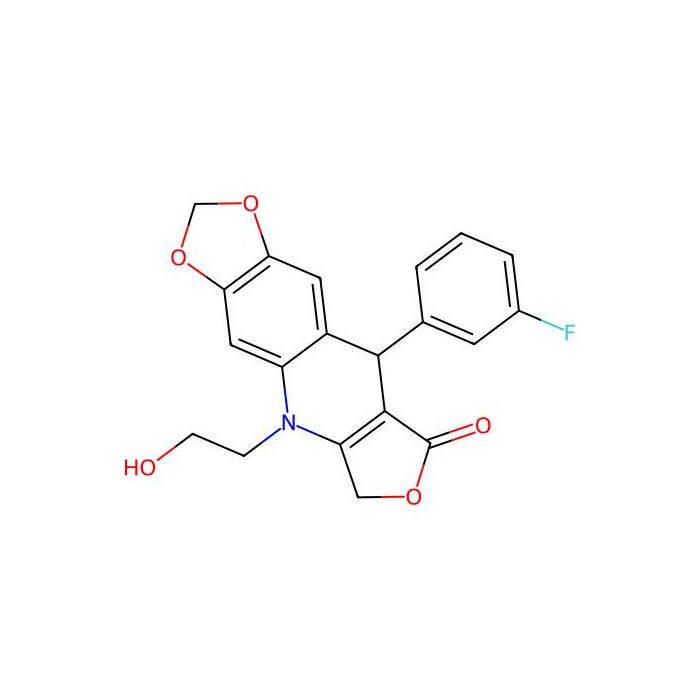
SU056 is a YB-1 inhibitor. SU056 induces cell-cycle arrest, apoptosis , and inhibits cell migration in ovarian cancer cells. SU056 interacts with YB-1 and inhibits and its associated downstream proteins and pathways. SU056 can enhance the cytotoxic effects of Paclitaxel.
仕様
仕様と純度
Moligand™, 10 mM in DMSO
保管条件
Store at -80°C
入荷
Dry ice packs + Cold packs
この製品は冷冷この冷このこの製品の運送が必要です。地上およびその他の経済サービスは利用できません。
等級
Moligand™
名前と識別子
分子量
369.34
詳細データ
証明書(CoA、COO、BSE/TSEと分析図)
C of A & Other Certificates(BSE/TSE, COO):
Analytical Chart:
ソリューション計算機
Molarity Calculator
Determine the necessary mass, volume, or concentration for preparing a solution.
Dilution Calculator
Determine the dilution needed to prepare a stock solution.
Reconstitution Calculator
レビュー
顧客レビュー
Application Protocols
No vendor-validated assay protocols are provided for SU056. The following general procedures are offered as practical guidance for handling small-molecule screening compounds.
Stock preparation:
Bring vial to room temperature in a desiccated environment before opening to avoid moisture condensation.
Dissolve in anhydrous DMSO to 10–50 mM. If solubility is uncertain, start at 10 mM and adjust.
Vortex and, if needed, brief sonication. Avoid prolonged heating.
Aliquoting and storage:
Prepare single-use aliquots (e.g., 10–50 μL) in inert, low-bind tubes or assay plates. Minimize headspace to reduce moisture uptake.
Store frozen at the item’s recommended temperature (see Storage & Reconstitution) and avoid repeated freeze–thaw cycles.
Assay dilution:
Dilute into assay buffer maintaining consistent final DMSO (typ. ≤0.5–1%). Mix thoroughly to prevent microprecipitates. Inspect for haze/precipitation.
Include appropriate negative and positive controls; add detergent if aggregation is suspected and target-compatible.
Quality checks:
Confirm initial purity and identity from CoA; optionally verify by LC–MS prior to critical screens.
Run interference controls for fluorescence/absorbance and redox activity in optical assays.
Note: Concentrations, incubation times, and buffer compositions must be optimized for each target/assay format.
Biological Roles
Biological function, targets, and pathways for SU056 are not disclosed in this listing. As a Moligand-grade screening compound, it should be treated as a target-agnostic small molecule until data establish a specific role.
General considerations for small-molecule library members:
Potential modalities: enzyme inhibition/activation, receptor modulation (orthosteric/allosteric), or pathway perturbation in phenotypic assays.
Off-target risks: aggregation-based inhibition, covalent promiscuity, metal chelation, redox cycling, and assay interference (fluorescence/absorbance). Employ counter-screens to identify these behaviors.
ADME-relevant properties (logP, TPSA, MW, pKa) are unknown for this item; measure or compute once structure is available to guide permeability/solubility expectations.
Practical guidance:
In biochemical assays, include controls for detergent sensitivity and thiol dependence where relevant.
In cellular assays, monitor cytotoxicity independently (e.g., resazurin, CellTiter-Glo) to distinguish target effects from general stress.
For binding studies, orthogonal confirmation (SPR, ITC, DSF, MST, ligand-observed NMR) is recommended to validate direct engagement.
Note: No biological role is claimed here. This product is for research use only, not for human or veterinary applications.
Buffer Applications
SU056 is a small organic screening compound rather than a buffering agent. It is not typically used to establish or maintain pH.
Buffer systems: Not applicable to this item. Select assay buffers based on the biological target (e.g., HEPES, PBS, Tris) and compatibility with DMSO stocks.
Practical notes:
Maintain consistent final DMSO (e.g., ≤1% v/v) across wells to avoid apparent activity shifts.
Include low levels of non-ionic detergent if aggregation is suspected and compatible with the target.
pH-dependent stability/ionization for SU056: Not specified for this item; determine experimentally if structure becomes available.
Green Alternatives
Because structure and solubility of SU056 are not disclosed, solvent selection must be guided by empirical testing. Nevertheless, greener choices and practices can reduce environmental impact in screening workflows.
Prefer DMSO over DMF/NMP when feasible: DMSO has a more favorable EHS profile and is widely accepted in assays at ≤1% v/v.
Favor ethanol or isopropanol as secondary co-solvents over chlorinated solvents for intermediate preparations, if solubility permits.
Minimize chlorinated solvent use (DCM, CHCl3) for any auxiliary sample handling; replace with ethyl acetate or CPME when applicable.
Use micro-scale dissolution and low-dead-volume liquid handlers to reduce solvent consumption.
Comparison (general characteristics):
DMSO: good solvency; low volatility; generally preferred for stocks.
Ethanol/IPA: greener, but limited solvency for highly lipophilic compounds; watch assay tolerance.
CPME/2-MeTHF: greener ethers for synthetic steps; less relevant to plate-ready stocks but useful in any resynthesis/cleanup.
Operational practices:
Implement closed, chilled storage of master DMSO stocks to reduce peroxide or impurity formation from air/moisture exposure.
Consolidate waste streams and adopt solvent recycling where validated by QA.
Note: No item-specific green metrics (e.g., PMI, LCA) are available for SU056.
Pharmaceutical Uses
No excipient or formulation uses are specified for SU056. This product is supplied for research use only in discovery and screening contexts.
General context for small-molecule tools (not specific to this item):
Early discovery compounds may be formulated in DMSO for in vitro testing and, upon sufficient characterization, transitioned to suitable vehicles for in vivo research (e.g., PEG/solutol systems). Such uses require robust stability and safety data, which are not provided here.
Pharmacopeial status: Not specified for this item; refer to CoA/Spec Sheet.
Compliance note:
Not for human or veterinary use. No clinical, diagnostic, or therapeutic claims are made or implied for SU056.
Physical Properties
Item-specific physicochemical data are not disclosed in this listing. Where a parameter is absent, consult the CoA/Spec Sheet or SDS. Do not assume values for experimental design.
Appearance: Not specified for this item; refer to CoA/Spec Sheet.
Molecular formula: Not specified for this item; refer to CoA/Spec Sheet.
Molecular weight: Not specified for this item; refer to CoA/Spec Sheet.
Melting point: Not specified for this item; refer to CoA/Spec Sheet.
Boiling point: Not specified for this item; refer to CoA/Spec Sheet.
Density: Not specified for this item; refer to CoA/Spec Sheet.
Refractive index: Not specified for this item; refer to CoA/Spec Sheet.
pKa: Not specified for this item; refer to CoA/Spec Sheet.
logP/logD: Not specified for this item; refer to CoA/Spec Sheet.
Solubility profile (water, DMSO, alcohols, chlorinated solvents): Not specified for this item; refer to CoA/Spec Sheet.
General guidance (literature/practice):
Library compounds are commonly provided as dry films or DMSO solutions. If supplied dry, initial dissolution in anhydrous DMSO is typical, then diluting into assay buffers with ≤1% final DMSO.
If sparingly soluble, gentle warming (room temperature to 37 °C) and brief sonication can help; avoid prolonged heating or strong base/acid unless stability is known.
Determine solubility and stability empirically using analytical LC–UV/MS and a small pre-screen solubility test (e.g., serial dilution in DMSO and aqueous buffer).
Quality and Grades
This item is supplied as Moligand™ grade, intended for small-molecule screening and discovery research.
What Moligand™ typically implies (general description):
Screening-library suitability, with identity and purity appropriate for HTS/fragment/lead-finding workflows.
Lots are commonly supported by analytical characterization (e.g., LC–MS, and where applicable NMR); exact tests and thresholds vary by item.
Item-specific specifications: Not specified for this item; refer to CoA/Spec Sheet.
UV cutoff, residual solvents, water content, metal content, and stabilizers: Not specified for this item; refer to CoA/Spec Sheet.
Practical guidance for users:
Before screening, verify purity and identity against the supplier CoA; consider in-house spot checks by LC–MS for critical campaigns.
If counter-screens are sensitive to impurities (e.g., fluorescence, redox cycling), perform a quick PAINS/aggregator filter and add orthogonal controls.
If the compound is used as a tool in SAR, align lot-to-lot identity via spectral overlays or HRMS.
Documentation: For audits and data packages, archive the supplier CoA, SDS, lot number, and storage history linked to SKU S1497680 and CAS 2376580-08-2.
Reaction and Applications
SU056 is offered as a small-molecule screening member of a discovery library rather than a synthetic reagent. Reaction chemistry specific to SU056 is not provided. The primary application domain is assay-based screening and target validation.
Typical research applications (general):
High-throughput screening (biochemical or biophysical) to identify preliminary hits against enzymes, receptors, or PPIs.
Phenotypic assays (cell-based or organismal) to reveal pathway modulation, followed by deconvolution.
Fragment-based or lead-like screening depending on the physicochemical profile; follow with orthogonal confirmation (e.g., DSF, SPR, ITC, NMR binding).
Probe development: after confirming activity and selectivity, analog synthesis and SAR exploration are common.
Assay development tips:
Use appropriate counter-screens for fluorescence/absorbance interference and redox activity; include detergent (e.g., 0.01% Triton X-100 or Tween-20) to mitigate aggregation if compatible.
Titrate across multiple concentrations (e.g., 10–12 point curves) to identify steep Hill slopes indicative of aggregation or multi-site effects.
Control final DMSO content and plate edge effects; validate activity with fresh aliquots to rule out degradation artifacts.
Note: Without a disclosed structure, reactivity, stability in buffers, and liability motifs (e.g., Michael acceptors) cannot be inferred—perform stability and reactivity checks as needed.
Reaction Conditions
Reaction conditions are not applicable to SU056 as provided; the product is intended as a ready-to-use screening compound, not a reagent for promoting or undergoing specific synthetic reactions in the user’s workflow.
General discovery-operations guidance (non-item-specific):
Preparation of assay stocks: dissolve in anhydrous DMSO to a convenient concentration (e.g., 10–50 mM), then dilute into assay buffer, maintaining constant final DMSO (typically ≤1%). Verify absence of precipitation visually and by plate reader baseline scans.
Stability checks: perform a short-term stability test (e.g., 24–72 h at room temperature and 4 °C in assay media) using LC–UV/MS to ensure integrity during assay windows.
Light/air sensitivity: if suspected, use amber vials, inert headspace, and minimize exposure times.
If SU056 is later used as a synthetic intermediate in your lab, reaction conditions must be designed from its actual functional groups; no generalized conditions can be responsibly recommended without the structure.
Safety and Handling
Safety information specific to SU056 is not provided in this listing. Always consult the product SDS for authoritative hazard classification and response procedures.
Signal word: Not specified for this item; refer to SDS.
GHS classification: Not specified for this item; refer to SDS.
Hazard statements (H-phrases): Not specified for this item; refer to SDS.
Pictograms: Not specified for this item; refer to SDS.
General laboratory precautions (good practice for small organic molecules):
PPE: lab coat, safety glasses, and appropriate chemically resistant gloves (e.g., nitrile). Use in a certified chemical fume hood to avoid inhalation of dust or aerosols.
Avoid skin/eye contact and ingestion. Prevent inhalation of powders; weigh in a ventilated balance enclosure if available.
Incompatibilities: Unknown for this specific item. As a precaution, segregate from strong oxidizers, acids/bases, and reactive metals until compatibility is known.
First aid (overview; follow SDS/site protocol):
Inhalation: move to fresh air; seek medical attention if symptoms persist.
Skin/eye contact: rinse with water for at least 15 minutes; remove contaminated clothing; seek medical attention as needed.
Ingestion: rinse mouth; do not induce vomiting unless directed; seek medical attention.
Waste: Collect in organic waste streams compliant with institutional and local regulations; do not discharge to drains.
Transport/handling: Keep sealed, minimize freeze–thaw cycles if in solution, and avoid light if photolability is suspected.
Solvent Selection
Solvent choice for SU056 cannot be specified from this listing; confirm experimentally. The following guidance reflects common practice for screening compounds.
Primary stock solvent:
DMSO (anhydrous) is typically preferred for small-molecule stocks due to broad solvency and assay compatibility at ≤0.5–1% v/v final concentration.
Alternative solvents (as needed):
DMF or NMP can dissolve challenging compounds but may be less assay-friendly; consider minimized percentages and appropriate controls.
Alcohols (MeOH, EtOH) may work for some chemotypes but can affect enzyme/cell assays above low percentages.
Aqueous buffers rarely dissolve hydrophobic libraries without co-solvent or surfactant.
Polarity/miscibility: Not specified for this item; refer to CoA/Spec Sheet.
Practical tips:
Start with 10–50 mM stocks in dry DMSO. If precipitation occurs on dilution, include a small co-solvent ramp (e.g., keep final DMSO at 0.5–1.0%).
Assess stability in chosen solvent by short-term LC–MS at room temperature and after freeze–thaw.
Filter clarification through 0.2 μm PTFE can remove particulates if compatible.
Quick comparison (general):
DMSO: broad solvency, assay-compatible; hygroscopic, can oxidize some motifs over time.
DMF/NMP: stronger solvency; higher cytotoxicity risk and background; use sparingly.
MeOH/EtOH: volatile, convenient; limited for highly lipophilic structures.
Storage and Reconstitution
Follow the item-specific storage and shipping conditions for SU056 to preserve integrity for screening use.
Storage conditions (as provided): Store at -80°C.
Shipped in: Dry ice packs + Cold packs.
Appearance: Not specified for this item; refer to CoA/Spec Sheet.
Reconstitution guidance (general, not item-specific):
Allow the sealed container to equilibrate to room temperature in a dry environment before opening to prevent moisture condensation.
Reconstitute initially in anhydrous DMSO to prepare a concentrated master stock (e.g., 10–50 mM), unless the CoA specifies an alternative solvent. Exact solvent suitability and concentration limits: Not specified for this item; verify empirically.
Mix by gentle vortexing; brief sonication can assist dissolution. Avoid exposure to strong light if chromophoric structures are suspected.
Aliquoting and handling:
Prepare single-use aliquots to avoid freeze–thaw. Store aliquots at -80°C in tightly sealed, moisture-resistant vials.
For working solutions, keep on ice or at 4°C during assay setup and return unused sealed aliquots promptly to -80°C.
Stability notes:
Long-term stability, solution stability in DMSO/buffer, and photostability: Not specified for this item; refer to CoA/Spec Sheet. Validate stability by LC–MS for critical experiments.
Research use only: Not for human or veterinary use.
Structure and Identity
Overview for SU056 (SKU S1497680), a Moligand-grade small-molecule library member intended for research screening workflows.
Product name: SU056
SKU: S1497680
CAS: 2376580-08-2
Category path: 全部 / 可售 / 小分子和化合物库
Grade: Moligand™ (screening-library grade)
Molecular formula: Not specified for this item; refer to CoA/Spec Sheet.
Molecular weight: Not specified for this item; refer to CoA/Spec Sheet.
SMILES: Not specified for this item; refer to CoA/Spec Sheet.
InChIKey: Not specified for this item; refer to CoA/Spec Sheet.
Structural features (general guidance):
Specific functional groups, ring systems, stereochemistry, and heteroatom content are not provided for this item. Consult the CoA/SDS for structural identifiers when available.
2D/3D depiction: Not supplied in this listing. If structure is later disclosed, evaluate for common screening alerts (e.g., PAINS substructures, redox-active moieties) before use in target-based assays.
Identification notes:
Use the CAS (2376580-08-2) and internal SKU to cross-reference in LIMS and inventory systems.
For analytical verification, typical orthogonal methods include LC–MS, 1H/13C NMR, and HRMS. Request the supplier CoA for exact identity tests applied to this lot.
Synthetic Utility
SU056 is offered as a screening compound for biological assays rather than as a synthetic building block. Without disclosed structure, no specific reactivity or functional-handle guidance can be provided.
General guidance if analog synthesis is pursued after hit identification (non-item-specific):
Map potential liabilities (e.g., Michael acceptors, quinones, catechols) and protected/latent functionalities before planning modifications.
Consider classical transformations to probe SAR: bioisosteric swaps, heterocycle edits, vector additions, polarity tuning, and conformational constraints.
Establish robust and scalable routes for resupply, choosing greener solvents and convergent steps where possible.
Note: Named reactions, protecting group strategies, and coupling methods depend entirely on the undisclosed scaffold; consult structure once available to plan synthetic campaigns.
Target Specificity
Target, binding mode, and selectivity data for SU056 are not provided in this listing.
Primary target(s): Not specified for this item; refer to CoA/Spec Sheet or internal screening results.
Mechanism of action: Not specified for this item.
Species selectivity or panel profiling: Not specified for this item.
Guidance:
Establish target specificity experimentally via orthogonal binding/functional assays and counterscreens against common off-targets relevant to your modality (e.g., kinases, CYPs, hERG, or assay-format artifacts) as appropriate for the program stage.
よくある質問
What is Moligand??
Moligand? is one of Aladdin Scientific's premium product lines, formulated for high-purity applications across multiple workflows. Compared to standard grades in the same workflow, Moligand? products typically offer tighter specifications, more rigorous QC, and stronger lot-to-lot consistency.
How should this product be stored?
Store at ?80 °C. Ultra-low temperature storage is required to maintain the specified shelf life.
How is this product shipped?
This product ships frozen with dry ice and cold packs. Unpack on arrival and transfer it to the storage condition stated above; handle dry ice with insulated gloves in a ventilated area.
What are the CAS number, molecular formula and molecular weight?
The CAS Number is 2376580-08-2, the molecular formula is C20H16FNO5, and the molecular weight is 369.34 g/mol.
What documentation is provided?
Available product documentation, including Certificates of Analysis (COA), Safety Data Sheets (SDS), and specification sheets, is shown in the product document area. Document availability and access follow the current site policy.
Products are supplied to verified businesses, institutions, and qualified professionals for research and development use only. Not for use in humans, animals, diagnosis, or therapy.