GRADE & PURITYMoligand™?Moligand™ — Aladdin's line of ligands and bioactive small molecules. Use for receptor, pathway, and binding studies needing defined small-molecule tools.10 mM in DMSO
Moligand™, 10 mM in DMSO Moligand™ for sensitive chromatographic and analytical workflows requiring minimal baseline interference.
🌡
Storage & shipping
Store at -80°C Ships Dry ice packs + Cold packs Check lot-specific COA for exact specifications.
📋
Quality documents
SDS, COA, datasheet, and spec sheet available for download. Lot-specific COA accessible via lot number lookup.
📚
Literature proof
Cited in 0 peer-reviewed publications across chromatography, organic synthesis, and cross-coupling reactions.
概要
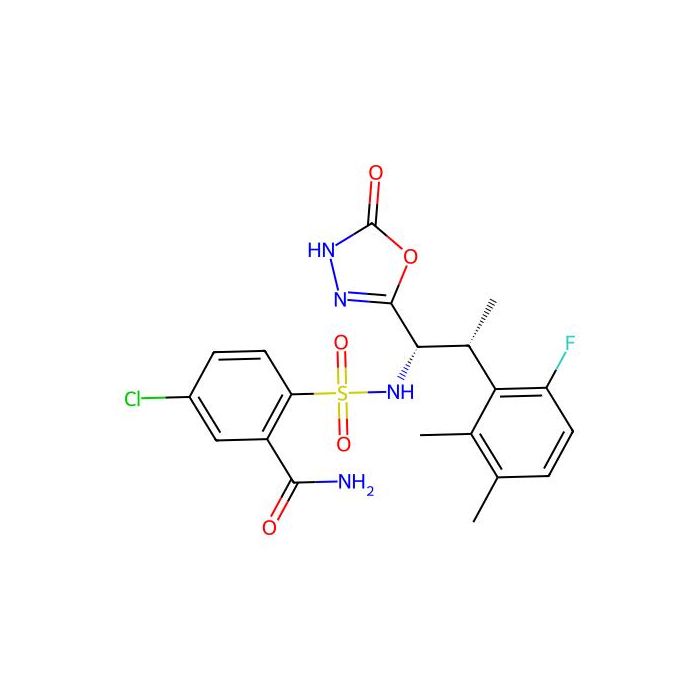
TAS1553 is a potent, orally active protein–protein interaction (PPI) inhibitor with an IC 50 values of 0.0396 μM. TAS1553 inhibits DNA replication and reduces intracellular dATP pool. TAS1553 induces apoptosis . TAS1553 can be used for cancer research.
Specifications
仕様と純度
Moligand™, 10 mM in DMSO
保管条件
Store at -80°C
入荷
Dry ice packs + Cold packs
この製品は冷冷この冷このこの製品の運送が必要です。地上およびその他の経済サービスは利用できません。
等級
Moligand™
名前と識別子
分子量
482.91
Documentation
📋 Safety Data Sheet (SDS)
Comprehensive hazard, handling, storage, and regulatory compliance document.
Determine the necessary mass, volume, or concentration for preparing a solution.
Dilution Calculator
Determine the dilution needed to prepare a stock solution.
Reconstitution Calculator
レビュー
顧客レビュー
Application Protocols
No vendor-tested biological applications or dilution guidelines are provided for this item.
General setup for small-molecule screening (non-item-specific):
Prepare a concentrated DMSO stock (e.g., 10 mM) if soluble; filter if your assay permits. Serially dilute in DMSO, then back-dilute into assay buffer to the desired final concentration, keeping DMSO constant across wells.
Include vehicle controls and, where available, positive/negative control ligands. Run at least triplicates and evaluate Z′-factor to qualify assay performance.
Confirm hits with independent batches or reweigh/requantify from the same batch.
Biological Roles
No biological mechanism, target class, or pathway information is provided for this item in the product data. As supplied in a compound library, TAS1553 should be treated as an investigational research chemical with undetermined biological roles.
General guidance for researchers (non-item-specific):
Establish baseline cytotoxicity in your model system and confirm on-target activity using orthogonal assays to rule out assay interference, redox activity, or colloidal aggregation.
If a hypothesized target emerges, integrate biochemical potency with ADME-relevant properties (stability in buffer/serum, permeability, and nonspecific binding) to contextualize phenotype.
Avoid extrapolation to clinical relevance; this product is for research use only.
Buffer Applications
This product is not a buffering reagent. No buffer system, pH range, or ionic strength specifications are applicable.
Practical note (general): When dosing small molecules from DMSO stocks into aqueous buffers, pre-warm and add slowly with thorough mixing to minimize precipitation. Validate buffer compatibility and final cosolvent percentages empirically for your assay.
Green Alternatives
Because TAS1553 is a library screening compound rather than a process solvent or commodity reagent, “green alternatives” typically refer to handling practices rather than replacing the molecule itself.
Greener handling suggestions (general, not item-specific):
Use minimal DMSO volumes and prefer aqueous-compatible assay formats to reduce organic solvent consumption.
Consolidate stock concentrations to decrease freezer footprint and packaging waste.
Apply microscale screening (e.g., 384/1536-well formats) to cut solvent and consumable usage per data point.
Favor room-temperature workflows and short equilibration times to lower energy demand, consistent with compound stability.
If your need is a synthetic transformation rather than screening with TAS1553, consider greener solvent systems (e.g., water/ethanol, 2-MeTHF, CPME) and catalytic methods; however, those are not applicable to this SKU’s primary use as a screening molecule.
Pharmaceutical Uses
This product is supplied strictly for research use; it is not formulated as an excipient or active ingredient and has no pharmacopeial status provided.
Regulatory/compliance: Not intended for human or veterinary use; no GMP/ICH attributes are claimed.
Potential formulation learnings (general, not item-specific): If preformulation screening is desired (e.g., solubility, stability, salt formation), perform on a research scale and do not construe results as suitable for clinical translation without appropriate quality upgrades and regulatory controls.
Physical Properties
Item-specific physicochemical constants are not included in the product data. Where needed for method development or formulation, please consult the CoA/SDS or perform a small-scale pretest.
Appearance: Not specified for this item; refer to CoA/Spec Sheet.
Molecular weight: Not specified for this item; refer to CoA/Spec Sheet.
Melting point: Not specified for this item; refer to CoA/Spec Sheet.
Boiling point: Not specified for this item; refer to CoA/Spec Sheet.
Density: Not specified for this item; refer to CoA/Spec Sheet.
pKa/logP/refractive index: Not specified for this item; refer to CoA/Spec Sheet.
Solubility: Not specified for this item; refer to CoA/Spec Sheet.
General laboratory guidance (literature/common practice, not item-specific):
For unknown small molecules in screening collections, initial dissolution is often evaluated in anhydrous DMSO at 10–50 mM, followed by dilution into assay buffers containing 0.1–1% DMSO to minimize precipitation.
If aqueous use is required, consider co-solvent systems (e.g., DMSO or ethanol ≤1–2% v/v) and surfactant wetting (0.01–0.05% nonionic) after verifying compatibility with your assay.
Assess stability by LC–UV/LC–MS after freeze–thaw cycling and during bench-top exposure to establish handling windows.
Quality and Grades
Grade/Purity: Moligand™ (as listed). This denotes inclusion in Aladdin’s small-molecule/ligand-oriented discovery collection intended for research screening and method development. It is not a pharmaceutical grade and is not intended for human or veterinary use.
Purity specification, residual solvents, water content, metal limits, and stabilizers: Not specified for this item; refer to CoA/Spec Sheet.
What Moligand™ commonly implies (general guidance, not a specification):
Emphasis on ligand-like chemical space suitable for target discovery, biochemical assays, and phenotypic screening.
Identity typically supported by spectral methods (e.g., LC–MS, NMR) in screening collections; for this SKU, consult the provided CoA for the exact tests performed.
Batch-to-batch documentation: A certificate of analysis is provided upon request or with shipment for traceability.
Practical notes for users:
If you require chromatography-ready material (e.g., HPLC/LC–MS reference standard with low UV background), verify UV cutoff and absorbance profile in the CoA—Not specified for this item.
If your workflow is sensitive to peroxides, water, or metals, perform incoming QC checks (iodometric peroxide test, KF, ICP) as needed.
For bioassays, confirm endotoxin sensitivity of your system; these items are not certified endotoxin-free unless explicitly stated in the CoA.
Reaction and Applications
This item is supplied as a research screening compound within a small-molecule/compound library, not as a synthetic reagent. Consequently, classical synthetic reaction applications (e.g., coupling, reductions) are not the primary use-case.
Biochemical target screening: Use as part of primary/secondary assays to probe ligandability. Validate with orthogonal readouts to mitigate assay artifacts (e.g., redox cycling, aggregation). Conditions are assay-specific.
Cell-based phenotypic assays: Evaluate concentration–response curves with appropriate vehicle controls and cytotoxicity counterscreens to detect nonspecific effects.
Mechanism-of-action follow-up: Employ thermal shift assays, CETSA, SPR/BLI, or target engagement MS where structural information becomes available. Negative controls and matched analogs strengthen interpretation.
Physicochemical profiling: Determine solubility, stability in assay buffers, and permeability (PAMPA/MDCK) as needed.
Note: Absent structural data, users should implement PAINS/REOS filters empirically via counterscreens and ensure detergent-sensitive assays include anti-aggregation controls. For synthesis or derivatization, please request structure disclosure or a building-block variant if available.
Reaction Conditions
Classical reaction conditions are not applicable for this SKU because it is provided as a finished screening compound rather than a reagent. No catalysis/temperature/solvent parameters are specified.
General experimental conditions relevant to screening (non-item-specific):
Stock handling: Prepare fresh DMSO stocks where feasible; limit freeze–thaw cycles to maintain integrity. Verify concentration by UV or quantitative 1H NMR if needed.
Assay incubation: Determine time-to-steady-state empirically; include vehicle controls at matched DMSO percentages.
Stability checks: Monitor by LC–MS after typical assay exposure (e.g., 1–24 h at ambient or 37°C) to confirm chemical stability.
Safety and Handling
Hazard classification for this specific item is not provided in the product data. Always consult the SDS supplied with the shipment for authoritative guidance.
GHS signal word/classification/pictograms: Not specified for this item; refer to SDS.
H-statements: Not specified for this item; refer to SDS.
General laboratory precautions (non-item-specific):
Handle in a chemical fume hood with appropriate PPE: lab coat, safety glasses, and chemically resistant gloves (e.g., nitrile). Avoid aerosolization of powders and inhalation of dusts.
Prevent contact with skin, eyes, and clothing. Wash thoroughly after handling. Do not eat, drink, or smoke in work areas.
Storage incompatibilities: Until specific functional groups are known, segregate from strong oxidizers and acids/bases; use secondary containment and desiccation if hygroscopicity is suspected.
First aid overview: In case of contact, rinse affected area with copious water; remove contaminated clothing. If inhaled, move to fresh air. If ingested or if symptoms persist, seek medical attention. Provide the SDS to responders.
Waste: Dispose according to institutional hazardous waste procedures. Avoid drain disposal. Label with full identity if available or as “organic research chemical—hazard undetermined.”
Note: Small-molecule libraries can include compounds with unknown or mixed hazards. Treat as harmful until proven otherwise; minimize exposure and scale.
Solvent Selection
The structure and polarity of TAS1553 are not disclosed here; therefore solvent choice should be guided by small-scale solubility screens and assay compatibility.
General strategy for library compounds (not item-specific):
Stock solutions: Start with anhydrous DMSO due to broad solvating power; typical screening stocks are 10 mM or 20 mM, prepared under dry, inert conditions when stability is uncertain.
Alternative solvents: If DMSO is unsuitable for your assay, try DMF or ethanol. For hydrophobic materials, consider co-solvent mixtures (DMSO/ethanol) or gentle warming/sonication. For basic/acidic compounds, buffered aqueous media at appropriate pH may aid dissolution after initial DMSO stock preparation.
Assay transfer: Keep final DMSO ≤0.1–1% v/v in biochemical/cell assays, subject to assay tolerance.
Precipitation control: Inspect visually and by light scattering/UV shift after dilution. Centrifuge or pre-filter (0.22 µm PTFE) if acceptable for your assay.
Comparison (general, literature-based):
DMSO: widest applicability; potential assay interference at >1%.
DMF: strong solvent but higher toxicity; verify compatibility.
Ethanol: biocompatible at low %; lower solvency for highly lipophilic compounds.
Note: Record exact solvent lots, concentrations, and handling to enhance reproducibility across screening campaigns.
Storage and Reconstitution
Storage conditions (from product data): Store at -80°C. Shipments are provided on dry ice packs + cold packs to maintain low-temperature integrity.
Container handling: Minimize headspace and moisture ingress. Use desiccation and inert gas backfill after opening if stability is uncertain. Keep tightly closed.
Stability: Not specified for this item; refer to CoA/Spec Sheet. Until data are available, treat as sensitive to light, moisture, and temperature.
Reconstitution (general guidance, not item-specific):
Allow the sealed vial to equilibrate to room temperature before opening to prevent condensation.
Dissolve an accurately weighed amount in anhydrous DMSO to prepare a concentrated stock (e.g., 10–20 mM if soluble). Mix gently; use brief sonication if needed.
If aqueous use is required, dilute the DMSO stock slowly into buffered media with vigorous mixing to mitigate precipitation. Keep final DMSO within assay-compatible limits.
Aliquoting: Prepare single-use aliquots to avoid repeated freeze–thaw. Store aliquots at -80°C in inert-atmosphere vials when possible.
Thawing/Refreezing: Avoid multiple cycles. Discard aliquots showing visible precipitation, discoloration, or LC–MS evidence of degradation.
Research use note: For research use only.
Structure and Identity
This entry corresponds to a proprietary small-molecule library member supplied under Aladdin’s Moligand series for discovery research. Item-specific structural identifiers are not disclosed in the product data below.
Product name: TAS1553 (SKU: T1497719)
CAS: 2166023-31-8
Molecular formula: Not specified for this item; refer to CoA/Spec Sheet.
Molecular weight: Not specified for this item; refer to CoA/Spec Sheet.
SMILES: Not specified for this item; refer to CoA/Spec Sheet.
InChIKey: Not specified for this item; refer to CoA/Spec Sheet.
Structural features: Not specified for this item; refer to CoA/Spec Sheet.
2D structural description (general): Without a provided structure, ring systems, heteroatoms, and stereochemical information cannot be summarized for this SKU. If your workflow requires substructure filters (e.g., PAINS, Lipinski compliance, heteroaromatic content), please request the CoA/structure file under appropriate confidentiality arrangements or screen empirically using orthogonal assays.
Synthetic Utility
Not applicable as primary value. TAS1553 is offered as a screening library compound rather than a building block or reagent.
If derivatization or SAR expansion is intended (general guidance):
Request structural disclosure or an analog set where available; absent structure, synthetic planning cannot be advised.
Employ parallel synthesis and micro-scale purification (FLASH/SFC/preparative LC) to generate confirmatory analogs once the core scaffold is known.
Use orthogonal analytics (LC–MS, 1H/13C NMR, HRMS, and purity by area %) to support SAR decisions and ensure biological data quality.
Target Specificity
No target information is provided for TAS1553 in the product data. There are no validated targets, selectivity panels, or binding constants disclosed for this SKU.
If your workflow requires target annotation (general guidance):
Apply chemoproteomics, CETSA/thermal profiling, or affinity capture with appropriate controls.
Use orthogonal biochemical assays and counterscreens to confirm specificity and detect assay interference.
よくある質問
What is Moligand??
Moligand? is one of Aladdin Scientific's premium product lines, formulated for high-purity applications across multiple workflows. Compared to standard grades in the same workflow, Moligand? products typically offer tighter specifications, more rigorous QC, and stronger lot-to-lot consistency.
How should this product be stored?
Store at ?80 °C. Ultra-low temperature storage is required to maintain the specified shelf life.
How is this product shipped?
This product ships frozen with dry ice and cold packs. Unpack on arrival and transfer it to the storage condition stated above; handle dry ice with insulated gloves in a ventilated area.
What are the CAS number, molecular formula and molecular weight?
The CAS Number is 2166023-31-8, the molecular formula is C20H20ClFN4O5S, and the molecular weight is 482.91 g/mol.
What documentation is provided?
Available product documentation, including Certificates of Analysis (COA), Safety Data Sheets (SDS), and specification sheets, is shown in the product document area. Document availability and access follow the current site policy.
Need help choosing the grade?
Our grade selection guide covers purity, stabilizer status, and application suitability for all variants in our catalog.
Products are supplied to verified businesses, institutions, and qualified professionals for research and development use only. Not for use in humans, animals, diagnosis, or therapy.