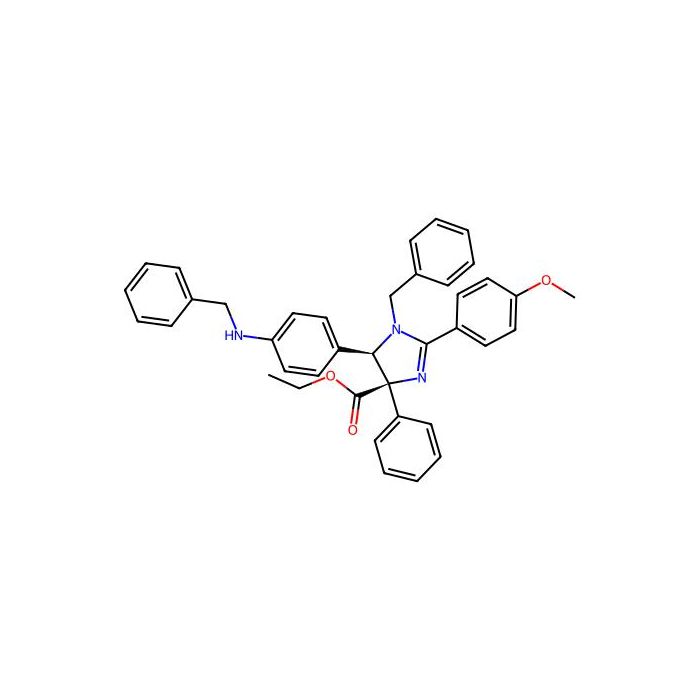
Determine the necessary mass, volume, or concentration for preparing a solution.
TCH-165 is a small molecule modulator of proteasome assembly , which increases 20S levels and facilitates 20S -mediated protein degradation
In Vitro
TCH-165 (0.01-10 μM; 72 hours; RPMI8226 and U87MG cells) treatment inhibits cell growth of RPMI8226 and U87MG cells with IC 50 of 1.6 μM and 2.4 μM, respectively. ?\nTCH-165 (0-10 μM; 24 hours; HEK293T cells) treatment enhances ODC degradation is blocked by BTZ indicated that this event is proteasome-mediated. TCH-165 enhances proteolytic degradation in a concentration-dependent manner. ?\nTCH-165 enhances the chymotrypsin-like (CT-L), trypsin-like (Tryp-L) and caspase-like (Casp-L) activities with EC 50 s of 4.2 μM, 3.2 μM and 4.7 μM, respectively. ?\nTCH-165 enhances 20S-mediated degradation of IDPs, α-syn, and tau in vitro, and does not induce the degradation of structured proteins such as GAPDH. ?\nTCH-165-treated cells display a decrease in the assembled 26S and an increase in the 20S proteasome. TCH-165 regulates the dynamic equilibrium between the 20S and 26S proteasome complexes, favoring 20S-mediated protein degradation. MCE has not independently confirmed the accuracy of these methods. They are for reference only. Cell Viability AssayCell Line: RPMI8226 and U87MG cells Concentration: 0.01-10 μM Incubation Time: 72 hours Result: Inhibited cell growth of RPMI8226 and U87MG cells with IC 50 of 1.6 μM and 2.4 μM, respectively. Western Blot AnalysisCell Line: HEK293T cells Concentration: 0 μM, 3 μM, 10 μM Incubation Time: 24 hours Result: Enhanced proteolytic degradation in a concentration-dependent manner.
Form:Solid
IC50& Target:Proteasome assembly
Taxonomy Tree
| Kingdom | Organic compounds |
|---|---|
| Superclass | Phenylpropanoids and polyketides |
| 分類 | Stilbenes |
| Subclass | Not available |
| Intermediate Tree Nodes | Not available |
| Direct Parent | Stilbenes |
| Alternative Parents | Phenylbenzamines Alpha amino acids and derivatives Anisoles Phenylalkylamines Phenoxy compounds Benzylamines Methoxybenzenes Aniline and substituted anilines Secondary alkylarylamines Alkyl aryl ethers Imidolactams Imidazolines Carboxylic acid esters Carboximidamides Carboxamidines Propargyl-type 1,3-dipolar organic compounds Monocarboxylic acids and derivatives Azacyclic compounds Carbonyl compounds Hydrocarbon derivatives Organic oxides |
| Molecular Framework | Aromatic heteromonocyclic compounds |
| Substituents | Phenylbenzamine - Stilbene - Alpha-amino acid or derivatives - Phenoxy compound - Anisole - Benzylamine - Phenol ether - Phenylmethylamine - Methoxybenzene - Phenylalkylamine - Aniline or substituted anilines - Alkyl aryl ether - Secondary aliphatic/aromatic amine - Aralkylamine - Imidolactam - Benzenoid - Monocyclic benzene moiety - 2-imidazoline - Amino acid or derivatives - Carboxylic acid ester - Organoheterocyclic compound - Propargyl-type 1,3-dipolar organic compound - Organic 1,3-dipolar compound - Carboximidamide - Amidine - Carboxylic acid amidine - Carboxylic acid derivative - Secondary amine - Ether - Azacycle - Monocarboxylic acid or derivatives - Amine - Organic oxide - Organic nitrogen compound - Carbonyl group - Organonitrogen compound - Organooxygen compound - Hydrocarbon derivative - Organic oxygen compound - Aromatic heteromonocyclic compound |
| 説明 | This compound belongs to the class of organic compounds known as stilbenes. These are organic compounds containing a 1,2-diphenylethylene moiety. Stilbenes (C6-C2-C6 ) are derived from the common phenylpropene (C6-C3) skeleton building block. The introduction of one or more hydroxyl groups to a phenyl ring lead to stilbenoids. |
| External Descriptors | Not available |
Find and download the COA for your product by matching the lot number on the packaging.
| Lot Number | Certificate Type | 日付 | 商品 |
|---|---|---|---|
| Certificate of Analysis | Apr 15, 2026 | T650057 | |
| Certificate of Analysis | Apr 15, 2026 | T650057 | |
| Certificate of Analysis | Apr 15, 2026 | T650057 | |
| Certificate of Analysis | Apr 15, 2026 | T650057 | |
| Certificate of Analysis | Apr 15, 2026 | T650057 | |
| Certificate of Analysis | Apr 15, 2026 | T650057 |
| 溶解度 | DMSO : 250 mg/mL (419.65 mM; Need ultrasonic) |
|---|---|
| 感度 | Light sensitive |
| 分子量 | 595.700 g/mol |
| XLogP3 | 7.500 |
| Hydrogen Bond Donor Count | 1 |
| Hydrogen Bond Acceptor Count | 5 |
| Rotatable Bond Count | 12 |
| Exact Mass | 595.283 Da |
| Monoisotopic Mass | 595.283 Da |
| Topological Polar Surface Area | 63.200 Ų |
| Heavy Atom Count | 45 |
| Formal Charge | 0 |
| Complexity | 937.000 |
| Isotope Atom Count | 0 |
| Defined Atom Stereocenter Count | 2 |
| Undefined Atom Stereocenter Count | 0 |
| Defined Bond Stereocenter Count | 0 |
| Undefined Bond Stereocenter Count | 0 |
| The total count of all stereochemical bonds | 0 |
| Covalently-Bonded Unit Count | 1 |
No manufacturer-validated application protocols are provided in the product data for this item. The following is general guidance for handling small-molecule screening compounds; it is not a substitute for item-specific instructions.
General protocol outline (discovery assays):
Analytical confirmation:
If the manufacturer provides future protocols (e.g., recommended concentration ranges, assay windows, or instrument settings) for this exact CAS/CID, follow those item-specific instructions preferentially.
No target, pathway, or mechanism of action is specified for this item in the provided data. The following notes describe general considerations for small-molecule ligands used in discovery research.
General roles for screening ligands:
Assay planning considerations (general):
Biophysical assessments:
Important: Do not attribute specific biological activities, targets, or therapeutic implications to this product without explicit data from the CoA, literature tied to the exact CAS/CID, or internal validation. Research Use Only.
This product is a discrete small-molecule research ligand rather than a buffering reagent. Therefore, conventional buffer formulation guidance (e.g., phosphate, HEPES, Tris recipes and pH ranges) does not apply directly.
Practical notes for assay buffers (general, not item-specific):
Buffer additives (as assay-appropriate):
Because no item-specific pKa, solubility, or stability data are available, any buffer optimization should be empirically determined and documented for reproducibility.
Green chemistry considerations mainly pertain to solvents and processing, since the compound’s structure and hazards are not specified.
Greener handling strategies (general guidance):
Comparison of common options (general):
Operational best practices:
Because item-specific environmental metrics (e.g., degradability, aquatic toxicity) are not provided, prioritize institutional green lab policies and select greener solvents/co-solvents consistent with your assay’s needs.
This product is supplied strictly for research use only and is not intended for human or veterinary use, diagnostic procedures, or as an API.
Context for discovery research (general information, not specific to this item):
Manufacturing/formulation relevance:
Documentation:
In summary, there are no pharmaceutical or excipient uses claimed or implied for this listing.
Item-specific physicochemical properties are not provided in the current data package and should be obtained from the CoA/Spec Sheet.
Item-specific (from Product Data):
Typical small-molecule library compound handling notes (general guidance, not item-specific specifications):
Literature/computed properties: Not provided here due to absent structure. If you obtain the SMILES/InChI, you may predict:
Important: Do not treat any estimates as product specifications. Always defer to the lot-specific CoA and your in-house measurements.
Grade/Purity designation: Moligand™.
What Moligand™ means (general program description):
Implications for this item:
How to interpret the grade in practice:
Quality control recommendations:
Note: No contradictions with the product data are implied; where specifics are absent, consult the CoA.
This product is supplied as a Moligand™ small-molecule entry for research screening and ligand discovery. It is not primarily intended as a synthetic reagent, catalyst, or solvent.
Applicable uses (general for Moligand-class items):
Not typically applicable for this item:
Practical tips (general):
Please consult the CoA for any manufacturer-provided functional annotations before designing application studies.
Not typically applicable. This product is not provided as a reagent for chemical synthesis but as a research small molecule for screening.
General handling conditions (non-synthetic, assay-oriented):
If you intend to derivatize or immobilize the compound (advanced users):
Note: Do not extrapolate synthetic conditions from unrelated compounds. Verify stability experimentally under any proposed conditions before scale-up.
GHS and hazard statements are not specified for this item; consult the Safety Data Sheet (SDS) for authoritative information.
Product Data safety fields:
General laboratory precautions for small organic molecules (non-item-specific):
Special risks (class-level considerations):
Always defer to the SDS for this specific item and your institution’s EHS guidance.
Item-specific solubility is not provided; use the following general approach for small-molecule screening ligands.
Primary stock preparation (general guidance):
Alternative solvents (general, choose empirically):
Polarity and miscibility profile:
Small comparison (general):
Always establish solvent compatibility with your biological or analytical system. Do not treat this guidance as item-specific specification.
Item-specific storage and shipping (from Product Data):
Reconstitution guidance (general, not item-specific specification):
Aliquoting and stability:
Handling notes:
For exact solubility limits, stability windows, and any stabilizers present, refer to the lot-specific CoA/Spec Sheet.
Overview for SKU T650057 (TCH-165). This listing is part of Aladdin Scientific's Moligand™ small-molecule/compound library collection.
Structural features:
2D structure description (general guidance):
Identity best practices:
This listing represents a finished small-molecule ligand for screening and is not positioned as a synthetic intermediate or reagent.
Non-applicability:
Potential utility in method development (general):
Retrosynthetic/value considerations:
Conclusion:
No target, pathway, or binding partner is specified for this item in the provided product data.
Item-specific details (strictly from product data):
Guidance:
Until target information is officially provided, treat TCH-165 as an unassigned screening compound.
当社のグレード選定ガイドでは、カタログ内のすべてのバリエーションについて、純度、安定剤の状態、用途への適合性を網羅しています。
Moligand™ グレードガイドを見る →