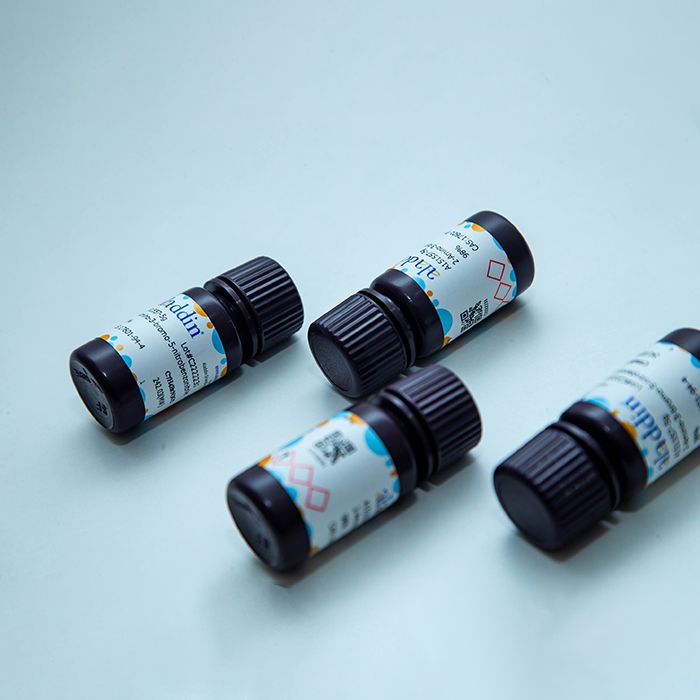
Teprasiran - ≥90% , CAS No.1231737-88-4

CAS: 1231737-88-4 Cat. No.: T648826 分子量: 12320.00
注文可能
GRADE & PURITY ≥90%
Storage
Store at 2-8°C,Desiccated
Shipped In
Wet ice
★
Size
USA
ドイツ (EU)*
Price
Qty
1mg
T648826-1mg
受注生産 · 8~12週間
$800.90
5mg
T648826-5mg
受注生産 · 8~12週間
$2,360.90
Enter a quantity for the sizes you want to add.
🧪
Why this grade

≥90% for sensitive chromatographic and analytical workflows requiring minimal baseline interference.

🌡

Storage & shipping

Store at 2-8°C,Desiccated Ships Wet ice Check lot-specific COA for exact specifications.

📋

Quality documents

SDS, COA, datasheet, and spec sheet available for download. Lot-specific COA accessible via lot number lookup.

📚

Literature proof

Cited in 0 peer-reviewed publications across chromatography, organic synthesis, and cross-coupling reactions.

概要

Teprasiran (QPI-1002) is a small interfering RNA that temporarily inhibits p53 -mediated cell death that underlies acute kidney injury (AKI).

In Vitro

Teprasiran is a synthetic, chemically stabilized small interfering RNA (siRNA) acting through RNA interference, which temporarily inhibits p53 expression for ≈48 to 72 hours. MCE has not independently confirmed the accuracy of these methods. They are for reference only.

Form:Solid

Specifications

仕様と純度
≥90%
生化学的・生理学的メカニズム
Teprasiran (QPI-1002) is a small interfering RNA that temporarily inhibits p53 -mediated cell death that underlies acute kidney injury (AKI).
保管条件
Store at 2-8°C,Desiccated
入荷
Wet ice
この製品は冷冷この冷このこの製品の運送が必要です。地上およびその他の経済サービスは利用できません。
純度
≥90%
名前と識別子
カノニカル・スマイル
[Teprasiran]
分子量
12320.00

Documentation

📋 Safety Data Sheet (SDS)

Comprehensive hazard, handling, storage, and regulatory compliance document.

Download SDS →

✅ Certificate of Analysis (COA)

Lot-specific quality data. Enter your lot number to retrieve the exact COA.

Look up COA →

📊 Datasheet

Quick-reference summary of product specifications and applications.

View datasheet →

🔬 Specification Sheet

Full quality attributes and acceptance criteria for this grade.

View spec sheet →

Advanced Data

証明書(CoA、COO、BSE/TSEと分析図)
C of A & Other Certificates(BSE/TSE, COO):
Analytical Chart:
化学的性質と物理的性質
溶解度H2O : ≥ 20 mg/mL (1.62 mM)
ソリューション計算機
レビュー

顧客レビュー

Application Protocols

No tested applications, protocols, or recommended dilutions are provided in the Product Data for SKU T648826.

  • Item-specific methods (WB, IHC, IF, FC, transfection conditions, etc.): Not specified for this item; refer to CoA/Spec Sheet.

Recommendation:

  • For general, literature‑based siRNA transfection and knockdown workflows, consult peer‑reviewed protocols and the documentation for your chosen transfection reagent. Validate conditions empirically with appropriate positive and negative controls.
Biological Roles

Item-specific biological target information is not provided in the Product Data for Teprasiran.

General context (literature/general):

  • siRNA mechanism: double‑stranded siRNA is incorporated into the RNA‑induced silencing complex (RISC). The guide (antisense) strand directs sequence‑specific recognition of complementary mRNA, leading to endonucleolytic cleavage by Argonaute proteins or translational repression.
  • Cellular effects: mRNA reduction can yield decreased protein levels and modulation of downstream pathways. The timing and magnitude depend on target transcript stability, translation rate, and protein half‑life.
  • Innate immune considerations: certain siRNA sequences and motifs can activate pattern‑recognition receptors (e.g., TLR7/8, RIG‑I) in a sequence‑ and chemistry‑dependent manner; 2′‑O‑modifications can mitigate this (literature/general). Item‑specific modification data are not provided here.
  • Stability and trafficking: extracellular and intracellular nucleases rapidly degrade unmodified RNA. Complexation with delivery agents (lipid nanoparticles, cationic lipids/polymers) protects siRNA and promotes endosomal uptake; endosomal escape is often the efficiency bottleneck.

Important limitations:

  • No target specificity, sequence, or modification chemistry is supplied for this SKU. Do not infer biological role or pathway engagement without the CoA/spec sheet.
  • For rigorous studies, verify knockdown by qPCR or RNA‑seq (mRNA) and by immunoblot or targeted proteomics (protein), using appropriate controls.
Buffer Applications

Item-specific buffer recommendations are not provided. The following are general, literature‑based practices for siRNA handling and storage; they are not product specifications.

Common buffer systems (general):

  • RNase‑free water: suitable for immediate‑use reconstitution and short‑term storage on ice; lacks buffering capacity.
  • TE buffer (10 mM Tris‑HCl, 1 mM EDTA, pH 7.5–8.0): commonly used to stabilize RNA against divalent‑cation‑dependent nucleases during refrigerated or frozen storage. EDTA can interfere with cationic delivery reagents; dilute or exchange buffer prior to transfection as needed.
  • PBS (pH ~7.4; without Ca2+/Mg2+): isotonic medium for handling/dilution. For complexation steps, follow the transfection reagent’s buffer guidance (often proprietary reduced‑serum medium such as Opti‑MEM).

Practical tips (general):

  • Use certified RNase‑free water, tubes, and tips. Work in a clean area; wipe down surfaces and equipment with RNase‑inactivating solutions.
  • Prepare concentrated master stocks (e.g., 10–100 µM) and aliquot to minimize freeze–thaw cycles. Filter sterilize (0.22 µm) only if required by the application; filtration can cause adsorption losses.
  • For long incubations in cells, final buffer composition is dictated by the delivery reagent and cell culture medium; avoid divalent cations during complexation if recommended by the vendor.

For definitive buffer and solvent instructions for this SKU, consult the item‑specific CoA/spec sheet.

Green Alternatives

Green chemistry considerations for siRNA reagents focus on solvent minimization, benign buffers, and reduction of plastic waste rather than substitution by another chemical.

  • Solvent profile: siRNA work is predominantly aqueous. Favor RNase‑free water or mild buffers over organic cosolvents (literature/general).
  • Process intensification: use concentrated stocks to reduce packaging and transport footprint; prepare only required volumes to minimize waste.
  • Consumables: select low‑extractable, recyclable plastics where feasible; consolidate steps to reduce tip and tube usage; implement RNase decontamination to extend workspace life.
  • Cold‑chain optimization: coordinate shipments to avoid reships; promptly refrigerate upon receipt (Product Data: store at 2–8 °C, desiccated; shipped on wet ice).

Comparison of options (general):

  • Aqueous TE (10 mM Tris, 1 mM EDTA, pH 7.5–8.0): greener than solvent‑containing vehicles; enhances stability—verify compatibility with delivery systems.
  • PBS (without divalent cations): suitable for handling and dilution; avoid buffers requiring hazardous preservatives.
  • Avoid strong chaotropes or high concentrations of organic solvents that complicate waste disposal and may degrade RNA.

Trade‑offs:

  • RNase‑free practices may increase single‑use plastic consumption; mitigate by careful planning and aliquoting.
  • Lower‑temperature storage consumes energy; minimize by batching experiments and limiting freezer door‑open time.

No item‑specific alternative is suggested; the focus is on best practices to reduce environmental impact within the constraints of RNA work.

Pharmaceutical Uses

No pharmaceutical or formulation details are provided in the Product Data for this catalog item. This product is designated for research use only.

General, non‑clinical formulation context for siRNA (literature/general):

  • Excipients: isotonic buffers (e.g., phosphate), sugars (e.g., sucrose, trehalose) as lyoprotectants, and polysorbates as surfactants are commonly evaluated in non‑clinical formulations to enhance stability during storage and handling.
  • Delivery systems: cationic lipids, lipid nanoparticles, or polymeric carriers are widely used to encapsulate and deliver siRNA in research settings. Formulation details are highly sequence‑ and chemistry‑dependent.
  • Stability considerations: sequence and backbone modifications, pH ~7–8, low ionic strength, and protection from nucleases are key. Freeze–thaw cycling and shear can induce aggregation when complexed with cationic carriers.
  • Analytical controls: assess identity/purity (MS, HPLC), concentration (A260), integrity (gel/CE), and, where relevant, particle size/ζ‑potential for nanoparticle formulations.

Important restrictions:

  • Do not infer any therapeutic indications, dosage forms, or clinical performance from this listing. For any regulated use, consult appropriate guidelines and perform independent development and validation.
  • For this specific SKU, consult the CoA/spec sheet for any item‑specific excipients, salt forms, or recommended handling media; none are provided here.
Physical Properties

Item-specific physicochemical parameters are not provided in the Product Data.

  • Appearance (item-specific): Not specified for this item; refer to CoA/Spec Sheet.
  • Molecular weight (item-specific): Not specified for this item; refer to CoA/Spec Sheet.
  • Solubility (item-specific): Not specified for this item; refer to CoA/Spec Sheet.
  • Melting point, boiling point, density, refractive index: Not specified for this item; refer to CoA/Spec Sheet.

General properties for siRNA oligonucleotides (literature/general, not specifications for this lot):

  • Physical state: typically supplied lyophilized (powder/cake) or as an aqueous solution; strongly hygroscopic and polyanionic.
  • Solubility: readily soluble in nuclease‑free water and low‑ionic‑strength, neutral pH buffers (e.g., 10 mM Tris, 1 mM EDTA, pH 7.5–8.0). Poorly soluble in most neat organic solvents due to high charge density (literature/general).
  • UV characteristics: nucleic acids exhibit a strong absorption maximum at ~260 nm; A260 can be used to estimate concentration using sequence-dependent extinction coefficients (literature/general). Exact ε values require the specific sequence.
  • pKa/logP: not typically defined as a single value for polyanionic biopolymers; the phosphate groups are fully ionized at neutral pH (literature/general).

Practical notes (general):

  • Use RNase‑free consumables and solutions to preserve integrity.
  • Reconstitute at concentrations suitable for downstream delivery (e.g., 10–100 µM stock) only after confirming the item‑specific solvent guidance on the CoA.
Quality and Grades

Item-specific grade or purity is not provided in the Product Data for Teprasiran (SKU T648826).

  • Grade/purity (item-specific): Not specified for this item; refer to CoA/Spec Sheet.

General guidance for oligonucleotide quality (literature/general):

  • Common production grades:
    • Desalted/crude: minimal purification; typically not suitable for sensitive cell applications.
    • Cartridge or HPLC‑purified: reduced n‑1/n+1 and failure sequences; preferred for transfection and in vivo‑like assays.
    • PAGE‑purified: high resolution removal of shorter sequences; used when stringent length control is critical.
  • Identity confirmation: mass spectrometry (MALDI‑TOF/ESI), analytical HPLC/UPLC, and, where relevant, capillary electrophoresis.
  • Quantitation: UV A260 with sequence‑specific extinction coefficient; report in OD260 units or nmol. Sequence and modification pattern determine theoretical yield and MW.
  • Stabilizers/counterions: sodium or other cations commonly serve as counterions; some siRNA products may include lyoprotectants (e.g., trehalose). Any such details must be confirmed on the item‑specific CoA.

What this means for this item:

  • In the absence of a stated grade, verify the purification method, sequence, modification chemistry, residual solvents/salts, endotoxin/bioburden status, and RNase test results on the CoA before planning sensitive biological experiments.
Reaction and Applications

This product is an siRNA research tool rather than a traditional small‑molecule reagent. No chemical reaction applications are specified in the Product Data.

General research applications for siRNA duplexes (literature/general):

  • RNA interference (RNAi): sequence‑specific post‑transcriptional gene silencing via RISC loading of the antisense strand, guiding mRNA recognition and cleavage or translational repression.
  • Functional genomics: transient knockdown in mammalian cells to probe gene function, pathway mapping, and synthetic‑lethality screening.
  • Target validation: evaluate phenotype upon gene suppression prior to small‑molecule screening or CRISPR editing.
  • Assay development: create positive controls for reporter assays tied to target gene expression.

Practical considerations (general):

  • Duplex handling: maintain RNase‑free conditions; avoid repeated freeze–thaw cycles by preparing single‑use aliquots.
  • Delivery: optimize transfection reagent, cell density, and siRNA dose; consider electroporation for hard‑to‑transfect lines.
  • Controls: include non‑targeting siRNA, mock transfection, and, if available, a knockdown‑validated positive control siRNA.
  • Timing: maximal mRNA knockdown often occurs 24–72 h post‑transfection; protein nadirs may lag based on turnover.

Note: No manufacturer‑stated applications are provided for this specific item. Confirm sequence and intended target on the CoA/spec sheet before designing experiments.

Reaction Conditions

Classical reaction conditions (solvent, catalyst, temperature) are not applicable to siRNA reagents. No conditions are provided in the Product Data.

General conditions for cellular application of siRNA (literature/general):

  • Complexation: prepare siRNA–lipid complexes in serum‑free medium (e.g., Opti‑MEM) at room temperature for 10–30 minutes following the transfection reagent’s instructions. Optimize N/P (charge) ratio empirically.
  • Dosing: common starting ranges are 1–50 nM final siRNA in cell culture; optimal concentrations depend on cell type, delivery reagent, and target expression. Titrate to minimize off‑target effects.
  • Incubation: add complexes to cells at 30–70% confluence; replace with complete growth medium after 4–24 h if recommended by the reagent vendor.
  • Readouts: measure mRNA knockdown by qPCR at 24–48 h; assess protein reduction by immunoblot or targeted proteomics at 48–96 h, accounting for protein half‑life.
  • Controls: include non‑targeting siRNA and transfection‑reagent‑only controls; consider a validated positive‑control siRNA.

Environmental parameters (general):

  • Temperature: standard mammalian cell culture conditions (37 °C, 5% CO2) unless otherwise specified by cell model.
  • Buffering: near‑neutral pH; avoid divalent cations during complex formation if specified by the transfection reagent.

Note: These are literature‑based, general guidelines and not specifications for this item. Always confirm any item‑specific constraints from the CoA/spec sheet.

Safety and Handling

Safety information specific to this item is not provided in the Product Data. Always review the SDS for SKU T648826 before use.

  • GHS classification (item-specific): Not specified for this item; refer to SDS.
  • Signal word / pictograms / H-statements (item-specific): Not specified for this item; refer to SDS.

General laboratory safety guidance for oligonucleotides (literature/general):

  • Expected hazards: siRNA oligonucleotides are generally considered of low acute toxicity; treat as laboratory chemicals. Avoid inhalation of powders and contact with skin/eyes.
  • PPE: lab coat, safety glasses, and appropriate disposable gloves (e.g., nitrile). Change gloves frequently to avoid RNase contamination.
  • Engineering controls: handle powders in a clean area; use a biosafety cabinet when preparing sterile or RNase‑free solutions for cell culture.
  • Incompatibilities: avoid strong acids/bases that can hydrolyze phosphodiester linkages; avoid nucleases (RNase) present on unclean surfaces, skin, or non-sterile plastics.
  • First aid (general): if contacted with eyes/skin, rinse with water. If inhaled, move to fresh air. If ingested, rinse mouth. Seek medical attention as appropriate. Defer to SDS for authoritative instructions.
  • Waste: dispose of according to institutional and local regulations for nonhazardous biological chemicals; decontaminate surfaces with RNase‑inactivating agents when necessary.

Storage notes (from Product Data): Store at 2–8 °C, desiccated. Shipments are on wet ice.

Solvent Selection

For siRNA materials like Teprasiran, solvent choice focuses on maintaining integrity, solubility, and nuclease control rather than chromatographic performance.

Item-specific solvent guidance: Not specified for this item; refer to CoA/Spec Sheet.

General recommendations (literature/general):

  • Primary solvents: RNase‑free water or low‑ionic‑strength buffers (e.g., 10 mM Tris‑HCl, 1 mM EDTA, pH 7.5–8.0). EDTA helps chelate divalent cations that can promote nuclease activity.
  • Acceptable buffers for cell delivery: nuclease‑free PBS (without Ca2+/Mg2+) or Opti‑MEM for complexation with cationic lipids; follow transfection reagent guidance.
  • Avoid: neat organic solvents (acetonitrile, methanol, DMSO) for stock preparation—these can destabilize duplex structure or impact downstream biological assays. Small percentages of DMSO (<5%) may be tolerated in some delivery protocols but should be validated.
  • Ionic strength and pH: maintain near‑neutral pH (7.0–8.0). High ionic strength can affect duplex Tm and aggregation with cationic carriers.

Comparison (general):

  • RNase‑free water: maximal compatibility; requires sterile technique; no buffering capacity.
  • TE buffer (10 mM Tris, 1 mM EDTA, pH 7.5–8.0): good stability for frozen stocks; EDTA may interfere with divalent‑cation–dependent delivery systems.
  • PBS (pH ~7.4, no divalent salts): isotonic for cell handling; phosphate may interact with some transfection chemistries—optimize empirically.

Always verify any item‑specific solvent or stabilizer guidance on the CoA before reconstitution.

Storage and Reconstitution

Item-specific conditions from Product Data:

  • Storage: Store at 2–8 °C, desiccated.
  • Shipping: Shipped on wet ice.

Additional guidance (literature/general; not item‑specific specifications):

  • Long‑term storage: many siRNA oligos are stable for months at −20 to −80 °C when lyophilized or in TE buffer (pH 7.5–8.0). In the absence of item‑specific guidance, maintaining 2–8 °C desiccated is acceptable for short‑term storage; for extended storage, consult the CoA to determine if freezing is recommended.
  • Reconstitution solvent: RNase‑free water or TE buffer. Avoid divalent cations during stock preparation. Verify any stabilizers or counterions on the CoA.
  • Concentration and aliquoting: prepare concentrated stocks (e.g., 10–100 µM) and aliquot single‑use portions to prevent freeze–thaw cycles. Label aliquots with concentration, buffer, and date.
  • Working solutions: keep on ice during use; discard unused diluted solutions to avoid RNase contamination.
  • Container considerations: use low‑bind, RNase‑free tubes and tips. If adsorption losses are observed at very low concentrations, add carrier (e.g., 0.1 mg/mL RNase‑free glycogen or 1 mM EDTA) if compatible with downstream steps.

Note: This product is for research use only. For definitive storage stability, reconstitution volume, and buffer composition for SKU T648826, refer to the item‑specific CoA/spec sheet.

Structure and Identity

Brief overview: Teprasiran is widely referenced in the literature as a short interfering RNA (siRNA) construct; however, item-specific structural identifiers are not provided in the Product Data for this catalog entry.

  • SKU: T648826
  • Product name: Teprasiran
  • CAS: 1231737-88-4
  • Molecular formula (item-specific): Not specified for this item; refer to CoA/Spec Sheet.
  • Molecular weight (item-specific): Not specified for this item; refer to CoA/Spec Sheet.
  • SMILES: Not specified for this item; refer to CoA/Spec Sheet.
  • InChIKey: Not specified for this item; refer to CoA/Spec Sheet.

Structural features (general literature context, not item-specific specifications):

  • Teprasiran has been described in literature as a double‑stranded RNA duplex (siRNA) designed for RNA interference against a defined mRNA target. Such constructs typically comprise ~19–23 nt antisense and sense strands with 3′ overhangs, phosphodiester or modified backbones, and ribose sugars that may include 2′-modifications to enhance stability and reduce immunostimulation (literature/general).
  • 2D description (literature/general): linear polyanionic biopolymer with repeating ribose–phosphate backbone, heterocyclic nucleobases (A, U, G, C) arranged in Watson–Crick base-paired duplex.

Important note: No sequence, modification pattern, or strand length is provided for this specific catalog item. For definitive identity (sequence, modification chemistry, counterions, salt form, and MW), consult the certificate of analysis (CoA) or specification sheet for SKU T648826.

Synthetic Utility

Teprasiran (as an siRNA) is not typically used as a synthetic reagent or building block in organic chemistry. No synthetic utility is provided in the Product Data.

General context (literature/general):

  • Function: siRNAs serve as sequence‑defined, biologically active nucleic acids for transient suppression of gene expression via RNA interference, not as substrates/catalysts in chemical transformations.
  • Chemical features: polyanionic phosphate backbone, multiple hydrogen‑bond donors/acceptors, and base‑pairing complementarity determine duplex stability and specificity rather than conventional reagent‑like reactivity.
  • Conjugation chemistry: when applicable, siRNAs may bear terminal functional handles (e.g., amines, thiols, azides) for labeling or conjugation (fluorophores, biotin, lipophilic ligands). Any such features must be confirmed on the item’s CoA; none are specified here.

Use in experimental design (general):

  • Tool compound role: acts upstream of phenotypic readouts to modulate target expression in cells/lysates/organisms for pathway interrogation and validation.
  • Orthogonal strategies: combine with CRISPR knockdown/knockout or small‑molecule inhibitors to dissect mechanisms and build confidence in target engagement.

Conclusion: In the absence of item‑specific reactive handles or modifications, treat this product as a functional nucleic acid tool rather than a chemical reagent for synthesis.

Target Specificity

No target specificity, sequence, isotype, clone, or species reactivity information is provided in the Product Data for SKU T648826.

  • Item-specific target: Not specified for this item; refer to CoA/Spec Sheet.

Caution:

  • Do not assume gene target, sequence, or modification chemistry for this product. Any mention of targets in the literature for similarly named materials may not apply to this specific catalog listing. Confirm via the CoA/spec sheet or contact technical support with the SKU number.

よくある質問

How should this product be stored?
Store at 2–8 °C, desiccated. Keep the container tightly closed with desiccant — the material is moisture-sensitive.
What is the purity of this product?
This product is supplied at ≥90% purity (chemical assay). Lot-specific values are stated on the Certificate of Analysis.
How is this product shipped?
This product ships chilled on wet ice. Unpack on arrival and transfer it to the storage condition stated above.
What are the CAS number, molecular formula and molecular weight?
The CAS Number is 1231737-88-4, and the molecular weight is 12320.00 g/mol.
What documentation is provided?
Available product documentation, including Certificates of Analysis (COA), Safety Data Sheets (SDS), and specification sheets, is shown in the product document area. Document availability and access follow the current site policy.

Shall we send you a message when we have discounts available?

Remind me later

Thank you! Please check your email inbox to confirm.

Oops! Notifications are disabled.