≥98% for sensitive chromatographic and analytical workflows requiring minimal baseline interference.
🌡
Storage & shipping
Store at -20°C Ships Ice chest + Ice pads Check lot-specific COA for exact specifications.
📋
Quality documents
SDS, COA, datasheet, and spec sheet available for download. Lot-specific COA accessible via lot number lookup.
📚
Literature proof
Cited in 0 peer-reviewed publications across chromatography, organic synthesis, and cross-coupling reactions.
概要
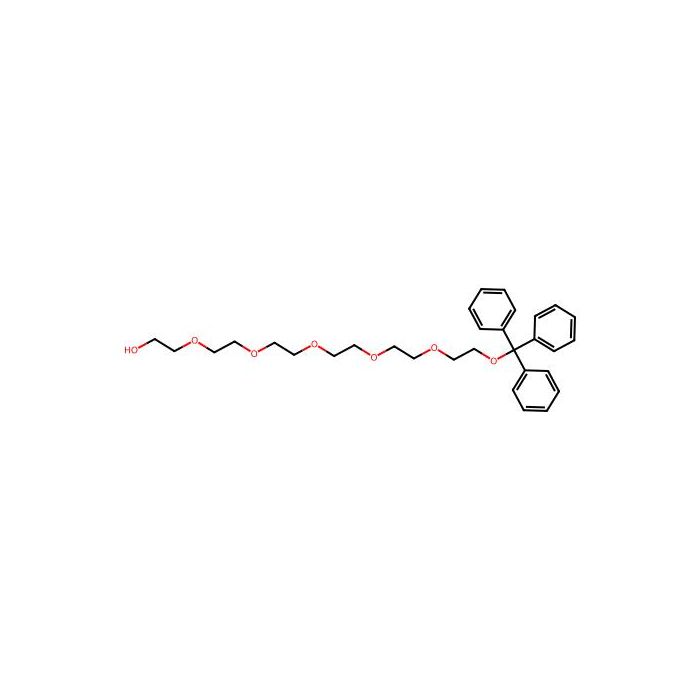
Tr-PEG7 is a PEG derivative containing a trityl alcohol protecting group. The trityl group can be removed under acidic conditions or through hydrogenolysis. The hydrophilic PEG linker increases the water solubility properties of compounds. Increasing the number of ethylene glycol units within a PEG chain improves their water solubility properties.
Specifications
仕様と純度
≥98%
保管条件
Store at -20°C
入荷
Ice chest + Ice pads
この製品は冷冷この冷このこの製品の運送が必要です。地上およびその他の経済サービスは利用できません。
純度
≥98%
名前と識別子
分子量
524.7
Documentation
📋 Safety Data Sheet (SDS)
Comprehensive hazard, handling, storage, and regulatory compliance document.
Determine the necessary mass, volume, or concentration for preparing a solution.
Dilution Calculator
Determine the dilution needed to prepare a stock solution.
Reconstitution Calculator
レビュー
顧客レビュー
Application Protocols
No application protocols are specified for this catalog item. As a general-purpose PEG-based linker, procedures depend on the intended synthetic route (e.g., trityl deprotection, activation to sulfonates, nucleophilic substitution, or click conjugation). Refer to the Reaction Conditions and Synthetic Utility sections for literature-style guidance, and consult primary literature for protocols tailored to your specific substrate and end-use.
Biological Roles
Applicability: This product is supplied for research use only. No medical or clinical claims are made.
General context for PEG spacers (literature; not item-specific)
PEG segments are widely used in biointerface engineering to reduce nonspecific protein adsorption and cell adhesion due to their high hydration and conformational flexibility.
Short oligomeric PEGs (e.g., PEG7) serve as tunable spacers to control distance between a bioactive motif and a surface or scaffold, which can modulate accessibility and reduce steric hindrance.
A trityl end-cap provides a temporary, acid-labile mask that allows stepwise, orthogonal construction of multifunctional ligands or surface coatings before unveiling a terminal hydroxyl (or related nucleophile).
In biochemical assay development, PEG linkers can help:
Improve solubility of hydrophobic probes in mixed aqueous/organic media.
Reduce aggregation of labeled proteins/peptides by spacing dyes or affinity tags away from the biomolecule core.
Enzymatic recognition: PEG chains are generally not recognized by most enzymes, decreasing enzymatic degradation of appended constructs in in vitro settings.
Caveats
Very short PEGs may not fully suppress biofouling compared to higher molecular-weight PEGs or dendritic polyglycerols.
The presence of a hydrophobic trityl group may influence biomolecular interactions until it is removed; plan deprotection prior to biological exposure if a fully hydrophilic interface is required.
Buffer Applications
This item is not a buffering reagent. It does not define solution pH or provide classical buffer capacity.
Related laboratory uses (general; not item-specific)
PEG oligomers can sometimes be included in research buffer formulations as crowding or solubilizing additives; however, PEG7 with a trityl end-cap is typically employed as a synthetic linker rather than a buffer additive.
If the deprotected PEG terminus is used to prepare hydrophilic conjugates, those conjugates may subsequently be handled in standard biological buffers (PBS, HEPES, Tris), but the buffer system selection depends on the conjugate, not on Tr-PEG7 itself.
For pH control, choose established buffer systems (e.g., phosphate pH 6–8, HEPES pH 6.8–8.2, acetate pH 3.6–5.6) appropriate to your analyte and application.
Green Alternatives
Context: PEG-based linkers often require chlorinated solvents, strong acids for deprotection, and polar aprotics for coupling. Greener choices can reduce environmental and safety burdens while maintaining performance. The exact feasibility depends on terminal functionality (not specified here).
Opportunities (literature; general)
Solvent swaps:
Replace DCM/CHCl3 with 2-MeTHF, EtOAc, CPME, or methyl 5-(dimethylamino)-2-methyl-5-oxopentanoate (Rhodiasolv PolarClean) where solubility permits.
Favor bio-based ethanol/i-PrOH for wash/precipitation steps.
Acidolysis of trityl:
Use minimal TFA loadings in greener co-solvents (EtOAc, 2-MeTHF) and capture acid vapors with scrubbers.
Explore solid-supported acids for easier quench and reduced waste.
Couplings/activations:
Employ greener coupling reagents or catalytic methods (e.g., organocatalytic carbonate formation from CDI in EtOAc rather than DMF, where applicable).
Use aqueous micellar catalysis for certain substitutions after unveiling hydrophilic termini (if water compatibility is desired).
Compact comparison (illustrative; not item-specific)
DCM vs 2-MeTHF: similar solvency for many organics; 2-MeTHF is bio-derived, less toxic, and higher boiling (slower evaporation).
DMF/DMSO vs PolarClean/propylene carbonate: greener profiles but may alter kinetics and workup; check compatibility with bases and activators.
Note: Validate solubility and reaction rates on small scale before process adoption; maintain trityl integrity by avoiding inadvertent acid sources.
Pharmaceutical Uses
Research-use only statement: This material is supplied strictly for research and laboratory use. No therapeutic or clinical use is intended or implied.
General formulation/manufacturing context for PEG-based linkers (literature; not item-specific)
PEG linkers are widely employed in the discovery and process development stages as spacers to modify physicochemical properties (solubility, aggregation, viscosity) of investigational conjugates, probes, or affinity reagents.
Oligomeric PEG segments such as PEG7 balance hydrophilicity with compact size, enabling:
Attachment of solubilizing tethers to small-molecule leads for assay development.
Preparation of analytical standards and surfaces with controlled anti-fouling properties.
The trityl protecting group offers orthogonal protection strategies during multi-step linker assembly before final deprotection.
Excipient/regulatory notes
While high–molecular weight PEGs (e.g., PEG 300–6000) are classical pharmaceutical excipients, specifications and qualification pathways for short, functionalized PEG oligomers differ and are application-specific. Any use beyond bench research would require comprehensive quality, impurity, and safety evaluations.
Process considerations
Residual acids/solvents from trityl deprotection must be controlled during purification to meet analytical acceptance criteria.
Surface-engineered components leveraging PEG spacers should be characterized for extractables/leachables when used in contact with drug substances during development studies.
Physical Properties
Item-specific data
Appearance: Not specified for this item; refer to CoA/Spec Sheet.
Purity/Grade: Not specified for this item; refer to CoA/Spec Sheet.
Molecular Weight: Not specified for this item; refer to CoA/Spec Sheet.
Melting/Freezing Point, Boiling Point, Density, Refractive Index, Water/Peroxide/Metal content, UV cutoff: Not specified for this item; refer to CoA/Spec Sheet.
General/literature guidance for Tr-protected PEG oligomers (context; not item-specific)
Physical state: short PEG oligomers with hydrophobic protecting groups can be low-melting solids or viscous oils depending on terminal functionality and exact DP (degree of polymerization).
Solubility profile:
Typically soluble in polar aprotic organics (DCM, THF, DMF, DMSO) and many alcohols (MeOH, EtOH).
Limited solubility in nonpolar hydrocarbons (hexanes, heptane); solubility often improves with small additions of EtOAc or DCM.
Aqueous solubility varies strongly with terminal end-groups; trityl end-caps markedly reduce water solubility relative to deprotected PEGs.
Hygroscopicity: PEG segments can absorb moisture; drying under vacuum at mild temperature is commonly practiced prior to moisture-sensitive transformations.
Partitioning: PEG chains confer hydrophilicity; a terminal trityl group increases hydrophobic character, yielding amphiphilic behavior.
Thermal behavior: PEG oligomers typically exhibit glass transitions rather than sharp melting points; decomposition temperatures depend on substituents.
Note: Use the item’s CoA/Spec Sheet for quantitative properties and specifications controlling analytical release.
Quality and Grades
Item-specific release parameters
Grade/Purity: Not specified for this item; refer to CoA/Spec Sheet.
Stabilizers/Inhibitors: Not specified for this item; refer to CoA/Spec Sheet.
How to interpret grades for PEG-based linkers (general guidance)
Research grade: suitable for most synthetic and materials workflows. Analytical characterization typically includes NMR and HRMS/ESI-MS; for oligomers, a narrow mass distribution and low residual solvents are preferred.
High-purity/bioconjugation grade: emphasizes low levels of residual metals, acids, and peroxides; enhanced documentation for trace impurities and endotoxin/bioburden may be provided when relevant to surface/biointerface studies.
Chromatography or LC–MS grade solvents/reagents: when downstream analytics involve UV or MS detection, selecting matched high-purity solvents minimizes background.
What to look for in the CoA (practical checklist)
Identity confirmation: 1H/13C NMR consistent with trityl aromatic resonances and PEG methylene signals; MS consistent with the specified end groups and distribution.
Purity: report of single dominant oligomer or a defined distribution centered at PEG7; low-level shorter/longer oligomers quantified where applicable.
Residuals: solvents (e.g., DCM, EtOAc), acid scavengers, or reagents from protection/deprotection steps.
Water content: Karl Fischer value if provided; PEGs are often dried to low ppm prior to moisture-sensitive chemistry.
For critical applications, request the current lot’s CoA/Spec Sheet for exact specifications of SKU T596767.
Reaction and Applications
Scope (based on typical roles of trityl-protected PEG linkers; item-specific functionalities not provided)
Spacer/linker in materials science: introduce a defined PEG7 segment to surfaces, polymers, or small molecules to modulate hydrophilicity, reduce fouling, or improve dispersibility of nanomaterials.
Temporary protection: the trityl group masks a terminal hydroxyl or heteroatom during multistep synthesis; subsequent acidolysis reveals the reactive site.
Precursor to functional handles: after deprotection, PEG–OH can be transformed into tosylate/mesylate, halides, azides, amines, carboxylates, or click-ready termini for modular assembly.
Representative application themes (literature; not item-specific)
Surface modification: grafting PEG segments onto silica, metal oxides, or polymers to create hydrophilic brushes and resist protein adsorption in analytical devices (e.g., microfluidics).
Nanomaterials processing: enhancing dispersion of CNTs/graphene/oxide nanoparticles in polar media via PEGylated adducts; trityl capping enables orthogonal synthetic sequences prior to unveiling the hydrophilic end.
Supramolecular chemistry: using PEG spacers to tune host–guest distances and solubility in rotaxanes/catenanes.
Solid-phase synthesis: trityl as an acid-labile tag for resin-bound assemblies; PEG spacer improves reagent accessibility.
Practical tips
Keep acidic species minimal until trityl removal is desired.
Dry thoroughly before moisture-sensitive steps (sulfonylation, carbamate formation).
Verify integrity by 1H NMR: trityl aromatic multiplets (~7.1–7.5 ppm) and benzylic signal (~6–7 ppm region) alongside PEG methylenes (~3.4–3.8 ppm) are typical (literature observations).
Reaction Conditions
The following conditions are representative literature practices for trityl-protected PEG oligomers and are provided as general guidance only. Adjust based on the actual terminal functionality of the purchased item (not specified here) and verify on small scale.
Trityl deprotection (acidolysis):
Reagents: 1–5% TFA in DCM or EtOAc; alternatively HCl in dioxane.
Temperature/time: 0–25 °C, minutes to 1 h depending on scale and substitution.
Workup: neutralize with triethylamine or solid scavengers; rapid concentration; avoid acidic silica.
Tosylation/mesylation of PEG–OH (post-deprotection):
Reagents: TsCl (1.1–1.5 eq) or MsCl (1.1–1.5 eq), base (pyridine/NEt3/DMAP catalytic).
Solvent: DCM or THF, anhydrous.
Temperature: 0 °C to RT, 1–4 h.
Typical outcomes: high conversion; purify by flash with basic modifiers.
Azidation (from sulfonate):
Reagents: NaN3 (2–4 eq).
Solvent: DMF (anhydrous).
Temperature: 60–90 °C, 2–16 h.
CuAAC “click” (if alkyne/azide installed):
Catalyst: CuSO4/sodium ascorbate (aqueous-organic) or CuBr/ligand (anhydrous).
Solvent: t-BuOH/H2O or DMF/MeOH mixtures; 25–60 °C.
Reagents: CDI (1.1–1.5 eq) in DMF/EtOAc, then nucleophile.
Temperature: RT to 40 °C.
These are general/literature conditions; confirm compatibility with the trityl group and any additional end-groups present.
Safety and Handling
Item-specific hazard information
GHS Classification, Signal Word, Pictograms, H-Statements: Not specified for this item; refer to the SDS.
General safety guidance for trityl-protected PEG oligomers (literature; not item-specific)
Expected hazards: typically low acute toxicity for PEG motifs; the presence of aromatic/trityl moieties can introduce eye/skin irritation potential. Handle as a laboratory chemical of unknown hazard profile.
PPE: lab coat, safety glasses or face shield, and appropriate chemically resistant gloves (e.g., nitrile). Use in a fume hood to avoid inhalation of dusts/aerosols or vapors from reaction solvents and acids used for deprotection.
Incompatibilities: avoid strong protic acids and Lewis acids (TFA, HCl, BF3·Et2O, etc.) if preserving the trityl group; these conditions promote trityl cleavage. Strong oxidants and halogenating reagents may attack the aromatic/trityl moiety.
Thermal/hygroscopic considerations: PEG segments may absorb water; store tightly closed, desiccated, and cold to minimize hydrolysis and aggregation.
First aid (overview; defer to SDS):
Skin/eye contact: rinse with water for ≥15 min; seek medical evaluation if irritation persists.
Inhalation: move to fresh air; obtain medical attention for respiratory symptoms.
Ingestion: rinse mouth; do not induce vomiting; seek medical advice.
Spill/cleanup: absorb liquids with inert material; for solids, avoid dust generation; collect in suitable container for disposal according to local regulations.
Always consult the product-specific SDS for authoritative hazard classifications and response measures.
Solvent Selection
Applicability: Trityl-protected PEG oligomers are amphiphilic; solvent choice drives handling, coating, and derivatization outcomes.
General solvent compatibility (literature; not item-specific)
Highly suitable:
Polar aprotic: DCM, CHCl3, THF, DMF, DMSO, MeCN.
Protic: MeOH, EtOH, i-PrOH (solubility often good, but monitor for acid contaminants that could deprotect trityl).
Moderately suitable: EtOAc, MTBE, CPME.
Poor: aliphatic hydrocarbons (hexanes, heptane) unless blended with more polar cosolvents.
Aqueous media: solubility depends on the non-trityl terminus; a trityl end-cap generally suppresses water solubility.
Selection strategy
Dissolution for synthesis: use dry DCM/THF/DMF. For acid-labile protection, avoid acids and acid traces; add base (e.g., Hunig’s base) when using acylation sulfonylation protocols to buffer adventitious acid.
Film/coating deposition: DCM or THF enable rapid evaporation; include small fractions of alcohol to tune wetting on oxide/metal surfaces.
Workup/purification: precipitation into cold MTBE/hexanes may remove polar impurities; flash chromatography on silica should avoid strong acids—use mildly basic modifiers (0.1–1% Et3N) to retain trityl.
Quick comparison (literature)
DCM: excellent solubility, fast evaporation; watch for acid impurities.
THF: good solvency; peroxide monitoring recommended for aged THF (solvent-specific concern).
DMF/DMSO: maximum solvency for coupling/azidation; challenging to remove—plan for aqueous workup or high vacuum.
Storage and Reconstitution
Item-specific conditions
Storage: Store at -20 °C (per product data).
Shipped: In ice chest with ice pads (per product data).
General handling/reconstitution guidance (literature; not item-specific)
Protect from moisture and acids to preserve the trityl group. Store tightly sealed in an inert atmosphere (desiccator with desiccant; optional argon/nitrogen blanket). Allow container to equilibrate to room temperature before opening to avoid moisture condensation.
If solidified or viscous, gently warm to RT to facilitate weighing.
Dissolution: common solvents include anhydrous DCM, THF, DMF, DMSO, MeOH/EtOH. Start with 5–20 mg/mL; adjust based on solubility and application.
Drying before moisture-sensitive steps: place under high vacuum (≤1 mbar) at ambient to 30 °C for several hours; alternatively, azeotrope with dry toluene.
Post-use: purge headspace with dry inert gas and re-cap promptly.
Stability notes
Avoid prolonged exposure to light/heat/acidic vapors which can induce trityl cleavage or discoloration.
For long-term storage, maintain original container at -20 °C in secondary containment; periodically review lot-specific CoA for recommended retest/expiry information (not specified for this item).
Structure and Identity
SKU: T596767
Product Name: Tr-PEG7
CAS: 127999-16-0
Category: Materials Science (research use only)
Item-specific identifiers
Molecular Formula: Not specified for this item; refer to CoA/Spec Sheet.
Molecular Weight: Not specified for this item; refer to CoA/Spec Sheet.
SMILES: Not specified for this item; refer to CoA/Spec Sheet.
InChIKey: Not specified for this item; refer to CoA/Spec Sheet.
General structural notes (literature/context; not item-specific)
The designation “Tr-PEG7” commonly denotes a trityl (triphenylmethyl, Tr)–protected oligomeric polyethylene glycol containing seven ethylene oxide (–CH2–CH2–O–) repeat units.
Typical architecture: a hydrophobic trityl group bound to one terminus of a short PEG chain; the opposite terminus may be hydroxyl or otherwise functionalized, but the present listing does not specify terminal functionality.
Key functional features expected for such linkers include:
An acid-labile trityl protecting group (stable to base/nucleophiles; cleavable by Brønsted acids).
A flexible, hydrophilic PEG spacer that imparts water compatibility, reduces nonspecific adsorption, and increases solubility of conjugates.
2D description (generic): one benzylic carbon bonded to three phenyl rings (trityl) linked via an ether to a hepta(ethylene glycol) chain of alternating –CH2–CH2– and –O– units; the distal terminus depends on the actual item specification (not provided here).
Important: Because structure fields for this catalog item are not provided, the above is general/literature context for “Tr-PEG7” naming only; consult the CoA/Spec Sheet for the definitive structure of SKU T596767.
Synthetic Utility
Functional platform (literature; general)
A “Tr-PEG7” motif provides:
An acid-labile trityl group to temporarily mask a nucleophilic terminus.
A hepta(ethylene glycol) spacer to impart polarity and flexibility between reactive headgroups and substrates (surfaces, polymers, small molecules).
After deprotection, the liberated PEG–OH (or related heteroatom) can be diversified into numerous handles enabling stepwise construction.
Common transformations (illustrative; not item-specific)
Trityl deprotection: TFA (1–5%) in DCM/EtOAc at 0–25 °C; rapid cleavage monitored by TLC/NMR; quench with base/scavengers; avoid silica with residual acidity.
Activation to leaving groups:
Tosylation/mesylation with TsCl/MsCl, base (pyridine/NEt3/DMAP), 0–25 °C → RT.
Halogenation via Appel-type conditions (CBr4/PPh3) or via sulfonate displacement.
Nucleophilic substitution: conversion to azide (NaN3, DMF, 60–90 °C), then Staudinger or catalytic hydrogenation to amine.
Urethane/carbamate formation: CDI or p-NPC activation followed by amines to yield carbamates; useful for bioconjugation-ready termini.
“Click” handles: install alkyne (propargylation via carbonate/carbamate formation) or azide for CuAAC/SPAAC strategies.
Practical notes
Drying: azeotrope with toluene or dry under high vacuum at ambient/mild heat to remove water before activation steps.
Analysis: 1H/13C NMR and ESI-MS to verify oligomer distribution and end-group integrity; IR to confirm loss of trityl (disappearance of aromatic C–H overtones; appearance of OH stretch).
Purification: minimize acid exposure to preserve trityl; use basic modifiers in silica eluent.
Target Specificity
Not applicable. This product is a chemical linker/reagent, not an antibody, protein, or assay-specific probe. No antigen/epitope, isotype, or species reactivity information applies.
We use cookies to ensure the website functions properly and, where permitted, to improve your experience. You can manage your preferences at any time in Settings. Learn more in our Cookie Policy.
Shall we send you a message when we have discounts available?
Remind me later
Thank you! Please check your email inbox to confirm.
Products are supplied to verified businesses, institutions, and qualified professionals for research and development use only. Not for use in humans, animals, diagnosis, or therapy.