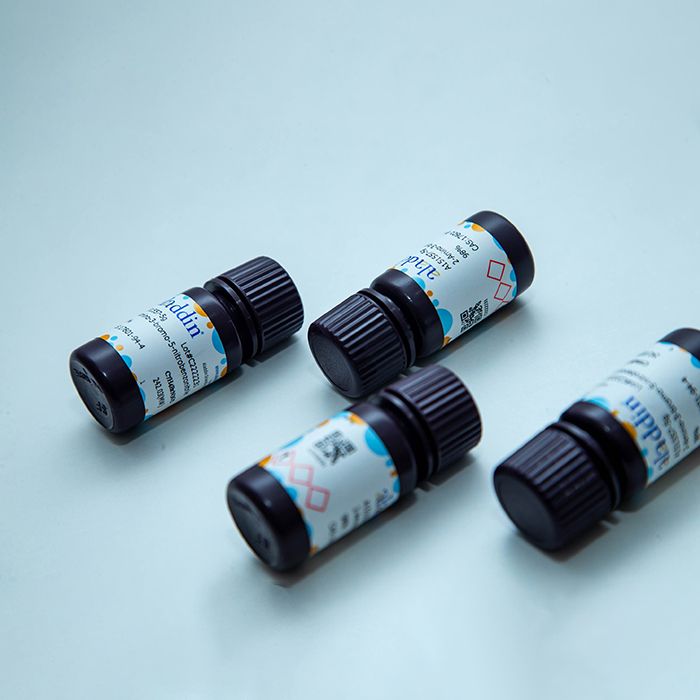
Trabedersen (AP 12009) is an antisense oligodeoxynucleotide that specifically inhibits TGF-β2 (TGF-beta/Smad). Trabedersen can be used for the study of malignant brain tumors and other solid tumors overexpressing TGF-β2 , such as those of the skin, pancreas and colon.
In Vitro
Trabedersen (1-80 μM; 7 days) reduces TGF-β2 secretion in human pancreatic cancer cell line Hup-T3 with an IC 50 in the low μM range, clearly inhibits cell proliferation, and completely blocks migration of pancreatic cancer cells. Trabedersen reverses TGF-β2-mediated immunosuppression of pancreatic cancer cells. MCE has not independently confirmed the accuracy of these methods. They are for reference only. Cell Proliferation AssayCell Line: Hup-T3 cells Concentration: 1 μM, 2.5 μM, 5 μM, 10 μM, 20 μM, 40 μM, 60 μM, 80 μM Incubation Time: 7 days Result: Inhibited cell proliferation, and completely blocked migration of pancreatic cancer cells.
In Vivo
Trabedersen (initial loading dose of 50 mg/kg bodyweight followed by 16 mg/kg three times a week; i.p.) treatment significantly reduces tumor growth, lymph node metastasis and angiogenesis in an orthotopic mouse model of metastatic pancreatic cancer. MCE has not independently confirmed the accuracy of these methods. They are for reference only. Animal Model: Eight-week-old male athymic nude mice (BALB⁄Cnu ⁄nu) bearing human pancreatic cancer cells. Dosage: Initial loading dose of 50 mg/kg bodyweight followed by 16 mg/kg three times a week. Administration: Intraperitoneal (i.p.) injection; three times a week; for 27 days Result: Significantly reduced tumor growth, lymph node metastasis and angiogenesis.
Form:Solid
仕様
仕様と純度
≥92%
生化学的・生理学的メカニズム
Trabedersen (AP 12009) is an antisense oligodeoxynucleotide that specifically inhibits TGF-β2 (TGF-beta/Smad). Trabedersen can be used for the study of malignant brain tumors and other solid tumors overexpressing TGF-β2 , such as those of the skin, pancre
Determine the necessary mass, volume, or concentration for preparing a solution.
Dilution Calculator
Determine the dilution needed to prepare a stock solution.
Reconstitution Calculator
レビュー
顧客レビュー
Application Protocols
No tested applications or protocols are provided in the product data for this item. Aladdin Scientific supplies this product for research use only. For protocol development, please consult peer‑reviewed literature relevant to antisense oligonucleotides and validate all conditions in your system.
Any recommended dilutions, positive controls, or instrument settings must be developed empirically and are not specified for this SKU.
Biological Roles
The biological context below is provided as general literature background for antisense oligonucleotides of this class and does not constitute item-specific claims.
Mode of action (general, literature): Antisense oligonucleotides hybridize to complementary RNA sequences. Depending on backbone and design, they can recruit RNase H to cleave RNA in RNA–DNA hybrids or sterically block ribosome binding, splicing, or microRNA interactions.
Reported target context (literature): Trabedersen has been described as targeting TGF‑β2 mRNA, enabling interrogation of signaling pathways regulated by transforming growth factor beta 2, including extracellular matrix modulation and epithelial–mesenchymal transition processes in research settings.
Cellular handling: Uptake is typically facilitated by delivery systems (e.g., cationic lipids, peptides, or nanoparticles). Once internalized, endosomal escape and nuclease resistance largely dictate intracellular efficacy; phosphorothioate modifications (if present) enhance serum stability and protein binding (general, literature).
Readouts in research: Changes in target mRNA by RT‑qPCR; protein levels by Western blot/ELISA; pathway activity via reporter assays; phenotypic outcomes in proliferation/migration assays depending on model and study design (general guidance).
Off‑target considerations: Sequence‑dependent off‑target binding and innate immune activation via TLRs can occur; careful design, appropriate controls, and chemical modifications mitigate these effects (general, literature).
No biological specifications (sequence, length, backbone) are provided in this product data; consult the CoA/Spec Sheet for item‑specific details.
Buffer Applications
As an oligonucleotide reagent, Trabedersen is typically prepared and stored in nuclease‑free aqueous buffers. The following are general, literature‑based practices for nucleic acid handling and are not item‑specific specifications.
Common buffers and pH ranges:
TE buffer: 10 mM Tris‑HCl, 1 mM EDTA, pH 7.5–8.0 — stabilizes by chelating trace metals; widely used for stock solutions and long‑term storage.
PBS: ~pH 7.2–7.6 — suitable for isotonic handling and many cell‑based applications after complex formation with delivery agents.
HEPES buffer: pH 7.2–7.6 — Good buffering at physiological pH with minimal temperature dependence.
Preparation tips:
Use certified nuclease‑free reagents and consumables; filter sterilize (0.22 μm) when appropriate.
Avoid Mg2+ and Ca2+ in storage buffers to reduce nuclease activity, unless required for a specific assay.
Determine concentration by A260 using the item‑specific extinction coefficient (ε260), which must be obtained from the CoA/Spec Sheet or calculated from the exact sequence.
Hybridization/annealing:
Duplex formation with complementary strands can be performed by heating to 90–95°C followed by gradual cooling; salt concentration and pH affect Tm (general guidance).
No buffer composition is specified for this SKU; follow internal SOPs and consult the CoA for any manufacturer recommendations.
Green Alternatives
For oligonucleotide tools such as Trabedersen, environmental considerations focus on formulation and handling rather than substituting the active with a different chemical. Nevertheless, greener choices can be made in solvents, buffers, and synthesis workflows (general, literature).
Greener handling/formulation choices:
Prefer aqueous buffers (water, TE, PBS) over organic co‑solvents.
Avoid halogenated extraction steps; use ethanol precipitation or centrifugal desalting.
Select low‑toxicity transfection reagents when possible and minimize solvent volumes.
Employ high‑efficiency solid‑phase synthesis with solvent recovery (e.g., acetonitrile recycling) and greener deprotection conditions.
Explore enzymatic synthesis routes for certain sequences to reduce solvent usage.
Waste minimization:
Consolidate aqueous waste streams and neutralize before disposal per local regulations.
Use RNase/DNase decontamination solutions that are non‑corrosive and biodegradable where feasible.
Comparison snapshot (general):
Aqueous buffers: renewable, low hazard; ideal for preparation and use.
DMSO/DMF: sometimes used in delivery research but present higher EHS concerns; restrict to minimal percentages and ensure proper disposal.
Item-specific green metrics (e.g., solvent volumes, E‑factors) are not provided for this SKU.
Pharmaceutical Uses
No therapeutic or clinical claims are made for this catalog item. The following describes general formulation and manufacturing considerations for antisense oligonucleotides in research and development contexts (literature background).
Excipient and formulation roles (general):
Oligonucleotides are often formulated as sterile aqueous solutions with isotonic adjusters (e.g., NaCl), pH buffers (e.g., citrate, phosphate), and chelators (e.g., EDTA) to enhance stability.
For delivery research, complexation with cationic lipids/polymers or encapsulation in lipid nanoparticles (LNPs) can be explored to enhance cellular uptake.
Processing considerations:
Sterile filtration (0.22 μm) of solutions when compatible with concentration and viscosity.
Control of endotoxin and bioburden for parenteral‑grade research materials; use validated depyrogenated ware when necessary.
Avoid shear- and heat‑induced degradation; minimize exposure to strong acids/bases.
Analytics for formulation development:
Potency assays (RT‑qPCR, protein assays), stability‑indicating HPLC, and LC–MS profiling for degradation (dephosphorylation, depurination, backbone cleavage).
Regulatory references: Pharmacopeial monographs for specific oligonucleotides are limited; general tests follow nucleic acid guidelines and ICH Q-series for stability and impurities in development programs (general).
Item-specific excipient compatibility and pharmacopeial status are not provided in the product data; consult CoA/Spec Sheet and internal quality systems.
Physical Properties
Item-specific physicochemical data are not provided for this product entry.
Appearance: Not specified for this item; refer to CoA/Spec Sheet.
Molecular weight: Not specified for this item; refer to CoA/Spec Sheet.
Molecular formula: Not specified for this item; refer to CoA/Spec Sheet.
Melting point (material): Not typically defined for oligonucleotides as discrete crystalline solids; they are usually supplied lyophilized amorphous solids or pellets (general, literature).
Solubility: Oligonucleotides are generally freely soluble in nuclease‑free water and common biological buffers (e.g., TE, PBS) at mg/mL concentrations; solubility may depend on length, counterion, and sequence (general, literature). Item-specific solubility is not specified for this item; refer to CoA/Spec Sheet.
LogP: Not applicable in the conventional sense due to high polarity and polyanionic nature (general, literature).
pKa: Multiple acidic phosphates; net charge is strongly negative at physiological pH (general, literature).
Density, refractive index: Not typically specified for oligonucleotides; Not specified for this item; refer to CoA/Spec Sheet.
UV absorbance: Oligonucleotides exhibit a characteristic λmax near 260 nm; extinction coefficients are sequence‑dependent (general, literature). Item-specific ε260 is not specified for this item; refer to CoA/Spec Sheet.
Thermal denaturation (Tm): Duplex Tm with complementary RNA/DNA depends on length, sequence, salt, and backbone chemistry. Item-specific Tm data are not provided.
All values above, unless otherwise stated, are general literature guidance for oligonucleotides and not specifications of this item.
Quality and Grades
Grade/Purity: Not specified for this item; refer to CoA/Spec Sheet.
What grade implies (general, oligonucleotides): Oligonucleotide quality is commonly described by coupling efficiency, full‑length content, residual protecting groups, counter‑ion identity (e.g., Na+), salt content, water content, and analytical purity assessed by HPLC/UPLC and mass spectrometry. Specialized grades may include desalting, cartridge purification, HPLC purification, or PAGE purification.
Analytical verification (general):
Identity: LC–MS or MALDI‑TOF, and sequence confirmation by enzymatic digestion mapping.
Purity: Ion‑pair RP‑HPLC or anion‑exchange HPLC with UV at 260 nm.
Residual solvents/reagents: Monitoring for acetonitrile, dichloroacetic acid, protecting group remnants (literature).
Stabilizers: Not specified for this item. Some oligonucleotides are provided with volatile counter‑ions (e.g., NH4 +) or as sodium salts; stabilizers are typically unnecessary when stored desiccated and frozen.
Documentation: For lot‑specific purity, length, sequence, counter‑ion, and residual analyses, consult the CoA/Spec Sheet. This is essential for method validation or regulated workflows.
Reaction and Applications
This product is primarily a functional nucleic‑acid tool rather than a small‑molecule reagent. Its applications are centered on sequence‑specific hybridization and modulation of gene expression (general, literature), not on classical organic reactions.
Research applications (general):
Antisense knockdown of target transcripts via RNase H recruitment (for DNA‑like backbones) or steric blockade of translation/splicing (depending on chemistry).
Pathway interrogation by reducing levels of a specific mRNA to study downstream signaling and phenotypes in cells or model systems.
Use as a control or benchmark in delivery optimization (lipid nanoparticles, cationic lipids/polymers) and in nuclease‑stability studies.
Practical considerations:
Maintain RNase/DNase‑free conditions; incorporate EDTA to sequester divalent cations when long-term storage is needed.
Optimize dose and exposure time; monitor target mRNA by qPCR and protein by immunoblotting.
Duplex formation with complementary strands follows standard hybridization thermodynamics; salt and temperature critically affect Tm.
Literature context: Trabedersen is reported as an antisense oligonucleotide directed at TGF‑β2 mRNA, employed to attenuate gene expression in research models. This contextual information is provided for scientific background only and is not an item-specific specification.
No manufacturer application notes are provided in the product data for this SKU; users should validate conditions for their specific system.
Reaction Conditions
Classical reaction conditions (solvent, catalyst, yield) are not applicable. For nucleic acid use, hybridization and cell‑based delivery conditions are most relevant (general, literature):
Hybridization/annealing to complementary strands:
Buffer: 10 mM Tris‑HCl, 50–200 mM NaCl (or KCl), pH 7.5–8.0.
Protocol: Heat mixture to 90–95°C for 2–5 min, then cool slowly to room temperature, followed by equilibration at 4°C. Optimize salt and temperature for desired Tm and specificity.
Culture conditions: Standard cell culture media; transfect using cationic lipid/polymer per supplier recommendations; serum presence may affect uptake and stability.
Dosing: Empirically determine; typical screening ranges 1–200 nM in vitro (general literature guidance). Verify cytotoxicity independently.
Stability tests:
Incubate in 50% serum at 37°C; monitor integrity by denaturing PAGE or HPLC to assess nuclease resistance (general method).
Analytical readouts:
Measure mRNA by RT‑qPCR (ΔΔCt) and protein by Western/ELISA at time points reflecting transcript and protein half‑lives.
All conditions above are general guidance for antisense oligonucleotides, not specifications for this SKU. Item-specific backbone chemistry and sequence will dictate optimal conditions.
Safety and Handling
GHS classification: Not specified for this item; refer to CoA/Spec Sheet and SDS.
Signal word / H‑statements / pictograms: Not specified for this item; consult the SDS for authoritative hazard communication.
General hazards (literature, oligonucleotides): Not expected to be volatile; dust may cause mechanical irritation to eyes/respiratory tract. Avoid inhalation of powders and contact with eyes/skin. Some oligonucleotide salts may be hygroscopic.
PPE: Laboratory coat, suitable gloves (e.g., nitrile), and safety glasses. Handle powders in a clean area; use a fume hood or powder hood to minimize aerosolization.
Handling practices:
Work RNase/DNase‑free to prevent degradation and cross‑contamination.
Use dedicated nuclease‑free tips, tubes, and solutions.
Incompatibilities: Strong acids/bases and nucleases can degrade the material; avoid metal contamination and microbial bioburden. Oxidants or reducing agents may affect modified backbones (general guidance).
First aid (general): In case of eye/skin contact, rinse with water for several minutes; remove contaminated clothing. If inhaled, move to fresh air. If ingested, rinse mouth with water. Seek medical attention if symptoms persist. Follow institutional protocols.
Spill/leak: Avoid dust formation; gently collect solids with clean, damp, disposable wipes or HEPA‑vacuum suitable for fine powders. Dispose of waste per local regulations and institutional biosafety guidance.
Always defer to the item-specific SDS for definitive hazard, toxicology, and response procedures.
Solvent Selection
Trabedersen, as an oligonucleotide material, is designed for aqueous handling rather than organic solvents.
Primary solvents (general, literature):
Nuclease‑free water (Milli‑Q or equivalent)
TE buffer (10 mM Tris‑HCl, 1 mM EDTA, pH 7.5–8.0)
Phosphate‑buffered saline (PBS) for biological applications
Polarity/miscibility: Highly polar and polyanionic; miscible with water. Limited solubility in most neat organic solvents; may precipitate in alcohols (e.g., ethanol, isopropanol), which are sometimes used for desalting/precipitation.
Additives (general): Monovalent salts (Na+, K+) increase ionic strength and influence duplex stability; Mg2+ promotes nuclease activity in some contexts and should be used judiciously depending on application.
When to choose which solvent:
Water or TE for stock solutions and long-term stability.
Low‑salt buffers for transfection complex formation with cationic lipids/polymers.
Physiological buffers (e.g., HBSS, PBS) for cell‑based assays after complexation.
Comparison (general):
Water/TE: maximizes stability against depurination and chelates trace metals via EDTA.
PBS: isotonic handling; slightly lowers Tm vs high‑salt buffers.
Organic co‑solvents: typically avoided; small percentages of DMSO may aid delivery in some systems but can affect cells—optimize empirically.
Item-specific solvent guidance is not provided in the product data; consult CoA/Spec Sheet for any restrictions.
Storage and Reconstitution
Storage conditions (item-specific): Store at −20°C, desiccated. Shipped in an ice chest with ice pads (as provided in the product data). Minimize exposure to moisture; keep container tightly closed.
Stability notes (general, literature): Oligonucleotides are stable for extended periods when kept dry at −20°C. Aqueous solutions are generally stable for weeks to months at 2–8°C and longer at −20°C, depending on sequence and backbone. Avoid repeated freeze–thaw cycles.
Reconstitution (general guidance):
Use nuclease‑free water or TE buffer (pH 7.5–8.0).
To prepare a stock, calculate the required volume based on the item‑specific mass and molecular weight (both not specified here; refer to CoA/Spec Sheet). If MW is unknown, concentration can be estimated by A260 using the sequence‑specific extinction coefficient.
Gently vortex and briefly spin down; allow to sit on ice until fully dissolved.
Optional: Sterile‑filter through 0.22 μm if compatible with concentration and volume.
Aliquoting: Divide into single‑use aliquots in low‑bind, nuclease‑free tubes to limit freeze–thaw and adsorption losses.
Light and metal sensitivity: Protect from prolonged UV exposure; EDTA (1 mM) in TE can chelate trace metals that catalyze degradation (general practice).
For exact concentration, counter‑ion, and any stabilizers, consult the lot‑specific CoA/Spec Sheet.
Structure and Identity
Trabedersen is widely known in the literature as an antisense oligonucleotide designed to modulate gene expression. Item-specific identifiers are not provided in this listing.
Item-specific identifiers
CAS: 925681-61-4 (provided)
InChIKey: Not specified for this item; refer to CoA/Spec Sheet.
SMILES: Not specified for this item; refer to CoA/Spec Sheet.
Molecular formula: Not specified for this item; refer to CoA/Spec Sheet.
Molecular weight: Not specified for this item; refer to CoA/Spec Sheet.
Structural class (general, literature): antisense oligonucleotide, typically a short, single‑stranded, polyanionic nucleotide polymer (often phosphorothioate-backbone in reported formulations). The exact sequence, backbone chemistry, counter‑ions, and length determine final identity and properties and are not specified here for this catalog item.
2D structural description (general): a linear chain of nucleoside monomers (base-sugar-phosphate), joined 3′→5′ through phosphate (or modified phosphate) linkages, bearing heteroaromatic nucleobases capable of Watson–Crick hydrogen bonding to complementary RNA targets. Side-chain and backbone sulfur substitution (if phosphorothioate; literature) increases nuclease resistance and protein binding.
Stereochemistry (general): multiple stereogenic centers exist at each sugar moiety; phosphorothioate linkages (if present) introduce additional stereocenters at phosphorus (Rp/Sp). Item-specific stereochemistry is not provided.
Notes: The above structural features are general to antisense oligonucleotides and are provided for context (literature). Consult the CoA/Spec Sheet for this item’s exact sequence, backbone chemistry, counter‑ion, and formula.
Synthetic Utility
Trabedersen functions as a biological probe rather than a synthetic building block. Consequently, it is not typically employed as a reagent or intermediate in classical organic synthesis. Nevertheless, there are research‑method utilities relevant to nucleic acids (general, literature):
Use as a sequence‑defined ligand in biophysical assays (e.g., protein–oligonucleotide binding studies) to map RNA- or DNA‑binding domains.
Serve as a standard or control for hybridization, nuclease stability, or delivery optimization workflows.
Enable construction of duplexes, triplexes, or heteroduplexes with complementary strands for thermodynamic characterization (Tm, ΔH, ΔS) in buffer systems.
Participate in click‑chemistry conjugations if bearing terminal functional handles (e.g., azide/alkyne, amine, thiol) — item-specific functionalization not provided here; refer to CoA/Spec Sheet.
For traditional reaction chemistry, this product is not applicable. If your objective is chemical synthesis or ligation of nucleic acids, consider enzymatic ligase strategies or solid‑phase synthesis with controlled‑pore glass supports (general guidance).
Target Specificity
No target, sequence, clone, isotype, or species reactivity information is provided in the product data for SKU T651462. Item-specific target specificity is therefore not stated. Consult the CoA/Spec Sheet for any available sequence or target annotations.
Note: Literature commonly associates Trabedersen with TGF‑β2 mRNA; this is provided solely as background context and is not an item-specific specification.
よくある質問
What is the purity of this product?
This product is supplied at ≥92% purity (chemical assay). Lot-specific values are stated on the Certificate of Analysis.
How should this product be stored?
Store at ?20 °C, desiccated. Keep the container tightly closed with desiccant — the material is moisture-sensitive.
How is this product shipped?
This product ships in an insulated container with ice pads. Unpack on arrival and transfer it to the storage condition stated above.
What are the CAS number, molecular formula and molecular weight?
The CAS Number is 925681-61-4, and the molecular weight is 5768.70 g/mol.
What documentation is provided?
Available product documentation, including Certificates of Analysis (COA), Safety Data Sheets (SDS), and specification sheets, is shown in the product document area. Document availability and access follow the current site policy.
Products are supplied to verified businesses, institutions, and qualified professionals for research and development use only. Not for use in humans, animals, diagnosis, or therapy.