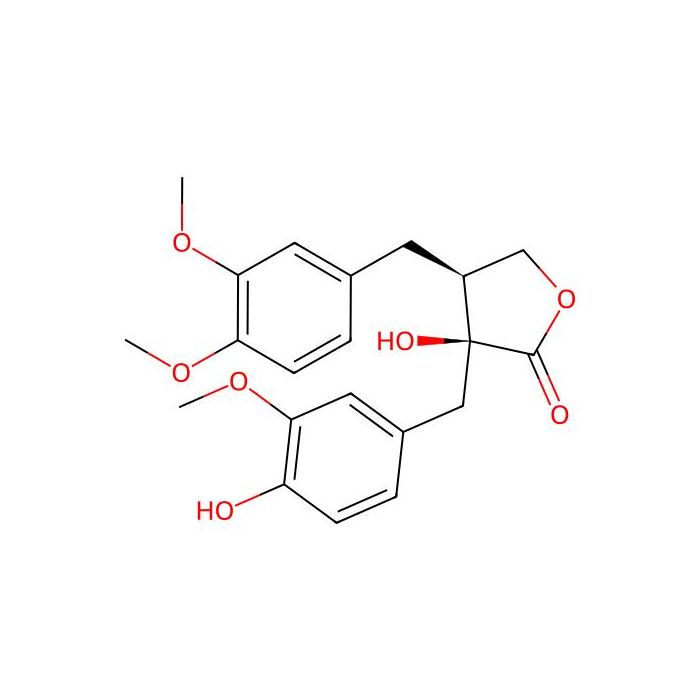
≥99% for sensitive chromatographic and analytical workflows requiring minimal baseline interference.
🌡
Storage & shipping
Protected from light,Store at -80°C Ships Dry ice packs + Cold packs Check lot-specific COA for exact specifications.
📋
Quality documents
SDS, COA, datasheet, and spec sheet available for download. Lot-specific COA accessible via lot number lookup.
📚
Literature proof
Cited in 0 peer-reviewed publications across chromatography, organic synthesis, and cross-coupling reactions.
概要
Trachelogenin ((-)-Trachelogenin) is an HCV entry inhibitor without genotype specificity, and with low cytotoxicity. Trachelogenin inhibits HCVcc infection and HCVpp cell entry in a dose-dependent manner with an IC 50 of 0.325 and 0.259 μg/mL in HCVcc and HCVpp models, respectively. Trachelogenin exhibits effective antiviral, anti-inflammatory and analgesic effects.
Trachelogenin ((-)-Trachelogenin) is an HCV entry inhibitor without genotype specificity, and with low cytotoxicity. Trachelogenin inhibits HCVcc infection and HCVpp cell entry in a dose-dependent manner with an IC 50 of 0.325 and 0.259 μg/mL in HCVcc and
This compound belongs to the class of organic compounds known as dibenzylbutyrolactone lignans. These are lignan compounds containing a 3,4-dibenzyloxolan-2-one moiety.
External Descriptors
Lignans
1. Djoumbou Feunang Y, Eisner R, Knox C, Chepelev L, Hastings J, Owen G, Fahy E, Steinbeck C, Subramanian S, Bolton E, Greiner R, and Wishart DS. ClassyFire: Automated Chemical Classification With A Comprehensive, Computable Taxonomy. Journal of Cheminformatics, 2016, 8:61.
Determine the necessary mass, volume, or concentration for preparing a solution.
Dilution Calculator
Determine the dilution needed to prepare a stock solution.
Reconstitution Calculator
レビュー
顧客レビュー
Application Protocols
The following are general, non-item-specific protocols for handling small-molecule lignans in research settings. Adjust to your system and verify with small-scale pilots.
Preparation of stock solutions (analytical/biological assays):
Dissolve trachelogenin in anhydrous DMSO to 10–50 mM. Vortex and, if needed, gently warm (≤40°C) briefly to aid dissolution, protecting from light. Filter (0.22 µm PTFE) if particulate persists.
Aliquot stocks to minimize freeze–thaw cycles. Store at −20 to −80°C protected from light; see Storage section for solid storage guidance.
LC–MS reference standard workflow:
Prepare 1.0 mg/mL primary stock in MeOH or acetonitrile. Generate calibration levels by serial dilution in 50:50 MeCN:H2O with 0.1% formic acid. Record retention time and UV spectrum.
Inject replicate standards for system suitability (peak symmetry, %RSD of area <2% typical target, method-dependent; literature/general).
Prepare working solutions in EtOH or DMSO and follow established DPPH/ABTS assay protocols, keeping final organic solvent ≤1–2% v/v in aqueous media. Include appropriate blanks and reference compounds.
These procedures are illustrative and not validated for your laboratory; confirm compatibility with your assay and instrumentation.
Biological Roles
Trachelogenin is a plant lignan, a class of phenylpropanoid dimers biosynthesized via oxidative coupling of coniferyl alcohol-derived units.
Biosynthetic context (general/literature):
Lignans arise from dirigent protein-mediated radical coupling followed by tailoring steps (methylation, oxidation, and lactonization) to yield dibenzylbutyrolactone frameworks.
In plants, lignans can contribute to defense, UV protection, and structural integrity, often co-occurring with their glycosides (e.g., tracheloside is the glycosylated counterpart of trachelogenin).
Chemical biology considerations (non-clinical, literature/general):
Phenolic moieties impart antioxidant capacity and metal-chelating potential in model systems.
The rigid lactone-bridged scaffold is a common motif in studies of phenylpropanoid metabolism and enzyme selectivity (e.g., O-methyltransferases, oxidoreductases in lignan pathways).
Experimental utility:
Serves as a reference metabolite in phytochemical profiling (LC–MS/MS libraries) and in studies of lignan biosynthesis and degradation.
No medical or therapeutic claims are made. All uses are for laboratory research and analytical purposes only.
Buffer Applications
This product is a small-molecule natural product, not a buffering agent. It does not constitute a conventional buffer system and is not typically used to control pH.
Practical note: When preparing assay solutions containing trachelogenin, use an appropriate buffer for your biological or analytical system (e.g., phosphate, HEPES), and introduce trachelogenin from a concentrated organic cosolvent stock (commonly DMSO) to avoid precipitation.
For guidance on solvent handling and stocks, see the Solvent Selection and Application Protocols sections.
Green Alternatives
Because trachelogenin is a target compound rather than a solvent or reagent, “green alternatives” focus on choosing greener media and methods for its handling, extraction, and purification.
Greener solvent choices (general guidance):
Prefer ethanol or isopropanol over methanol where feasible for dissolution and recrystallization; replace halogenated solvents with ethyl acetate or 2-MeTHF for extractions and normal-phase chromatography when compatible with selectivity.
For reverse-phase HPLC, reduce acetonitrile usage by employing methanol-based gradients or water-rich gradients with longer columns.
Example comparisons (literature/general):
CH2Cl2 vs EtOAc: EtOAc offers lower toxicity and better biodegradability, though CH2Cl2 may provide sharper normal-phase separations; test selectivity before switching.
THF vs 2-MeTHF: 2-MeTHF is bio-based and less prone to peroxide formation; solubility and elution strength are similar for many lignans.
Process-intensity reductions:
Use solid-phase extraction (SPE) for pre-purification to reduce solvent volume prior to preparative HPLC.
Implement micro-scale method development (analytical HPLC scouting gradients) to minimize solvent waste before scale-up.
Note: Validate that greener substitutions preserve analyte stability (avoid basic aqueous phases that can open lactones) and meet your analytical requirements.
Pharmaceutical Uses
Trachelogenin is provided for research use only. No excipient or compendial pharmaceutical role is specified for this item.
Formulation context (general/non-clinical):
As a reference standard, it can be incorporated into analytical method validation for botanicals or complex mixtures (e.g., calibration curves, system suitability) using LC–UV or LC–MS.
For in vitro research assays, solutions are typically prepared in DMSO and diluted into test media; validate maximal tolerated cosolvent levels for the assay format.
Pharmacopeia/monographs: None specified for this item; refer to CoA/Spec Sheet and applicable regulatory databases if pharmacopoeial status is required for your application.
No medical, diagnostic, or therapeutic claims are made or implied.
Physical Properties
Item-specific properties (specifications):
Appearance: Not specified for this item; refer to CoA/Spec Sheet.
Molecular Weight: Not specified for this item; refer to CoA/Spec Sheet.
Molecular Formula: Not specified for this item; refer to CoA/Spec Sheet.
Literature/general expectations for lignan-type small molecules (for planning only; not product specifications):
Physical state: typically a crystalline solid or amorphous powder with limited aqueous solubility and good solubility in polar aprotic organic solvents (e.g., DMSO) and alcohols (MeOH, EtOH).
Acid–base: phenolic OH groups can exhibit weak acidity (typical phenol pKa ca. 9–10, literature/generic), while the lactone is neutral under physiological pH but can hydrolyze under strong basic conditions.
Partitioning: polyphenolic aromatic scaffolds often show moderate to high lipophilicity coupled with H-bond donor/acceptor capacity; expect limited water solubility but good solubility in DMSO (literature/generic behavior of lignans).
Thermal behavior: lignans usually have melting points in the low-to-mid hundreds °C; exact MP/BP for trachelogenin should be verified from primary literature or CoA.
Refractive index, density, UV cutoff, logP, pKa, solubility values: Not specified for this item; refer to CoA/Spec Sheet.
Important: Do not treat the above general notes as specifications. Confirm exact values with the CoA/SDS for this SKU before method validation.
Quality and Grades
Item-specific quality information:
Grade/Purity: Not specified for this item; refer to CoA/Spec Sheet.
Guidance on interpreting common grades (general):
Research grade: suitable for discovery chemistry, screening, and reference use; impurity profiles may not meet pharmacopeial monographs.
Analytical/Reference standard grade: emphasizes identity and purity verification with orthogonal methods (HPLC/UPLC, NMR, HRMS), and stability data. If required, request supporting documentation.
HPLC/LC–MS suitability: when applications include quantitative analysis, ensure low non-volatile residue and documented purity by chromatographic assay with UV or MS detection.
Stabilizers and additives:
None specified for this item. If stabilizers are present in a given lot, they will be listed on the CoA/SDS; these can impact UV backgrounds or derivatization chemistry.
Recommended verification practices (general for lignans):
Identity: 1H/13C NMR (DMSO-d6, CD3OD), HRMS exact mass, and IR (lactone C=O band typically near 1750–1770 cm−1, literature/general).
Purity: HPLC with diode array detection using a C18 column; phenolic lignans often show strong absorbance near 220–230 nm and 270–290 nm (literature/general). Confirm absence of significant isomeric/oxidative byproducts.
Consult the CoA for lot-specific assay, residual solvents, and impurity thresholds.
Reaction and Applications
This product is supplied as a defined small-molecule lignan intended for research use (screening, reference material, derivatization). While not a reagent per se, trachelogenin’s functional groups enable several synthetic manipulations and analytical applications.
Applications (general for lignans):
Analytical reference: use as a reference standard for plant metabolomics, QC of herbal extracts, or stability studies; verify identity by NMR/HRMS and retention time matching.
SAR/derivatization: phenolic OH groups are handles for etherification/esterification; the lactone can be selectively reduced or opened and reclosed for scaffold diversification.
Materials/antioxidant studies: phenolic redox properties allow evaluation in radical scavenging assays (e.g., DPPH, ABTS) as methodology controls (literature/general; not a performance claim).
Typical transformations (literature/general):
O-Acylation/O-alkylation under mild base (e.g., K2CO3) in acetone/DMF to generate prodrugs or solubility-tuned analogs.
Demethylation of anisoles (if present) using BBr3 or AlCl3/thiols to access catechols; protect phenols as silyl or benzyl ethers for multistep chemistry.
Lactone chemistry: selective reduction (DIBAL-H) to the corresponding lactol/diol; basic hydrolysis to hydroxy-acid followed by relactonization under acidic conditions.
Practical tips:
Protect from light during reactions to limit oxidative discoloration.
Avoid prolonged strong base at elevated temperature to prevent unwanted lactone opening and phenolic oxidation.
Use inert atmosphere for moisture/oxygen-sensitive steps.
Reaction Conditions
General laboratory conditions suitable for manipulating lignan scaffolds like trachelogenin are summarized below. These are literature/general guidelines and not specifications for this item.
Etherification/Esterification of phenols:
Base: K2CO3 or Cs2CO3 (1.5–2.0 equiv) in acetone, DMF, or MeCN; 25–60°C, 2–16 h.
Mitsunobu etherification: DEAD/DIAD and PPh3 in THF or toluene; 0–25°C, 2–6 h; protect other phenols as needed.
Steglich esterification: EDCI or DCC with DMAP in CH2Cl2 or DMF; 0–25°C, 2–12 h.
Demethylation of anisoles (if applicable):
BBr3 (1–3 equiv per OMe) in CH2Cl2, −78 to 0°C, 1–6 h; quench carefully with MeOH/H2O. Alternative: BCl3/TBAI or AlCl3/thiophenol systems.
Lactone manipulations:
Reduction: DIBAL-H (1.5–2.0 equiv) in toluene or CH2Cl2 at −78 to −20°C to avoid over-reduction; aqueous workup yields diols/lactols.
Hydrolysis: Na2CO3/NaOH (mild) in MeOH/H2O at 0–25°C for ring opening; re-lactonize under acidic conditions (e.g., p-TsOH, toluene, Dean–Stark) if desired.
Analytical monitoring:
TLC with UV 254/280 nm; HPLC-DAD at 230 and 280 nm; LC–MS with ESI negative mode often enhances response for phenolics (literature/general).
Optimize conditions for your substitution pattern; avoid prolonged strong base or high temperature to limit oxidative decomposition.
Safety and Handling
Regulatory/GHS information for this item:
Signal Word: Not specified for this item; refer to SDS.
Hazard Statements (H-Statements): Not specified for this item; refer to SDS.
GHS Classification and Pictograms: Not specified for this item; refer to SDS.
General laboratory safety (applicable to phenolic lignans; not product-specific):
PPE: wear lab coat, safety glasses, and appropriate chemically resistant gloves (e.g., nitrile). Use in a chemical fume hood to avoid inhalation of dust or solvent vapors.
Avoid generation of dust; handle solids gently. Prevent contact with skin and eyes; wash thoroughly after handling.
Incompatibilities: strong oxidizers may react with phenolics; strong bases can promote lactone hydrolysis; strong acids may cause degradation under prolonged exposure.
Light sensitivity: follow Product Data — protect from light.
First aid (general): in case of skin/eye contact, rinse with plenty of water for several minutes and seek medical advice. If inhaled, move to fresh air; if ingested, rinse mouth and seek medical advice. Always follow institutional SOPs.
Storage and shipping (from Product Data):
Storage Conditions: Protected from light; Store at -80°C.
Shipped In: Dry ice packs + Cold packs.
Always consult the Aladdin Scientific SDS for the definitive safety and hazard profile of this SKU.
Solvent Selection
Trachelogenin is a neutral polyphenolic lactone; solvent choice is driven by its limited aqueous solubility and compatibility with phenolic/lactone functionality.
Practical solvent choices (general guidance):
Stock solutions: DMSO is commonly used for small-molecule lignans due to high solvating power and compatibility with biochemical assays. Prepare concentrated stocks (e.g., 10–50 mM) and dilute into assay media with mixing; avoid local supersaturation.
Chromatography: Reverse-phase (C18) with MeCN/H2O + 0.1% formic acid or MeOH/H2O is typical. For normal-phase purification, EtOAc/hexanes or CH2Cl2/MeOH mixtures often work; avoid strong base in eluents to limit lactone opening.
Spectroscopy: CD3OD or DMSO-d6 facilitate sharp NMR signals for phenolics; CDCl3 may be feasible if solubility permits.
Miscibility/polarity (general):
Expected to be soluble in polar aprotic (DMSO, DMF) and protic solvents (MeOH, EtOH) and sparingly soluble in water.
When to choose alternatives:
If biological assays are water-based, cosolvent strategies (≤1–2% DMSO v/v) or cyclodextrin vehicles can improve apparent solubility (literature/general). For greener workups, prefer EtOAc/EtOH over halogenated solvents when compatible.
Note: No item-specific solubility data are provided. Validate solvent choice empirically for your system.
Storage and Reconstitution
From Product Data (item-specific):
Storage Conditions: Protected from light; Store at -80°C.
Shipped In: Dry ice packs + Cold packs.
General best practices for this compound class:
Solid form: Keep container tightly closed under inert headspace if possible. Store desiccated to avoid moisture uptake that could promote lactone hydrolysis over long periods.
Light protection: Use amber vials or wrap containers in foil. Minimize exposure during weighing and solution preparation.
Reconstitution: For most applications, reconstitute in anhydrous DMSO to prepare a concentrated stock. Alternatively, MeOH or EtOH may be used depending on downstream compatibility. Mix thoroughly to ensure complete dissolution before dilution.
Working solutions: Prepare fresh before use. When diluting into aqueous buffers, add slowly with vigorous mixing to prevent precipitation; maintain final DMSO typically ≤1–2% v/v for biochemical systems (assay-dependent).
Freeze–thaw: Avoid repeated cycles. Aliquot stock solutions; store at −80°C protected from light. Discard if discoloration, precipitation, or unexpected HPLC impurities appear.
Stability data: Not specified for this item; refer to CoA/Spec Sheet and SDS for shelf life and any lot-specific stability information.
Structure and Identity
Trachelogenin is a plant-derived small-molecule lignan, commonly classified within the dibenzylbutyrolactone lignan family.
Item-specific identifiers (from Product Data):
CAS: 34209-69-3
PubChem CID: 452855
InChIKey: 436215 (as provided)
SMILES: Not specified for this item; refer to CoA/Spec Sheet.
Molecular Formula: Not specified for this item; refer to CoA/Spec Sheet.
Molecular Weight: Not specified for this item; refer to CoA/Spec Sheet.
Structural features (general/literature description):
Core scaffold: dibenzylbutyrolactone lignan framework featuring a five-membered butyrolactone ring linking two substituted aryl (phenyl) units.
Functional groups: phenolic and/or methoxy substituents on the aromatic rings; an internal ester (lactone) functionality.
Stereochemistry: lignans frequently possess one or more stereogenic centers in the butyrolactone side chain; absolute configuration for trachelogenin is documented in the literature but is not specified for this item.
2D structure in words (general): two anisole/phenol-type rings connected through a C3–C3' linkage to a γ-lactone-bearing side chain, forming a rigid, moderately polar polyphenolic ester.
Notes: Exact constitutional and stereochemical details, and machine-readable identifiers (e.g., canonical SMILES, InChI), should be confirmed against the Certificate of Analysis/SDS for this specific lot.
Synthetic Utility
As a functionalized lignan scaffold, trachelogenin offers several synthetic entry points useful for medicinal and natural product chemistry studies.
Transformable motifs:
Phenolic OH groups: amenable to protection (TBS, TBDPS, benzyl), etherification (Williamson, Mitsunobu), and esterification (acyl chlorides/anhydrides, Steglich conditions).
Aromatic methoxy groups (if present): demethylation (BBr3, BCl3/TBAI) to access catechols, enabling metal-binding probes or further diversification.
Lactone: reduction (DIBAL-H, NaBH4 with activation) to diols; ring opening under base to hydroxy acids followed by re-lactonization or amide formation.
Retrosynthetic considerations:
The dibenzylbutyrolactone core can be assembled by coupling of appropriately substituted C6–C3 fragments followed by intramolecular esterification. Oxidative coupling strategies (e.g., laccase or metal-catalyzed) and chiral auxiliary/catalyst approaches address stereochemical control (literature/general).
Analytical leverage:
Strong UV chromophores on the aromatic rings allow straightforward monitoring by HPLC-DAD; HRMS provides sensitive tracking of late-stage modifications.
These features make trachelogenin a versatile starting point for SAR around phenylpropanoid natural products and for generating analog libraries.
Target Specificity
Not applicable. This SKU is a small-molecule natural product, not an antibody, enzyme, or biologic. No antigen/epitope, clone, isotype, or species reactivity information is relevant.
For biochemical assay planning, consult literature on lignan–protein interactions as needed, but note that such data are context-dependent and are not specifications for this item.
よくある質問
What are the CAS number, molecular formula and molecular weight?
The CAS Number is 34209-69-3, the molecular formula is C21H24O7, and the molecular weight is 388.41 g/mol. InChIKey YFVZKLQNMNKWSB-BTYIYWSLSA-N.
What is the purity of this product?
This product is supplied at ≥99% purity (chemical assay). Lot-specific values are stated on the Certificate of Analysis.
How should this product be stored?
Store at ?80 °C, protected from light. The material is light-sensitive — keep it in its original opaque or amber container.
How is this product shipped?
This product ships frozen with dry ice and cold packs. Unpack on arrival and transfer it to the storage condition stated above; handle dry ice with insulated gloves in a ventilated area.
What documentation is provided?
Available product documentation, including Certificates of Analysis (COA), Safety Data Sheets (SDS), and specification sheets, is shown in the product document area. Document availability and access follow the current site policy.
Products are supplied to verified businesses, institutions, and qualified professionals for research and development use only. Not for use in humans, animals, diagnosis, or therapy.