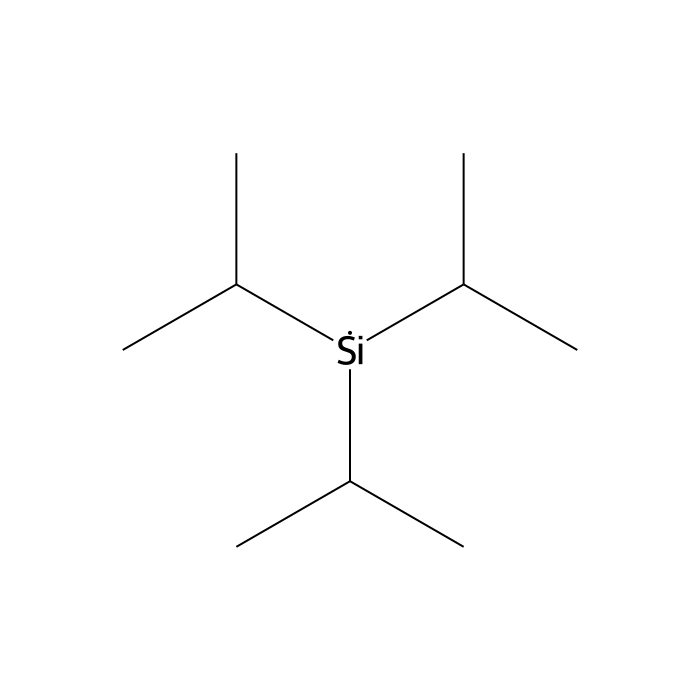
Triisopropylsilane(TIPS) - ≥98.5% , CAS No.6485-79-6

CAS: 6485-79-6 Cat. No.: T420182 分子式: C9H22Si 分子量: 158.36 Beilstein Registry Number: 1733718 EC番号: 464-880-1
注文可能
グレード&純度 ≥98.5%
Synonyms
EN300-117959 | J-525100 | tris(propan-2-yl)silane | PD118098 | AKOS006222744 | AS-19155 | Aksci Bulk ReagentTriisopropylsilane | Triisopropylsilane, 98% | A14931 | AKOS030228028 | Benzenesulfonic acid,5-[(4-amino-1-naphthalenyl)azo]-2-[2-[4-[(2-hydroxy-1-
Storage
Room temperature,Argon charged
Shipped In
Normal
★
サイズ
USA
ドイツ (EU)*
価格
個数
5ml
T420182-5ml
在庫あり ≥10
—

$9.90

$10.90
保存 $1.00 (9.17%)
25ml
T420182-25ml
9 在庫あり
—
$29.90
100ml
T420182-100ml
在庫あり ≥10
7 在庫あり
$79.90
500ml
T420182-500ml
1 在庫あり
—
$279.90
Enter a quantity for the sizes you want to add.
🧪
このグレードを選ぶ理由

≥98.5% ベースライン干渉を最小限に抑える必要がある、感度の高いクロマトグラフィーおよび分析ワークフロー向け。

🌡

保管・配送

Room temperature,Argon charged Normal に出荷。正確な仕様については、ロット固有の COA をご確認ください。

📋

品質書類

SDS、COA、データシート、仕様書をダウンロードできます。ロット固有の COA はロット番号検索で入手可能です。

📚

文献的裏付け

クロマトグラフィー、有機合成、クロスカップリング反応に関する 73 件の査読済み論文で引用されています。

概要

Triisopropylsilane (TIPS) is an organosilicon compound used as a reducing agent in organic synthesis due to its relatively low toxicity, ease of handling, and its ability to selectively reduce various functional groups. It is used in the presence of a Lewis acid such as titanium (IV) chloride to selectively reduce ketones and aldehydes to their corresponding alkanes and selective reduction of epoxides to the corresponding alcohols.
Purpose
Triisopropylsilane can be used as a reducing agent:
To synthesize 4-pyrrole phenylacyl peptide during solid-phase peptide synthesis. 
In transition metal complex-catalyzed reaction of amides with hydrosilanes. 
For the selective reduction of C-arylglucosides into β-C-aryl glucosides.
To facilitate the cleavage of acetamidomethyl (Acm), 4-methoxybenzyl (Mob), and tert-butyl (But) protecting groups from cysteine (Cys) residues in the presence of trifluoroacetic acid.
For the reduction of amides to corresponding amines in the presence of transition-metal catalysts.

仕様

同義語
EN300-117959 | J-525100 | tris(propan-2-yl)silane | PD118098 | AKOS006222744 | AS-19155 | Aksci Bulk ReagentTriisopropylsilane | Triisopropylsilane, 98% | A14931 | AKOS030228028 | Benzenesulfonic acid,5-[(4-amino-1-naphthalenyl)azo]-2-[2-[4-[(2-hydroxy-1-
仕様と純度
≥98.5%
保管条件
Room temperature,Argon charged
入荷
Normal
純度
≥98.5%
名前と識別子
パブケム・シド
パブケム・シド・ウル
https://pubchem.ncbi.nlm.nih.gov/substance/508811475
カノニカル・スマイル
CC(C)[Si](C(C)C)C(C)C
InChIKey
ZGYICYBLPGRURT-UHFFFAOYSA-N
INCHI
1S/C9H21Si/c1-7(2)10(8(3)4)9(5)6/h7-9H,1-6H3
異性体SMILES
CC(C)[Si](C(C)C)C(C)C
WGKドイツ
3
UN番号
1993
分子量
158.36
Beilstein
1733718
Reaxy-Rn
1733718

ドキュメント

📋 安全データシート(SDS)

危険性、取扱い、保管、および規制遵守を網羅した包括的な文書。

<<<<<<< HEAD SDS をダウンロード → ======= SDS をダウンロード → >>>>>>> release248-p3

✅ 分析証明書(COA)

ロット固有の品質データ。ロット番号を入力して、正確な COA を取得してください。

COA を検索 →

📊 データシート

製品仕様と用途のクイックリファレンス概要。

データシートを見る →

🔬 仕様書

このグレードの完全な品質特性と合格基準。

仕様書を見る →

詳細データ

Taxonomic Classification

Taxonomy Tree

KingdomOrganic compounds
SuperclassHydrocarbon derivatives
分類Not available
SubclassNot available
Intermediate Tree Nodes Not available
Direct ParentHydrocarbon derivatives
Alternative Parents Organosilicon compounds  
Molecular FrameworkAliphatic acyclic compounds
Substituents Hydrocarbon derivative - Organosilicon compound - Organic metalloid moeity - Aliphatic acyclic compound
説明This compound belongs to the class of organic compounds known as hydrocarbon derivatives. These are derivatives of hydrocarbons obtained by substituting one or more carbon atoms by an heteroatom. They contain at least one carbon atom and heteroatom.
External Descriptors Not available
3 D構造
インタラクティブ化学構造モデル


証明書(CoA、COO、BSE/TSEと分析図)
C of A & Other Certificates(BSE/TSE, COO):
Analytical Chart:

Find and download the COA for your product by matching the lot number on the packaging.

45 results found

Lot NumberCertificate Type日付商品
L2404568L2404568Certificate of AnalysisSep 04, 2026 T420182
F2616482F2616482Certificate of AnalysisJun 08, 2026 T420182
F2616481F2616481Certificate of AnalysisJun 08, 2026 T420182
F2616480F2616480Certificate of AnalysisJun 08, 2026 T420182
F2616479F2616479Certificate of AnalysisJun 08, 2026 T420182
F2616476F2616476Certificate of AnalysisJun 08, 2026 T420182
J2509726J2509726Certificate of AnalysisSep 19, 2025 T420182
J2509725J2509725Certificate of AnalysisSep 19, 2025 T420182
J2509724J2509724Certificate of AnalysisSep 19, 2025 T420182
D2601060D2601060Certificate of AnalysisSep 19, 2025 T420182
D2601061D2601061Certificate of AnalysisSep 19, 2025 T420182
D2601062D2601062Certificate of AnalysisSep 19, 2025 T420182
J2509723J2509723Certificate of AnalysisSep 19, 2025 T420182
L2404578L2404578Certificate of AnalysisNov 21, 2024 T420182
L2404577L2404577Certificate of AnalysisNov 21, 2024 T420182
E2522013E2522013Certificate of AnalysisNov 21, 2024 T420182
F2427357F2427357Certificate of AnalysisJun 19, 2024 T420182
K2425008K2425008Certificate of AnalysisJun 19, 2024 T420182
F2427356F2427356Certificate of AnalysisJun 19, 2024 T420182
F2427360F2427360Certificate of AnalysisJun 19, 2024 T420182
F2427359F2427359Certificate of AnalysisJun 19, 2024 T420182
F2427358F2427358Certificate of AnalysisJun 19, 2024 T420182
F2222395F2222395Certificate of AnalysisMar 21, 2024 T420182
F2222394F2222394Certificate of AnalysisMar 21, 2024 T420182
F2222393F2222393Certificate of AnalysisMar 21, 2024 T420182
F2222388F2222388Certificate of AnalysisMar 21, 2024 T420182
D2429453D2429453Certificate of AnalysisFeb 29, 2024 T420182
D2429454D2429454Certificate of AnalysisFeb 29, 2024 T420182
D2429455D2429455Certificate of AnalysisFeb 29, 2024 T420182
D2429456D2429456Certificate of AnalysisFeb 29, 2024 T420182
D2429457D2429457Certificate of AnalysisFeb 29, 2024 T420182
D2429452D2429452Certificate of AnalysisFeb 29, 2024 T420182
J2319539J2319539Certificate of AnalysisOct 13, 2023 T420182
J2319540J2319540Certificate of AnalysisOct 13, 2023 T420182
J2319541J2319541Certificate of AnalysisOct 13, 2023 T420182
I2315087I2315087Certificate of AnalysisSep 09, 2023 T420182
I2315262I2315262Certificate of AnalysisSep 09, 2023 T420182
I2315086I2315086Certificate of AnalysisSep 09, 2023 T420182
I2315085I2315085Certificate of AnalysisSep 09, 2023 T420182
H23031214H23031214Certificate of AnalysisJul 15, 2023 T420182
H23031185H23031185Certificate of AnalysisJul 15, 2023 T420182
H23031072H23031072Certificate of AnalysisJul 15, 2023 T420182
H23031070H23031070Certificate of AnalysisJul 15, 2023 T420182
H23031040H23031040Certificate of AnalysisJul 15, 2023 T420182
F2222398F2222398Certificate of AnalysisJul 01, 2022 T420182
化学的性質と物理的性質
溶解度Immiscible with water.
感度Moisture sensitive.
屈折率1.434
引火点(°F)100.4 °F
引火点(°C)38 °C
沸点(°C)84-86 °C/35 mmHg (lit.)
分子量157.350 g/mol
XLogP3
Hydrogen Bond Donor Count0
Hydrogen Bond Acceptor Count0
Rotatable Bond Count3
Exact Mass157.141 Da
Monoisotopic Mass157.141 Da
Topological Polar Surface Area0.000 Ų
Heavy Atom Count10
Formal Charge0
Complexity65.700
Isotope Atom Count0
Defined Atom Stereocenter Count0
Undefined Atom Stereocenter Count0
Defined Bond Stereocenter Count0
Undefined Bond Stereocenter Count0
The total count of all stereochemical bonds0
Covalently-Bonded Unit Count1
よくある質問と記事
Protection Reagents
A Complete Guide to Choosing Resins for SPPS (Solid-Phase Peptide Synthesis): Fmoc/Boc Routes, C-Terminal Acid/Amide, and a Key-Parameter Navigator
From Analytical Instrument to Synthetic Platform: A New Strategy for Reconstructing Automated Flow Solid-Phase Peptide Synthesis with Standard Analytical HPLC
New Progress in the Solid-Phase Synthesis of Sterically Hindered Peptides: Background, Core Breakthroughs, and Implications for Automation Compatibility of the RMMR Strategy
Low Racemization in Peptide Synthesis Is Not Just About Reagent Choice: Stereochemical Risk During the Activation Stage and Practical Strategies for Experimental Control
Decision Logic for Peptide Synthesis Routes: Applicability and Criteria for Choosing among SPPS, LPPS, and Recombinant Expression
Boc₂O Selection Cannot Be Judged by Protection Installation Alone: Experimental Decision-Making from Substrate Nucleophilicity and Medium Effects to Deprotection Pathways
How to Troubleshoot Abnormal Impurities in Peptide Synthesis? Locating Process Issues Through Amino-Related Side Reactions
Peptide Intermediates Difficult to Dissolve and Separate? Route Design and Workup Strategies for Tag-Assisted Liquid-Phase Peptide Synthesis (TAG-LPPS)
Formation and Control of Carboxyl- and Hydroxyl-Related Impurities in Peptide Synthesis — Using Asp/Glu and Ser/Thr Residue Side Reactions as Examples
Citations of This Product
ソリューション計算機
レビュー

顧客レビュー

Shall we send you a message when we have discounts available?

Remind me later

Thank you! Please check your email inbox to confirm.

Oops! Notifications are disabled.