≥98%(HPLC) for sensitive chromatographic and analytical workflows requiring minimal baseline interference.
🌡
Storage & shipping
Store at 2-8°C,Protected from light Ships Wet ice Check lot-specific COA for exact specifications.
📋
Quality documents
SDS, COA, datasheet, and spec sheet available for download. Lot-specific COA accessible via lot number lookup.
📚
Literature proof
Cited in 0 peer-reviewed publications across chromatography, organic synthesis, and cross-coupling reactions.
概要
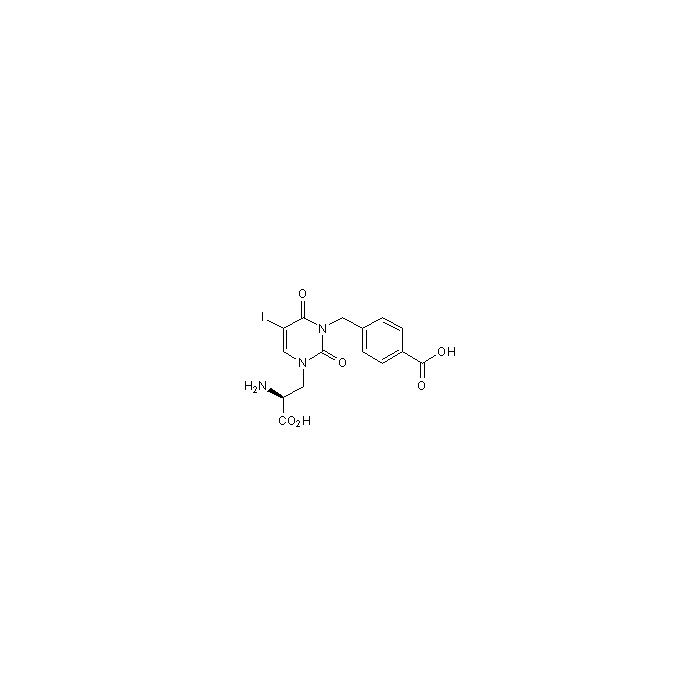
UBP301 is a potent and selective kainate receptor antagonist with IC50 and KD values of 164 μM and 5.94 μM, respectively. UBP301 is 30 times more selective to chloric acid receptors than AMPA receptors. UBP301 is a derivative of Willardiine
This compound belongs to the class of organic compounds known as l-alpha-amino acids. These are alpha amino acids which have the L-configuration of the alpha-carbon atom.
External Descriptors
Not available
1. Djoumbou Feunang Y, Eisner R, Knox C, Chepelev L, Hastings J, Owen G, Fahy E, Steinbeck C, Subramanian S, Bolton E, Greiner R, and Wishart DS. ClassyFire: Automated Chemical Classification With A Comprehensive, Computable Taxonomy. Journal of Cheminformatics, 2016, 8:61.
Solvent:DMSO, Max Conc. mg/mL: 2.3, Max Conc. mM: 5 with gentle warming
感度
Moisture sensitive;light sensitive
分子量
459.190 g/mol
XLogP3
-2.500
Hydrogen Bond Donor Count
3
Hydrogen Bond Acceptor Count
7
Rotatable Bond Count
6
Exact Mass
458.993 Da
Monoisotopic Mass
458.993 Da
Topological Polar Surface Area
141.000 Ų
Heavy Atom Count
25
Formal Charge
0
Complexity
614.000
Isotope Atom Count
0
Defined Atom Stereocenter Count
1
Undefined Atom Stereocenter Count
0
Defined Bond Stereocenter Count
0
Undefined Bond Stereocenter Count
0
The total count of all stereochemical bonds
0
Covalently-Bonded Unit Count
1
ソリューション計算機
Molarity Calculator
Determine the necessary mass, volume, or concentration for preparing a solution.
Dilution Calculator
Determine the dilution needed to prepare a stock solution.
Reconstitution Calculator
レビュー
顧客レビュー
Application Protocols
Manufacturer-tested applications and protocol parameters: Not specified for this item.
General recommendations for small-molecule use in research assays:
Stock preparation: Prepare fresh stocks in DMSO; filter if needed. Record exact concentration using mass and volumetric accuracy, or confirm by quantitative NMR/UV if applicable.
Working concentrations: Establish a broad range and refine using preliminary screens; include vehicle-only controls at matching solvent percentages.
Plate handling: Use low-binding, solvent-resistant plates/tubes. Pre-wet tips with solution to improve dosing precision at low volumes.
Light protection: Given the storage requirement “Protected from light,” use amber vials and minimize light exposure during setup.
Documentation: Record lot number, preparation date, storage conditions, and freeze–thaw cycles.
For method-specific parameters (e.g., WB, IF, IHC, FC, electrophysiology, enzyme assays), optimize empirically for your platform. Consult the SDS and CoA for any additional constraints.
Biological Roles
Item-specific biological function/target: Not specified for this item. No claims regarding mechanism, target class, or pathway are made here.
General context for small-molecule library members:
Such compounds are typically used as research tools to probe biochemical pathways, modulate protein function, or serve as starting points in hit discovery. Their biological roles are determined empirically through assays tailored to the suspected target class.
When identity and literature are known, typical information includes putative targets, binding modes, and selectivity profiles. For this item, consult the CoA and peer-reviewed sources tied to the CAS (569371-10-4) and CID (6604913) to confirm any reported roles before experimental use.
Best practices in biological evaluation:
Establish solubility and stability in assay media to avoid artifacts.
Run orthogonal assays (e.g., biochemical vs cellular) to differentiate direct target effects from pathway-level outcomes.
Implement selectivity panels early to identify off-target risks.
Monitor cytotoxicity in parallel when working with cellular systems, using appropriate viability assays.
Reminder: This product is for research use only and is not intended for diagnostic, therapeutic, or clinical applications.
Buffer Applications
This item is a small-molecule library compound, not a buffering agent. No intrinsic buffering system or pH range is specified for this product.
Practical guidance (when preparing assay buffers that include small-molecule stocks):
Prepare primary stocks in DMSO or a suitable organic solvent, then dilute into the desired biological buffer (e.g., PBS, HEPES, Tris) while maintaining final organic solvent ≤0.1–1% v/v as permitted by your assay.
Verify that the compound remains in solution across the working pH and ionic strength; precipitation can confound results.
Use filtering (0.22 μm) if compatible to remove particulates after dilution.
If your application requires a specific buffer system (HEPES pH 7.2–7.6; MOPS pH 6.5–7.9; Tris pH 7–9; general literature ranges), select the buffer based on your biological target, not this compound. No buffer recipes or pKa values are provided for UBP 301.
Green Alternatives
Greener chemistry considerations primarily concern solvents and handling rather than the compound itself, since this product is a specific small molecule and not interchangeable.
Solvent strategy (general):
Prefer greener solvents where feasible for dissolution and work-up: water > ethanol > isopropanol > ethyl acetate > acetone > acetonitrile > DMF > DMSO (considered acceptable in small volumes for screening).
Reduce DMSO volumes by using concentrated stocks and minimizing carryover in assays.
Comparison of common stock solvents (general characteristics):
Water: Greenest; limited by compound ionization/solubility.
Ethanol: Renewable, lower toxicity; miscible with water, good for moderately polar organics.
DMSO: Broad solvency, biologically tolerated at low %; higher energy cost to purify and disposal considerations.
DMF: Powerful polar aprotic solvent; more stringent EHS profile—avoid if DMSO suffices.
Operational measures:
Right-size aliquots to minimize freeze-thaw and waste.
Use amber vials and light-protective secondary containment to maintain stability (reduces wastage).
Implement microscale assays to reduce solvent and consumable usage.
Note: Since no structural data are provided, solvent choices must be validated empirically. Prioritize greener options first, escalating only as solubility demands.
Pharmaceutical Uses
No pharmacopeial grade or excipient role is specified for this item; it is supplied strictly for research use only.
General considerations (non-clinical, formulation science context):
Small-molecule research tools may be formulated into vehicles suitable for preclinical in vitro work (e.g., DMSO stocks diluted into aqueous buffers) or non-GLP exploratory in vivo studies when permitted by institutional approvals. For this item, no formulation guidance is provided.
Do not infer suitability for human or veterinary use. There is no USP/EP/JP monograph entry indicated, and no GMP status is claimed.
If formulation-like activities are performed in a research setting:
Validate solvent tolerability in the chosen biological system, control for vehicle effects, and characterize stability (LC-MS) in the vehicle across the dosing window.
Record exact lot, concentration, and vehicle composition for reproducibility.
Important: This product is not intended for therapeutic or diagnostic applications, and no clinical claims are made or implied.
Physical Properties
Item-specific values: Not specified for this item; refer to CoA/Spec Sheet for definitive data.
Typically reported properties for small-molecule library compounds (literature/general):
Appearance: Often supplied as a solid or film; some items may be oily or hygroscopic. Not specified for this item.
Melting point (MP): Not specified for this item.
Boiling point (BP): Not applicable/rarely reported for nonvolatile solids; not specified for this item.
Density: Not specified for this item.
Solubility: Not specified for this item. Many screening compounds dissolve in DMSO at 10–50 mM (general guidance), but empirical verification is required.
LogP/logD, pKa, and refractive index: Not specified for this item.
Practical characterization suggestions (general best practice):
Determine solubility by small-scale titration in DMSO, ethanol, or aqueous buffers across pH 2–9, monitoring by UV-Vis or HPLC.
If crystalline, DSC and TGA can inform thermal stability and potential solvates.
Record UV-Vis spectrum (200–400 nm) to estimate working wavelengths for analytical HPLC detection; do not assume a specific UV cutoff without data.
Important: Do not treat any of the above as specifications. For experimental planning, rely on the product’s CoA/SDS and your in-lab measurements.
Quality and Grades
Item-specific grade/purity: Not specified for this item; refer to CoA/Spec Sheet.
How to interpret grades (general guidance):
Research grade: Suitable for R&D; purity and impurity profiles are defined on the CoA (e.g., HPLC area %). UV absorbance and trace metal limits may not be controlled unless stated.
Analytical/HPLC grade: Used primarily for solvents; implies low UV background and defined residue on evaporation. Not implied here unless specified.
Pharma/USP/EP grade: Conforms to pharmacopeial monographs. Not implied here.
Verification steps recommended for small-molecule library members:
Identity: HRMS and 1H/13C NMR.
Purity: Analytical HPLC/UPLC with at least two orthogonal methods (e.g., C18 gradient and HILIC if polar) and appropriate detection (UV at multiple wavelengths and/or MS).
Water content: Karl Fischer if hygroscopic or if aqueous solubility is critical. Not specified for this item.
Residual solvents and stabilizers: Not specified for this item; check CoA.
Batch documentation:
Request CoA with batch number, chromatograms, and spectral data. If UV cutoff, residual metals, or specific assay purity are critical to your application, confirm in writing prior to ordering.
Bottom line: Use the CoA as the single source of truth for this item’s grade, purity, and analytical acceptance criteria.
Reaction and Applications
This product is cataloged as a small-molecule/compound library member rather than a synthetic reagent. As such, it is not typically used to mediate or catalyze organic reactions.
Relevant applications (general for screening compounds):
In vitro biochemical assays: Evaluate compound activity against purified protein targets, enzymes, or receptors using spectroscopic or LC-MS readouts.
Cell-based phenotypic assays: Assess effects on cellular pathways or phenotypes. Optimize solvent carryover (often ≤0.1–0.5% DMSO) and include vehicle controls.
Electrophysiology/ion channel studies and binding assays may be applicable depending on the true identity; however, for this specific item no target is provided—consult literature and the CoA before designing target-focused assays.
Practical tips:
Establish a concentration-response curve spanning at least 8–10 points with duplicate/triplicate wells.
Verify chemical stability in assay buffer over the assay duration by LC-MS.
Important: Do not assume a pharmacological class or mechanism for this item in the absence of verified structural/target information. Use appropriate positive/negative controls relevant to your assay system.
Reaction Conditions
Not typically applicable. This product is provided as a research compound for screening/biological studies rather than as a reagent to run chemical reactions. No catalytic or stoichiometric reaction role is specified for this item.
General handling conditions relevant to solution preparation:
Dissolution: Begin with dry DMSO to prepare a concentrated stock (e.g., 10–50 mM if soluble). Warm gently (≤40°C) and sonicate as needed. Do not overheat or expose to bright light (store/handle in amberware).
Dilution: Add stock slowly into vigorously mixed buffer/media to minimize precipitation. Keep final organic cosolvent low as dictated by your assay.
Stability checks: Use quick LC-MS or analytical HPLC to assess stability over the intended usage period (e.g., 0, 2, 24 hours at room temperature or 37°C as relevant).
If you intend to use this material in a chemical transformation, first confirm the full structure and consult the literature for compatible conditions; none are provided here for UBP 301.
Safety and Handling
Item-specific hazard details: Not specified for this item; consult the Safety Data Sheet (SDS) for authoritative information.
From Product Data:
Storage: Store at 2–8°C, protected from light.
Shipping: Shipped on wet ice.
General laboratory precautions for research chemicals of unknown hazard class:
GHS/Signal word/H-statements/pictograms: Not specified for this item; refer to SDS.
PPE: At minimum, wear lab coat, safety glasses, and appropriate chemically resistant gloves (e.g., nitrile). Work in a fume hood to avoid inhalation exposure.
Handling: Avoid dust/aerosol generation. Minimize skin/eye contact and ingestion. Use light-protection (amber vials/foil) during handling and storage as indicated.
Incompatibilities: Without structural data, avoid strong oxidizers, strong acids/bases, and reactive reducing agents until compatibility is known. Separate from food and feed.
First aid (general): If inhaled—move to fresh air; if on skin—wash with soap and water; if in eyes—rinse cautiously with water for several minutes; if ingested—rinse mouth and seek medical attention. Always follow the SDS for detailed measures.
Spill/accident: Contain solids with inert absorbent, avoid dust, and dispose of waste according to institutional and local regulations.
Note: Because specific hazards are not provided, adopt conservative handling practices and consult the product SDS before use.
Solvent Selection
Item-specific solubility and polarity: Not specified for this item; refer to CoA/Spec Sheet and perform a bench-top solubility screen.
General strategy for small-molecule library compounds:
Primary stock solvent: DMSO is typically preferred for biological screening due to broad solvating power and compatibility at ≤1% v/v in many assays.
Secondary options: DMF, ethanol, methanol for stocks; aqueous buffers (pH-adjusted) for immediate use if the compound bears ionizable groups.
Miscibility: DMSO mixes with water; pre-dilute DMSO stocks into media/buffer slowly with mixing to prevent precipitation.
Practical solubility screening (stepwise):
Test solubility at 10 mM in dry DMSO. If insoluble, warm gently (≤40°C), sonicate, or decrease target concentration.
If solubility remains poor, evaluate DMF or 1:1 DMSO:DMF, then alcoholic cosolvents (EtOH, MeOH).
For aqueous use, assess pH dependence (e.g., buffers at pH 3, 7.4, 9) and include 0.1–1% DMSO as a cosolvent.
Filter through 0.22 μm if compatible to remove particulates before assays.
Notes:
Avoid plastic adsorption for hydrophobic/charged compounds by using low-binding tubes and adding carrier proteins/detergents only if assay-compatible.
Do not assume stability in any solvent; confirm by LC-MS over your intended storage/use timeframe.
Storage and Reconstitution
From Product Data (item-specific):
Storage conditions: Store at 2–8°C, protected from light.
Shipping condition: Shipped on wet ice.
Reconstitution guidance (general, since no solvent/solubility is specified):
Solvent selection: Start with anhydrous DMSO to prepare a concentrated stock solution. If DMSO is unsuitable, test DMF or ethanol; for aqueous use, evaluate buffered solutions at relevant pH values.
Concentration: Common screening stocks are 10–50 mM (general practice); adjust based on actual solubility determined experimentally.
Technique: Allow vial to equilibrate to room temperature before opening to avoid condensation. Weigh quickly, minimize light exposure, and use amber vials.
Aliquoting: Divide into single-use aliquots to avoid repeated freeze–thaw cycles. Label with concentration, solvent, date, and lot number.
Short-term storage of solutions: Typically at 2–8°C for hours to days if stable; long-term at −20°C or −80°C may be appropriate for DMSO stocks—verify stability by LC-MS/HPLC. Because no stability data are provided for this item, perform your own verification.
Disposal: Follow institutional and local regulations for organic solvent waste and small-molecule research chemicals.
Note: Where specific values (solubility, stability windows) are critical, consult the CoA/Spec Sheet for this product and confirm empirically in your laboratory.
Structure and Identity
Brief overview: UBP 301 is listed as a small-molecule library member in Aladdin Scientific’s catalog. The supplier record does not include structural identifiers beyond CAS and CID.
Item-specific (from Product Data):
Product name: UBP 301 (SKU: U288472)
CAS: 569371-10-4
PubChem CID: 6604913
InChIKey: 160793 (as provided)
SMILES: Not specified for this item; refer to CoA/Spec Sheet.
Molecular formula: Not specified for this item; refer to CoA/Spec Sheet.
Molecular weight: Not specified for this item; refer to CoA/Spec Sheet.
Structural description cannot be provided without a formula or SMILES. If you require a detailed 2D/3D depiction, please consult the Certificate of Analysis (CoA), Spec Sheet, or validated databases using the CAS or CID.
Notes on identity control (general best practice):
Confirm identity via orthogonal methods prior to critical experiments: high-resolution MS, NMR (1H/13C), and HPLC/UPLC purity profiling.
Where an InChIKey/SMILES is missing or uncertain, use the CAS + CID to retrieve a vetted structure from a primary database (e.g., PubChem), and verify against the vendor CoA.
Synthetic Utility
UBP 301 is offered as a discrete small molecule rather than a synthetic building block or reagent. Without a disclosed structure, it is not possible to outline functional group compatibility or specific transformations.
General guidance for users considering derivatization (only after structure confirmation from CoA/literature):
If the compound contains common functional handles (e.g., amines, carboxylates, phenols, halides), classical transformations such as amide coupling, alkylation, Suzuki cross-coupling, or protection/deprotection may be feasible.
Prior to any derivatization, record baseline purity and identity, then re-characterize products via NMR, HRMS, and LC purity.
However, for this catalog item as listed:
No recommendation is made to use it as a reagent or starting material in synthesis.
No named reaction applicability is asserted, and no retrosynthetic value is claimed due to lack of structural disclosure in the provided data.
If synthetic utility is desired, retrieve the validated structure using the CAS or CID and consult the primary literature for established chemistry on this scaffold.
Target Specificity
Item-specific target, selectivity, and binding data: Not specified for this item.
Notes:
No protein target, receptor class, enzyme family, or pathway information is provided in the Product Data. Do not assume target engagement or selectivity without consulting the CoA and peer-reviewed literature associated with CAS 569371-10-4 and CID 6604913.
If your work requires defined selectivity, run an appropriate panel (e.g., enzymatic isoforms, receptor subtypes, off-target safety screens) using standard assay conditions and include orthogonal confirmation methods.
This section will remain blank of specifics until validated target information is supplied by the manufacturer or derived from reputable literature sources.
よくある質問
What is the purity of this product, and how is it determined?
This product is supplied at ≥98% purity, determined by HPLC. Lot-specific values are stated on the Certificate of Analysis.
How should this product be stored?
Store at 2–8 °C, protected from light. The material is light-sensitive — keep it in its original opaque or amber container.
How is this product shipped?
This product ships chilled on wet ice. Unpack on arrival and transfer it to the storage condition stated above.
What are the CAS number, molecular formula and molecular weight?
The CAS Number is 569371-10-4, the molecular formula is C??H??IN?O?, and the molecular weight is 459.20 g/mol. InChIKey JHSYCOCOIYSZGI-NSHDSACASA-N.
What documentation is provided?
Available product documentation, including Certificates of Analysis (COA), Safety Data Sheets (SDS), and specification sheets, is shown in the product document area. Document availability and access follow the current site policy.
Products are supplied to verified businesses, institutions, and qualified professionals for research and development use only. Not for use in humans, animals, diagnosis, or therapy.