This compound belongs to the class of organic compounds known as acyl fluorides. These are organic compounds containing the functional group -CO-F.
External Descriptors
Not available
1. Djoumbou Feunang Y, Eisner R, Knox C, Chepelev L, Hastings J, Owen G, Fahy E, Steinbeck C, Subramanian S, Bolton E, Greiner R, and Wishart DS. ClassyFire: Automated Chemical Classification With A Comprehensive, Computable Taxonomy. Journal of Cheminformatics, 2016, 8:61.
Determine the necessary mass, volume, or concentration for preparing a solution.
Dilution Calculator
Determine the dilution needed to prepare a stock solution.
Reconstitution Calculator
レビュー
顧客レビュー
Application Protocols
No assay protocols (e.g., WB, IHC, IF, FC) are applicable to this small‑molecule reagent. For laboratory use, see Reaction Conditions for representative procedures to employ Undecafluorohexanoyl fluoride in acylation reactions, and Safety & Handling for operational guidance.
Biological Roles
This product is a synthetic perfluoroacylating reagent intended for chemical synthesis. It does not have intrinsic biological roles in metabolic pathways.
General context (not application claims):
Perfluoroalkyl chains can modulate hydrophobicity and surface interactions when appended to biomolecules or materials, but such modifications are typically explored in method development or materials science rather than biology.
Hydrolysis yields perfluorohexanoic acid (a PFAS), which has environmental relevance but no beneficial biological function; handle to prevent environmental release.
For any use intersecting biological systems, treat strictly as a research chemical and validate compatibility empirically. No clinical or therapeutic uses are implied.
Buffer Applications
Not typically applicable. Undecafluorohexanoyl fluoride is a moisture‑sensitive acylating agent and is incompatible with aqueous buffer systems due to rapid hydrolysis to the corresponding perfluoroacid and HF. For aqueous work, see Reaction & Applications and Safety & Handling regarding controlled hydrolysis/quench procedures.
Green Alternatives
Assessment of Undecafluorohexanoyl fluoride through a green chemistry lens (general):
PFAS considerations: perfluoroalkyl substances are environmentally persistent and bioaccumulative. Use should be justified by unique performance needs (e.g., surface energy control) and accompanied by robust containment, minimal scale, and compliant waste management.
Reagent choice: compared to acid chlorides, acyl fluorides can offer cleaner reactions (fewer side products) and may operate at lower temperatures, potentially reducing energy input. However, HF byproduct management is essential.
Solvent selection: prefer safer solvents (e.g., ethyl acetate, 2‑MeTHF, anisole) when compatible with reactivity; avoid chlorinated solvents where possible.
Process intensification: use catalytic acyl transfer agents (DMAP) and continuous‑flow or microreactor setups to reduce inventory of hazardous intermediates and improve containment.
Illustrative comparison (general; not item specs):
Option: Undecafluorohexanoyl fluoride vs. perfluorohexanoyl chloride
Reactivity/selectivity: fluoride often provides greater chemoselectivity and less over‑acylation.
Byproducts: HF (manageable with base) vs. HCl (corrosive gas); both require scrubbing/neutralization.
Moisture sensitivity: acyl fluoride can be somewhat more robust than chloride, but still hydrolyzes.
Practical recommendations:
Right‑size scale and adopt closed, inert transfer.
Substitute non‑fluorinated acyl groups where performance allows.
Segregate and treat PFAS‑containing effluents; consult institutional EHS guidance on PFAS waste.
Pharmaceutical Uses
No pharmacopeial or excipient status is specified for this item. It is supplied for research use only.
General, nonclinical context:
In process chemistry development, acyl fluorides can be explored as alternative acylating agents for amide/ester bond formation due to their chemoselectivity. However, the perfluorohexanoyl group is rarely desired in drug substances; PFAS persistence raises EHS and regulatory concerns.
If evaluated in a manufacturing setting, ensure full clearance of PFAS residues and robust waste management. Confirm acceptance criteria and residual reagent limits with appropriate quality systems.
Item-specific note: Grade/purity and compendial compliance are Not specified for this item; refer to CoA/Spec Sheet.
Physical Properties
Item-specific physico-chemical specifications (bp, mp, density, refractive index, UV cutoff, water/peroxide/metal content) are Not specified for this item; refer to CoA/Spec Sheet.
General/literature characteristics for perfluoroacyl fluorides (context, not item specs):
Phase/appearance: typically colorless liquids with low surface energy and high volatility relative to hydrocarbon analogs.
Polarity: weakly polar bulk behavior despite a polar carbonyl; overall dominated by the highly fluorinated chain.
Solubility: immiscible with water; soluble in many nonpolar and moderately polar organic solvents (e.g., chlorinated solvents, ethers, perfluorinated solvents).
Acidity/basicity: not protic; susceptible to hydrolysis by water to the corresponding perfluorohexanoic acid with evolution of HF.
Thermal behavior: perfluoroalkyl chains are thermally robust; however, the acyl fluoride group is reactive and should not be heated unnecessarily, especially in moist environments.
Vapor handling: volatile enough to warrant use in well‑ventilated hoods; handle as a lachrymator/corrosive‑potential acylating agent.
Computed/literature identifiers (non-spec):
Empirical formula basis: C6F12O (per discussion in Structure & Identity).
Calculated formula mass: ~316.04 g/mol.
For exact physical constants and acceptance criteria for this SKU, please consult the lot-specific Certificate of Analysis.
Quality and Grades
Grade/purity: Not specified for this item; refer to CoA/Spec Sheet for assay, related substances, stabilizers, and acceptance criteria.
Context and expectations for this class of reagent (general guidance):
Acyl fluoride quality considerations typically include assay by GC/19F NMR, hydrolyzable fluoride content, acidity (as perfluoroacid), and volatile impurities. Water content is often tracked due to hydrolytic sensitivity.
UV absorbance specifications are uncommon unless sold for chromatographic use; if HPLC grade is claimed (not specified here), low UV background and minimal nonvolatile residues would be expected.
Stabilizers: Many acyl fluorides are supplied without stabilizers; others may be packaged under inert gas. For this SKU, the Product Data specifies Argon charged packaging and “Cool, room temperature” storage, indicating moisture‑exclusion as a quality practice.
Packaging: Use PTFE‑lined closures to minimize reaction with caps; crimp‑sealed septa facilitate inert transfers and minimize moisture ingress.
Action items for users:
Verify lot-specific purity, residual solvents, and identity on the CoA before use in critical applications.
If ultra‑low moisture or trace metal levels are required, pre‑treat (e.g., distill under inert gas) and document in your method, as no such limits are specified for this item.
Reaction and Applications
Use Undecafluorohexanoyl fluoride as a perfluoroacylating agent to install the perfluorohexanoyl (C5F11CO–) group.
Typical applications (literature/general):
Amide formation: acylation of primary/secondary amines to give perfluorohexanamides. Employ non-nucleophilic base (e.g., DIPEA, Et3N) to scavenge HF; catalytic DMAP can accelerate acyl transfer. Monitor by 19F NMR/LC–MS.
Ester formation: reaction with alcohols/phenols to furnish perfluorohexanoate esters; DMAP or pyridine catalysis is often beneficial.
Hydrolysis: controlled conversion to perfluorohexanoic acid under aqueous/basic conditions.
Mixed anhydrides/acid chlorides: conversion under halogenating or coupling conditions (e.g., SOCl2, oxalyl chloride, or via fluoride exchange chemistry) when alternate acyl derivatives are needed.
Polymer/materials modification: surface perfluoroacylation of hydroxylated polymers or silica to impart oleophobicity/hydrophobicity (appropriate EHS safeguards required due to PFAS persistence).
Peptide/bioconjugation (method development only): temporary perfluoroacyl protection or tagging can aid fluorous phase separations; ensure compatibility with sensitive residues and avoid aqueous conditions that generate HF.
Practical tips:
Moisture control: rigorously dry glassware and solvents; work under argon (as supplied) to limit hydrolysis.
Base management: pre‑charge base to reaction to neutralize HF formed in situ; consider HF scavengers compatible with the substrate.
Workup: quench residual acyl fluoride with a controlled addition of alcohol/base at low temperature; separate PFAS‑containing waste streams for compliant disposal.
Reaction Conditions
Representative, literature‑style guidance for using Undecafluorohexanoyl fluoride (not product specifications):
Amide formation:
Solvent: dry DCM, THF, toluene, or MeCN.
Base: 1.1–2.0 equiv DIPEA or Et3N; optionally 5–10 mol% DMAP for acceleration.
Temperature: 0–25 °C; cool initial addition to manage exotherm and HF formation.
Stoichiometry: 1.0–1.2 equiv acyl fluoride per amine N–H.
Time: 0.5–4 h typical; monitor by TLC/LC–MS/19F NMR.
Ester formation (alcohol/phenol):
Solvent: DCM or THF; add 5–10 mol% DMAP.
Base: 1.5–2.5 equiv pyridine/Et3N.
Temperature: 0–25 °C.
Hydrolysis to acid:
Aqueous base (e.g., NaHCO3 or Na2CO3) at 0–10 °C, then warm to rt; vigorous gas/vapor handling due to HF.
Workup and purification:
Quench residual acyl fluoride with MeOH/pyridine at 0 °C before aqueous workup.
Wash with bicarbonate and brine; dry over MgSO4/Na2SO4; avoid silica acid sites for unreacted reagent.
For fluorous‑tagged products, consider F‑SPE or biphasic partitioning with perfluorinated solvents.
Notes:
Rigorous exclusion of moisture is critical until intentional quench.
Glassware is generally compatible, but HF formed in situ can etch glass; minimize headspace humidity and neutralize promptly.
Expected yields vary with substrate; acyl fluoride routes commonly afford good to excellent yields under mild conditions in the literature.
Safety and Handling
Authoritative safety data must be taken from the SDS for this item. The following are general precautions for perfluoroacyl fluorides and acylating agents:
GHS classification, signal word, H‑statements, and pictograms: Not specified for this item; refer to the SDS.
Primary hazards (general): corrosive/irritant potential; strong acylating agent; hydrolyzes to a perfluoroacid with possible release of HF. Vapors may be irritating; treat as a lachrymator.
PPE: chemical‑resistant gloves (e.g., fluoroelastomer or multilayer laminate when feasible), lab coat, splash goggles; face shield for bulk transfers.
Engineering controls: handle in a certified chemical fume hood; ensure local exhaust when charging reactions. Use closed transfer where possible.
Incompatibilities: water/moisture (hydrolysis); strong bases (rapid acylation and HF formation); strong nucleophiles; alcohols and amines (reactive); avoid reactive metals that can be attacked by HF if generated. Use PTFE‑lined caps and fluoropolymer tubing for extended contact.
First aid (general overview; defer to SDS):
Inhalation: move to fresh air; seek medical attention.
Skin/eye contact: immediate decontamination with copious water for ≥15 min; remove contaminated clothing; obtain medical aid. Treat potential HF exposure per institutional protocol.
Ingestion: do not induce vomiting; seek urgent medical care.
Spill/cleanup: evacuate area, ventilate, absorb with inert material compatible with acid fluorides; neutralize cautiously after containment. Waste may be PFAS‑containing—segregate and dispose per regulations.
Fire safety: use CO2, dry chemical, or foam; heating may generate corrosive/irritant fluoride fumes.
Solvent Selection
This product is a reactive acylating agent, not a process solvent. Solvent choice pertains to using Undecafluorohexanoyl fluoride as a reagent in synthesis.
General/literature guidance:
Polarity/miscibility: perfluoroacyl fluorides dissolve well in halogenated solvents (e.g., dichloromethane, chloroform), ethers (THF, MTBE), and aromatic hydrocarbons (toluene). They are immiscible with water.
Selection for acylations:
Amines to amides: use aprotic, non-nucleophilic media (DCM, acetonitrile, toluene) with a tertiary base (DIPEA, triethylamine) and optional acylation catalysts (DMAP).
Alcohols/phenols to esters: DCM or THF with a hindered base and catalytic DMAP are common.
Hydrolysis (to acid): biphasic water/organic systems can be used intentionally; otherwise, exclude water strictly.
Temperature: low to ambient temperatures often provide better selectivity and minimize side reactions (e.g., oligomerization, over‑acylation).
Fluorous media: in specialized separations, perfluorinated solvents (e.g., perfluorohexane) may be used for phase‑tag strategies; ensure compatibility with equipment and EHS policies.
Comparison (general):
Versus acid chlorides: acyl fluorides are typically less moisture‑sensitive and can be more chemoselective, yet still reactive enough to acylate amines/alcohols under mild conditions.
Versus anhydrides: cleaner stoichiometry (one equivalent HF formed), often fewer byproducts but requires appropriate bases to manage HF.
Storage and Reconstitution
Item-specific storage and logistics (from Product Data):
General handling guidance for this class of reagents:
Keep container tightly closed and under a dry inert atmosphere (argon or nitrogen). Use PTFE‑lined caps/septa.
Minimize headspace and moisture ingress; consider storing in a desiccator or drybox if available.
Do not freeze aqueous mixtures; the neat reagent does not require reconstitution.
Before use: pre‑dry syringes/needles/solvents; perform transfers via cannula or gas‑tight syringe to maintain inert conditions.
After opening: if partial quantities are used, backfill with argon and re‑seal promptly. Inspect periodically; any signs of pressure build‑up or acid odor may indicate hydrolysis—evaluate before use.
Stability: acyl fluorides are moisture‑sensitive; long‑term stability depends on moisture exclusion and temperature control. For lot‑specific retest/expiry, refer to the CoA/label.
Note: This product is for research use only. Dispose of PFAS‑containing residues and quench solutions in accordance with institutional and regulatory requirements.
Structure and Identity
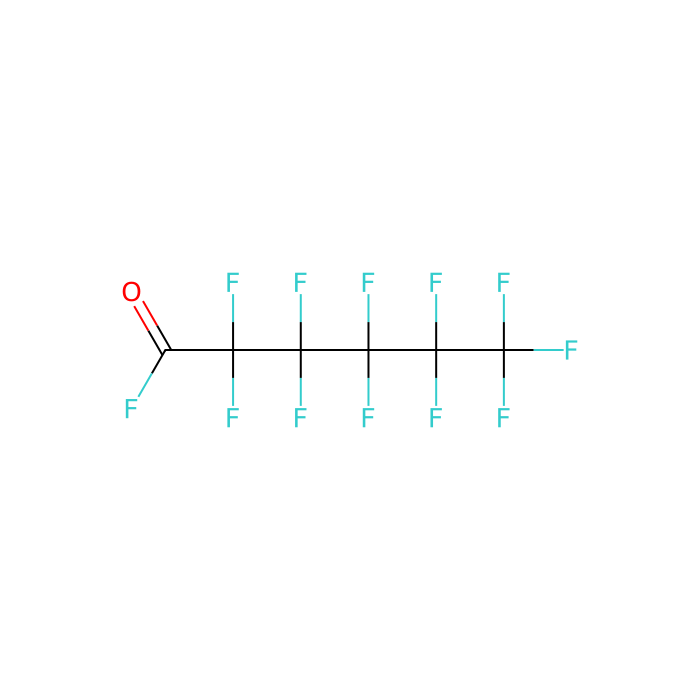
Undecafluorohexanoyl fluoride is a perfluoroacyl fluoride (a perfluorinated carboxylic acid fluoride) used to introduce the perfluorohexanoyl group.
SMILES: Not specified for this item; refer to CoA/Spec Sheet.
Molecular formula: C6F12O (computed/literature for perfluorohexanoyl fluoride)
Molecular weight: ~316.04 g/mol (computed from C6F12O; literature)
Structural features (general/literature):
Functional group: acyl fluoride (–COF), a carboxylic acid derivative less reactive than acid chlorides but moisture‑sensitive.
Perfluoroalkyl chain: a six‑carbon backbone in which the five carbons of the side chain are fully fluorinated (R = C5F11; total F typically 12 including the carbonyl fluoride).
2D description: F–C(=O)–CF2–CF2–CF2–CF2–CF3; linear, highly electron‑withdrawing chain, no stereocenters, no unsaturation.
Notes:
All item‑specific identifiers above reflect the Product Data where provided. Additional identifiers (canonical SMILES, full InChI) are not specified for this item; consult the CoA/Spec Sheet if needed.
Synthetic Utility
Key reactivity features (general/literature):
Electrophilic acylation: the –COF group activates the carbonyl toward nucleophilic attack while the perfluoroalkyl chain further withdraws electron density, enhancing reactivity toward amines and alcohols.
Selectivity: acyl fluorides are often more chemoselective than acid chlorides, enabling acylation in the presence of sensitive functionalities under milder conditions.
Leaving group: fluoride is a relatively poor leaving group in many contexts, but in acyl fluorides it departs as HF; adding a tertiary base both catalyzes acylation (via acylammonium intermediates) and sequesters HF.
Transformations:
Amide and ester synthesis (with base and/or DMAP).
Hydrolysis to perfluorohexanoic acid.
Conversion to mixed anhydrides or to the acid chloride under halogenating conditions when different reactivity is needed.
Analytical handle: 19F NMR provides sensitive monitoring of both reagent consumption and product formation across distinct fluorine environments.
Strategic value:
Introduction of a strongly lipophilic, low‑surface‑energy perfluorohexanoyl group for materials modification, fluorous‑phase tagging, or property tuning in model compounds.
Temporary protection/tagging: the perfluoroacyl group can serve as a removable tag enabling fluorous separation workflows (subsequent hydrolysis removes the tag).
Target Specificity
Not applicable. This product is a small‑molecule chemical reagent and has no antigen/epitope or biological target specificity. See Reaction & Applications and Synthetic Utility for its chemical reactivity profile.
Products are supplied to verified businesses, institutions, and qualified professionals for research and development use only. Not for use in humans, animals, diagnosis, or therapy.

 A2629531