This compound belongs to the class of organic compounds known as aryl alkyl ketones. These are ketones have the generic structure RC(=O)R', where R = aryl group and R'=alkyl group.
External Descriptors
Not available
1. Djoumbou Feunang Y, Eisner R, Knox C, Chepelev L, Hastings J, Owen G, Fahy E, Steinbeck C, Subramanian S, Bolton E, Greiner R, and Wishart DS. ClassyFire: Automated Chemical Classification With A Comprehensive, Computable Taxonomy. Journal of Cheminformatics, 2016, 8:61.
Determine the necessary mass, volume, or concentration for preparing a solution.
Dilution Calculator
Determine the dilution needed to prepare a stock solution.
Reconstitution Calculator
Reviews
Customer Reviews
Application Protocols
No item-specific tested application protocols (e.g., WB, IHC, IF, FC) apply to this small-molecule reagent. For synthetic and analytical use, consider the following general practices:
Preparation of analytical standards: Dissolve accurately weighed material in HPLC- or GC-grade solvent (e.g., MeOH, ACN). Prepare serial dilutions gravimetrically to minimize volumetric bias.
GC analysis: Use polar or mid-polar columns (e.g., WAX, 5% phenyl) with temperature programming; include an internal standard. Split/splitless inlet depending on volatility.
LC analysis: C18 columns with water/ACN or water/MeOH gradients; monitor at 210–280 nm and/or MS detection (m/z 122).
For reaction protocols (oxime formation, reductive amination, reductions), see the Reaction Conditions tab for literature-style procedures.
Biological Roles
No item-specific biological data are provided for this product. The following context is general literature information on the chemical class and this scaffold:
Heteroaromatic pyrazines are prominent in thermal Maillard chemistry and have been detected as volatile/semi-volatile components in complex matrices (research context). 2-Acetyl-substituted pyrazines are often studied as reference compounds to understand formation pathways and analytical detection.
Functional features relevant to biochemistry (general):
The diazine ring can engage in hydrogen bonding as an acceptor and π–π interactions with aromatic residues in proteins or nucleic acids in model studies.
The ketone participates in reversible derivatization (e.g., oximes/hydrazones) used to tag or capture carbonyls in biochemical assays.
Metabolism/transformations (in vitro/in vivo research literature): aromatic ketones can undergo phase I reductions/oxidations and phase II conjugation after prior activation; ring N-oxidation is a known pathway for diazines in some systems.
Note: This product is supplied strictly for research use only (per Product Data). No clinical, nutritional, or diagnostic claims are made or implied.
Buffer Applications
This compound is not a buffering reagent and is not typically used to prepare biological buffers. If included in biochemical assays, it would usually be as a test substrate or standard dissolved in an appropriate buffer or co-solvent system.
Guidance (general): Dissolve in a compatible organic co-solvent (e.g., DMSO, ethanol) and dilute into the target buffer keeping final organic content low (typically ≤1–2%) to avoid perturbing biological systems.
For buffer preparation and selection, refer instead to dedicated buffering agents (e.g., phosphate, HEPES, MOPS) appropriate to your assay pH range.
Green Alternatives
As a solid building block, 2-acetylpyrazine itself is not replaced by a direct “green alternative,” but the processes using it can be greener by thoughtful solvent and reagent selection.
Solvent choices (general guidance):
Prefer ethyl acetate, methanol/ethanol, 2-methyltetrahydrofuran (2-MeTHF), cyclopentyl methyl ether (CPME), or water/co-solvent systems when compatible.
Minimize or replace chlorinated solvents (DCM, chloroform) and dipolar aprotics (DMF, NMP) where performance allows.
Example greener swaps (illustrative):
Carbonyl reductions: Use ethanol or 2-MeTHF instead of THF/DCM; choose NaBH4 over boranes where selectivity permits.
Reductive amination: Ethanol/AcOH with NaBH(OAc)3 in place of DCE/AcOH with NaBH3CN to reduce cyanide handling.
Enolate chemistry: 2-MeTHF or CPME as alternatives to THF/toluene; consider potassium bases (t-BuOK) at lower temperature if chemoselective.
Workup and purification:
Favor liquid–liquid extraction with greener solvents (EtOAc) and employ minimal solvent volumes.
Where feasible, replace normal-phase chromatography with crystallization or reversed-phase purification using aqueous alcohols.
Trade-offs: Greener media can affect reaction rates/selectivity and substrate solubility. Pilot small-scale screens to confirm that greener conditions maintain yield and purity.
Pharmaceutical Uses
No item-specific pharmacopeial status or excipient role is provided for this product.
General (non-clinical, manufacturing/analytical) context:
Can serve as a reference standard or process intermediate in medicinal chemistry campaigns involving pyrazine-containing scaffolds (analytical method development, impurity profiling, or SAR exploration).
The ketone functionality enables derivatization to libraries of analogs (imines, alcohols, amines) for early discovery screening and analytical characterization.
Compliance notes:
Not specified as USP/EP/JP grade; Not specified for this item; refer to CoA/Spec Sheet.
Supplied for research use only (per Product Data); not for human or veterinary use, drug substance, or excipient applications without appropriate qualification.
Physical Properties
Item-specific specifications:
Appearance: Not specified for this item; refer to CoA/Spec Sheet.
Purity/grade: Not specified for this item; refer to CoA/Spec Sheet.
Literature/general physical data (for guidance only; not item-specific):
Typical state: low-melting solid or crystalline powder reported for many lots in literature.
Expected solubility profile: good in polar organics (e.g., ethanol, methanol, acetonitrile, acetone, ethyl acetate, DMSO, DMF); limited to moderate in water due to aromatic core balanced by heteroatoms.
Acid/base behavior: weakly basic ring nitrogens (protonation under strong acid); non-ionizable carbonyl (forms imines/oximes under dehydrating conditions).
Commonly cited literature values (approximate; verify in primary sources):
Molecular weight: 122.12 g/mol (matches formula C6H6N2O, literature)
Boiling point, melting point, density, refractive index, logP, pKa: Not specified here; consult primary literature or the item’s CoA/Spec Sheet.
Practical implication: Its moderate polarity and conjugated carbonyl support broad solubility in common organic solvents and compatibility with chromatographic purification (normal phase, reversed phase when needed). Always verify exact numeric properties for your application from the lot-specific documentation.
Quality and Grades
Item-specific grade/purity: Not specified for this item; refer to CoA/Spec Sheet.
How to interpret common grades (general guidance):
Research grade: Suitable for most synthetic and analytical tasks; impurity levels are controlled for lab use but may not meet pharmacopeial specifications.
High-purity/GC grade: Beneficial when trace volatiles or UV background must be minimized (e.g., GC–olfactometry, trace-flavor profiling).
HPLC grade (for solvents) is not applicable to this solid, but low-UV-absorbing impurity profiles are still helpful for LC/UV analyses.
Stabilizers/inhibitors: Not specified for this item; refer to CoA/Spec Sheet. This compound typically does not require polymerization inhibitors, but trace antioxidants or drying agents may be employed during storage in some labs (literature/general).
Quality control recommendations (general):
Identity: Confirm by 1H/13C NMR (characteristic acetyl methyl near 2–2.7 ppm depending on solvent; carbonyl at ~195–200 ppm in 13C), IR (C=O ~1675–1710 cm−1, ring C=N stretches), and GC–MS/LC–MS (M+ at m/z 122).
Purity: Assess by GC or HPLC; for GC, use polar phases (e.g., wax) if separating from other pyrazines; for LC, C18 with aqueous-organic gradient works well.
Water/volatile residue, metals, UV cutoff: Not specified for this item; refer to CoA/Spec Sheet.
Reaction and Applications
2-Acetylpyrazine combines a conjugated methyl ketone with an electron-deficient pyrazine ring, enabling diverse synthetic manipulations.
Carbonyl chemistry (literature/general):
Oxime/hydrazone formation with hydroxylamine or hydrazines; useful for derivatization and analytical confirmation.
Reductive amination with primary/secondary amines to furnish 2-(aminoalkyl)pyrazines via imine formation followed by hydride delivery (NaBH3CN, NaBH(OAc)3).
Chemoselective reduction: to secondary alcohol (2-(1-hydroxyethyl)pyrazine) using NaBH4 or Luche conditions; full reduction to ethyl (2-ethylpyrazine) via Wolff–Kishner or Clemmensen-type conditions.
Alpha-functionalization (literature/general):
Enolization of the acetyl methyl with strong base (LDA/LHMDS) enables halogenation (NBS/NCS), alkylation, or acylation; subsequent elaboration to β-dicarbonyl motifs.
Haloform-style oxidative cleavage of the methyl ketone to yield 2-pyrazinecarboxylic acid under appropriate conditions (e.g., halogen/base), a valuable handle for further coupling.
N-oxidation (m-CPBA) to pyrazine N-oxides, altering electronics for subsequent substitution.
Electrophilic substitution is generally disfavored on pyrazine; use metalation (TMP bases) or C–H activation strategies for C-3/C-5 functionalization.
Application contexts:
Model Maillard chemistry and heteroaromatic flavor-forming pathways (research/analytical only; no food-use claims).
Analytical derivatization standard for GC/LC method development involving heteroaromatic ketones.
Practical tips: Dry conditions benefit enolate chemistry; buffer or mildly acidic conditions aid reductive amination selectivity; control temperature to avoid ring N-alkylation under harsh conditions.
Reaction Conditions
Representative literature-style conditions for common transformations of 2-acetylpyrazine (general guidance; optimize for your system):
Oxime formation: Hydroxylamine·HCl (1.2–1.5 equiv), pyridine or Et3N (2–3 equiv) in EtOH or MeOH, rt to 50 °C, 2–6 h. Workup by solvent removal and aqueous wash; crystallization often effective.
Hydrazone/semicarbazone: Hydrazine/semicarbazide (1.2–2 equiv) in EtOH/AcOH catalytic, rt to reflux, 2–12 h.
Reductive amination: Amine (1.1–1.5 equiv), AcOH (0.2–0.5 equiv) in MeOH/EtOH/MeCN; add NaBH(OAc)3 (2–3 equiv) at 0–25 °C; 2–16 h. Quench with NaHCO3, extract with EtOAc.
Carbonyl reduction (Luche): NaBH4 (1.2–2 equiv), CeCl3·7H2O (0.1–0.3 equiv) in MeOH or EtOH at 0–25 °C, 0.5–3 h.
Alpha-bromination: NBS (1.0–1.2 equiv) with catalytic acid (AcOH/HBr) or radical initiator (AIBN) in CCl4/CH2Cl2/MeCN, 0–25 °C, 1–4 h; monitor to avoid overbromination.
Enolate alkylation: LDA (1.1–1.5 equiv) generated in situ in dry THF at −78 °C; add substrate then electrophile (R–X), warm to −40 to 0 °C; 1–3 h. Quench with NH4Cl.
Haloform oxidation to acid: Halogen (Br2/Cl2) in base (NaOH) followed by hydrolysis; temperatures 0–25 °C; then acidify to isolate 2-pyrazinecarboxylic acid (yields vary; control over-oxidation).
Analysis and purification: Monitor by TLC (UV 254 nm active), GC–MS, or LC–MS. Silica gel chromatography with EtOAc/hexanes or DCM/MeOH gradients is typical. Always conduct small-scale trials to fine-tune reagent equivalents and temperature profiles.
Safety and Handling
Authoritative data:
GHS classification, signal word, pictograms, and H-statements: Not specified for this item; refer to the SDS for definitive hazard information.
General laboratory guidance (literature/general):
Likely hazards: Many low-MW heteroaromatic ketones are classified as irritants; avoid inhalation of dust/vapors and skin/eye contact.
PPE: Lab coat, safety glasses or goggles, and appropriate chemical-resistant gloves (e.g., nitrile). Work in a fume hood when weighing, dissolving, or heating.
First aid (overview):
Inhalation: Move to fresh air; seek medical attention if symptoms persist.
Skin/eye contact: Rinse with plenty of water for ≥15 minutes; remove contaminated clothing; seek medical advice if irritation persists.
Ingestion: Rinse mouth; do not induce vomiting; obtain medical advice.
Handling notes:
Avoid strong oxidizers and strong acids/bases that may lead to degradation or side reactions (e.g., ring N-oxidation, aldol/condensation under strong base).
Minimize moisture exposure during moisture-sensitive transformations (oximation/imidation steps can be water-sensitive).
Not an ether—peroxide formation is not a typical concern; nonetheless, follow good solvent management practices.
Storage per Product Data: Store at room temperature under an argon atmosphere; keep container tightly closed. Shipments: normal conditions.
Always defer to the product’s SDS and your institutional EHS protocols for risk assessment and emergency procedures.
Solvent Selection
This product is a heteroaromatic ketone substrate, not a solvent. Solvent choice focuses on dissolution, reaction compatibility, and purification.
Polarity class (general): Moderately polar, H-bond acceptor; dissolves well in polar organics.
Aqueous: limited solubility expected; co-solvent strategies (≤20–50% organic) may be used for analytical work.
Selection by use case (general):
Carbonyl derivatization (oxime/hydrazone): ethanol, pyridine or buffered aqueous-alcoholic media.
Reductive amination: acetonitrile, methanol, or ethanol under mildly acidic conditions with NaBH3CN/NaBH(OAc)3.
Carbonyl reduction: methanol/ethanol (NaBH4) or THF/EtOH (Luche: NaBH4/CeCl3).
Alpha-functionalization (enolate): dry THF, 2-MeTHF, or toluene with LDA/LHMDS at low temperature.
Purification: Normal-phase silica with EtOAc/hexanes or DCM/MeOH; reversed-phase C18 for closely related pyrazines.
Tip: Where possible, prefer greener solvents (EtOAc, MeOH, 2-MeTHF, CPME) over chlorinated/aprotic amide solvents, provided your reaction/selectivity is maintained.
Storage and Reconstitution
Storage conditions (from Product Data): Store at room temperature. Container is argon charged. Shipments under normal conditions.
Container management: Keep tightly sealed to limit moisture/air ingress. If frequent access is expected, consider flushing the headspace with inert gas after each use (argon or nitrogen) and minimizing exposure time with the cap off.
Light/moisture: Protect from excessive humidity; store in a dry cabinet or with a desiccant pack if practical. Ambient light is generally acceptable, but amber glass minimizes potential photodegradation.
Reconstitution/dissolution (general guidance):
Readily dissolves in polar organics (e.g., MeOH, EtOH, ACN, acetone, EtOAc, DMSO, DMF). For aqueous applications, use a co-solvent strategy.
Prepare stock solutions (e.g., 10–100 mM) in dry solvent; store aliquots in sealed vials under inert gas at 2–8 °C or −20 °C for extended periods to reduce evaporative loss and adventitious oxidation (verify stability for your use case).
Stability notes: Ketones are generally stable at ambient conditions; avoid strong acids/bases and oxidants. Inspect solids periodically for discoloration or odor changes and verify purity by NMR or chromatography before critical experiments.
Always consult the lot-specific CoA/Spec Sheet and SDS for definitive handling and stability information.
Structure and Identity
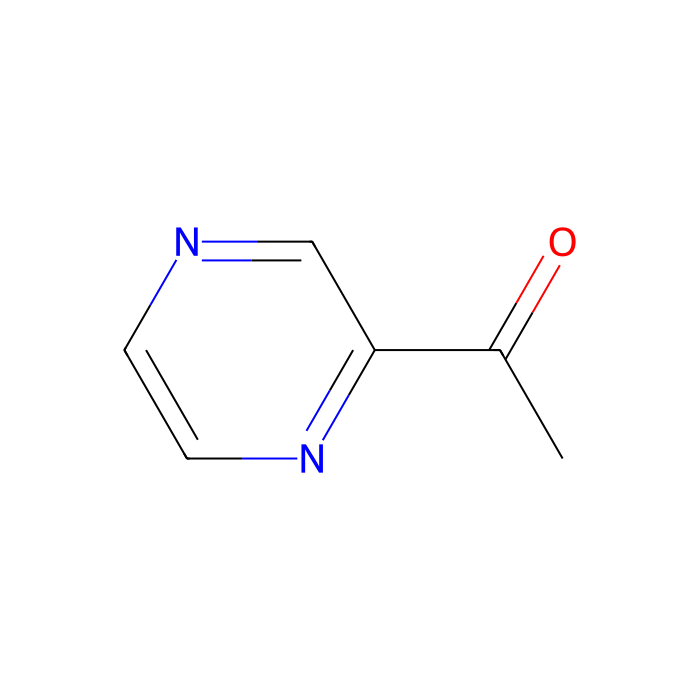
Overview: 2-Acetylpyrazine is a monoacylated pyrazine (an azine heteroaromatic) bearing a methyl ketone at the 2-position adjacent to a ring nitrogen. The scaffold combines an electron-deficient diazine ring with a conjugated carbonyl, imparting distinctive reactivity and polarity.
Product identifiers (from Product Data):
CAS: 22047-25-2
CID: 30914
InChIKey: Not specified for this item; refer to CoA/Spec Sheet.
SMILES: Not specified for this item; refer to CoA/Spec Sheet.
Molecular formula (literature): C6H6N2O
Molecular weight (literature): 122.12 g/mol
2D structural description (general):
Six-membered aromatic ring with two ring nitrogens at pyrazine positions 1 and 4 (1,4-diazine).
An acetyl group (–COCH3) is attached at C-2 (alpha to one ring N), creating a conjugated aryl ketone (aryl = pyrazinyl).
Planar, heteroatom-rich π-system; no stereocenters; resonance delocalization spans the pyrazine ring and the carbonyl.
Key functional groups/features (general):
Aromatic diazine (electron-poor N heteroaromatic).
Potential hydrogen-bond acceptors: ring nitrogens and carbonyl oxygen.
Notes: Structural identifiers not listed in Product Data are provided as literature/general information for context only; confirm lot-specific identifiers on the CoA/Spec Sheet.
Synthetic Utility
The juxtaposition of an electron-poor pyrazine ring and a benzylic-like methyl ketone makes 2-acetylpyrazine a versatile synthon.
Oxime/hydrazone/semicarbazone formation for characterization or as intermediates to amines (via reduction) or nitriles (via dehydration).
Reductive amination to access 2-(aminomethyl/ethyl)pyrazine analogs; conditions: amine + mild acid + NaBH(OAc)3/NaBH3CN in MeOH/EtOH/MeCN.
Selective reduction to secondary alcohol (Luche conditions) preserves ring integrity; over-reduction strategies (Wolff–Kishner/Clemmensen) yield 2-ethylpyrazine.
Alpha-carbon chemistry:
Enolate generation (LDA, −78 to −20 °C) enables alkylation/acylation; NBS-mediated alpha-bromination in acetic acid or under radical conditions forms a handle for further substitution.
Haloform-type oxidation converts the methyl ketone into the corresponding carboxylic acid (2-pyrazinecarboxylic acid), a versatile coupling partner (amide formation, esterification, cross-coupling as acid chloride or via Cu-mediated decarboxylative variants).
Ring modulation:
N-oxidation (m-CPBA) followed by nucleophilic substitution or Polonovski-type manipulations can diversify substitution.
Directed metalation at C-3/C-5 using strong bases (TMP lithium) or transition-metal C–H activation allows further arylation/alkylation in advanced routes.
These features make 2-acetylpyrazine a practical entry to pyrazine-based libraries and to carboxyl/alkyl derivatives via reliable, well-documented transformations.
Target Specificity
Not applicable. This product is a small-molecule heteroaromatic ketone, not an antibody, enzyme, or affinity reagent. No antigen/epitope specificity, clone, isotype, or species reactivity applies.
Frequently Asked Questions
What is the purity of this product?
This product is supplied at ≥99% purity (chemical assay). Lot-specific values are stated on the Certificate of Analysis.
How should this product be stored?
Store at room temperature under argon. It is supplied under an argon blanket; reseal under inert gas after each use.
How is this product shipped?
This product ships under standard ambient conditions. No temperature-controlled packaging is required.
What are the CAS number, molecular formula and molecular weight?
The CAS Number is 22047-25-2, the molecular formula is C6H6N2O, and the molecular weight is 122.12 g/mol. InChIKey DBZAKQWXICEWNW-UHFFFAOYSA-N.
What documentation is provided?
Available product documentation, including Certificates of Analysis (COA), Safety Data Sheets (SDS), and specification sheets, is shown in the product document area. Document availability and access follow the current site policy.
We use cookies to ensure the website functions properly and, where permitted, to improve your experience. You can manage your preferences at any time in Settings. Learn more in our Cookie Policy.
Shall we send you a message when we have discounts available?
Remind me later
Thank you! Please check your email inbox to confirm.
Products are supplied to verified businesses, institutions, and qualified professionals for research and development use only. Not for use in humans, animals, diagnosis, or therapy.

 J2228209