
What Is Pyrazine? Structural Features, Naming Clarification, Application Scenarios, and a Reagent Selection Roadmap (with Product Tables 1–4)
What Is Pyrazine? Structural Features, Naming Clarification, Application Scenarios, and a Reagent Selection Roadmap (with Product Tables 1–4)
1.Why do we keep encountering pyrazines in “drugs, materials, and food aroma”?
When you smell the characteristic “roasted / nutty / toasty” notes in coffee, roasted nuts, or cocoa powder, a common group of key volatile compounds behind that aroma is alkyl-substituted pyrazines (alkylpyrazines). They are generated in large amounts during thermal processing such as the Maillard reaction, and they can make a substantial contribution to flavor.
In research and industry, pyrazine is also a classic nitrogen-containing aromatic heterocycle: it can serve as a tunable electronic module in drug molecules, and it can also act as a nitrogen donor / bridging unit in coordination chemistry and materials chemistry.
A very intuitive example is the frontline antituberculosis drug pyrazinamide (PZA), which contains a pyrazine ring and is one of the key drugs in combination TB therapy. Its distinctive value is often associated with “sterilizing activity” against tolerant or non-replicating bacterial populations in acidic / inflammatory microenvironments at lesion sites. For this reason, it is widely regarded as one of the important components that help shorten treatment duration in standard regimens.
2.What exactly do pyrazine and “paradiazines” correspond to?
1. Pyrazine is a six-membered aromatic heterocycle with two nitrogen atoms positioned para to each other (1,4-positions).
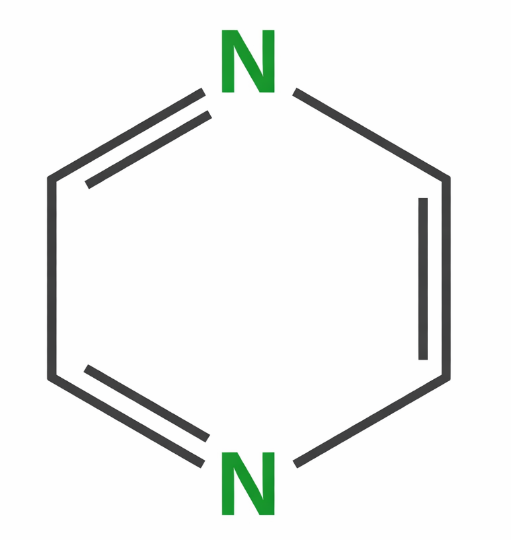
2. Because the two nitrogen atoms are in a para relationship, pyrazine can also be written as 1,4-diazine or p-diazine (para-diazabenzene). In databases and older literature, you may also see spellings such as paradiazine (Paradiazine), but modern textbooks and papers more commonly use pyrazine / 1,4-diazine.
3. It is important to distinguish this clearly: “diazines” are not limited to pyrazine. They also include two other positional isomers:
a) 1,2-diazine: pyridazine
b) 1,3-diazine: pyrimidine
c) 1,4-diazine: pyrazine
Common English Name | N Positions (Numbering) | Common Aliases / Notes | One-Sentence Identifier |
Pyridazine | 1,2-Diazine | ortho-diazine (1,2-diazabenzene) | Two N atoms adjacent (1,2). |
Pyrimidine | 1,3-Diazine | meta-diazine (1,3-diazabenzene) | Two N atoms separated by one carbon (1,3). |
Pyrazine | 1,4-Diazine | para-diazine (1,4-diazabenzene); p-Diazine / para-Diazine / Paradiazine | Two N atoms opposite each other (1,4). |
3.Structural features of pyrazine
The key structural takeaways for pyrazine can be captured in three points:
1. “Two nitrogens make the ring more electron-deficient.”
The two ring nitrogens collectively withdraw electron density from the aromatic ring, giving pyrazine an electron-deficient character.
2. “Therefore, it is a weak base and more often behaves as an ‘acceptor.’”
The lone pairs on aromatic nitrogens can accept a proton or coordinate to metals. However, due to the inductive/withdrawal effect from two nitrogens, pyrazine is typically much less basic than pyridine (pyrazine conjugate acid pKa ≈ 0.6, pyridine conjugate acid pKa ≈ 5.2; values may vary slightly with solvent and ionic strength). As a result, pyrazine more often participates in molecular recognition as a hydrogen-bond acceptor / coordination acceptor.
3. “Two nitrogens = two handles: coordination and architecture are designable.”
Pyrazine can act as a monodentate ligand, and it also frequently serves as a bridging bidentate ligand that “links” two metal centers, enabling the construction of coordination polymers, molecular wire-like architectures, or other functional materials.
4.What are the characteristics of pyrazine-related products?
Pyrazine reagents are not only important—they belong to a heterocycle family with high reuse across disciplines. From the practical perspective of buying reagents and doing research, pyrazine-related products commonly share these traits:
1. High value as a general scaffold: the pyrazine ring is a reusable module for molecular design, applicable to drug leads as well as materials and coordination systems.
2. Large derivatization space: introducing functional groups such as halogens, amino, carboxyl, cyano, etc., quickly turns pyrazine into building blocks that are cross-coupling-ready, substitution-ready, salt-formable, and coordination-capable.
3. Clear and predictable electronic effects: its electron deficiency makes certain substitution strategies and interaction designs more predictable and “computable.”
4. Broad “real-world landing zones” in applications: three mature main lines—food aroma (roasted flavors), pharmaceuticals (a representative antituberculosis drug), and coordination/materials (bridging units and electron-acceptor fragments)—all support widespread use.
5.How to Classify Pyrazine-Related Products
Product Category (by Use) | Representative Examples | Key Structural / Property Clues | Typical Uses (Research Tasks) |
Parent core & simply substituted pyrazines | Pyrazine; methyl/ethyl/dimethyl pyrazines (alkylpyrazines) | Basic 1,4-diazine aromatic ring; alkyl substitution often increases volatility and enhances flavor impact | Basic physicochemical benchmarks; food flavor/volatile studies (Maillard reaction, GC–MS fingerprinting) |
Further functionalizable “building blocks” | Halopyrazines (chloro/bromo/fluoro); aminopyrazines | Reactive “handles” (halogens, −NH₂, etc.) for coupling/substitution | Heterocycle assembly; medicinal-chemistry lead synthesis; compound library construction |
Polar derivatives (tuning solubility / salt formation) | Pyrazine carboxylic acids; pyrazine carboxamides (e.g., pyrazinamide-type) | −CO₂H/−CONH₂ increase polarity, facilitate salt formation, and improve solubility | Salt form / solubility optimization; drug-related studies; metabolism and analytical method development |
N-oxides & electronic-effect tuning | Pyrazine N-oxide, etc. | N→O alters electron distribution and coordination/reactivity features | Reaction-mechanism studies; electronic-effect tuning in coordination chemistry/materials |
Fused systems (expanded π systems) | Quinoxaline (benzopyrazine), etc. | Larger π system, often stronger conjugation and richer properties | Lead scaffolds in drug discovery; optoelectronic/functional materials; coordination assembly |
Standards for analysis / quantitation | Isotopically labeled pyrazines (e.g., pyrazine-d₄) | Suitable as internal standards to improve GC/LC–MS quantitation reliability | Quantitation/traceability for flavoromics, metabolomics, and quality control |
6.Typical applications of pyrazine: turning “structural features” into real scenarios
6.1 Food and aroma chemistry: a “key puzzle piece” of roasted flavors
1. Many pyrazine derivatives occur in baked, roasted, and stir-fried foods, and are closely associated with nutty, roasted, cocoa, and cereal aroma notes.
2. Common research tasks include: elucidating Maillard reaction pathways, regulating flavor formation, GC–MS quantitation, and flavor fingerprinting.
6.2 Medicinal chemistry and anti-infectives: from scaffold to real clinical drugs
1. Pyrazinamide (PZA) is one of the key drugs in combination therapy for tuberculosis, with distinctive mechanistic significance against non-replicating / persister-state Mycobacterium tuberculosis. The classic view is that PZA must be activated by the bacterial pncA/pyrazinamidase to pyrazinoic acid (POA) in order to exert activity; the downstream steps are considered complex and continue to be refined (different studies emphasize different targets/pathways).
2. The pyrazine ring itself is often used as a fragment that can provide hydrogen-bond acceptors, tunable electronics, and tunable polarity, helping a molecule balance target binding with physicochemical properties.
6.3 Coordination chemistry and materials: two nitrogens make it a master of “bridging and assembly”
Pyrazine can coordinate to metals in monodentate or bridging modes, building polynuclear complexes, coordination polymers, or electronically coupled systems. It is a common “linker” in inorganic and materials research.
6.4 Natural products and pharmacology: a representative example—tetramethylpyrazine (TMP/ligustrazine)
Tetramethylpyrazine (TMP, ligustrazine) is a representative pyrazine-derived natural constituent found in Ligusticum chuanxiong (Chuanxiong) and related sources, and there is substantial review literature discussing its pharmacological mechanisms and clinical applications.
7.Safety and storage essentials
Pyrazine and some of its derivatives may be irritating and somewhat volatile. In flavor/volatile experiments in particular, pay close attention to airtight sealing, low-temperature storage, light protection, adequate ventilation, and personal protective equipment (PPE). Isotope-labeled standards also often come with explicit hazard classification statements.
8.Product Navigation Table | Quickly Locate Pyrazine-Related Standards, Building Blocks, and Ligands by Research Task / Experimental Need (corresponding to Tables 1–4)
Research Task / Experimental Need | Key Structural / Property Clues to Look For | Recommended Table(s) to Check First | What You Can Find in the Table |
Quantify volatiles and aroma in foods/flavors/spirits (GC–MS / GC–O) | Focus on alkylpyrazines (roasted/nutty notes) and methoxypyrazines (green bell pepper/herbal; extremely low odor thresholds). Using IBMP as an example, the sensory threshold in water can reach the ng/L range; thresholds vary across matrices and systems. Use isotopically labeled internal standards to improve quantitative reliability. | Table 1 | 2-methyl, dimethyl, trimethyl, tetramethyl, ethyl / ethyl-methyl / ethyl-dimethyl pyrazines; 2-acetylpyrazine; methoxypyrazines (IBMP / IPMP / 2-methoxy-6-methyl); the pyrazine parent core and pyrazine-d4 internal standard |
Develop / validate GC or LC methods (retention time, response factor, linearity, recovery) | Prioritize a set that spans polarity/volatility: parent core + representative substituted analogs; add an internal standard for absolute quantitation | Mainly Table 1 | A “calibration-curve set” from parent pyrazine to typical flavor pyrazines and methoxypyrazines; pyrazine-d4 for correcting matrix effects and instrument drift |
Rapid derivatization / substitution-site exploration on the pyrazine scaffold (SNAr; one-pot introduction of amines/thiols/alcohols, etc.) | Choose chloropyrazines / polychloropyrazines (more suitable for SNAr); select the platform by desired substitution pattern: 2-, 2,3-, 2,5-, 2,6-, and tetrachloro platforms | Table 2 | “Electrophilic chassis” such as 2-chloro, 2,3-dichloro, 2,5-dichloro, 2,6-dichloro, and tetrachloropyrazine for building substituted-pyrazine libraries |
Build libraries via cross-coupling (Suzuki / Negishi / Buchwald, etc.) | Bromopyrazines / dibromopyrazines are broadly applicable; for directly attaching a pyrazin-2-yl group to aryl/heteroaryl rings, consider boronic acids | Table 2 (halogenated) + Table 3 (boronic acids) | 2-bromo, 2,5-dibromo, 2,6-dibromopyrazine; and (pyrazin-2-yl)boronic acid (commonly used for Suzuki coupling) |
Need a “functional handle” for continued transformations (amide formation / reductive amination / hydrolysis / coordination) | For amides: choose pyrazine carboxylic acids / diacids; for reductive amination / Schiff bases: choose pyrazine-2-carboxaldehyde; for electronic tuning or further conversion: consider cyano and N-oxides | Table 3 | 2-pyrazinecarboxylic acid, its methyl ester, 2-carboxaldehyde, 2-cyano, pyrazine N-oxide / 1,4-dioxide; plus multi-carboxylic-acid series |
MOFs / coordination polymers / metal complexation (need N sites + carboxylate anchors / high connectivity) | For linkers, choose diacids / tetracarboxylic acids (higher connectivity and more rigid frameworks); for strong acceptor character / tunable electronics, consider N-oxides | Mainly Table 3 + Table 4 (ligand expansion) | MOF linkers such as pyrazine-2,3-/2,5-/2,6-dicarboxylic acids and pyrazine tetracarboxylic acid; ligand expansion options in Table 4 (bipyrazine, multi-pyridyl ligands) |
Transition-metal complexes / luminescence / electrochemical materials (multiple N-coordination sites) | For polydentate N ligands, prioritize bipyrazine or tetra(2-pyridyl)pyrazine to build chelating/self-assembled systems | Table 4 | Multi-nitrogen ligands such as 2,2′-bipyrazine and tetra(2-pyridyl)pyrazine for coordination complexes and photophysical/electrochemical studies |
Quinoxaline / fused diaza-aromatic systems (medicinal chemistry / materials) | Target is not mono-pyrazine but fused rings (quinoxaline) and derivatives such as carboxylic acids, dihydroxy, and N-oxides | Table 4 | Quinoxaline core and derivatives including 2-quinoxalinecarboxylic acid, 2,3-dihydroxyquinoxaline, and quinoxaline 1,4-dioxide |
Drug analysis / activity references / control experiments (pyrazine-containing drugs) | Need high-purity reference standards; check salt form / hydrate (affects weighing and solubility). Match internal standards or close analogs to your analytical platform | Mainly Table 4 + Table 1 (method / internal-standard support) | References such as favipiravir, pyrazinamide, amiloride hydrochloride hydrate; plus Table 1 parent-core / internal-standard support for method validation |
Table 1 | Aroma / Volatile Standards: Alkylpyrazines, Methoxypyrazines, and the Parent Core / Internal Standard (Common for GC–MS / GC–O)
Category | CAS No. | Aladdin Cat. No. | Name | Specification / Purity | Key Features & Applications |
Parent pyrazine core (basic reference) | 290-37-9 | Pyrazine | ≥99% | Fundamental pyrazine core; used as a method-development reference (GC/LC), a starting material for synthesis routes, and a model system for heteroaromatic electronic/coordination studies | |
Parent pyrazine core (isotopic internal standard) | 1758-62-9 | Pyrazine-d4 | ≥98 atom% D, ≥98% | Stable-isotope internal standard; used for GC/LC–MS quantitation of pyrazine and derivatives, correcting matrix effects, recovery, and instrument drift | |
Flavor alkylpyrazines (aroma/volatile standards) | 109-08-0 | 2-Methylpyrazine | ≥98% (GC) | Common roasted/nutty volatile; used for GC–MS method setup, aroma quantitation, and reaction-formation pathway studies | |
Flavor alkylpyrazines (aroma/volatile standards) | 5910-89-4 | 2,3-Dimethylpyrazine | ≥98% | Representative roasted/nutty compound; used as a reference in food flavor research, fragrance formulation, and GC–MS qualitative/quantitative analysis | |
Flavor alkylpyrazines (aroma/volatile standards) | 123-32-0 | 2,5-Dimethylpyrazine | ≥98% | Common component in roasted aroma profiles; used in flavoromics/flavor quantitation and for building standard spectral libraries | |
Flavor alkylpyrazines (aroma/volatile standards) | 108-50-9 | 2,6-Dimethylpyrazine | ≥98% (GC) | Common roasted note contributor; used as a reference for food/flavor volatile analysis and heated reaction systems (Maillard chemistry) | |
Flavor alkylpyrazines (aroma/volatile standards) | 14667-55-1 | 2,3,5-Trimethylpyrazine | ≥99% | Typical “roasted/toasty” flavor molecule; standard for food flavor and baked/coffee volatile profiling | |
Flavor alkylpyrazines (aroma/volatile standards) | 1124-11-4 | 2,3,5,6-Tetramethylpyrazine | ≥98% | Classic roasted-aroma component; used for flavor-chemistry standards and volatile spectral library building (especially in baked/coffee samples) | |
Flavor alkylpyrazines (aroma/volatile standards) | 13925-00-3 | 2-Ethylpyrazine | ≥99% (GC) | Common roasted/nutty volatile; standard for aroma profiling (GC–MS/GC–O) and flavor formulation studies | |
Flavor alkylpyrazines (aroma/volatile standards) | 15707-23-0 | 2-Ethyl-3-methylpyrazine | ≥99% | One of the key roasted/nutty contributors; reference for aroma quantitation and heated reaction (Maillard) system studies | |
Flavor alkylpyrazines (aroma analysis standard) | 27043-05-6 | 2-Ethyl-3,5(6)-dimethylpyrazine | Analytical standard; isomeric mixture | Typical “roasted/nutty/cocoa” aroma component; used as a GC–MS qualitative/quantitative reference (isomeric mixture is closer to real samples) | |
Functionalized flavor pyrazines (carbonyl handle) | 22047-25-2 | 2-Acetylpyrazine | ≥99% | Signature Maillard aroma marker; used in flavor research. The carbonyl group is also convenient for derivatization (condensation, reduction, etc.) | |
Methoxypyrazines (green/herbal trace standards) | 2882-21-5 | 2-Methoxy-6-methylpyrazine | ≥97% | Pronounced “green/herbal” odor; standard for trace-aroma analysis and studies of sensory threshold / release behavior | |
Methoxypyrazines (green/herbal trace standards) | 25773-40-4 | 2-Isopropyl-3-methoxypyrazine | ≥98% (GC) | Key “green bell pepper/grass” odorant; used for trace quantitation and sensory-correlation studies in wines and fruits/vegetables | |
Methoxypyrazines (green/herbal trace standards) | 24683-00-9 | 2-Isobutyl-3-methoxypyrazine | ≥99% | Extremely low-threshold “green/herbal” odor source; widely used standard for trace volatile analysis (GC–MS/GC–O) in wines and agricultural products |
Table 2 | Halogenated / Highly Halogenated Pyrazines: Electrophilic Building Blocks for SNAr and Cross-Coupling (Rapid Assembly of Substituted Pyrazines)
Category | CAS No. | Aladdin Cat. No. | Name | Specification / Purity | Key Features & Applications |
Halopyrazines (electrophilic building blocks) | 14508-49-7 | 2-Chloropyrazine | ≥98% | A classic halopyrazine starting material; used for SNAr to introduce amines/alcohols/thiols, or for coupling reactions to build substituted pyrazines | |
Halopyrazines (electrophilic building blocks) | 56423-63-3 | 2-Bromopyrazine | ≥97% | The bromo site is well-suited for Pd-catalyzed couplings (Suzuki/Buchwald, etc.); commonly used to build 2-substituted pyrazine libraries | |
Halopyrazines (electrophilic building blocks) | 4858-85-9 | 2,3-Dichloropyrazine | ≥98% (GC) | Electron-poor halopyrazine suitable for SNAr substitution or cross-coupling; enables rapid access to 2,3-disubstituted pyrazine scaffolds | |
Halopyrazines (electrophilic building blocks) | 19745-07-4 | 2,5-Dichloropyrazine | ≥97% | Used for selective SNAr or cross-coupling to quickly enter 2,5-disubstituted pyrazine series (common in lead molecules/materials motifs) | |
Halopyrazines (electrophilic building blocks) | 4774-14-5 | 2,6-Dichloropyrazine | ≥98% | Suitable for selective SNAr substitution or coupling; used to build 2,6-disubstituted pyrazines (a common linkage pattern in medicinal chemistry/materials) | |
Halopyrazines (electrophilic building blocks) | 23229-26-7 | 2,5-Dibromopyrazine | ≥98% (GC) | Bromo sites facilitate Suzuki/Negishi and related couplings; used to construct 2,5-disubstituted pyrazines and multi-substituted heteroaromatic frameworks | |
Halopyrazines (electrophilic building blocks) | 23229-25-6 | 2,6-Dibromopyrazine | ≥95% | Well-suited for dual-site cross-coupling to build symmetric or 2,6-disubstituted pyrazines; often used for extending materials/ligand backbones | |
Highly halogenated pyrazines (SNAr platform) | 13484-50-9 | Perchloropyrazine | ≥97% | Strongly electron-withdrawing, multi-chloro platform for stepwise SNAr; enables rapid introduction of amines/thiols/alcohols to build highly substituted pyrazine scaffolds |
Table 3 | Functionalized Pyrazine Building Blocks: Amino / Cyano / Aldehyde / Carboxylic Acid (Ester) / N-Oxides and Polycarboxylic Acids (High-Frequency in Synthesis & Coordination Studies)
Category | CAS No. | Aladdin Cat. No. | Name | Specification / Purity | Key Features & Applications |
Aminopyrazines (amination platform) | 5049-61-6 | Aminopyrazine | ≥99% | A commonly used N-heteroaryl amine building block; easy to acylate/sulfonylate/cyclize, introduces H-bonding sites; a high-frequency intermediate in medicinal chemistry | |
Aminopyrazines (multi-amine building blocks) | 13134-31-1 | 2,3-Diaminopyrazine | ≥97% | Two amine sites enable acylation/cyclization/condensation and multiple H-bond interactions; widely used in medicinal chemistry and coordination-ligand construction | |
Aminopyrazines (multi-amine building blocks) | 41536-80-5 | 2,6-Diaminopyrazine | ≥95% | 2,6-diamine pattern facilitates bifunctionalization and ring formation; used to build multi-H-bond fragments in medicinal chemistry or as an N,N-coordination building unit | |
Functionalized pyrazine building blocks (cyano) | 19847-12-2 | Pyrazinecarbonitrile | ≥99% | Strong electron-withdrawing group for tuning scaffold electronics; nitrile can be further hydrolyzed/reduced, etc.; commonly used in pharma/agrochemical building-block synthesis | |
Functionalized pyrazine building blocks (aldehyde) | 5780-66-5 | Pyrazine-2-carbaldehyde | ≥97% | Aldehyde enables reductive amination/condensation (Schiff base) and construction of pyrazine-containing ligands; frequently used in medicinal and coordination chemistry derivatization | |
Functionalized pyrazine building blocks (monocarboxylic acid) | 98-97-5 | 2-Pyrazinecarboxylic acid | ≥98% | Common pyrazine-carboxylic-acid fragment; used for amide coupling with amines (high-frequency in medicinal chemistry) and also as a coordination/chelation anchor | |
Functionalized pyrazine building blocks (carboxylate ester) | 6164-79-0 | Methyl 2-Pyrazinecarboxylate | ≥97% (GC) | Ester supports downstream hydrolysis/transesterification/amide formation; used as a synthetic intermediate to introduce pyrazine-2-carbonyl fragments | |
Core derivatives (N-oxide) | 2423-65-6 | Pyrazine N-oxide | ≥97% | Common intermediate and electronic-effect model; used to study how N-oxidation affects heteroaromatic reactivity/coordination, and as a precursor for further substitution | |
Core derivatives (di-N-oxide) | 2423-84-9 | Pyrazine 1,4-Dioxide | ≥95% | Dual N-oxidation enhances electron-acceptor character; used in redox/electronic-structure studies and as a precursor for further reduction or substitution | |
Pyrazine polycarboxylic acids (ligands / MOF linkers) | 122-05-4 | Pyrazine-2,5-dicarboxylic acid | ≥97% | Dicarboxylic acid provides multidentate coordination and a rigid backbone; widely used as a linker in MOFs/coordination polymers and in metal-complex studies | |
Pyrazine polycarboxylic acids (ligands / MOF linkers) | 940-07-8 | Pyrazine-2,6-dicarboxylic acid | ≥95% | Linear, rigid dicarboxylate linker; often used to build MOFs/coordination polymers with regular channels and for metal complexation and structure–property studies | |
Pyrazine polycarboxylic acids (ligands / MOF linkers) | 89-01-0 | 2,3-Pyrazinedicarboxylic acid | ≥97% | Ortho-dicarboxylation strengthens multi-point coordination; used in metal complexation, MOF/coordination-polymer construction, and tuning via acidic functional groups | |
Pyrazine polycarboxylic acids (high-connectivity ligands) | 43193-60-8 | Pyrazinetetracarboxylic acid | ≥97% | Multiple carboxylates provide high connectivity and strong coordination; commonly used for MOFs/coordination networks, metal-ion chelation, and porous-material construction | |
Coupling reagent (pyrazine boronic acid) | 762263-64-9 | (Pyrazin-2-yl)boronic acid (contains varying amounts of anhydride) | ≥97% | Common Suzuki coupling reagent; used to incorporate a “pyrazin-2-yl” unit into aryl/heteroaryl systems for rapid construction of medicinal-chemistry/materials frameworks |
Table 4 | Drugs, Fused-Ring Derivatives, and Coordination Ligands: Bioactive References, Quinoxaline Series, and Polynitrogen Ligands
Category | CAS No. | Aladdin Cat. No. | Name | Specification / Purity | Key Features & Applications |
Pyrazine-based drugs / bioactive references | 259793-96-9 | Favipiravir | Moligand™, ≥99% | An antiviral small molecule containing a pyrazine scaffold; reference material for analytical method development, quality control, and in vitro activity/metabolism studies | |
Pyrazine-based drugs / bioactive references | 98-96-4 | Pyrazinamide | Moligand™, ≥98% | Classic antitubercular pyrazinamide; commonly used as a reference in quantitative drug analysis, dissolution/stability studies, and metabolism-related experiments | |
Pyrazine-based drugs / biological probes | 2016-88-8 | Amiloride hydrochloride hydrate | ≥98% | An ion-transport inhibitor containing a pyrazine ring; widely used as a tool compound and method reference in cellular physiology (e.g., ENaC/NHE-related pathways) | |
Quinoxaline scaffold (fused diaza-aromatic) | 91-19-0 | Quinoxaline | ≥99% (GC) | Common fused diaza-aromatic scaffold; used in medicinal/materials chemistry (electron acceptor, luminescent scaffold) and as a synthesis-intermediate reference | |
Quinoxaline derivatives (hydroxylated) | 15804-19-0 | 2,3-Dihydroxyquinoxaline | ≥98% | A 2,3-dihydroxy fused diaza-aromatic; used as a synthetic intermediate and to study how substitution affects electronic/coordination properties of fused systems | |
Quinoxaline derivatives (carboxylic-acid building block) | 879-65-2 | 2-Quinoxalinecarboxylic acid | ≥97% | “Dual-handle” fused diaza-aromatic + carboxylic acid; used for amide coupling to introduce drug fragments or as a coordination anchor for complex studies | |
Quinoxaline derivatives (N-oxide fused system) | 2423-66-7 | Quinoxaline 1,4-Dioxide | ≥95% | N-oxide fused structure; used in drug-activity screening and redox/electronic-effect studies, and as a precursor for further fused-ring derivatization | |
Pyrazine ligands for coordination/materials (bipyrazine) | 10199-00-5 | 2,2'-Bipyrazine | ≥97% (GC) | Bipyrazine N,N-coordination fragment; commonly used in transition-metal complexes, coordination polymers/MOFs, and electrochemical/photophysical studies | |
Polydentate ligands for coordination/materials | 25005-97-4 | Tetra-2-pyridinylpyrazine | ≥94% | Strong chelating ligand with multiple N sites; used for transition-metal complexes, luminescent/electrochemical materials, and coordination self-assembly (a typical “multi-pyridyl” ligand type) |
Note: The products above are representative items from Aladdin. For additional specifications, please refer to the full product list at the end of the article, or search the Aladdin website using the product name / CAS / catalog number.
For more related articles, please see below: