
Determine the necessary mass, volume, or concentration for preparing a solution.
| Activity Type | Activity Value -log(M) | Mechanism of Action | Activity Reference | Publications (PubMed IDs) |
|---|
Moligand™, 10mM in DMSO Moligand™ for sensitive chromatographic and analytical workflows requiring minimal baseline interference.
Store at -80°C Ships Dry ice packs + Cold packs Check lot-specific COA for exact specifications.
SDS, COA, datasheet, and spec sheet available for download. Lot-specific COA accessible via lot number lookup.
Cited in 1 peer-reviewed publications across chromatography, organic synthesis, and cross-coupling reactions.
Information
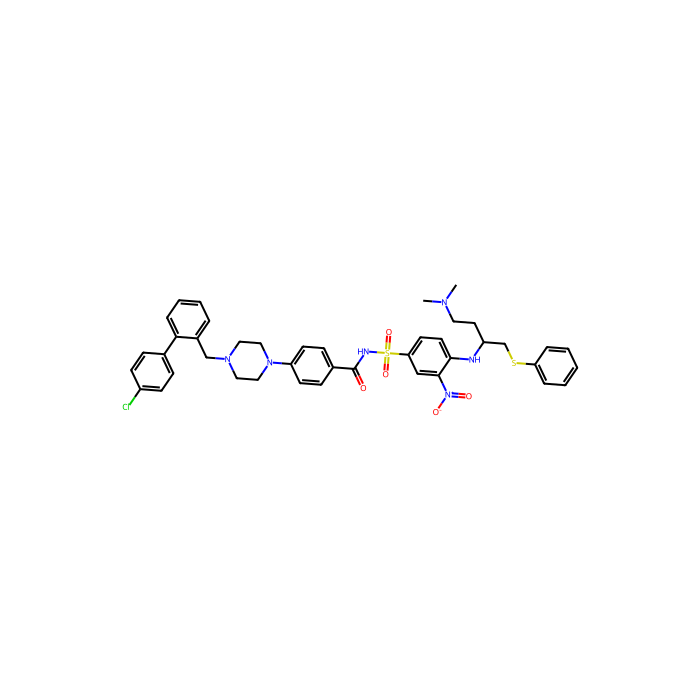
ABT-737 is a BH3 mimetic inhibitor ofBcl-xL,Bcl-2andBcl-wwithEC50of 78.7 nM, 30.3 nM and 197.8 nM in cell-free assays, respectively; no inhibition observed against Mcl-1, Bcl-B or Bfl-1. ABT-737 inducesmitochondrial pathway apoptosisandmitophagy. Phase 2.
In vitro
ABT-737 shows low activity to Bcl-B and no effects to Mcl-1 and BFL-1. ABT-737 is sensitive to HL60, KG1 and NB4 cells with IC50 of 50 nM, 80 nM and 80 nM, respectively. ABT-737 induces apoptosis in HL60 cells, which due to decreased Bcl-2/Bax heterodimerization and has no effect on cell cycle distribution. ABT-737 also induces cytochrome c release from purified mitochondria and promotes conformational changes in Bax that are associated with apoptosis. Resistant cells (Hela and MCF-7) can be sensitized to ABT-737 by approaches that down-regulate, destabilize, or inactivate Mcl-1. ABT-737 also causes Bax/BAK-dependent cytochrome c release only when Mcl-1 has been neutralized. ABT-737 displaces Bim from Bcl2\'s BH3-binding pocket, allowing Bim to activate Bax, induce mitochondrial permeabilization, and rapidly commit the primary chronic lymphocytic leukemia (CLL) cells to death. Knockdown of Mcl-1 with siRNA sensitizes two resistant SCLC cell lines H196 and DMS114 to ABT-737 by enhancing the induction of apoptosis. Likewise, up-regulation of Noxa sensitizes H196 cells to ABT-737. ABT-737 inhibits proliferation and induces apoptosis in many SCLC cell lines including NCI-H889, NCI-H1963, NCI-H1417, NCI-H146 and etc. Bcl-2 and Noxa may contribute mechanistically to the cellular response to ABT-737 in NCI-H146 cells. A recent study shows that ABT-737 significantly induces apoptosis in HTLV-1 infected T-cell lines as well as in fresh ATLL cells.
In vivo
In aggressive leukemia model, ABT-737 suppresses the leukemia burden by 53% at the 30 mg/kg, with significantly extended survival of mice. ABT-737 does not induce significantly abnormalities in blood cell counts or serum chemistries. ABT-737 prolongs the survival of recipient mice transplanted with Bcl-2-transduced tumors. ABT-737 shows great antitumor activity in an ATLL mouse model at a dose of 100 mg/kg.
Cell Data
cell lines:
Concentrations:0.001-10 μM
Incubation Time:48 hours
Powder Purity:≥97%
Comprehensive hazard, handling, storage, and regulatory compliance document.
Download SDS →Lot-specific quality data. Enter your lot number to retrieve the exact COA.
Look up COA →Full quality attributes and acceptance criteria for this grade.
View spec sheet →| Activity Type | Activity Value -log(M) | Mechanism of Action | Activity Reference | Publications (PubMed IDs) |
|---|
| Activity Type | Activity Value -log(M) | Mechanism of Action | Activity Reference | Publications (PubMed IDs) |
|---|
| Activity Type | Activity Value -log(M) | Mechanism of Action | Activity Reference | Publications (PubMed IDs) |
|---|
| Activity Type | Activity Value -log(M) | Mechanism of Action | Activity Reference | Publications (PubMed IDs) |
|---|
| Solubility | Solubility (25°C) In vitro DMSO: 64 mg/mL (197.3 mM); Ethanol: 64 mg/mL (197.3 mM); Water: Insoluble; |
|---|---|
| x_refractive_index | 1.7 |
| x_melt_point_char | 148-151°C |
Our grade selection guide covers purity, stabilizer status, and application suitability for all variants in our catalog.
View Moligand™ grade guide →