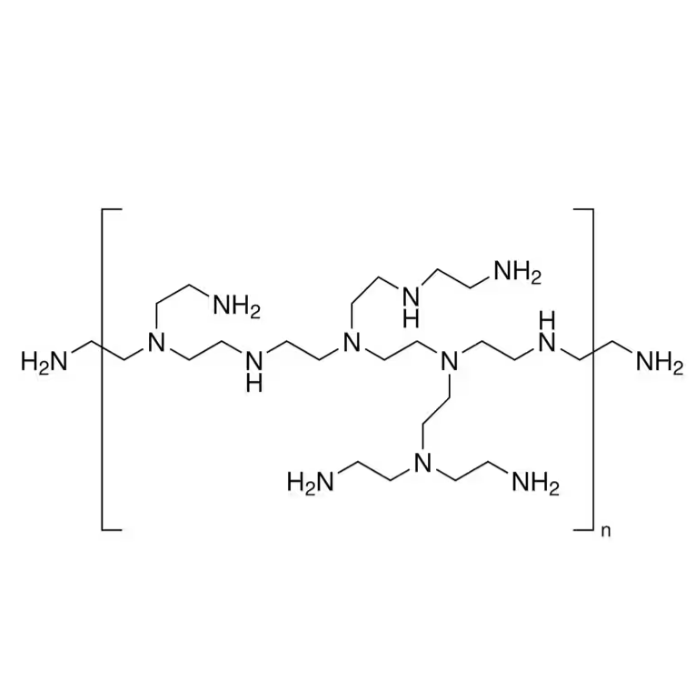
Ethylene imine polymer(PEI) - ≥98%, M.W. 1200 , CAS No.9002-98-6

CAS: 9002-98-6 Cat. No.: E670260 Formula: H(NHCH2CH2)nNH2 EC Number: 618-346-1
AVAILABLE TO ORDER
GRADE & PURITY ≥98% M.W. 1200
Synonyms
PEI
Storage
Protected from light,Room temperature,Argon charged,Desiccated
Shipped In
Normal
★
Size
Germany (EU)
USA*
Price
Qty
25g
E670260-25g
—
1 In stock
€9.46
100g
E670260-100g
—
2 In stock
€32.89
500g
E670260-500g
1 In stock
1 In stock
€121.40
Enter a quantity for the sizes you want to add.

Specifications

Synonyms
PEI
Specifications & Purity
≥98%, M.W. 1200
Storage
Protected from light,Room temperature,Argon charged,Desiccated
Shipped In
Normal
Purity
≥98%
Names and Identifiers
Pubchem Sid
Pubchem Sid Url
https://pubchem.ncbi.nlm.nih.gov/substance/528774804
SMILES
C1CN1
IUPAC Name
aziridine
InChIKey
NOWKCMXCCJGMRR-UHFFFAOYSA-N
InChI
1S/C2H5N/c1-2-3-1/h3H,1-2H2
Isomeric SMILES
C1CN1
WGK Germany
2
RTECS
TQ7917000
Alternate CAS
106899-94-9
UN Number
3082
Packing Group
III
Reaxys
102380
Reaxys-RN_link_address
https://www.reaxys.com/reaxys/secured/hopinto.do?context=S&query=IDE.XRN=102380&ln=

Advanced Data

Taxonomic Classification

Taxonomy Tree

KingdomOrganic compounds
SuperclassOrganoheterocyclic compounds
ClassAziridines
SubclassNot available
Intermediate Tree Nodes Not available
Direct ParentAziridines
Alternative Parents Dialkylamines  Azacyclic compounds  Organopnictogen compounds  Hydrocarbon derivatives  
Molecular FrameworkAliphatic heteromonocyclic compounds
Substituents Azacycle - Secondary amine - Secondary aliphatic amine - Aziridine - Organic nitrogen compound - Organopnictogen compound - Hydrocarbon derivative - Organonitrogen compound - Amine - Aliphatic heteromonocyclic compound
DescriptionThis compound belongs to the class of organic compounds known as aziridines. These are organic compounds containing a saturated three-member heterocycle with one amino group and two methylene groups.
External Descriptors azacycloalkane - saturated organic heteromonocyclic parent - aziridines
3D Structure
Interactive Chemical Structure Model


Mechanisms of Action
Certificates (CoA,COO,BSE/TSE and Analysis Chart)
C of A & Other Certificates(BSE/TSE, COO):
Analytical Chart:

Find and download the COA for your product by matching the lot number on the packaging.

24 results found

Lot NumberCertificate TypeDateItem
E2607398E2607398Certificate of AnalysisApr 22, 2026 E670260
E2607397E2607397Certificate of AnalysisApr 22, 2026 E670260
E2607384E2607384Certificate of AnalysisApr 22, 2026 E670260
E2607382E2607382Certificate of AnalysisApr 22, 2026 E670260
E2429338E2429338Certificate of AnalysisMar 11, 2026 E670260
E2429352E2429352Certificate of AnalysisMar 11, 2026 E670260
E2429363E2429363Certificate of AnalysisMar 11, 2026 E670260
L2525087L2525087Certificate of AnalysisFeb 20, 2025 E670260
L2525058L2525058Certificate of AnalysisFeb 20, 2025 E670260
L2522077L2522077Certificate of AnalysisFeb 20, 2025 E670260
B2526365B2526365Certificate of AnalysisFeb 20, 2025 E670260
B2526363B2526363Certificate of AnalysisFeb 20, 2025 E670260
B2526362B2526362Certificate of AnalysisFeb 20, 2025 E670260
B2526358B2526358Certificate of AnalysisFeb 20, 2025 E670260
E2429356E2429356Certificate of AnalysisApr 16, 2024 E670260
E2429360E2429360Certificate of AnalysisApr 16, 2024 E670260
E2429353E2429353Certificate of AnalysisApr 16, 2024 E670260
E2429347E2429347Certificate of AnalysisApr 16, 2024 E670260
H2401034H2401034Certificate of AnalysisApr 16, 2024 E670260
H2405054H2405054Certificate of AnalysisApr 16, 2024 E670260
J2416222J2416222Certificate of AnalysisApr 16, 2024 E670260
J2428255J2428255Certificate of AnalysisApr 16, 2024 E670260
A2513363A2513363Certificate of AnalysisApr 16, 2024 E670260
A2513226A2513226Certificate of AnalysisApr 16, 2024 E670260
Chemical and Physical Properties
SensitivityLight sensitive.Air and moisture sensitive
x_refractive_index1.5290
x_boil_point_char100 °C
x_melt_point_char-10 °C
Molecular Weight43.07
XLogP3-0.400
Hydrogen Bond Donor Count1
Hydrogen Bond Acceptor Count1
Rotatable Bond Count0
Exact Mass43.0422 Da
Monoisotopic Mass43.0422 Da
Topological Polar Surface Area21.900 Ų
Heavy Atom Count3
Formal Charge0
Complexity10.300
Isotope Atom Count0
Defined Atom Stereocenter Count0
Undefined Atom Stereocenter Count0
Defined Bond Stereocenter Count0
Undefined Bond Stereocenter Count0
The total count of all stereochemical bonds0
Covalently-Bonded Unit Count1
Safety and Hazards(GHS)
x_symbol
GHS07,   GHS09
x_signal_word
Danger
x_hazard_statements

H225:Highly Flammable liquid and vapor

H300:Fatal if swallowed

H310:Fatal in contact with skin

H314:Causes severe skin burns and eye damage

H330:Fatal if inhaled

H340:May cause genetic defects

H350:May cause cancer

H411:Toxic to aquatic life with long lasting effects

x_precautionary_statements

P210:Keep away from heat, hot surface, sparks, open flames and other ignition sources. - No smoking.

P233:Keep container tightly closed.

P240:Ground/bond container and receiving equipment.

P241:Use explosion-proof [electrical/ventilating/lighting/.../] equipment.

P242:Use only non-sparking tools.

P243:Take precautionary measures against static discharge.

P260:Do not breathe dust/fume/gas/mist/vapors/spray.

P262:Do not get in eyes, on skin, or on clothing.

P264:Wash hands [and …] thoroughly after handling.

P270:Do not eat, drink or smoke when using this product.

P271:Use only outdoors or in a well-ventilated area.

P273:Avoid release to the environment.

P280:Wear protective gloves/protective clothing/eye protection/face protection.

P281:Use personal protective equipment as required.

P284:[In case of inadequate ventilation] Wear respiratory protection.

P320:Specific treatment is urgent (see ... on this label).

P321:Specific treatment (see ... on this label).

P330:Rinse mouth.

P363:Wash contaminated clothing before reuse.

P391:Collect spillage.

P301+P330+P331:IF SWALLOWED: Rinse mouth. Do NOT induce vomiting.

P302+P352:IF ON SKIN: wash with plenty of water.

P303+P361+P353:IF ON SKIN (or hair): Take off Immediately all contaminated clothing. Rinse SKIN with water [or shower].

P304+P340:IF INHALED: Remove person to fresh air and keep comfortable for breathing.

P361+P364:Take off immediately all contaminated clothing and wash it before reuse.

P370+P378:In case of fire: Use ... to extinguish.

P405:Store locked up.

P403+P233:Store in a well-ventilated place. Keep container tightly closed.

P403+P235:Store in a well-ventilated place. Keep cool.

P501:Dispose of contents/container to an approved waste disposal plant.

P203:Obtain, read and follow all safety instructions before use.

P301+P316:IF SWALLOWED: Get emergency medical help immediately.

P305+P354+P338:IF IN EYES: Immediately rinse with water for several minutes. Remove contact lenses if present and easy to do. Continue rinsing.

P318:if exposed or concerned, get medical advice.

P302+P361+P354:IF ON SKIN: Take off Immediately all contaminated clothing. Immediately rinse with water for several minutes.

P316:Get emergency medical help immediately.

x_wgk_germany
2
x_rtecs
TQ7917000
x_reaxy_rn
102380
x_reaxys_rn_link_address
https://www.reaxys.com/reaxys/secured/hopinto.do?context=S&query=IDE.XRN=102380&ln=
x_cas_class
9
FAQs and Articles
Non-viral Vectors for Gene Transfection: Polyethyleneimine
Differences Between Transformation and Transfection
Nucleic Acid and Nuclease Decontamination in Biopharmaceutical Manufacturing and Molecular Testing Workflows
Materials Can “Switch”: How Smart Polymers Respond to Temperature, pH, and Light (with Experimental Selection Tips & Product Navigation)
Understanding Hydrophilic Polymers in Aqueous Systems: Hydration Mechanisms, Structural Knobs, and Task-Oriented Selection Guide (Including Tables 1–3)
Biomedical Polymer Insights: Role-Based Task Map, Six Key Material Levers, and a Risk-Driven Evidence Chain (including the Product Navigation Guide and Product Tables 1–3)
dsDNase-Mediated Hydrolysis of Double-Stranded DNA: Enzymatic Characteristics, Methodological Strategies, and Bioanalytical Applications
Research Value of Polyelectrolyte Multilayers: Layer-by-Layer Design of Interfacial Composition, Mass Transport, and Function
What Are Polyamines? Structural Features, Classification and Representative Compounds, Applications, and Synthetic Strategies
Signal Transduction Mechanism of Graphene Biosensors: From Molecular Recognition to Electrical/Optical Signal Readout and Materials Selection
Key Variable in the Long-Term Stability of Waterborne Pigment Concentrates: How Dispersant Molecular Weight Distribution (MWD) Affects Pigment Dispersion, Surface Adsorption-Layer Formation, and Storage Stability
Dispersants, Anti-Redeposition Agents, and Scale-Control Materials in Household Cleaning Formulations: Mechanisms of Action, Selection Logic, and Representative Products
Citations of This Product
Solution Calculators
Reviews

Customer Reviews

Shall we send you a message when we have discounts available?

Remind me later

Thank you! Please check your email inbox to confirm.

Oops! Notifications are disabled.