GRADE & PURITYCarrier Free?Carrier-free — supplied without added carrier protein/stabilizer. Use when carriers (e.g. BSA) would interfere with conjugation or sensitive assays.ExactAb™?ExactAb™ — Aladdin's antibody line emphasizing precision and validated quality. Use for reliable, specificity-validated antibody applications.Validated?Validated grade — performance confirmed in defined applications before release. Use when you want documented assurance the reagent works as stated.High Performance?High-performance grade with optimized purity and performance characteristics. Use for sensitive analyses where ordinary grades fall short.See COA
Carrier Free, ExactAb™, Validated, High Performance, See COA Carrier Free,ExactAb™,High Performance,Validated for sensitive chromatographic and analytical workflows requiring minimal baseline interference.
🌡
Storage & shipping
Store at -20°C,Avoid repeated freezing and thawing Ships Ice chest + Ice pads Check lot-specific COA for exact specifications.
📋
Quality documents
SDS, COA, datasheet, and spec sheet available for download. Lot-specific COA accessible via lot number lookup.
📚
Literature proof
Cited in 0 peer-reviewed publications across chromatography, organic synthesis, and cross-coupling reactions.
Overview
Mouse anti Human Gelsolin Antibody, Monoclonal (D1), could be used for WB, IHC and so on. Application WB: 0.01-3 µg/mL IHC: 5-20 μg/mL Protein Function Calcium-regulated, actin-modulating protein that binds to the plus (or barbed) ends of actin monomers or filaments, preventing monomer exchange (end-blocking or capping). It can promote the assembly of monomers into filaments (nucleation) as well as sever filaments already formed. Plays a role in ciliogenesis.
Specifications
Product Name
Gelsolin Mouse mAb - Primary antibody, specific to Gelsolin, Mouse IgG1
Carrier Free, ExactAb™, Validated, High Performance, See COA
Host species
Mouse
Specificity
Gelsolin
Immunogen
Recombinant GSN expressed in E.coli (AA 434-782).
Epitope
The antibody is directed against an epitope located on the 47 kD peptide derived from a chymotryptic cleavage of gelsolin. This peptide contains the carboxy terminal actin binding site for gelsolin.
Positive Control
WB: Human serum, A549, HeLa and C6 lysates. IHC: Human kidney and colon tissues.
Conjugation
Unconjugated
Grade
Carrier Free, ExactAb™, High Performance, Validated
Isotype
Mouse IgG1
Light Chain Type
kappa
SDS-PAGE
150 kDa
Purification Method
Protein A + Protein G purified
Concentration
See COA
Storage and Shipping
Shape
Liquid
Storage
Store at -20°C,Avoid repeated freezing and thawing
Shipped In
Ice chest + Ice pads
Stability And Storage
Store at 4℃ short term (1-2 weeks). Store at -20℃ long term (24 months). Upon receipt, it is recommended to aliquot. Avoid freeze/thaw cycle.
Images
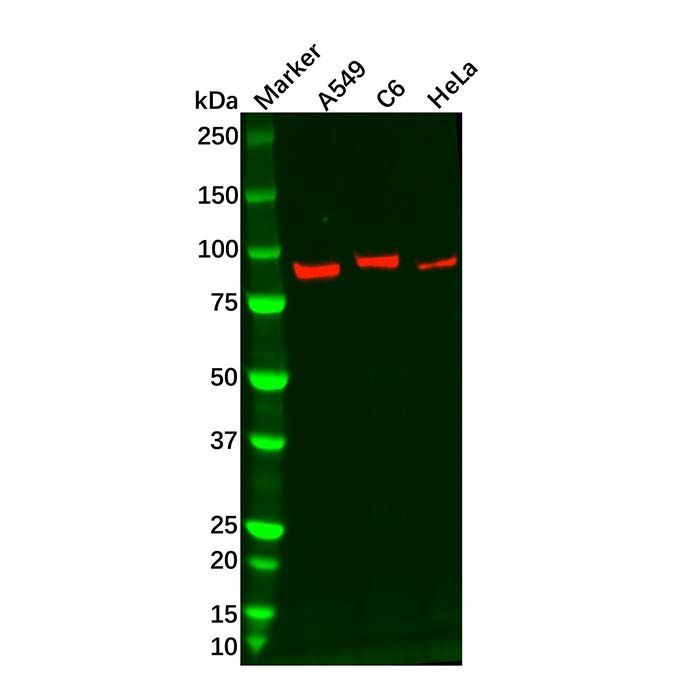
Gelsolin Mouse mAb (Ab105175) - Western Blot All lanes: Gelsolin Mouse mAb (Ab105175) at 1/1000 dilution Samples: Lysates at 20 µg per lane Secondary: Goat Anti-Mouse IgG H&L (HRP) (Ab138040) at 1/20000 dilution
Predicted band size: 86 kDa Observed band size: 90 kDa Exposure time: 14.7 s
Gelsolin Mouse mAb (Ab105175) - Western Blot All lanes: Gelsolin Mouse mAb (Ab105175) at 1/1000 dilution Samples: Lysates at 20 µL per lane Secondary: Goat Anti-Mouse IgG H&L (HRP) (Ab138040) at 1/20000 dilution
Predicted band size: 86 kDa Observed band size: 90 kDa Exposure time: 10.7 s
Gelsolin Mouse mAb (Ab105175) - IHC DAB staining on IHC Samples: Human Kidney Tissue Primary Ab: 10 µg/mL Gelsolin Mouse mAb (Ab105175) Second Ab: 2 µg/mL HRP-Linked Caprine Anti-Mouse IgG Polyclonal Antibody.
Gelsolin Mouse mAb (Ab105175) - IHC DAB staining on IHC Samples: Human Colon Tissue Primary Ab: 10 µg/mL Gelsolin Mouse mAb (Ab105175) Second Ab: 2 µg/mL HRP-Linked Caprine Anti-Mouse IgG Polyclonal Antibody.
Application
Application
Dilution info
WB
0.01-3 µg/mL
IHC
5-20 µg/mL
Documentation
📋 Safety Data Sheet (SDS)
Comprehensive hazard, handling, storage, and regulatory compliance document.
Determine the necessary mass, volume, or concentration for preparing a solution.
Dilution Calculator
Determine the dilution needed to prepare a stock solution.
Reconstitution Calculator
Reviews
Customer Reviews
Application Protocols
Tested applications, recommended dilutions, incubation conditions, retrieval methods, and positive controls are not specified for this item; refer to CoA/Spec Sheet.
General guidance (to aid initial optimization; not item-specific specifications)
Western blot: Start with 0.1–1 µg/mL primary; optimize based on signal and background. Use lysates known to express gelsolin as positive controls.
IHC/IF: Trial range 1–10 µg/mL; adjust antigen retrieval and permeabilization according to fixation method. Include no‑primary and isotype controls.
IP: 1–5 µg antibody per mg lysate protein as a starting point; titrate for efficiency and specificity.
ELISA: Coat with capture antibody per plate manufacturer’s recommendations; determine working range by checkerboard titration.
Because this product is carrier-free, it may be well-suited for direct conjugation prior to use in these workflows; verify buffer compatibility first.
Biological Roles
Gelsolin (GSN) is a conserved actin-binding protein with critical roles in cytoskeletal dynamics (general, literature information):
Actin filament remodeling: Gelsolin severs and caps F‑actin in a Ca2+‑dependent manner, nucleates actin assembly, and promotes filament turnover, enabling cell shape changes and motility.
Signal integration: Activity is regulated by Ca2+, phosphoinositides (e.g., PIP2), and pH, linking signaling events to cytoskeletal rearrangements.
Cellular processes: Contributes to endocytosis, apoptosis-associated membrane changes, vesicle trafficking, and mechanotransduction.
Isoforms/localization: Exists as cytoplasmic and secreted plasma isoforms generated by alternative initiation/processing; the plasma form participates in extracellular actin scavenging after tissue injury.
Interactions: Binds actin monomers/filaments and interfaces with proteins such as CapG, villin family members, and components of focal adhesions (literature), influencing cell migration and morphology.
Research utility of an anti-gelsolin mAb
Mapping gelsolin expression, distribution, and regulation across tissues and model systems.
Studying actin dynamics and cytoskeletal signaling by perturbing or tracking gelsolin in biochemical assays and microscopy.
Note: The specific epitope recognized, species reactivity, and validated applications for this item are not provided here; consult the CoA/Spec Sheet for item-specific biological performance data.
Buffer Applications
Not typically applicable. This product is an antibody reagent, not a buffering agent. It is used within biological buffer systems appropriate for the target assay (e.g., WB, IHC, IF, ELISA). If buffer composition affects your assay or conjugation chemistry, optimize pH/ionic strength empirically and consult the CoA/Spec Sheet for any formulation details (not specified for this item).
Green Alternatives
Green chemistry considerations are not typically applied to biologic antibodies in the same way as organic solvents or reagents. Nevertheless, sustainability can be improved in how the antibody is used:
Carrier-free format reduces the need for azide- or glycerol‑containing preservatives in your workflow, which can simplify waste handling.
Minimize single-use plastics by aliquoting efficiently and planning experiments to reduce freeze–thaw cycles and disposables.
Prefer aqueous buffer systems and avoid supplemental organic cosolvents that may denature the protein and add hazardous waste streams.
Comparison (general considerations)
Preserved antibody stocks (with azide/glycerol) vs. carrier-free:
Environmental impact: Carrier-free avoids azide, a toxic preservative; however, it may require stricter asepsis and cold-chain care.
Performance: Carrier-free is superior for conjugation and certain cell-based assays; preserved formats may be more convenient for routine storage.
Because item-specific formulation is not provided, align your buffer and storage practices with institutional green lab guidelines while maintaining protein integrity.
Pharmaceutical Uses
Research Use Only: As stated, this product is for research use only. It is not intended for diagnostic, therapeutic, or clinical applications.
Formulation/excipient status: Not specified for this item; antibodies for research are typically supplied in laboratory buffer matrices rather than pharmacopeial excipient grades.
Process development (general): Carrier‑free antibodies are suitable starting materials for method development of conjugation workflows (e.g., ADC research, imaging probe generation) in preclinical laboratories; any transition to GMP would require re‑sourcing under appropriate quality systems.
No pharmacopeial monograph, dosage form, or clinical formulation details are provided or implied for this item.
Physical Properties
For monoclonal antibodies, conventional small‑molecule physical constants (bp, mp, logP, refractive index) are not applicable.
Item-specific properties
Appearance: Not specified for this item; refer to CoA/Spec Sheet.
Concentration/formulation/buffer: Not specified for this item; refer to CoA/Spec Sheet.
Molecular weight: Not specified for this item; refer to CoA/Spec Sheet.
General/literature information (for context; not item-specific specifications)
Typical IgG size: ~150 kDa (literature).
Solubility: Antibodies are water-soluble proteins; solubility and stability depend on buffer composition (pH ~6.5–7.5, ionic strength, excipients) (literature).
Isoelectric point: Many murine IgGs exhibit pI in the ~6–9 range depending on sequence and glycosylation (literature).
Practical notes
Carrier-free format (as specified under Grade) usually indicates absence of protein carriers/preservatives, which can influence solution behavior and conjugation efficiency, but exact buffer details for this item are not provided.
For any quantitative property required for method development (e.g., exact concentration), consult the CoA/Spec Sheet for this specific lot.
Quality and Grades
Item-specific grade descriptors
Carrier Free: Indicates the antibody is supplied without common carriers/preservatives such as BSA, gelatin, glycerol, or sodium azide. Practical implications:
Advantages: Optimal for chemical conjugation (e.g., NHS-ester, maleimide), sensitive cell-based assays, and applications where carriers interfere (MS, SPR, microarrays).
Considerations: Increased sensitivity to adsorption and microbial growth; handle aseptically, minimize surfaces, and avoid repeated freeze–thaw.
ExactAb™: Branded designation indicating controlled manufacturing and high lot-to-lot consistency (general interpretation of such labels); consult CoA for exact release criteria.
Validated: Signifies internal verification against defined acceptance criteria (e.g., specificity, background). Application-specific validation details are not provided here; refer to CoA/Spec Sheet.
High Performance: Marketing/quality descriptor denoting superior performance metrics (signal-to-noise, specificity, lot consistency). Exact metrics are not specified for this item.
What is not specified for this item (consult CoA/Spec Sheet)
Clone ID, isotype/subclass, host/ascites/culture origin, concentration, purity method (e.g., Protein A/G), endotoxin level, residuals (HCP/DNA), and formulation.
Recommendations for users
For regulated or quantitative workflows, obtain the CoA and, if needed, a QA letter describing exact test panels (purity, bioburden/endotoxin, aggregation) and acceptance limits used for this lot.
Reaction and Applications
As an analytical/biological reagent, this antibody is used in immunoassay workflows rather than chemical reactions. Typical applications for a gelsolin-targeting mouse mAb (general guidance; item-specific validations are not provided):
Detection/quantification of gelsolin in cell/tissue lysates by Western blot (WB) and in fixed samples by immunohistochemistry (IHC) or immunofluorescence (IF).
Immunoprecipitation (IP) or co‑IP to enrich gelsolin and associated complexes for proteomics.
ELISA or bead-based assays to measure gelsolin levels in research samples.
Conjugation to enzymes, fluorophores, or biotin for multiplex imaging or flow cytometry (after confirming reactivity and epitope accessibility).
Practical tips (literature/best practice):
Use carrier-free stocks for direct chemical conjugation (NHS-ester, maleimide) to avoid carrier competition. Verify buffer lacks primary amines (for NHS) or thiols (for maleimide).
Titrate antibody carefully for each matrix to optimize signal-to-noise; include isotype and no-primary controls.
Note: Application testing details, recommended dilutions, known positive controls, and species cross-reactivity are not specified for this item—consult CoA/Spec Sheet and perform in‑house optimization.
Reaction Conditions
Item-specific reaction/assay conditions are not provided. Below are general, literature-derived conditions for common antibody modifications; adapt to your system and confirm compatibility with your antibody’s buffer (not specified for this item):
NHS‑ester labeling (amines)
Buffer: 50–100 mM phosphate or bicarbonate, pH 8.3–8.5, amine‑free; avoid Tris/glycine.
Temperature/time: 20–25°C, 15–60 min; quench with Tris or ethanolamine.
Molar ratio (dye:IgG): 3–10:1 for moderate DOL; optimize to preserve binding.
Maleimide‑thiol labeling (cysteines)
Optional mild reduction: TCEP 0.5–5 mM, 15–30 min at RT; remove reductant before coupling.
Buffer: pH 6.5–7.0 (HEPES/PBS without EDTA for some systems); include 1–5 mM EDTA to suppress metal‑catalyzed oxidation if compatible.
Temperature/time: 4–25°C, 30–120 min.
Affinity immobilization (CNBr‑activated agarose)
Coupling buffer: 0.1 M NaHCO3, 0.5 M NaCl, pH ~8.3.
Quench/block: 0.1 M Tris‑HCl, pH 8.0; wash with alternating high/low pH buffers.
Verify post‑reaction integrity and activity (SEC to assess aggregation, SDS‑PAGE, binding assay). For this item, clone/epitope-specific sensitivities are unknown—titrate conditions conservatively.
Safety and Handling
Safety details provided for this item
GHS classification, signal word, pictograms, H‑statements: Not specified for this item; refer to the product SDS.
General guidance for protein antibodies (literature/best practice; defer to SDS)
Hazard profile: Monoclonal antibodies are proteins and are generally considered to have low acute hazard in laboratory handling; however, formulations may contain buffers or residual reagents with their own hazards. Always review the lot-specific SDS.
PPE: Use standard laboratory PPE—lab coat, gloves (nitrile), and safety glasses. Avoid aerosol generation and contact with skin/eyes.
Handling: Work on ice or at 2–8°C during bench procedures to preserve activity. Use sterile technique to avoid microbial contamination, especially for carrier‑free preparations.
Incompatibilities: Avoid strong oxidizers and proteases. Do not mix with sodium azide–sensitive systems if azide is present (not specified for this item).
First aid (overview; consult SDS):
Skin/eye contact: Rinse with water for several minutes. Remove contaminated clothing.
Ingestion/inhalation: Move to fresh air; seek medical advice if symptoms occur.
Waste: Dispose per institutional biosafety and local regulations for nonhazardous biological laboratory waste.
Always defer to the official SDS for authoritative safety, spill, and exposure-response information.
Solvent Selection
This product is a protein antibody reagent rather than a small-molecule solute; it is not selected by organic solvent polarity. Instead, performance depends on aqueous buffer conditions.
Applicability: Solvent screening in the organic chemistry sense is not relevant. Use standard biological buffers compatible with your downstream assay.
Carrier-free consideration: Absence of carriers/preservatives facilitates direct transfer into user-defined buffers (e.g., for conjugation or sensitive assays). Exact supplied buffer for this item is not specified; perform gentle buffer exchange if required.
Compatibility (general, literature):
Stable near neutral pH (~6.5–7.5) with isotonic salts; avoid extremes of pH and high organic content which can denature antibodies.
For conjugations, use amine-free buffers for NHS ester chemistry and reducing agent–free buffers for maleimide chemistry.
If your application requires a particular buffer composition or low-background matrix, perform small-scale pilot tests after buffer exchange/dialysis to your target formulation.
Storage and Reconstitution
Item-specific conditions (from Product Data)
Storage: Store at -20°C.
Handling: Avoid repeated freezing and thawing.
Shipping: Shipped in an ice chest with ice pads.
Research use: For research use only.
Additional notes
Specific formulation, concentration, and reconstitution instructions are not specified for this item; refer to CoA/Spec Sheet.
To implement the “avoid repeated freeze–thaw” instruction in practice, many users aliquot upon first use; adopt procedures consistent with your lab’s quality system and the lot-specific documentation.
Structure and Identity
This product is a mouse monoclonal antibody directed against the protein target gelsolin; it is a macromolecular biologic reagent, not a defined small molecule.
SKU: Ab105175; Product: Gelsolin Mouse mAb
Antibody type: mouse monoclonal antibody (mAb) against gelsolin (based on product name)
Small-molecule identifiers (SMILES, InChIKey, CAS, CID): Not applicable to antibodies; not specified for this item.
Molecular formula and exact molecular weight: Not specified for this item; refer to CoA/Spec Sheet.
Structural features (general, literature):
Typical IgG antibodies are Y‑shaped glycoproteins composed of two heavy chains and two light chains linked by disulfide bonds, with variable domains conferring antigen specificity and Fc constant domains mediating effector functions.
Approximate size of a full-length IgG: ~150 kDa (literature; item-specific value not provided).
Epitope/clone/isotype: Not specified for this item; refer to CoA/Spec Sheet.
Interpretation note: Because this is a protein reagent, conventional small‑molecule structure descriptors are not applicable. Identity is established by target specificity (gelsolin) and by antibody characteristics (species, clonality, clone/isotype), the latter of which are not provided here.
Synthetic Utility
Not a synthetic building block. However, as a biomolecular tool, a carrier‑free monoclonal antibody can be chemically derivatized for research (general guidance):
Conjugation handles (literature):
Lysine ε‑amines: Reaction with NHS ester–activated dyes/biotin/PEGs.
Reduced interchain cysteines or engineered thiols: Maleimide–thiol coupling for site-selective labeling; maintain control of reduction to avoid over‑fragmentation.
Carbohydrate Fc glycans: Periodate oxidation followed by oxime/hydrazone ligation for Fc‑selective conjugation.
Affinity immobilization: Coupling to activated solid supports (e.g., CNBr‑Sepharose, epoxy/methacrylate resins) to prepare immunoaffinity matrices for gelsolin capture.
Note: Clone/isotype and buffer composition strongly influence derivatization efficiency. These are not specified for this item—perform pilot reactions and analytical QC (SDS‑PAGE, SEC, UV‑Vis, MS as applicable).
Target Specificity
Item-specific information provided
Antigen/Target: Gelsolin (based on product name).
Antibody type: Mouse monoclonal antibody (mAb).
Not specified for this item; refer to CoA/Spec Sheet
Clone ID and isotype/subclass
Species reactivity (e.g., human/mouse/rat cross‑reactivity)
Epitope or domain mapping
Validated applications and positive controls
Cross-reactivity with related actin-binding proteins
Notes
For experiment planning, confirm that species reactivity and epitope accessibility match your sample type and fixation/permeabilization method. Without item-specific data, perform preliminary tests and include appropriate controls.
Need help choosing the grade?
Our grade selection guide covers purity, stabilizer status, and application suitability for all variants in our catalog.
We use cookies to ensure the website functions properly and, where permitted, to improve your experience. You can manage your preferences at any time in Settings. Learn more in our Cookie Policy.
Shall we send you a message when we have discounts available?
Remind me later
Thank you! Please check your email inbox to confirm.
Products are supplied to verified businesses, institutions, and qualified professionals for research and development use only. Not for use in humans, animals, diagnosis, or therapy.

 ZJ24F0303642