GRADE & PURITYPharmPure™?PharmPure™ — Aladdin's line of biopharmaceutical raw and starting materials. Use for pharma manufacturing inputs needing high purity and documentation.USP?United States Pharmacopeia grade — meets USP monograph specs for pharmaceutical use. Use for drug manufacturing, QC, and applications requiring US compendial compliance.JP?Japanese Pharmacopoeia grade — conforms to JP monograph standards. Use for pharmaceutical products subject to Japanese regulatory requirements.BP?British Pharmacopoeia grade — conforms to BP monograph requirements. Use for pharmaceutical products marketed under UK/BP regulatory standards.Ph.Eur.?European Pharmacopoeia grade — conforms to Ph.Eur. monographs across EU member states. Use for pharmaceutical work needing European compendial compliance.
Light sensitive. Quickly heat up to 289 ℃ for decomposition. Dissolved in hot ethanol, hydroxide alkali solution, and dilute hydrochloric acid, slightly soluble in water, insoluble in chloroform and ether. The aqueous solution exhibits a weak acidic reaction.
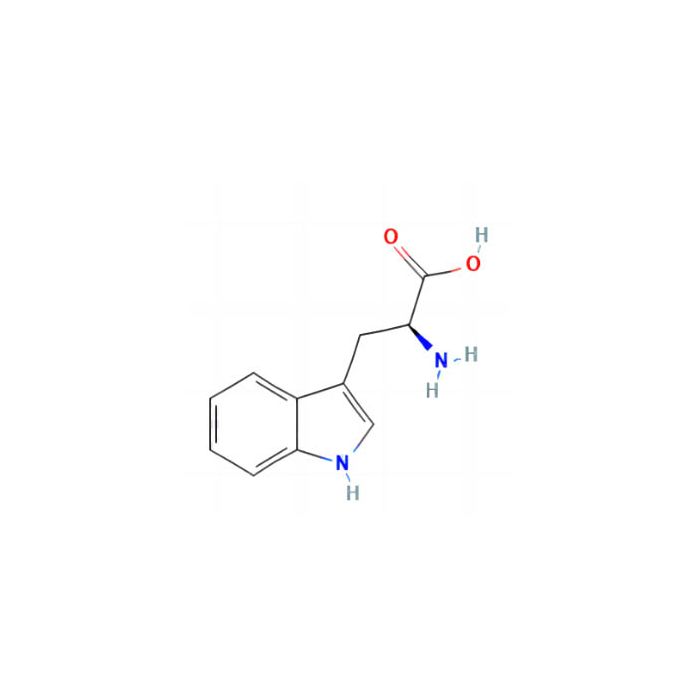
Tryptophan (Trp) is a heterocyclic compound that is an essential amino acid associated with growth, reproduction, and immunity. Increasing the availability of tryptophan is necessary for regulating emotions, cognition, and behavior. The brain's uptake of tryptophan depends on the ratio of Trp in plasma to all other large molecule neutral amino acids. The higher the proportion, the greater the Trp intake.
This compound belongs to the class of organic compounds known as indolyl carboxylic acids and derivatives. These are compounds containing a carboxylic acid chain (of at least 2 carbon atoms) linked to an indole ring.
External Descriptors
Common amino acids
1. Djoumbou Feunang Y, Eisner R, Knox C, Chepelev L, Hastings J, Owen G, Fahy E, Steinbeck C, Subramanian S, Bolton E, Greiner R, and Wishart DS. ClassyFire: Automated Chemical Classification With A Comprehensive, Computable Taxonomy. Journal of Cheminformatics, 2016, 8:61.
Determine the necessary mass, volume, or concentration for preparing a solution.
Dilution Calculator
Determine the dilution needed to prepare a stock solution.
Reconstitution Calculator
Reviews
Customer Reviews
Application Protocols
General laboratory protocols (illustrative; not product validation)
Preparation of aqueous stock solutions
Aim: 100 mM L-tryptophan for spectroscopy or biochemical assays.
Procedure: Weigh 2.04 g into an amber 100 mL volumetric flask; add ~70 mL water; adjust to pH ≈2 with 1 M HCl to dissolve completely; bring to volume; filter 0.22 μm if sterility is needed; store at 2–8 °C, protected from light, and use within a few days.
Fluorescence measurement
Instrument: Spectrofluorometer.
Conditions (literature): Excitation 280 nm; emission scan 300–400 nm; slit widths 2–5 nm; typical emission maximum ~350 nm in aqueous buffer; record background and correct for inner-filter effects at higher concentrations.
Capping (optional): Ac2O/NMM to block unreacted amines.
Cleavage: TFA with scavengers (e.g., TIPS/water), 0.5–2 h; precipitate in cold ether.
Cell culture media supplementation (research use only)
Prepare a sterile 100× concentrate in water or buffer; filter 0.22 μm; add to sterile media under aseptic conditions to desired final concentration; verify osmolarity and pH.
Note: Optimize parameters for your specific equipment, resin, and assay. Follow institutional SOPs.
Biological Roles
General biochemistry (literature; not medical/clinical claims)
Essential amino acid: L-Tryptophan is one of the 20 proteinogenic amino acids and cannot be synthesized de novo by humans; incorporated into proteins by the genetic code (codon UGG).
Indole chromophore: Confers intrinsic fluorescence to proteins containing tryptophan residues; sensitive to local environment, enabling biophysical studies of folding and interactions.
Metabolic pathways: Precursor for kynurenine pathway metabolites (e.g., kynurenine, quinolinic acid) and for serotonin and melatonin biosynthesis. Also contributes to de novo NAD+ biosynthesis (via kynurenine) in many organisms.
Enzymology: Substrate for tryptophan hydroxylase, indoleamine 2,3-dioxygenase (IDO), tryptophan 2,3-dioxygenase (TDO), aromatic amino acid aminotransferases, and various decarboxylases.
Transport and homeostasis: Competes with other large neutral amino acids for LAT transporters; availability influences protein synthesis and metabolic fluxes.
Structural roles: Tryptophan residues often localize at membrane interfaces due to amphipathic character of indole; participate in cation–π interactions and hydrogen bonding in protein active sites.
Laboratory relevance
Fluorescence reporter: Useful in FRET experiments (donor at ~280 nm), redox sensing (indole oxidation), and quenching assays (e.g., acrylamide quenching).
Isotopic variants: 13C/15N-labeled L-tryptophan is widely used in NMR, MS-based proteomics, and metabolic flux analysis.
Buffer Applications
Applicability
L-Tryptophan itself is not used as a buffering agent; its acid/base pairs are too far apart and its useful buffering capacity is limited compared to standard buffers.
Practical use in buffered systems (literature)
Fluorescence/UV assays: Prepare solutions in low-absorbance buffers (e.g., 10–50 mM phosphate, pH 6.5–7.5; or 10–50 mM acetate, pH 4.5–5.5). Avoid Tris for precise UV at 280 nm if baseline interference is problematic.
Dissolution tips: To prepare concentrated stocks, dissolve L-tryptophan in water adjusted to pH ~2 (HCl) or pH ~10 (NaOH), then dilute into the target buffer and readjust pH if necessary.
Ionic strength: Moderate ionic strength (50–150 mM) can improve stability and reproducibility of spectroscopic measurements.
Typical preparation examples (general guidance)
100 mM stock (acidic): Add 2.04 g L-tryptophan to ~80 mL water, adjust to pH 2 with 1 M HCl to dissolve, bring to 100 mL; store protected from light at 2–8 °C for short term.
10 mM working solution: Dilute 1 mL of 100 mM stock into 9 mL of 50 mM phosphate buffer, pH 7.4; use freshly.
Note: These are general laboratory practices; optimize conditions for your assay. For any compendial or regulated work, follow validated procedures.
Green Alternatives
Perspective: As a solid amino acid rather than a solvent or reagent with major environmental burdens, “green alternatives” focus on sourcing and process conditions rather than substituting the molecule itself.
Greener sourcing and processes (literature/general)
Bio-based production: Industrial L-tryptophan is commonly produced via microbial fermentation from renewable feedstocks (e.g., glucose), reducing reliance on petrochemical routes.
Aqueous processing: Favor water-based formulations and buffers over organic solvents. Where organic co-solvents are needed (e.g., DMSO), keep volumes minimal and recover when possible.
Protecting group strategy: Choose removable, low-toxicity protecting groups and coupling reagents with improved EHS profiles (e.g., OxymaPure/COMU as alternatives to HOBt/HBTU; ensure appropriate risk assessments).
Energy use: Dissolve at ambient temperature with pH assistance rather than heating; avoid prolonged reflux in polar aprotics.
Trade-offs
Fermentation-derived material requires robust impurity control (endotoxin/bioburden) for certain applications—balance with downstream purification energy.
Replacing DMF/NMP in SPPS with greener media (e.g., safer dipolar aprotics) may affect coupling efficiency and resin swelling; process re-optimization is needed.
Compendial compliance (USP/JP/BP/Ph.Eur.) facilitates use in pharmaceutical development, QC, and manufacturing contexts where monograph alignment is required.
Representative roles (general)
Raw material/starting material: Chiral pool precursor for synthesis of tryptophan-containing peptides and peptide-based APIs.
Process/formulation aid in R&D: Amino acid component in bioprocess media/feed development for upstream biomanufacturing; excipient-like roles in stabilizing proteins during formulation screening (e.g., as a kosmotropic/interaction-modulating additive), subject to compatibility.
Reference standard: UV/fluorescence calibrant for instrument qualification at 280 nm; amino acid analysis controls.
Regulatory/quality considerations
Use of compendial-grade lots may simplify method transfer and release testing (identity, assay, impurities) under pharmacopeial methods; nevertheless, lot-specific CoA verification and supplier qualification are mandatory.
Microbial/endotoxin limits: If intended for parenteral or cell-based work, ensure appropriate ancillary testing (not implied by this listing unless stated on CoA).
Note: For GMP or clinical manufacturing, follow your quality system for release specifications, change control, and stability programs.
Physical Properties
Item-specific specifications
Appearance: Not specified for this item; refer to CoA/Spec Sheet.
Molecular Formula (item): Not specified for this item; refer to CoA/Spec Sheet.
Molecular Weight (item): Not specified for this item; refer to CoA/Spec Sheet.
Solubility (approx., literature): Water ~10–12 g/L at 25 °C; more soluble in acidic or basic aqueous media; sparingly soluble in ethanol; limited in most nonpolar solvents; soluble in DMSO.
LogP (XlogP3, literature): ~−1.1 (zwitterionic character in neutral water leads to low apparent hydrophobicity).
Hygroscopicity: low-to-moderate; powders can cake in humid air.
Optical activity: L-enantiomer; solutions exhibit circular dichroism; specific rotation varies with solvent, pH, and concentration (consult primary data when critical).
USP/JP/BP/Ph.Eur.: Indicates the material is suitable to meet monograph requirements of the respective pharmacopeias (identity tests, purity assays, allowable impurities, heavy metals/elemental impurities per current chapters, microbial limits where applicable). End-users remain responsible for verifying suitability and compliance for their application and jurisdiction.
PharmPure™: Aladdin’s high-purity offering intended for applications demanding tight control of impurities; typically aligned with low bioburden and consistent assay. Not a guarantee of sterility unless explicitly stated.
Testing and documentation
Typical dossiers include CoA referencing assay, identity (e.g., IR/UV, optical rotation), limits on related substances, heavy metals/elemental impurities, loss on drying, and specific optical rotation as per compendial methods. Exact acceptance criteria: Not specified for this item; refer to CoA/Spec Sheet.
Stabilizers/processing aids
Stabilizers: Not specified for this item; refer to CoA/Spec Sheet. L-Tryptophan generally does not require added stabilizers but benefits from light protection due to indole oxidation susceptibility.
Use cases for these grades
Suitable for pharmaceutical development work (non-clinical), QC reference, process development, nutraceutical R&D, and cell culture/feed applications where compendial alignment is advantageous. For GMP use, qualify the lot and supplier per your quality system.
Reaction and Applications
Expanded research/manufacturer applications (general; align with typical L-tryptophan use)
Intrinsic fluorescence probe: The indole chromophore enables excitation near 280 nm and emission ~350 nm; widely used to probe protein folding, ligand binding, and microenvironment polarity.
Biochemical precursor studies: Substrate for enzymes in the kynurenine and serotonin/melatonin biosynthetic pathways; tracer studies with isotopologues to map metabolism.
Cell culture/nutrition R&D: Essential amino acid component in media optimization and feed strategies; limiting nutrient studies.
Peptide/protein synthesis: Chiral pool building block; protected derivatives support SPPS (e.g., Fmoc-Trp(Boc)-OH) with indole N-protection to avoid undesired acylation/oxidation.
Synthetic chemistry applications (literature)
Chiral auxiliary/chiral pool: The L-configuration is deployed for stereocontrolled syntheses via amide coupling, esterification, oxidative decarboxylation, and side-chain elaboration.
Indole functionalization: Electrophilic substitutions (e.g., N-protection, C2/C3 functionalization) and cross-coupling of pre-functionalized tryptophan derivatives.
Practical tips
Light sensitivity: Protect from light to minimize indole oxidation and fluorescence drift.
pH management: Dissolve at mildly acidic pH to accelerate dissolution; avoid prolonged exposure to strong base which can promote racemization and degradation.
Metal-catalyzed reactions: Indole can coordinate/poison catalysts; consider protecting groups or ligands that tolerate indoles.
Analytics: Monitor purity by RP-HPLC with UV 280 nm detection; consider fluorescence detection for sensitivity.
Reaction Conditions
General conditions (literature; guidance only)
Peptide couplings (solution or solid-phase):
Solvent: Anhydrous DMF or NMP (or greener alternatives after validation).
Reagents: HATU/HBTU/COMU (0.9–1.1 eq), base DIPEA (2–4 eq), 0–25 °C.
Time: 0.5–2 h per coupling; monitor by Kaiser/chloranil tests (SPPS) or TLC/HPLC (solution).
Notes: Use indole N-Boc protection to suppress side reactions; minimize exposure to strong base to limit racemization.
Carbodiimide couplings (EDC/Oxyma or EDC/HOBt):
Solvent: DMF/DCM mixtures or aqueous-organic (for water-compatible systems).
Temperature: 0–25 °C; add base (e.g., NMM/DIPEA) judiciously.
Deprotections:
Fmoc removal: 20% piperidine/DMF, 2×10 min at RT (SPPS typical).
Boc (indole) removal: TFA in DCM or neat TFA, 0.5–2 h at RT.
Stock solutions for spectroscopy/biochemistry:
Water or buffer (10–50 mM); adjust pH to aid dissolution; filter (0.22 μm). Use amber vessels; avoid prolonged light exposure.
Representative outcomes
Coupling yields: Often >90% per step in optimized SPPS; solution-phase yields vary (60–90%) depending on substrate and conditions.
Analytical controls
Monitor integrity by RP-HPLC (UV 280 nm) and MS; assess enantiopurity by chiral HPLC or derivatization (Marfey/DABS-Cl) followed by LC.
Safety and Handling
GHS/SDS status for this catalog item
Signal word: Not specified for this item; refer to SDS.
Hazard statements: Not specified for this item; refer to SDS.
GHS classification/pictograms: Not specified for this item; refer to SDS.
General laboratory safety guidance (literature/practice; not product-specific)
Expected hazards: L-tryptophan is generally regarded as low hazard for laboratory handling; may cause minor irritation to eyes/skin/respiratory tract in dust form.
PPE: Wear lab coat, safety glasses, appropriate gloves (e.g., nitrile). Avoid inhalation of dust and contact with eyes/skin.
Handling: Use in well-ventilated area; avoid creating dust clouds. For sterile/biological work, handle in clean environment and use sterile technique.
Incompatibilities: Strong oxidizers; strong acids/bases can promote degradation over time at elevated temperature; photosensitive (indole oxidation) — avoid light exposure.
First aid (overview): Eye contact—rinse cautiously with water for several minutes; Skin—wash with soap/water; Inhalation—move to fresh air; Ingestion—rinse mouth. Seek medical attention if symptoms persist.
Fire behavior: Organic solid; combustible. Use water spray, CO2, foam, or dry chemical. Thermal decomposition may generate nitrogen oxides and carbon oxides.
Spills: Avoid dusting; collect mechanically or damp-wipe. For sterile applications, discard contaminated material; do not attempt to re-sterilize unless validated.
Waste: Dispose in accordance with institutional and local regulations.
Always consult the product’s SDS for authoritative safety information.
Solvent Selection
Context: L-Tryptophan is a zwitterionic, aromatic amino acid; its solubility is strongly pH-dependent and influenced by ionic strength.
Polarity and miscibility (literature)
Water: Limited solubility at neutral pH (~10–12 g/L at 25 °C); substantially higher in acidic (pH < 2.5) or basic (pH > 9.5) media due to ionization.
Alcohols: Sparingly soluble in ethanol/methanol at ambient temperature.
Polar aprotic solvents: Soluble in DMSO and DMF (useful for stock solutions, peptide coupling). Avoid prolonged storage in DMF due to potential degradation.
Nonpolar solvents: Essentially insoluble.
Practical selection guidelines
Analytical fluorescence/UV work: Use phosphate or acetate buffers around pH 6–7 to maintain spectral characteristics; avoid high absorbance background.
Biochemistry/cell culture: Prepare in sterile water or appropriate media; adjust pH with HCl or NaOH to aid dissolution; filter-sterilize (0.22 μm) if needed.
Peptide synthesis: Use DMF or NMP for coupling steps; typical protected derivatives (e.g., Fmoc-Trp(Boc)-OH) are handled in anhydrous polar aprotics.
High concentration stocks: Dissolve in 0.1 M HCl (acidic) or 0.1 M NaOH (basic) to reach >50–100 mg/mL, then readjust pH after dilution into buffer.
Comparison notes (literature)
L-Trp vs. L-Phe: L-Trp is more polar (indole NH) and exhibits stronger UV/fluorescence; slightly more soluble in water at neutral pH.
L-Trp vs. 5-HTP: 5-HTP is more hydrophilic but less stable to oxidation; L-Trp offers better stability under neutral conditions.
Storage and Reconstitution
Item-specific storage/shipping
Storage Conditions: Protected from light; Room temperature (as provided in Product Data).
Shipped In: Normal (ambient) conditions (as provided in Product Data).
General guidance for best results
Solid stability: Store tightly closed in original container, protected from light (amber bottle or foil overwrap). Use desiccation if ambient humidity is high. Avoid prolonged exposure to air and light to minimize indole oxidation and color change.
Handling: Allow container to equilibrate to room temperature before opening to prevent moisture condensation. Reseal promptly after use.
Reconstitution and solution stability (literature)
Solubility strategy: For rapid dissolution, adjust water to pH ~2 (HCl) or ~10 (NaOH) before adding solid; stir until dissolved, then dilute and readjust pH as needed.
Filtration: For sterile applications, filter through 0.22 μm PES or PTFE membranes into sterile, light-protective vials.
Storage of solutions: Store in amber containers at 2–8 °C for short-term (days). For long-term storage, aliquot and freeze at −20 °C; avoid repeated freeze–thaw cycles. Monitor for precipitation, pH drift, and absorbance/fluorescence changes.
Specifications not listed
Appearance, assay, impurity limits, water content, and related tests: Not specified for this item; refer to CoA/Spec Sheet.
Research use note
For research use only (as provided). Not for human or veterinary use.
Structure and Identity
Brief overview: L-Tryptophan is an aromatic α-amino acid with an indole side chain; it is a chiral, proteinogenic building block and a common fluorescent probe in proteins.
Item-specific (from Product Data)
SKU: L774650
Product Name: L-Tryptophan
CAS: 73-22-3
PubChem CID: 6305
InChIKey: 298119 (as provided in Product Data)
Grade: PharmPure™, USP, JP, BP, Ph.Eur.
Storage: Protected from light; Room temperature
Shipped: Normal
Literature/computed identifiers and descriptors (general reference; not item specifications)
2D description: From the α-carbon center, the carboxylate and ammonium functions are geminal; the side chain extends as –CH2– indole; planar aromatic indole fused system orthogonal to the backbone; single stereocenter at Cα (L, S).
Indole chemistry: Electrophilic substitution at C3>C2; N-protection (e.g., Boc) mitigates undesired reactions and enables selective side-chain manipulations.
Chiral pool: The (S)-configured α-center serves as a stereochemical relay in downstream transformations (e.g., peptide coupling, auxiliary-directed reactions).
Common transformations (literature)
SPPS: Use Fmoc-Trp(Boc)-OH on solid support; coupling via HATU/HBTU/COMU with DIPEA; final deprotection with piperidine (Fmoc) and TFA (Boc, side chains).
Solution-phase coupling: Carbodiimide-mediated couplings (EDC/HOBt or EDC/Oxyma), mixed anhydrides, acid chlorides (with care to avoid racemization).
Side-chain elaboration: C–H functionalization at indole (e.g., metal-catalyzed borylation/arylation of pre-functionalized derivatives), oxidative transformations to kynurenine analogs.
Protection strategies: Indole N-Boc, amine Boc/Fmoc/CBz, carboxyl as methyl/benzyl esters; selection balances stability vs deprotection conditions.
Retrosynthetic value
Readily accessible from fermentation; serves as an entry to diverse tryptamine/tryptophol/β-carboline frameworks after decarboxylation/reduction/cyclization sequences.
Practical cautions
Racemization risk: Elevated pH/temperature can epimerize the α-center—use mild bases and short exposure times; monitor by chiral HPLC.
Oxidation: Indole susceptible to photo- and air-oxidation; exclude light/oxygen when sensitive steps are involved.
Target Specificity
Not applicable to this product type.
This item is a small-molecule amino acid, not an affinity reagent. There is no antigen/epitope/clone/isotype information associated with this catalog entry.
Frequently Asked Questions
What does PharmPure? mean?
PharmPure? refers to material produced and controlled to meet the requirements of pharmaceutical manufacturing and regulated workflows. Depending on the specific designation (GMP, RUO, Bio-medical, Injection grade, etc.), this may include controlled manufacturing environments, validated processes, audit-ready documentation and traceability.
What does USP mean?
USP indicates that the material complies with the published monographs of the relevant pharmacopoeia (USP). Specifications include identity, assay, impurity limits, residual solvents and other tests defined in the monograph. USP-compliant material is suitable for pharmacopoeia-compliant pharmaceutical use, including pharmaceutical manufacturing, QC and regulatory submission.
How should this product be stored?
Store at room temperature, protected from light. The material is light-sensitive — keep it in its original opaque or amber container.
How is this product shipped?
This product ships under standard ambient conditions. No temperature-controlled packaging is required.
What are the CAS number, molecular formula and molecular weight?
The CAS Number is 73-22-3, the molecular formula is C11H12N2O2, and the molecular weight is 204.23 g/mol. InChIKey QIVBCDIJIAJPQS-VIFPVBQESA-N.
What documentation is provided?
Available product documentation, including Certificates of Analysis (COA), Safety Data Sheets (SDS), and specification sheets, is shown in the product document area. Document availability and access follow the current site policy.
We use cookies to ensure the website functions properly and, where permitted, to improve your experience. You can manage your preferences at any time in Settings. Learn more in our Cookie Policy.
Shall we send you a message when we have discounts available?
Remind me later
Thank you! Please check your email inbox to confirm.
Products are supplied to verified businesses, institutions, and qualified professionals for research and development use only. Not for use in humans, animals, diagnosis, or therapy.

 GMC2613137