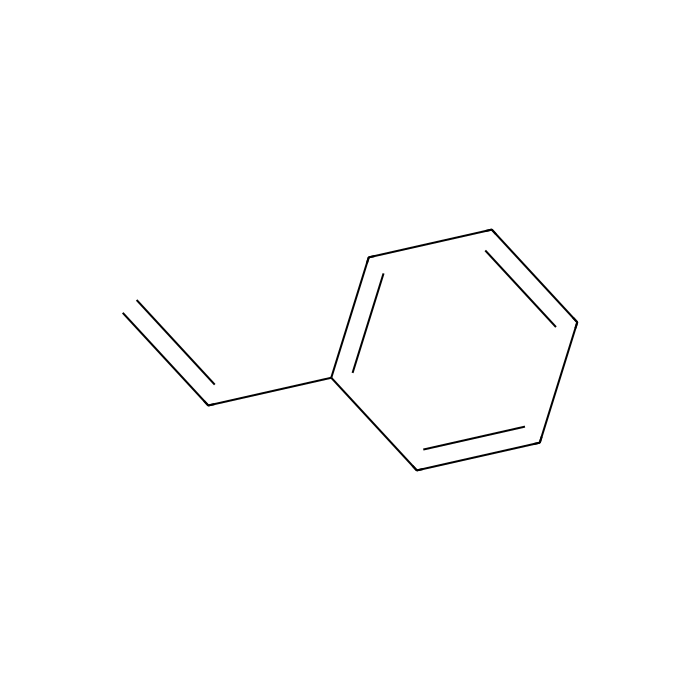
Styrene - Standard for GC, ≥99.5%(GC), stabilized with 10-15ppm TBC , CAS No.100-42-5

CAS: 100-42-5 Cat. No.: S110374 Formula: C8H8 Molecular Weight: 104.15 Beilstein Registry Number: 1071236 EC Number: 202-851-5
AVAILABLE TO ORDER
GRADE & PURITY Standard for GC ? GC reference standard — characterized compound for calibrating GC methods. Use to build calibration curves and verify GC quantitation. ≥99.5%(GC) stabilized with 10-15ppm TBC
Synonyms
STYRENE (IARC) | STYRENE-ALPHA-13C | Vinyl benzene | Diarex hf 77 | Styrol | HSDB 171 | STYRENE [MI] | Styrene monomer | Bulstren K-525-19 | CCRIS 564 | UNII-44LJ2U959V | EC 202-851-5 | NCGC00091056-01 | STYRENE | trans-Styrene-(beta)-d | NCGC00091056-05
Storage
Store at 2-8°C,Protected from light,Argon charged
Shipped In
Wet ice,FedEx DG Service
★
Size
Germany (EU)
USA*
Price
Qty
5ml
S110374-5ml
—
3 In stock

€15.53

€23.34
Save €7.81 (33.46%)
Enter a quantity for the sizes you want to add.
🧪
Why this grade

Standard for GC, ≥99.5%(GC), stabilized with 10-15ppm TBC Standard for GC for sensitive chromatographic and analytical workflows requiring minimal baseline interference.

🌡

Storage & shipping

Store at 2-8°C,Protected from light,Argon charged Ships Wet ice,FedEx DG Service Check lot-specific COA for exact specifications.

📋

Quality documents

SDS, COA, datasheet, and spec sheet available for download. Lot-specific COA accessible via lot number lookup.

📚

Literature proof

Cited in 810 peer-reviewed publications across chromatography, organic synthesis, and cross-coupling reactions.

Specifications

Synonyms
STYRENE (IARC) | STYRENE-ALPHA-13C | Vinyl benzene | Diarex hf 77 | Styrol | HSDB 171 | STYRENE [MI] | Styrene monomer | Bulstren K-525-19 | CCRIS 564 | UNII-44LJ2U959V | EC 202-851-5 | NCGC00091056-01 | STYRENE | trans-Styrene-(beta)-d | NCGC00091056-05
Specifications & Purity
Standard for GC, ≥99.5%(GC), stabilized with 10-15ppm TBC
Storage
Store at 2-8°C,Protected from light,Argon charged
Shipped In
Wet ice,FedEx DG Service
This product requires cold chain shipping. Ground and other economy services are not available.
Grade
Standard for GC
Purity
≥99.5%(GC)
Names and Identifiers
Pubchem Sid
Pubchem Sid Url
https://pubchem.ncbi.nlm.nih.gov/substance/508816375
Canonical Smiles
C=CC1=CC=CC=C1
IUPAC Name
styrene
InChIKey
PPBRXRYQALVLMV-UHFFFAOYSA-N
INCHI
1S/C8H8/c1-2-8-6-4-3-5-7-8/h2-7H,1H2
Isomeric SMILES
C=CC1=CC=CC=C1
WGK Germany
1
UN Number
2055
Packing Group
III
Molecular Weight
104.15
Beilstein
1071236

Documentation

📋 Safety Data Sheet (SDS)

Comprehensive hazard, handling, storage, and regulatory compliance document.

<<<<<<< HEAD Download SDS → ======= Download SDS → >>>>>>> release248-p3

✅ Certificate of Analysis (COA)

Lot-specific quality data. Enter your lot number to retrieve the exact COA.

Look up COA →

📊 Datasheet

Quick-reference summary of product specifications and applications.

View datasheet →

🔬 Specification Sheet

Full quality attributes and acceptance criteria for this grade.

View spec sheet →

Advanced Data

Taxonomic Classification

Taxonomy Tree

KingdomOrganic compounds
SuperclassBenzenoids
ClassBenzene and substituted derivatives
SubclassStyrenes
Intermediate Tree Nodes Not available
Direct ParentStyrenes
Alternative Parents Aromatic hydrocarbons  Cyclic olefins  
Molecular FrameworkAromatic homomonocyclic compounds
Substituents Styrene - Aromatic hydrocarbon - Cyclic olefin - Unsaturated hydrocarbon - Olefin - Hydrocarbon - Aromatic homomonocyclic compound
DescriptionThis compound belongs to the class of organic compounds known as styrenes. These are organic compounds containing an ethenylbenzene moiety.
External Descriptors a small molecule
3D Structure
Interactive Chemical Structure Model


Associated Targets(Human)
NR3C1 Tclin Glucocorticoid receptor (14987 Activities)
Activity TypeRelationActivity valueUnitsAction TypeJournalPubMed IddoiAssay Aladdin ID
TSHR Tclin Thyroid stimulating hormone receptor (29986 Activities)
Activity TypeRelationActivity valueUnitsAction TypeJournalPubMed IddoiAssay Aladdin ID
THRB Tclin Thyroid hormone receptor beta-1 (7926 Activities)
Activity TypeRelationActivity valueUnitsAction TypeJournalPubMed IddoiAssay Aladdin ID
ALDH1A1 Tchem Aldehyde dehydrogenase 1A1 (77053 Activities)
Activity TypeRelationActivity valueUnitsAction TypeJournalPubMed IddoiAssay Aladdin ID
Homo sapiens (32628 Activities)
Activity TypeRelationActivity valueUnitsAction TypeJournalPubMed IddoiAssay Aladdin ID
Lymphoblastoid cell (5959 Activities)
Activity TypeRelationActivity valueUnitsAction TypeJournalPubMed IddoiAssay Aladdin ID
Skin (286 Activities)
Activity TypeRelationActivity valueUnitsAction TypeJournalPubMed IddoiAssay Aladdin ID
Associated Targets(non-human)
Oryctolagus cuniculus (11301 Activities)
Activity TypeRelationActivity valueUnitsAction TypeJournalPubMed IddoiAssay Aladdin ID
Bursaphelenchus xylophilus (372 Activities)
Activity TypeRelationActivity valueUnitsAction TypeJournalPubMed IddoiAssay Aladdin ID
Mechanisms of Action
Certificates (CoA,COO,BSE/TSE and Analysis Chart)
C of A & Other Certificates(BSE/TSE, COO):
Analytical Chart:

Find and download the COA for your product by matching the lot number on the packaging.

13 results found

Lot NumberCertificate TypeDateItem
D2517584D2517584Certificate of AnalysisOct 13, 2026 S110374
C2408003C2408003Certificate of AnalysisOct 13, 2026 S110374
F2525516F2525516Certificate of AnalysisMar 11, 2026 S110374
B2513023B2513023Certificate of AnalysisOct 30, 2025 S110374
A2128047A2128047Certificate of AnalysisJan 09, 2025 S110374
G2419539G2419539Certificate of AnalysisJul 26, 2024 S110374
K2218715K2218715Certificate of AnalysisJun 19, 2024 S110374
K2218721K2218721Certificate of AnalysisJun 19, 2024 S110374
F2329284F2329284Certificate of AnalysisApr 03, 2024 S110374
H2217052H2217052Certificate of AnalysisMar 18, 2024 S110374
C2219472C2219472Certificate of AnalysisJan 08, 2024 S110374
G1809083G1809083Certificate of AnalysisJan 25, 2022 S110374
E1909009E1909009Certificate of AnalysisJan 12, 2022 S110374
Chemical and Physical Properties
SolubilityInsoluble in water, soluble in most organic solvents such as alcohols and ethers.
SensitivityLight sensitive.
x_refractive_index1.55
x_flash_point_drop_fahrenheit89.6 °F
x_flash_point_drop_centigrade32°C
x_boil_point_char145-146°C
x_melt_point_char-31°C(lit.)
Molecular Weight104.150 g/mol
XLogP32.900
Hydrogen Bond Donor Count0
Hydrogen Bond Acceptor Count0
Rotatable Bond Count1
Exact Mass104.063 Da
Monoisotopic Mass104.063 Da
Topological Polar Surface Area0.000 Ų
Heavy Atom Count8
Formal Charge0
Complexity68.100
Isotope Atom Count0
Defined Atom Stereocenter Count0
Undefined Atom Stereocenter Count0
Defined Bond Stereocenter Count0
Undefined Bond Stereocenter Count0
The total count of all stereochemical bonds0
Covalently-Bonded Unit Count1
FAQs and Articles
How to Choose the Correct Reference Material Quality Grade?
Standard for GC: A Practical Guide
Make “Aryl Chlorides + Low Pd Loading + Scale-Up Reproducibility” Reliable: The Initiation and Durability Logic of Pd–NHC (Palladium–N-Heterocyclic Carbene) Cross-Coupling (with Selection Navigation and Product Tables)
Experimental Selection Logic for C-C Bond Construction: Understanding Fragment Coupling, Carbonyl Chain Extension, Olefination, and Late-Stage Bond-Forming Pathways by Bond-Forming Task
Experimental Decision-Making for Cross-Coupling Reactions: Target Bond Type, Substrate Combination, and Catalytic System Selection
Application and Selection Guide for Alkyd Resin Coatings: Advantages, Limitations, Formulation Control, and Modification Directions
Structural and Performance Design of Acrylic Resins for Coatings: Monomer Composition, Key Parameters, and Film Formation/Curing Mechanisms
When Should You Choose Silicone Resin? Selection Comparison with Epoxy, Acrylic, Polyurethane, Fluororesin, and Other Coating Resins
Film Formation and Curing Mechanisms of Polyester Resins for Coatings: From Functional Groups and Curing Systems to Crosslinked Networks
Vinyl Ester Resin Systems: Structural Features, Curing Mechanism, and Key Application Considerations
How to Select Vinyl-Related Resins: Building Formulation Judgment Based on Substrate, Performance Targets, and Failure Risks
Applicability Boundaries, Failure Risks, and Alternative System Selection for Chlorinated Rubber Resin in Coatings
Waterborne Resin Technology Explained: Waterborne Forms, Performance Balance, and a Technology Map
Guide to Common Waterborne Resin Types and Application-Based Selection: How to Choose Acrylics, PUD, Waterborne Epoxy, Waterborne Alkyd, VAE, and Related Chemicals
From Water to Film: Film-Formation Mechanisms and Performance Development of Waterborne Emulsions and Dispersions
Diagnosis of Coating Performance Issues and Selection of Resin Modification Routes
Mechanisms and Control of Coating Yellowing: From Chromophoric Structure Formation to Source Diagnosis and Formulation Optimization
Structural Design Logic of Common Resin Modification Technologies: Molecular Chain Structure, Functional Groups, Phase Structure, Crosslinked Networks, and Hybrid/Functional Design
Resin Polarity in Coating Formulations: From Molecular Structure to Dissolution, Compatibility, Interfacial Interactions, and Formulation Design
Key Variable in the Long-Term Stability of Waterborne Pigment Concentrates: How Dispersant Molecular Weight Distribution (MWD) Affects Pigment Dispersion, Surface Adsorption-Layer Formation, and Storage Stability
From Diverse Ketones to Three-Dimensional Spirocyclic Building Blocks: Reaction Design of [1.1.1]Propellane-Involved Ketone Ring Expansion
Tether Effects in Intramolecular [2+2] Photocycloadditions: Straight and Crossed Regioselectivity and Stepwise C–C Bond Formation
How to Evaluate Reaction Generality through Substrate Scope: From the Number of Examples to Standardized Substrate Selection
Citations of This Product
Solution Calculators
Reviews

Customer Reviews

Shall we send you a message when we have discounts available?

Remind me later

Thank you! Please check your email inbox to confirm.

Oops! Notifications are disabled.