
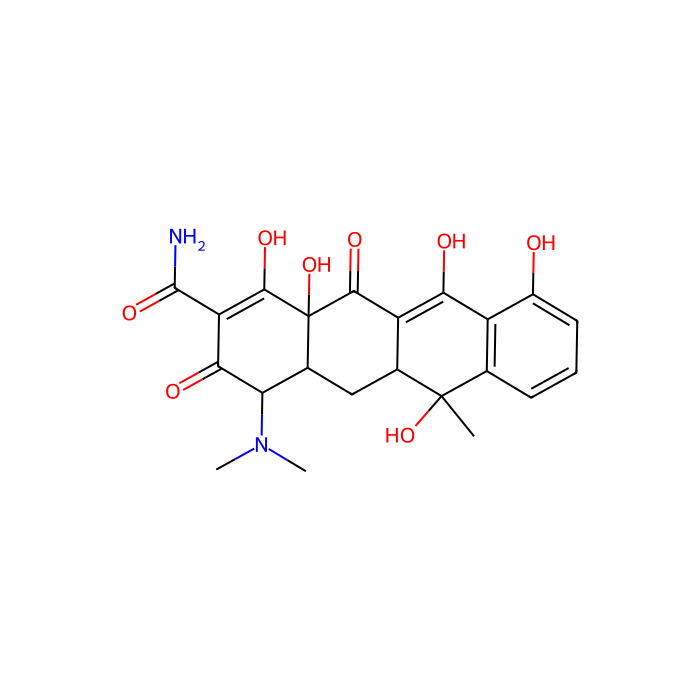
 I2621268
Determine the necessary mass, volume, or concentration for preparing a solution.
Tetracycline - Moligand™, 10mM in DMSO , CAS No.60-54-8
AVAILABLE TO ORDER
GRADE & PURITY Moligand™ ? Moligand™ — Aladdin's line of ligands and bioactive small molecules. Use for receptor, pathway, and binding studies needing defined small-molecule tools. 10mM in DMSO
Synonyms
Piracaps (base)|Sumycin (TN)|Tetracycl|(1S,2R)-(+)-Phenylpropanolamine|Liquamycin|Cyclomycin|Democracin|Lexacycline|Vetacyclinum|Copharlan|Vetquamycin-324 (free base)|2-Naphthacenecarboxamide, 4-(dimethylamino)-1,4,4a,5,5a,6,11,12a-octahydro-3,6,10,12,12a-pentahydroxy-6-methyl-1,11-dioxo-|Brodspec|Limecycline|TETRACYCLINE [HSDB]|TETRACYCLINE [WHO-DD]|(4S,4aS,5aS,12aS)-4-(Dimethylamino)-1,4,4a,5,5a,6,11,12a-octahydro-3,6,10,12,12a-pentahydroxy-6-methyl-1,11-dioxo-2-naphthacenecarboxamide|Tetrazyklin|Veracin|TETRACYCLINE [INN]|Tetracycline I|Tetrabon|Tetraciclina|TETRACYCLINE [VANDF]|Abricycline|Ala-Tet|Hostacyclin|TETRACYCLINE [JAN]|Omegamycin|Amycin|Economycin|Tetracycline HCl|Criseociclina|Serine, 2-(2,3,4-trihydroxybenzyl)hydrazide, monohydrochloride, DL-|Tetradecin|Cyclopar|(4S,4aS,5aS,6S,12aR)-4-(dimethylamino)-1,6,10,11,12a-pentahydroxy-6-methyl-3,12-dioxo-4,4a,5,5a-tetrahydrotetracene-2-carboxamide|Achromycin (naphthacene derivative)|Liquamycin (Veterinary)|Panmycin|Tsiklomitsin|Tetracyclinum|2-Naphthacenecarboxamide, 4-(dimethylamino)-1,4,4a,5,5a,6,11,12a-octahydro-3,6,10,12,12a-pentahydroxy-6-methyl-1,11-dioxo-, (4S-(4alpha,4aalpha,5aalpha,6beta,12aalpha))-|Sumycin|Tetracycline (internal use)|TETRACYCLINE [MART.]|Tetracycline base|2-Naphthacenecarboxamide, 4-(dimethylamino)-1,4,4a,5,5a,6,11,12a-octahydro-3,6,10,12,12a-pentahydroxy-6-methyl-1,11-dioxo-, (4S,4aS,5aS,6S,12aS)-|Orlycycline|Tetraciclina [INN-Spanish]|Centet (base)|Eldeprine|Ambramycin|SELEGILINE [USAN]|Ambramicina|TETRACYCLINE [MI]|tetracycline|Tetracyn|SK-Tetracycline|Tetraverine|Ciclibion|Achromycin V|Deschlorobiomycin|(4S,4aS,5aS,6S,12aS)-4-(dimethylamino)-3,6,10,12,12a-pentahydroxy-6-methyl-1,11-dioxo-1,4,4a,5,5a,6,11,12a-octahydrotetracene-2-carboxamide|Achromycin|Vetquamycin|Supramycin|Tetracyclinum [INN-Latin]|Tetra-Co|Tetracycline II|6-Methyl-1,11-dioxy-2-naphthacenecarboxamide|Tsiklomistsin|Biocycline|Tetracyclin|Tetracycline [USP:INN:BAN:JAN]|Bio-tetra|Micycline|Agromicina|Cefracycline|Cefracycline suspension|Roviciclina|Solvocin|Tetracyclinehydrate|Mericycline|S-(+)-N-METHYL-N-(.ALPHA.-METHYLPHENETHYL)FURFURYLAMINE|Tetrabid Organon
Storage
Store at -80°C
Shipped In
Dry ice packs + Cold packs