This compound belongs to the class of organic compounds known as anisoles. These are organic compounds containing a methoxybenzene or a derivative thereof.
External Descriptors
Not available
1. Djoumbou Feunang Y, Eisner R, Knox C, Chepelev L, Hastings J, Owen G, Fahy E, Steinbeck C, Subramanian S, Bolton E, Greiner R, and Wishart DS. ClassyFire: Automated Chemical Classification With A Comprehensive, Computable Taxonomy. Journal of Cheminformatics, 2016, 8:61.
Determine the necessary mass, volume, or concentration for preparing a solution.
Dilution Calculator
Determine the dilution needed to prepare a stock solution.
Reconstitution Calculator
Recensioni
Recensioni dei clienti
Application Protocols
No assay protocols (e.g., WB, IHC, IF, FC) are applicable to this small-molecule reagent. For practical use, see Reaction Conditions and Synthetic Utility sections for step-by-step guidance on common transformations.
Biological Roles
This compound is a synthetic organic building block and is not a biological metabolite or buffer component.
General notes (literature; not item-specific)
Aryl ethers with bromoethyl termini have no established endogenous roles in biochemistry.
In research settings, such electrophiles are sometimes used to tether the 2-(4-methoxyphenoxy)ethyl group onto nucleophilic biomolecule mimics or polymer backbones; however, such uses are purely in vitro/chemical and not biological functions.
No medical or clinical claims are made; for research use only.
Buffer Applications
Not typically applicable. 1-(2-Bromoethoxy)-4-methoxybenzene is a non-ionic organic building block and is not used to prepare aqueous buffer systems. For laboratory use, refer instead to sections on Reaction & Applications and Solvent Selection.
Green Alternatives
While 1-(2-Bromoethoxy)-4-methoxybenzene itself is a substrate, greener choices primarily concern solvent and halide selection.
Greener solvent choices (general; not item-specific)
Replace DMF/DMSO/NMP with MeCN, 2-MeTHF, CPME, or propylene carbonate where compatible.
Use ethyl acetate or 2-MeTHF in phase-transfer catalysis (PTC) systems to reduce chlorinated solvent usage.
Halide/reactivity strategy
Iodide (via in situ Finkelstein with NaI) can improve kinetics, enabling lower temperatures and shorter times—reducing energy and decomposition.
Phase-transfer or micellar catalysis (e.g., surfactant media) can enable aqueous/benign conditions for SN2 steps.
Comparison snapshot (general)
DMF vs MeCN: DMF offers higher SN2 rates but is a reproductive toxin and hard to remove; MeCN is less hazardous and easier to recycle, with slightly lower rates.
DCM vs 2-MeTHF/EtOAc: DCM provides excellent solubility and ease of workup but is chlorinated; 2-MeTHF/EtOAc are bio-based/biodegradable options with good performance in many substitutions.
Waste minimization
Use stoichiometric balance to limit excess nucleophile; recover iodide salts if used; apply silica-free workups (liquid–liquid or SPE) to lower solid waste.
Pharmaceutical Uses
Formulation/excipient role: None typical. This compound is not used as an excipient.
Research/manufacturing context (general; not item-specific)
May serve as a synthetic intermediate to install a 2-(4-methoxyphenoxy)ethyl moiety in small-molecule discovery or in process chemistry sequences.
The primary alkyl bromide enables late-stage functionalization via SN2, allowing rapid generation of analog libraries.
No therapeutic or clinical claims are implied; research use only.
Physical Properties
Item-specific specifications
Appearance: Not specified for this item; refer to CoA/Spec Sheet.
Molecular formula: Not specified for this item; refer to CoA/Spec Sheet.
Molecular weight: Not specified for this item; refer to CoA/Spec Sheet.
Other specs (bp, mp, density, refractive index, water/peroxide/metals/UV): Not specified for this item; refer to CoA/Spec Sheet.
Literature/general properties (for reference; not item-specific)
Physical state: typically a colorless to pale yellow liquid (literature, primary alkyl bromide ether).
Solubility: expected to be miscible with common aprotic organics (DCM, THF, EtOAc, acetone) and poorly soluble in water (literature trends for aryl ethers bearing C2–Br).
Volatility: moderate; primary alkyl bromides often distill under reduced pressure.
Polarity/logP: moderately lipophilic due to aryl ether and bromoalkyl chain; polarizable bromine increases refractivity (qualitative, literature).
Note: For authoritative, lot-specific values (bp, density, refractive index, purity), consult the product’s CoA/Spec Sheet.
Quality and Grades
Item-specific grade/purity: Not specified for this item; refer to CoA/Spec Sheet.
Interpreting grades (general guidance for this compound class)
Research grade: suitable for synthetic and analytical work; actual impurity profile (e.g., residual anisole, hydroxyethyl ether, dibromoethane) should be checked if critical to your application.
Low-UV/HPLC grade (if offered): indicates minimized UV-absorbing impurities and particulates—useful when employing UV detection in chromatography.
Stabilizers: not typically required for aryl ethers; if a stabilizer is present, verify compatibility with intended reactions (may affect base- or acid-sensitive transformations).
Documentation and lot control
Request CoA for assay, GC purity, residual solvents, and moisture. For nucleophilic substitution chemistry, residual water can impact outcomes; Karl Fischer values are informative.
If using in medicinal chemistry or materials workflows, consider in-house QC (GC/GC–MS; 1H/13C NMR; FTIR) to confirm identity and assess bromo integrity (look for elimination byproducts).
Reaction and Applications
Role: versatile primary alkyl electrophile (–CH2CH2–Br) tethered to a para-methoxyphenoxy group. The bromo terminus undergoes SN2 reactions to introduce the 2-(4-methoxyphenoxy)ethyl fragment.
Representative transformations (literature/general; not item-specific)
O-alkylation: Williamson ether synthesis with RO– to form R–O–CH2CH2–O–Ar(OMe-p).
N-alkylation: amines (primary/secondary) to give 2-(4-methoxyphenoxy)ethylated amines; tertiary amines furnish quaternary ammonium salts.
S-alkylation: thiolates afford thioethers efficiently, often at room temperature.
Halide exchange: Finkelstein (NaI in acetone/MeCN) to generate the iodo analogue for increased reactivity.
Azide displacement: NaN3 → azide, followed by reduction to the amine (useful in click/derivatization sequences).
Practical tips
Favor SN2: use dry, polar aprotic solvents and modest temperatures (20–60°C); avoid strong bases that may induce elimination to vinyl ether byproducts or hydrolysis to the alcohol.
Monitor reaction: TLC/GC; watch for anisole-derived impurities and unreacted starting material.
Workup: quench with aqueous NH4Cl or similar; thoroughly remove polar solvents (DMF/DMSO) before chromatography.
Use cases
Installation of a para-methoxyphenoxyethyl spacer in medicinal chemistry scaffolds, linkers for materials, or surface modifiers (research use only).
Reaction Conditions
General guidance (literature-informed; not item-specific). Optimize per substrate and scale.
O-/N-/S-alkylation (SN2)
Solvents: MeCN, acetone, THF, DMF, DMSO.
Bases: K2CO3, Cs2CO3 (for alcohols/phenols); DIPEA/Et3N for amines when deprotonation is unnecessary; NaH for challenging alcohols (low temperature, dry conditions).
Temperatures: 20–60°C commonly; reflux in MeCN/acetone if sluggish.
Catalysis: Phase-transfer (TBAB, TBAHS) enables reactions in biphasic toluene/aqueous K2CO3 or in greener solvents.
Typical times: 2–24 h depending on nucleophile strength and temperature.
Halide exchange (Finkelstein)
Conditions: NaI (3–5 equiv) in dry acetone or MeCN; 20–50°C; monitor displacement of Br− (NaBr precipitate in acetone).
Azide installation and reduction
NaN3 (1.2–2.0 equiv) in DMF/MeCN at 25–60°C; reduction to amine via catalytic hydrogenation (Pd/C, H2) or Staudinger (PPh3, H2O) under mild conditions.
Workup and purification
Quench/base neutralization with saturated NH4Cl or NaHCO3; extract with EtOAc/DCM; dry (Na2SO4/MgSO4); concentrate and purify by silica gel chromatography (hexanes/EtOAc gradients).
Note: Primary alkyl bromides are moisture- and base-sensitive; rigorously dry solvents and glassware improve outcomes.
Safety and Handling
Item-specific hazard data
Signal word: Not specified for this item; refer to SDS.
H-statements: Not specified for this item; refer to SDS.
GHS classification: Not specified for this item; refer to SDS.
Pictograms: Not specified for this item; refer to SDS.
General safety considerations (literature/analogous compounds; not item-specific)
Primary alkyl bromides are typically irritants and can be harmful if inhaled, swallowed, or upon skin contact. They can act as alkylating agents and may cause serious eye irritation.
Avoid moisture and strong bases unless intended for reaction—hydrolysis to 2-hydroxyethyl ether and release of HBr can occur.
Incompatibilities: strong nucleophiles/bases (uncontrolled reaction), strong oxidizers, powdered metals. Avoid prolonged contact with amines unless quaternization is desired.
Ethers can form peroxides upon prolonged air/oxygen exposure, though aryl ethers are generally less prone than dialkyl ethers; periodic peroxide testing is prudent for long-opened bottles of etheric materials.
PPE and handling
Use chemical-resistant gloves (e.g., nitrile), lab coat, and splash goggles; handle in a fume hood.
Prevent inhalation of vapors/aerosols; keep containers tightly closed.
First aid (summary; defer to SDS)
Skin/eye contact: immediate decontamination with copious water for ≥15 min; remove contaminated clothing; seek medical attention.
Inhalation: move to fresh air; monitor breathing; seek medical attention.
Ingestion: rinse mouth; do not induce vomiting; seek medical attention promptly.
Always consult the product SDS for authoritative hazard, exposure limits, and response guidance.
Solvent Selection
This material is a moderately lipophilic aryl ether bearing a primary bromoalkyl chain; it is generally handled as a neat liquid or dissolved in common organic solvents.
Polarity/miscibility (literature trends; not item-specific)
Poorly soluble: water; saturated hydrocarbons (e.g., hexanes) may dissolve it moderately due to the aromatic core but can be suboptimal for homogeneous reactions.
Choosing solvents by task
Nucleophilic substitution (SN2) at the bromo terminus: polar aprotic solvents (DMF, DMSO, MeCN, NMP) typically enhance rates with anionic nucleophiles.
Base-sensitive contexts: use less basic media (DCM, EtOAc, toluene) and neutral nucleophiles (e.g., thiols with weak base) to minimize elimination.
Workup/extraction: DCM or EtOAc often provide efficient phase separation and recovery; brine washes help break emulsions.
MeCN/acetone: good balance between rate and ease of removal.
DCM/toluene: good for neutral or phase-transfer conditions; slower SN2 without PTC.
Validate solvent choice against your nucleophile/basicity and desired selectivity.
Storage and Reconstitution
Item-specific storage and shipping
Storage: Store at 2–8°C (from Product Data). Keep container tightly closed under inert headspace if possible to limit moisture ingress.
Shipped in: Wet ice (from Product Data).
Handling/reconstitution (general guidance; not item-specific)
Typically supplied neat. If solidification/crystallization occurs at low temperature, gently warm to ambient and mix thoroughly before use.
For solution preparation, use dry, oxygen-free solvents (e.g., anhydrous MeCN, THF, DCM) in a dry flask; consider adding molecular sieves for moisture-sensitive SN2 reactions.
Avoid prolonged exposure to strong bases or nucleophiles unless reacting intentionally.
Stability
Primary alkyl bromides can slowly hydrolyze in moist air; minimize headspace humidity and recap promptly. Store away from strong light and heat.
Always consult the product’s CoA/SDS for definitive storage limits, stability, and compatibility.
Structure and Identity
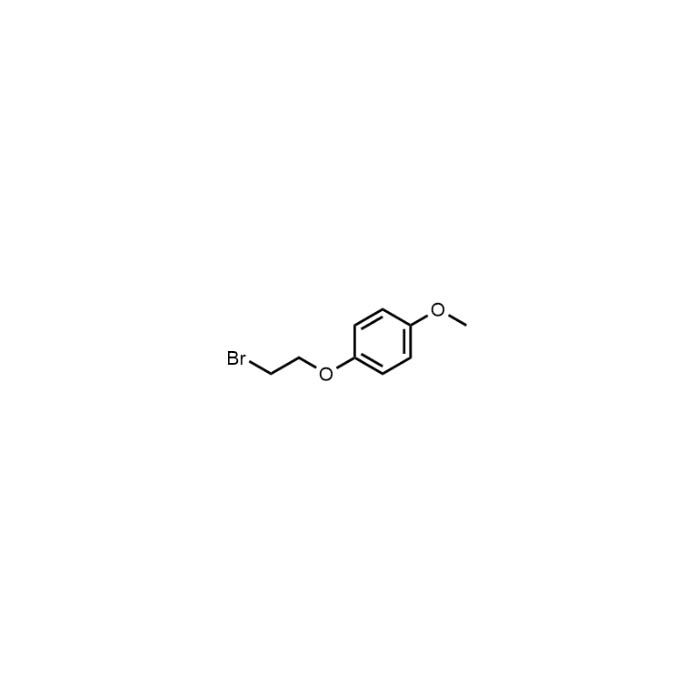
Brief description: 1-(2-Bromoethoxy)-4-methoxybenzene is a para-anisyl 2-bromoethyl ether. It features a primary bromoalkyl chain tethered to a methoxy-substituted phenyl via an ether linkage, making it a useful benzylic-ether electrophile for SN2 chemistry.
Item-specific identifiers (from Product Data)
CAS: 22921-76-2
CID: 579814
InChIKey: Not specified for this item; refer to CoA/Spec Sheet.
SMILES: Not specified for this item; refer to CoA/Spec Sheet.
Literature identity (for reference; not item-specific)
Aromatic ring: monosubstituted anisole core bearing two para-related substituents.
Functional groups: one aryl–O–CH2CH2–Br chain (primary alkyl bromide) and one aryl–O–CH3 (methoxy) group.
Stereochemistry: none (achiral, no stereocenters).
2D arrangement (verbal): a benzene ring with para methoxy (–OCH3) and para 2-bromoethoxy (–O–CH2–CH2–Br) substituents relative to each other.
Synthetic Utility
Functional group logic
Electrophile: primary bromo (–CH2CH2Br) suitable for SN2 with heteroatom and soft carbon nucleophiles.
Aryl ether: para-methoxyphenoxy group is stable under many conditions; can tune lipophilicity and electronics of target molecules.
Retrosynthetic value (general)
Serves as a convergent handle to append the 2-(4-methoxyphenoxy)ethyl fragment onto nucleophilic cores (amines, alcohols, thiols, enolates), streamlining SAR or material linker installation.
Named/typical methods utilized with this electrophile
Williamson etherification (O-alkylation of phenols/alcohols).
Finkelstein halide exchange (–Br → –I) to enhance reactivity when needed.
Azide substitution followed by Staudinger/hydrogenation to access amines.
Compatibility notes
Stable toward many neutral conditions; avoid strong nucleophiles at elevated temperature if elimination or cleavage is a concern.
The anisyl ether typically withstands mild acids/bases; harsh Lewis acids or strong bases can induce cleavage or rearrangement.
Target Specificity
Not applicable. This product is a small-molecule reagent and not a biological targeting agent (no antigen/epitope/clone/isotype). No item-specific data provided.
We use cookies to ensure the website functions properly and, where permitted, to improve your experience. You can manage your preferences at any time in Settings. Learn more in our Cookie Policy.
Shall we send you a message when we have discounts available?
Remind me later
Thank you! Please check your email inbox to confirm.
Products are supplied to verified businesses, institutions, and qualified professionals for research and development use only. Not for use in humans, animals, diagnosis, or therapy.

 H2628414