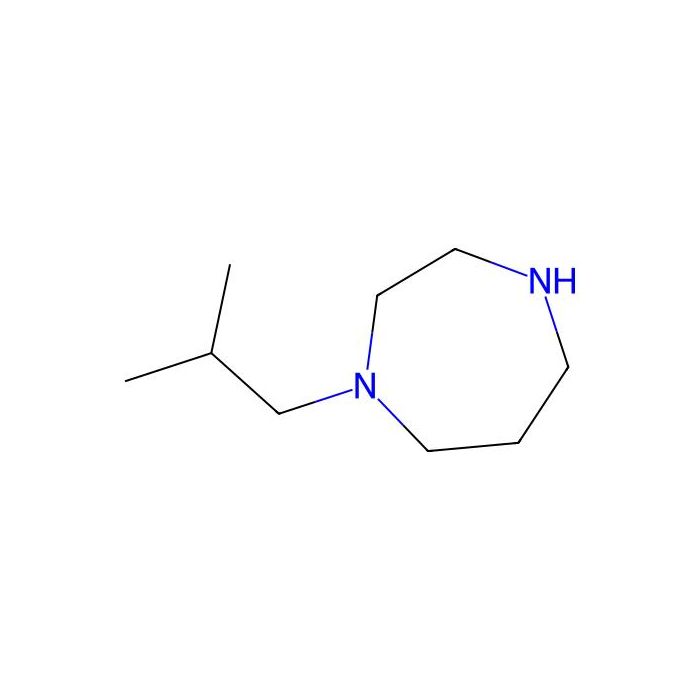
This compound belongs to the class of organic compounds known as 1,4-diazepanes. These are diazepanes having the two nitrogen atoms at position 1 and 4 of the diazepane ring.
External Descriptors
Not available
1. Djoumbou Feunang Y, Eisner R, Knox C, Chepelev L, Hastings J, Owen G, Fahy E, Steinbeck C, Subramanian S, Bolton E, Greiner R, and Wishart DS. ClassyFire: Automated Chemical Classification With A Comprehensive, Computable Taxonomy. Journal of Cheminformatics, 2016, 8:61.
Certificati (CoA, COO, BSE/TSE e tabella di analisi)
C of A & Other Certificates(BSE/TSE, COO):
Analytical Chart:
Proprietà chimiche e fisiche
Peso molecolare
156.270 g/mol
XLogP3
0.900
Hydrogen Bond Donor Count
1
Hydrogen Bond Acceptor Count
2
Rotatable Bond Count
2
Exact Mass
156.163 Da
Monoisotopic Mass
156.163 Da
Topological Polar Surface Area
15.300 Ų
Heavy Atom Count
11
Formal Charge
0
Complexity
102.000
Isotope Atom Count
0
Defined Atom Stereocenter Count
0
Undefined Atom Stereocenter Count
0
Defined Bond Stereocenter Count
0
Undefined Bond Stereocenter Count
0
The total count of all stereochemical bonds
0
Covalently-Bonded Unit Count
1
Calcolatori di soluzioni
Molarity Calculator
Determine the necessary mass, volume, or concentration for preparing a solution.
Dilution Calculator
Determine the dilution needed to prepare a stock solution.
Reconstitution Calculator
Recensioni
Recensioni dei clienti
Application Protocols
No application assays (e.g., WB, IHC, IF, FC) apply to this small-molecule reagent. For synthetic applications, refer to the Reaction & Applications and Reaction Conditions sections for practical guidance. If using in screening or materials contexts, develop protocol parameters (concentrations, pH, temperature) empirically and document in your lab notebook/SOPs.
Biological Roles
This compound is a synthetic aliphatic diamine; it is not a known endogenous metabolite. The following comments are general and literature-based for diamines and tertiary/secondary amines, not specific to any biological use of this exact compound:
Protonation state: At physiological pH, aliphatic diamines are predominantly protonated (mono- or dicationic), which strongly influences membrane interactions and aqueous solubility.
Noncovalent interactions: As polybasic ligands, diamines can bind to negatively charged biomolecules (e.g., nucleic acids, acidic proteins) via electrostatic interactions in vitro.
Enzymatic relevance: Unlike primary polyamines (putrescine, spermidine), N-alkylated diazepanes are not typical substrates for mammalian polyamine pathways and are generally considered xenobiotic.
Metal binding: Diamines can chelate metal ions; such interactions are exploited in analytical/coordination chemistry more than in biochemistry.
Research-only note: Any handling in biological systems should be limited to in vitro assays in a research setting. No claims are made regarding physiological activity, toxicity thresholds, ADME, or therapeutic relevance for this product. For biocompatibility or cytotoxicity data, consult primary literature or generate de novo under institutional approvals.
Buffer Applications
Not typically used as a buffer component. The conjugate-acid pKa values of aliphatic secondary/tertiary amines fall outside most common biological buffer ranges and offer limited buffering capacity near neutral pH. If a diamine buffer is specifically desired for specialized pH regimes, dedicated amine buffers (e.g., Tris, Bicine, PIPES) are preferred.
Practical guidance (general):
For extractions: The protonated salts of this amine can be used to modulate phase behavior, but that is a separation tactic rather than true buffering.
For synthetic workups: Adjust aqueous phases with mineral acids (e.g., HCl) to form the amine hydrochloride for easier handling; regenerate the free base with NaOH during basification. Do not rely on this compound to stabilize pH in biochemical assays.
Green Alternatives
This item is a nitrogenous building block rather than a bulk solvent. Green-chemistry considerations focus on solvent/media choice and alternative diamine scaffolds when functionally acceptable.
Greener media for reactions involving this amine (general guidance):
Replace DCM with 2-MeTHF, CPME, or EtOAc for acylations where feasible.
Use MeOH/EtOH or water/EtOH mixtures for reductive aminations and salt workups.
Favor MeCN or EtOAc over DMF/DMSO when reaction scope allows, to ease workup and reduce persistence.
Alternative diamines (when structural flexibility exists):
Piperazine (six-membered ring) and its N-alkyl derivatives have extensive precedent and may be available in greener supply chains.
Bio-based solvents/additives (e.g., Cyrene, 2-MeTHF) can sometimes replace chlorinated/polar aprotic media during transformations of this amine.
Comparison snapshot (general, representative):
DCM vs 2-MeTHF: 2-MeTHF is bio-derived, higher boiling, and less volatile; may slow some acylations but simplifies EHS profile.
DMF vs MeCN: MeCN offers easier removal and lower chronic toxicity concerns; dielectric constant remains high enough for many SN2 processes.
Trade-offs: Greener solvents can alter rates/selectivity and require temperature or catalyst adjustments. Conduct small-scale trials to validate equivalency.
Pharmaceutical Uses
No pharmacopeial or excipient status is provided for this item. It is sold for research use only.
General process-chemistry context (non-clinical, non-therapeutic):
Intermediate/building block: The diamine can be transformed into amide/urea/sulfonamide motifs relevant to medicinal chemistry SAR exploration.
Auxiliary/base: Tertiary amine functionality allows use as a base or acid scavenger in small-scale process steps, though common alternatives (e.g., DIPEA, TEA) are more typical.
Salt studies: Formation of crystalline salts with pharmaceutical acids (e.g., HCl, fumaric, maleic) can aid in solid-state screening of amine-containing APIs; here, the compound would be part of a counterion/toolbox exploration in discovery.
Compliance note: No medical, diagnostic, or therapeutic applications are implied. For any work in a regulated context, specification, impurity profile, and residual solvent control must be established via appropriate qualification and CoA review.
Physical Properties
Item-specific specifications (this catalog item):
Appearance: Not specified for this item; refer to CoA/Spec Sheet.
Grade/Purity: Not specified for this item; refer to CoA/Spec Sheet.
Molecular Formula: Not specified for this item; refer to CoA/Spec Sheet. (Computed/literature for the named structure: C9H20N2.)
Molecular Weight: Not specified for this item; refer to CoA/Spec Sheet. (Computed/literature for the named structure: ~156.27 g/mol.)
General/literature expectations for aliphatic 1,4-diazepane derivatives (informational only; not item specs):
Physical state: Typically low-viscosity liquids or low-melting solids; hygroscopic tendencies are possible for diamines.
Basicity: Two basic centers; conjugate-acid pKa values for analogous aliphatic secondary/tertiary amines are commonly in the ~9–11 range (strong organic bases); exact values for this specific derivative should be determined experimentally.
Solubility: Free bases are usually miscible with many polar organics (alcohols, ethers, chlorinated solvents) and display moderate water solubility; protonated salts are readily water-soluble.
Volatility: Boiling points for comparable C9 aliphatic diamines are typically in the mid-to-high 100s °C at ambient pressure; distillation under reduced pressure is commonly employed for purification.
Partitioning: LogP/logD values for related N-alkyl diamines are modest (amphiphilic), strongly pH-dependent due to protonation.
Refractive index/density: Often near those of other aliphatic amines (nD ~1.43–1.47; ρ ~0.8–0.9 g/mL), but exact values should be measured for this compound.
Always verify with the product’s CoA/SDS for definitive physical data.
Quality and Grades
Item-specific grade/purity information: Not specified for this item; refer to CoA/Spec Sheet.
Guidance for interpreting grades for amine building blocks (general):
Research/technical grade: Suitable for routine synthetic transformations; trace water and low-level volatile impurities may be present. Drying or distillation before moisture‑sensitive use is good practice.
High-purity/assay-specified grade: Tighter control of assay (e.g., ≥98–99%), GC area %, and residual solvents. Enables quantitative transformations, salt formation studies, and analytical reference work.
Chromatography/HPLC grade (if offered): Focuses on low UV background and minimal nonvolatile residue; usually not relevant for amines unless used as mobile-phase additives.
Stabilizers/inhibitors: Not typically required for saturated aliphatic amines; if any stabilizer is listed on a specific lot, understand its implications for downstream reactions and remove if necessary (e.g., by vacuum or acid/base wash).
Quality control practices (recommended):
Identity by 1H/13C NMR and MS; purity by GC-FID/GC–MS. Water by KF. Residual solvents per ICH Q3C when used in process development. Assay normalization via acidimetric titration can be useful for basic amines.
For exact assay, byproduct profile, and water content, consult the lot-specific CoA.
Reaction and Applications
As an N-alkylated 1,4-diazepane, this reagent provides two basic/nucleophilic sites with differentiated reactivity (tertiary vs. secondary amine). Typical research uses include:
Nucleophilic acyl substitution: Formation of ureas, amides, carbamates, and sulfonamides at the secondary nitrogen using acid chlorides, anhydrides, chloroformates, or sulfonyl chlorides. Tertiary nitrogen can serve as a base/acid scavenger.
Alkylation and quaternization: Selective alkylation of the secondary amine to give tertiary amines; exhaustive alkylation of both nitrogens affords mono- or bis-quaternary ammonium salts (phase-transfer or ionic-liquid precursors).
Reductive amination: Condensation of the secondary amine with aldehydes/ketones followed by reduction (NaBH3CN, BH3·THF, H2/Pd) to furnish further N-alkylated diazepane derivatives.
Metal binding/ligand roles: The diazepane framework can chelate transition metals (e.g., Cu, Ni, Pd) in exploratory catalysis or materials chemistry; substitution pattern tunes donor properties vs. piperazine analogs.
Base/catalyst: Acts as a non-nucleophilic base in some contexts, or as an organocatalyst/nucleophilic catalyst for acyl transfer when sterics permit.
Salt formation and materials: Protonated salts (e.g., dihydrochlorides) can be isolated for crystallographic studies or used as ionic building blocks.
Practical tips (general): Protect from CO2 when precise base equivalents are required. For selective monoacylation, control stoichiometry and temperature; for bis-functionalization exploit the differing basicities/sterics of the two nitrogens.
Reaction Conditions
The following are general literature-style conditions for transformations of secondary/tertiary aliphatic diamines. They are guidance only and not specifications for this catalog item:
Acylation (secondary N):
Reagents: Acyl chloride (1.0–1.2 equiv), base (2.0–3.0 equiv, DIPEA/NEt3)
Solvent: DCM or THF (0.1–0.5 M)
Temperature/time: 0 °C to rt, 1–4 h
Notes: Add acyl chloride slowly; monitor by TLC/LC–MS; quench with aqueous bicarbonate; isolate as free base or salt.
Notes: Maintain mildly acidic pH during reduction; alternative reductants: BH3·THF or H2/Pd.
N-Alkylation/quaternization:
Electrophile: Alkyl halide or sulfonate (1.2–3.0 equiv)
Base: K2CO3 or NaH (for stronger activation) in MeCN/DMF/acetone
Temperature/time: rt to 60 °C, 2–24 h
Notes: Control over-methylation; for bis-quaternization, use excess electrophile and polar aprotic solvent.
Carbamate formation:
Reagent: Alkyl/aryl chloroformate (1.1–1.3 equiv), base (2–3 equiv)
Solvent: DCM, 0 °C to rt
Typical isolated yields reported for well-optimized amide/carbamate or reductive amination steps are 70–90% on small scale; actual results depend on substrate and conditions.
Safety and Handling
Item-specific hazard information (from Product Data):
Signal Word: Not specified for this item; refer to SDS.
H-Statements: Not specified for this item; refer to SDS.
GHS Classification/Pictograms: Not specified for this item; refer to SDS.
General safety considerations for aliphatic diamines/tertiary amines (literature/general guidance; consult SDS for authoritative instructions):
Hazards: Can be corrosive/irritating to skin, eyes, and respiratory tract; may be harmful if swallowed. Combustible as an organic liquid/solid. Strong amine odor possible.
PPE: Use chemical-resistant gloves (e.g., nitrile), splash goggles, lab coat. Handle in a fume hood to control vapors/odors and avoid inhalation.
Incompatibilities: Strong oxidizers; acylating and sulfonylating agents (vigorous reactions); epoxides and alkyl halides (uncontrolled alkylation); carbon dioxide and mineral acids (salt formation). Avoid copper/bronze during storage of free bases due to potential complexation/tarnish.
Handling: Keep containers tightly closed to minimize uptake of CO2/moisture. Purge headspace with inert gas after use when feasible. Use dry techniques if employing as a base/nucleophile in moisture-sensitive syntheses.
First aid (overview): Eye/skin contact—immediate irrigation with water for 15+ minutes; remove contaminated clothing. Inhalation—move to fresh air; support respiration if needed. Ingestion—do not induce vomiting; rinse mouth; seek medical attention. Always follow site SOPs and consult the SDS.
Fire: Use CO2, dry chemical, or alcohol-resistant foam. Thermal decomposition may release nitrogen oxides.
Solvent Selection
This product is a diamine building block/base, not a process solvent. Solvent selection guidance here addresses media for its use in synthesis and handling.
Polarity and miscibility (general):
Free-base diamines typically dissolve well in polar organics (MeOH, EtOH, iPrOH, MeCN, acetone, THF, DCM) and to a moderate extent in water, with solubility strongly increasing upon protonation (e.g., as HCl salt).
Partitioning is pH-dependent; in basic media the neutral form is more organic-soluble, in acidic media the salt partitions to aqueous phase.
Choosing media by transformation:
Acylation/sulfonylation/carbamoylation: DCM, THF, or MeCN with a non-nucleophilic base; temperature control recommended.
THF/2-MeTHF: Broad solubility; compatible with bases; consider 2-MeTHF for greener profile.
Alcohols: Useful for salt handling and reductive aminations but can compete in acylations.
Storage and Reconstitution
Item-specific storage/shipping:
Storage Conditions: Room temperature (per Product Data).
Shipped In: Not specified for this item; refer to CoA/Spec Sheet.
General handling guidance for aliphatic diamines:
Container: Store in tightly sealed, chemically compatible containers (amine-grade caps/liners). Minimize headspace exposure to CO2 and moisture; consider inert gas backfill after use.
Stability: Free bases can slowly absorb CO2 to form ammonium carbamates; if precise base strength is critical, standardize prior to use (e.g., titration) or convert to a defined acid salt for storage.
Light/air: No special light sensitivity expected; ambient air storage is acceptable if well sealed. Avoid prolonged heat.
Reconstitution: If supplied as a salt or viscous oil, dissolve in suitable anhydrous solvent (e.g., MeOH, EtOH, MeCN, THF) at desired concentration. Filter through PTFE syringe filters if particulates are present.
Freeze-thaw: Generally unnecessary for liquids; for crystalline salts, avoid repeated dissolution/evaporation cycles that can alter hydration state.
Always consult the SDS and lot-specific CoA for any additional storage or stability notes.
Research Use Only: For research use only (per Product Data).
Structure and Identity
Professional overview of an N-alkylated 1,4-diazepane (seven-membered diamine ring) bearing an isobutyl substituent on N1.
2D description in words (general): A seven-atom ring alternating CH2 segments with two nitrogens at positions 1 and 4; the N at position 1 carries a branched four-carbon substituent (–CH2–CH(CH3)2).
Synthetic Utility
Functional-group profile and opportunities:
Nucleophilicity/basicity: Secondary amine (N4) is a strong nucleophile for acylation, sulfonylation, and reductive amination. The tertiary amine (N1) offers basicity and can be quaternized; it is less nucleophilic toward acyl transfer.
Bifunctional platform: Orthogonal reactivity enables stepwise derivatization—e.g., protect or acylate the secondary amine, then quaternize the tertiary amine, or vice versa.
Ring contribution: The 1,4-diazepane ring imparts conformational flexibility and spacing distinct from piperazine; useful in tuning basicity and spatial orientation in ligands or pharmacophores.
Mono- vs. bis-acylation controlled by stoichiometry/temperature and choice of base (e.g., NEt3, DIPEA) in DCM/THF.
Reductive amination with aldehydes/ketones using NaBH3CN or BH3·THF; catalytic hydrogenation (H2/Pd) following imine formation.
Quaternization with MeI/EtOTf/benzyl halides in MeCN or acetone; bis-quaternary salts accessible under forcing conditions.
Carbamate formation with alkyl/aryl chloroformates to introduce protecting or leaving groups.
Metal complexation to generate chelates for catalysis/materials; assess donor strength vs. steric hindrance from the isobutyl on N1.
Workup/purification tips: Convert to an acid salt (e.g., HCl) for crystallization and to suppress streaking in silica chromatography; regenerate free base with NaOH and extract into organic solvent.
Target Specificity
Not applicable. This product is a small-molecule diamine, not a biological macromolecule or affinity reagent. No antigen/epitope/clone/isotype information is relevant.
We use cookies to ensure the website functions properly and, where permitted, to improve your experience. You can manage your preferences at any time in Settings. Learn more in our Cookie Policy.
Shall we send you a message when we have discounts available?
Remind me later
Thank you! Please check your email inbox to confirm.
Products are supplied to verified businesses, institutions, and qualified professionals for research and development use only. Not for use in humans, animals, diagnosis, or therapy.