This compound belongs to the class of organic compounds known as phenol ethers. These are aromatic compounds containing an ether group substituted with a benzene ring.
External Descriptors
Not available
1. Djoumbou Feunang Y, Eisner R, Knox C, Chepelev L, Hastings J, Owen G, Fahy E, Steinbeck C, Subramanian S, Bolton E, Greiner R, and Wishart DS. ClassyFire: Automated Chemical Classification With A Comprehensive, Computable Taxonomy. Journal of Cheminformatics, 2016, 8:61.
Determine the necessary mass, volume, or concentration for preparing a solution.
Dilution Calculator
Determine the dilution needed to prepare a stock solution.
Reconstitution Calculator
Recensioni
Recensioni dei clienti
Application Protocols
Not applicable. No antibody or bioassay protocols are associated with this small-molecule reagent. For practical use, see the Reaction Conditions and Reaction & Applications sections for synthetic protocols and handling guidance.
Biological Roles
This compound is a synthetic protecting-group derivative of resorcinol and has no inherent biological role.
General context (informational)
MOM ethers are widely used in synthetic organic chemistry to mask alcohol/phenol functionality. They are not natural metabolites and are not designed for biological activity.
Upon acid-catalyzed cleavage, methanol and formaldehyde equivalents can be formed; both are biologically active/toxic at sufficient exposure, underscoring the need for proper handling and disposal.
No specific biological pathways, targets, or cellular roles are associated with 1,3-bis(methoxymethoxy)benzene; it is intended strictly for research and synthetic applications.
Buffer Applications
Not typically applicable. 1,3-Bis(methoxymethoxy)benzene is a neutral, water-insoluble organic compound and is not used to prepare aqueous buffers. For laboratory use, focus on the Synthetic Utility, Reaction & Applications, and Reaction Conditions sections.
Green Alternatives
Greener choices can be considered at two levels: (1) protecting-group strategy and (2) solvent/process selection.
Protecting-group strategy (general comparison)
MOM (this product): Installed with MOM chloride or equivalents; deprotected under mild acid. Pros: high stability to base/oxidants, orthogonal to many conditions. Cons: Potential use of chloromethylating reagents; generates methanol/formaldehyde on cleavage.
TBS/TBDMS ethers: Installed with silyl chlorides; cleaved by fluoride or acid. Pros: No formaldehyde; often more hydrolytically robust. Cons: Fluoride waste; moisture-sensitive reagents; sometimes poorer stability to strong base.
Benzyl (Bn) ethers: Installed via benzyl halides or carbonate routes; removed by hydrogenolysis. Pros: Avoids acid cleavage; catalysis under H2 can be green. Cons: Requires precious metal and H2; sensitive substrates may reduce.
Solvent and reagent choices (greener options)
Use 2-MeTHF or CPME instead of DCM/THF where feasible (renewable origins, better safety). For EAS or deprotection, EtOAc or Me-THF mixtures can replace chlorinated solvents in many cases.
For MOM installation, avoid chloromethyl methyl ether (CMME; carcinogenic). Safer approaches include using MOM chloride generated in situ from dimethoxymethane with acetyl chloride or greener sulfonate leaving groups (MOM-OTf) under controlled conditions.
Minimize strong mineral acids during deprotection by employing catalytic TFA in aqueous ethanol, then neutralizing and capturing methanol in closed systems.
Balance green metrics (E-factor, energy, toxicity) against chemoselectivity and substrate sensitivity; pilot solvent swaps at small scale before adoption.
Pharmaceutical Uses
No medical or clinical claims are made for this material. It is intended for research and process development only.
Formulation/excipient context (general)
Protecting-group intermediates like 1,3-bis(methoxymethoxy)benzene are occasionally encountered in pharmaceutical chemical development as transient intermediates en route to active pharmaceutical ingredient (API) cores or advanced intermediates derived from resorcinols.
As a neutral aryl ether, it is not used as an excipient in finished dosage forms. Instead, its role is synthetic—enabling transformations that would otherwise be incompatible with free phenolic OH groups.
Regulatory considerations
Not a pharmacopeial excipient. If used in a GMP setting as a process intermediate, manage according to ICH Q7/Q11 expectations for intermediates, including impurity fate-and-purge assessments, residual reagent controls (e.g., chloride, formaldehyde/methanol from deprotection), and validated analytical methods.
Practical guidance
Ensure complete removal or controlled purge of this intermediate and its potential cleavage products during API manufacturing. Validate cleaning procedures for equipment to control carryover of aryl ethers and alcohols.
Physical Properties
Item-specific specifications
Boiling point, melting point, density, refractive index, UV cutoff, residuals/metals: Not specified for this item; refer to CoA/Spec Sheet.
Literature/general properties for the MOM diether of resorcinol (informational; not item specifications)
Physical state: Typically a colorless to pale liquid or low-melting solid for similar aryl MOM diethers; exact appearance depends on purity and temperature.
Solubility: Expected to be insoluble in water and miscible with common organic solvents (e.g., dichloromethane, THF, ethyl acetate, toluene, acetonitrile); limited solubility in hexanes compared to less polar aryl ethers due to two ether oxygens.
Polarity/logP: Moderate lipophilicity with polar ether functions; behaves as a weakly polar, aprotic organic compound.
Volatility: Lower volatility than simple anisole; still amenable to removal under reduced pressure.
The MOM groups are acid-labile; the compound is stable to weak base but can hydrolyze under acidic aqueous conditions or strong Lewis acids, liberating methanol and formaldehyde equivalents.
Avoid prolonged contact with aqueous acids or silica strongly modified with acid sites during chromatography to minimize partial deprotection.
For exact numerical specifications relevant to your lot (bp/mp, density, residual solvents, metals, water), consult the product CoA/Spec Sheet.
Quality and Grades
Item-specific details
Grade/Purity: Not specified for this item; refer to CoA/Spec Sheet.
Stabilizers: Not specified for this item; refer to CoA/Spec Sheet.
Guidance on interpreting grade (general, for planning)
Research grade aryl ethers such as MOM-protected phenols are typically supplied at high assay suitable for synthesis and method development. If low UV absorbance or trace-metal control is critical (e.g., for photochemical steps or metal-catalyzed couplings on this scaffold), request a CoA listing UV profile and ICP metals.
Chromatographic suitability: If you intend to use UV detection at short wavelengths, inquire about UV cutoff of solvent impurities and baseline absorbance. For sensitive steps, a specification for residual chlorinated solvents (if used in protection) and residual formaldehyde/methanol may be relevant.
Stabilizer implications: MOM ethers generally do not require stabilizers; however, trace acid impurities can slowly promote deprotection. Lots exhibiting long-term stability typically have low total acidity and are packaged in compatible, low-leachable containers.
Recommendations
Request and review the CoA for your lot to confirm assay, related substances profile, water content, and any residual catalysts/reagents from synthesis (e.g., chloride from MOM chloride usage).
For GMP or scale-up contexts, specify desired assay method (qNMR/GC/HPLC) and limits on hydrolytic degradants.
Reaction and Applications
1,3-Bis(methoxymethoxy)benzene is primarily used as a protected resorcinol synthon. The methoxymethyl (MOM) groups mask the two phenolic OH groups, rendering the ring electron-rich and enabling transformations incompatible with free diols.
Typical applications
Protection strategy: Install MOM groups on resorcinol to block phenolic reactivity during electrophilic aromatic substitution (EAS), oxidations, or cross-couplings at positions 2,4,6. Later, remove MOM groups under mild acid to regenerate the diol.
Electrophilic aromatic substitution: The two aryloxy substituents are strong ortho/para directors, increasing ring activation. Nitrations, halogenations, Friedel–Crafts acylations/alkylations can proceed more selectively compared to unprotected resorcinol, provided Lewis/Brønsted acidity is controlled to avoid deprotection.
Cross-coupling: The protected ring tolerates Pd-catalyzed Suzuki/Miyaura, Buchwald–Hartwig (on aryl halide partners), or Kumada couplings on appropriately halogenated derivatives; MOM ethers are compatible with many catalytic systems.
Directed metalation: The oxygen substituents can influence ortho-lithiation; with strong bases (e.g., s-BuLi) at low temperature in THF, regioselective functionalization adjacent to an aryloxy group may be achieved on suitable derivatives.
Late-stage unveiling: Acidic deprotection with HCl, HBr, TFA, or Lewis acids (ZnBr2, BF3·OEt2) in mixed solvents liberates resorcinol, enabling further derivatization (e.g., ether/ester formation, macrocyclization) at the phenolic stage.
Practical tips
Exclude acids during non-deprotection steps; neutralize acidic silica with triethylamine for chromatography if tailing or partial cleavage is observed.
Monitor reactions by TLC at multiple wavelengths; MOM ethers often display at 254 nm and respond well to anisaldehyde or KMnO4 stains.
Workups: Rapid aqueous neutralization and removal of alcohols minimize incidental deprotection.
Reaction Conditions
The following conditions are representative literature guidance for MOM-protected phenolic arenes and should be adapted to substrate and scale. These are not item-specific specifications.
Acidic deprotection (to resorcinol)
HCl/MeOH: 0.5–3 M HCl in MeOH, 0–25°C, 0.5–6 h; monitor by TLC/LC. Quench with saturated NaHCO3. Typical rapid, clean cleavage for MOM ethers.
TFA/DCM or TFA/MeOH: 10–50% TFA, 0–25°C, 0.5–4 h. Evaporate solvents, neutralize residue, extract.
Lewis acids: ZnBr2 (1–3 equiv) in DCM or Et2O, 0–25°C, 1–6 h; or BF3·OEt2 (cat.–1 equiv) in THF/DCM. Useful when water-sensitive substrates are present.
Electrophilic aromatic substitution (on the protected ring)
Bromination: NBS or Br2 in DCM/AcOH, 0–25°C, minutes–hours; aim for para- to one MOM group; control stoichiometry to prevent polysubstitution.
Friedel–Crafts acylation: RCOCl, catalytic AlCl3 or FeCl3 in DCM/CS2, −20 to 0°C to limit MOM cleavage; alternatively, use milder catalysts (Sc(OTf)3) in DCE.
Metalation/functionalization
Ortho-lithiation (on suitably substituted derivatives): s-BuLi (1.1–1.5 equiv) in dry THF at −78 to −40°C, then quench with electrophile (CO2, B(OMe)3, DMF). Strictly anhydrous, acid-free setup required.
Purification
Silica gel chromatography with hexanes/EtOAc or hexanes/DCM; pre-treat silica with 1–2% Et3N if tailing or partial deprotection occurs.
Typical yields
MOM deprotections are commonly high-yielding (70–95%, literature) when acid strength and time are controlled. EAS and coupling yields vary with substitution pattern and catalyst choice.
Safety and Handling
Item-specific hazard data
Signal Word: Not specified for this item; refer to SDS.
H-Statements: Not specified for this item; refer to SDS.
GHS Classification: Not specified for this item; refer to SDS.
Pictograms: Not specified for this item; refer to SDS.
General safety guidance for aryl MOM ethers (informational; not item-specific classification)
Likely hazards: May cause eye/skin irritation on contact and respiratory irritation if mist/vapor is inhaled. Under acidic conditions, MOM ethers can release methanol and formaldehyde equivalents; avoid acid-mediated decomposition in confined spaces.
PPE: Use lab coat, safety glasses or goggles, and appropriate chemical-resistant gloves (e.g., nitrile). Employ local exhaust ventilation when handling large quantities or during transfers.
Incompatibilities: Strong acids (risk of deprotection and formaldehyde/methanol release), strong oxidizers, and strong Lewis acids (e.g., AlCl3, ZnCl2) which can promote cleavage. Avoid moisture plus acid.
First aid (overview; defer to SDS)
Inhalation: Move to fresh air; seek medical advice if symptoms persist.
Skin/eye contact: Rinse with water for at least 15 minutes; remove contaminated clothing; seek medical attention for persistent irritation.
Ingestion: Rinse mouth; do not induce vomiting; seek medical attention.
Fire safety: Combustible organic compound. Use CO2, dry chemical, or foam for extinguishing. Combustion can produce CO and CO2 and, after acid-catalyzed cleavage, traces of formaldehyde/methanol.
Always consult the product SDS for authoritative hazard classifications and emergency measures before use.
Solvent Selection
This compound is a neutral, weakly polar, aprotic aryl diether. Solvent choice is driven by solubility, stability toward acid, and downstream processing.
Polarity/miscibility (general behavior)
Readily soluble: dichloromethane (DCM), chloroform, THF, ethyl acetate, toluene, acetonitrile; typically soluble in ethers and aromatics.
Limited to moderate solubility: alcohols (MeOH/EtOH) due to competing polarity; hexanes/heptane depending on temperature.
Insoluble: water.
Selection guidance
For routine handling and chromatography: DCM/EtOAc/hexanes mixtures offer good control of Rf while minimizing acid exposure; avoid strongly acidic modifiers.
For reactions on the aryl core (e.g., electrophilic substitution): Non-protic solvents such as DCM, toluene, or nitrobenzene are typical. For lithiation or metalation at activated positions, use dry ethers (THF, MTBE) at low temperature and rigorously exclude acid/moisture.
For deprotection (acidic): Choose solvents that dissolve both substrate and acid (e.g., MeOH, EtOH, DCM/MeOH, acetone/water). Buffer workups promptly to prevent overexposure to acid.
Small comparison (general)
DCM vs THF: DCM maximizes stability (less basic) and offers easy removal; THF provides higher solubility but can coordinate Lewis acids used for deprotection.
Toluene vs EtOAc: Toluene enables higher-temperature operations; EtOAc is more polar and often improves chromatographic resolution.
Confirm lot-specific solubility/impurity behavior experimentally; no item-specific solvent specs are provided here.
Storage and Reconstitution
Item-specific storage
Storage Conditions: Room temperature (as provided in Product Data).
Shipped In: Not specified for this item; refer to CoA/Spec Sheet.
General storage guidance for MOM-protected phenols
Keep container tightly closed in a dry, well-ventilated place. Protect from acids and acidic vapors to prevent gradual deprotection. Store away from strong oxidizers.
For long-term stability, consider storing under inert gas (nitrogen/argon) and minimizing headspace. Amber glass is recommended to reduce potential light-induced reactions.
If chromatography reveals acid sensitivity (tailing/cleavage), add a small plug of basic alumina or pre-neutralized silica during storage/handling to minimize contact with acidic surfaces.
Reconstitution/dispensing
Supplied neat. No reconstitution is required. If preparing stock solutions, use dry, acid-free solvents (e.g., anhydrous DCM, THF, toluene) and store solutions at 2–8°C or below, protected from acid and moisture. Prepare fresh solutions for critical steps.
Always consult the lot-specific CoA and SDS for definitive handling instructions and stability information.
Structure and Identity
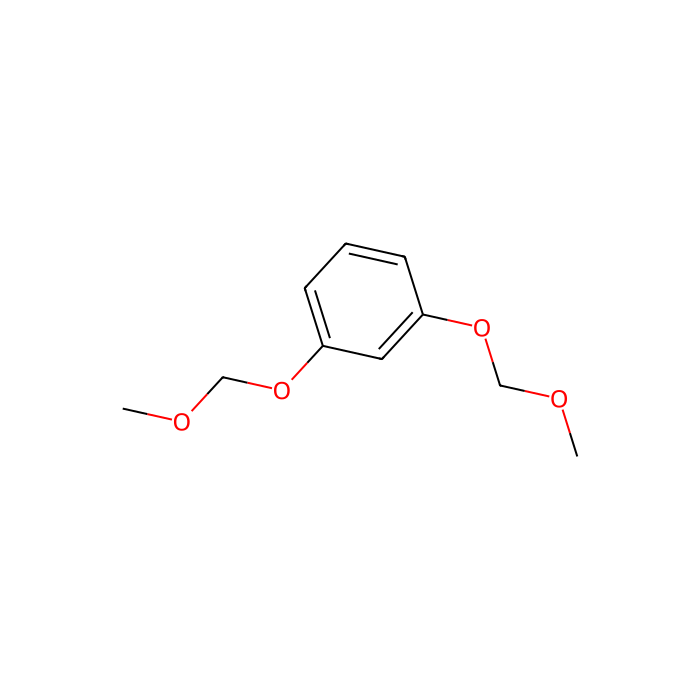
Brief description: 1,3-Bis(methoxymethoxy)benzene is the 1,3-dimethoxymethyl (MOM) diether of resorcinol, featuring two methoxymethoxy protecting groups on a benzene ring at the 1- and 3-positions.
Item-specific (from Product Data)
SKU: B405294
Product Name: 1,3-Bis(methoxymethoxy)benzene
CAS: 57234-29-4
InChIKey: 354475 (as provided; note this is not in standard InChIKey format)
Storage Conditions: Room temperature
Research Use Note: For research use only
Category Path: 全部 / 可售 / 化学和生化试剂
Grade/Purity: Not specified for this item; refer to CoA/Spec Sheet.
Appearance: Not specified for this item; refer to CoA/Spec Sheet.
Literature/computed identifiers (for reference; not item specifications)
Molecular formula (literature): C10H14O4 (resorcinol protected as two MOM ethers)
Molecular weight (literature): ~198.22 g/mol
SMILES (literature): representation of a 1,3-disubstituted benzene bearing two –O–CH2–O–CH3 groups; exact linear form varies by software depiction
Structural features: aromatic benzene core; two ether linkages per substituent forming methoxymethyl (MOM) acetals (Ar–O–CH2–O–CH3) at 1,3-positions; no stereocenters; no formal charge.
2D structure (verbal)
A benzene ring bearing two identical substituents at meta positions. Each substituent is an aryl-oxygen connected to a methylene (–CH2–) which is further connected to a methoxy group (–OCH3), i.e., Ar–O–CH2–O–CH3, twice in a 1,3-arrangement.
Synthetic Utility
Functional group profile
Two phenolic oxygens are masked as methoxymethyl ethers (Ar–O–CH2–O–Me), transforming a diol into a neutral, base-stable, acid-labile synthon. The ring becomes strongly activated toward electrophiles, with substituent control at the 2-, 4-, and 6-positions.
Key transformations enabled
Electrophilic aromatic substitution: Controlled halogenation, nitration, sulfonylation, and Friedel–Crafts acylation/alkylation with reduced risk of overreaction at phenols.
Cross-coupling compatibility: MOM groups survive many Pd-catalyzed couplings when acidic promoters are absent; allows construction of biaryls or aryl–heteroaryl motifs on resorcinol scaffolds.
Directed ortho-metalation (DoM): The aryloxy substituent can direct deprotonation adjacent to oxygen under strong base at low temperature, enabling formylation, borylation (via metallation then quench), or halogenation.
Late-stage unmasking: Acidic or Lewis acidic cleavage regenerates resorcinol for subsequent O-functionalization (e.g., etherification, esterification) or as a handle for macrocyclizations and H-bond motif installation.
Retrosynthetic value
Starting from this protected core, one can install substituents under conditions incompatible with free phenols (e.g., Vilsmeier formylation, SEAr under AlCl3). Subsequent deprotection yields the desired 1,3-diol with substituent pattern preserved.
Compatibility notes
Avoid strong protic/Lewis acids unless deprotection is intended. Basic oxidations (e.g., mCPBA epoxidation of appended alkenes) and many radical reactions are typically compatible. Hydrogenolysis conditions that cleave benzyl groups generally leave MOM intact.
Target Specificity
Not applicable. This product is a small-molecule synthetic intermediate/protecting-group derivative and does not have biological target specificity (no antigen/epitope, clone, isotype, or species reactivity). Refer instead to Synthetic Utility and Reaction & Applications.
Domande frequenti
What is the purity of this product?
This product is supplied at ≥96% purity (chemical assay). Lot-specific values are stated on the Certificate of Analysis.
How should this product be stored?
Store at room temperature.
What are the CAS number, molecular formula and molecular weight?
The CAS Number is 57234-29-4, the molecular formula is C10H14O4, and the molecular weight is 198.22 g/mol. InChIKey TZZPMRGYEPMHLA-UHFFFAOYSA-N.
What documentation is provided?
Available product documentation, including Certificates of Analysis (COA), Safety Data Sheets (SDS), and specification sheets, is shown in the product document area. Document availability and access follow the current site policy.
We use cookies to ensure the website functions properly and, where permitted, to improve your experience. You can manage your preferences at any time in Settings. Learn more in our Cookie Policy.
Shall we send you a message when we have discounts available?
Remind me later
Thank you! Please check your email inbox to confirm.
Products are supplied to verified businesses, institutions, and qualified professionals for research and development use only. Not for use in humans, animals, diagnosis, or therapy.

 B2307509