≥98%, stabilized with copper for sensitive chromatographic and analytical workflows requiring minimal baseline interference.
🌡
Storage & shipping
Store at 2-8°C,Protected from light Ships Wet ice Check lot-specific COA for exact specifications.
📋
Quality documents
SDS, COA, datasheet, and spec sheet available for download. Lot-specific COA accessible via lot number lookup.
📚
Literature proof
Cited in 1 peer-reviewed publications across chromatography, organic synthesis, and cross-coupling reactions.
Panoramica
The adsorption of 1,3-diiodopropane on a molybdenum-aluminum alloy thin film formed on dehydroxylated alumina has been studied 1,3-Diiodopropane has been used in the preparation of synthetically challenging bridged 1,2,4,5-tetraoxanes
This compound belongs to the class of organic compounds known as organoiodides. These are compounds containing a chemical bond between a carbon atom and an iodine atom.
External Descriptors
Not available
1. Djoumbou Feunang Y, Eisner R, Knox C, Chepelev L, Hastings J, Owen G, Fahy E, Steinbeck C, Subramanian S, Bolton E, Greiner R, and Wishart DS. ClassyFire: Automated Chemical Classification With A Comprehensive, Computable Taxonomy. Journal of Cheminformatics, 2016, 8:61.
Determine the necessary mass, volume, or concentration for preparing a solution.
Dilution Calculator
Determine the dilution needed to prepare a stock solution.
Reconstitution Calculator
Recensioni
Recensioni dei clienti
Application Protocols
No assay protocols (e.g., WB, IHC, IF, FC) are applicable to this small‑molecule reagent, and none are provided in the Product Data. For synthetic use, see the general procedures outlined under Reaction Conditions. As good practice:
Plan stoichiometry and dilution based on whether mono‑ or bis‑substitution is desired.
Select solvent/base according to nucleophile class (amines vs. alcohols vs. thiols) and desired temperature window.
Include light protection (amber glassware/foil) when prolonged reactions or storage are involved to minimize iodine generation.
Document batch details from the CoA (purity, any stabilizer) in your lab notebook for reproducibility.
Biological Roles
This product is a small synthetic organoiodide electrophile used in chemical synthesis. It does not have a known physiological role.
General biochemical context (literature-based, not item-specific):
Reactivity toward biomolecules: As a bifunctional alkylating agent, 1,3‑diiodopropane can in principle alkylate nucleophilic residues (thiols, amines) in proteins or nucleic acids. Such reactions are studied only in controlled in vitro chemical biology settings and are not indicative of any natural function.
Metabolic fate: Simple dihaloalkanes are generally not produced by primary metabolism and are typically transformed, if encountered, by nonspecific dehalogenation or conjugation pathways in organisms; details vary widely by species and are beyond the scope of research reagent documentation.
Use context at Aladdin Scientific:
Supplied strictly for research and laboratory use (as stated: For research use only). No clinical, diagnostic, or in vivo applications are supported.
If your work involves biomolecules:
Perform reactions in buffered aqueous/organic biphasic systems with appropriate quench protocols (e.g., excess nucleophile or thiosulfate to scavenge iodine/iodide) and thoroughly remove residual reagent before biological testing of products.
Verify extent and selectivity of alkylation by mass spectrometry or MS‑compatible derivatization; avoid extrapolating chemical reactivity to biological safety or function.
Buffer Applications
Not typically applicable. 1,3‑Diiodopropane is a hydrophobic organic reagent and not used as a buffering component. For work involving this reagent and aqueous systems:
Conduct reactions in biphasic setups (e.g., water/MeCN, water/2‑MeTHF) with phase‑transfer catalysts if needed.
After reaction, thoroughly extract and remove the organic reagent before adjusting pH or preparing analytical buffers.
Select buffers based on your substrate or product requirements (e.g., phosphate, HEPES), not on the properties of this reagent.
Green Alternatives
Green chemistry context (general comparison; not item-specific claims):
Benefit of iodide leaving group: Enables milder, lower‑temperature SN2 conditions, potentially reducing energy input and avoiding stronger bases that generate waste salts.
Tradeoff: Iodinated reagents have higher embedded halogen mass and may generate iodide‑rich waste streams requiring specialized handling; they are typically more resource‑intensive than bromo/chloro analogs.
Potential alternatives and tradeoffs (literature/practice):
Option | Advantages | Tradeoffs
--- | --- | ---
1,3‑Dibromopropane | Less iodine waste; often adequate reactivity with stronger bases/phase‑transfer; lower cost | Requires harsher conditions; higher temperatures may lower selectivity or increase side reactions
1,3‑Dichloropropane | Abundant and cheaper; lowest halogen mass | Significantly less reactive; may demand forcing conditions and less benign solvents
Carbonate‑based linkers (e.g., 1,3‑propanediol + tosylation/mesylation in situ) | Avoids iodinated waste; tosylates can be effective leaving groups | Adds steps and reagents (sulfonyl chlorides); may not match reactivity of iodides
Solvent choices (2‑MeTHF, CPME) | Greener solvent matrix for the same electrophile | May require PTC or heat to match rates seen in DMF/DMSO
Best‑practice suggestions:
Optimize stoichiometry and concentration to minimize over‑alkylation and waste.
Employ catalytic PTC instead of large quantities of polar aprotic solvents when feasible.
Implement iodide recovery or waste minimization strategies (e.g., aqueous thiosulfate treatments, segregation of halogenated waste).
Pharmaceutical Uses
No excipient or clinical use is intended or supported for this product. For research and process development contexts only.
General formulation/manufacturing context (literature/practice; not item-specific):
Synthetic intermediate: 1,3‑Diiodopropane can serve as a propylene spacer to tether amine, alcohol, or thiol functionalities during small‑molecule API route scouting, enabling rapid access to bis‑substituted analog series.
Quaternization agent: Useful for generating bis‑quaternary ammonium salts (e.g., model compounds, ion‑pair reagents) under mild conditions.
Building block for functional linkers: Can introduce propyl chains ending in masked nucleophiles or be converted to other handles (e.g., azide via SN2 → amine after reduction) for subsequent conjugation chemistry.
Regulatory considerations:
Pharmacopeial status: Not listed as a compendial excipient; any use in cGMP settings would require full impurity characterization, residual solvent analysis, and control of iodide/iodine carryover according to ICH guidelines.
Safety assessments: As a reactive alkylating agent, it is unsuitable for direct inclusion in drug products; it should be fully consumed and purged in synthetic steps with validated clearance.
Always confirm suitability, impurity profile, and purge factors experimentally if considering route development work.
Physical Properties
Item-specific specifications: Not specified for this item; refer to CoA/Spec Sheet.
Literature/general properties (for reference only; not item specifications):
Empirical formula: C3H6I2
Formula weight: 295.89 g/mol
Physical state/appearance: typically a colorless to pale yellow liquid that may darken on light exposure (literature observation for alkyl iodides).
Volatility/boiling behavior: higher boiling than the chloro/bromo analogs; heats to distillation only at elevated temperatures (literature trend for diiodoalkanes).
Density: substantially greater than water due to the two iodine atoms (literature trend).
Refractive index: elevated vs. lighter halides (literature trend for iodides).
Solubility: low in water; miscible with many organic solvents (e.g., ethers, chlorinated solvents, polar aprotics) — literature behavior for alkyl dihalides.
Partitioning: expected high logP/hydrophobicity relative to shorter/lighter halides (literature trend).
Notes on interpretation:
Exact numerical values (bp, mp, density, nD, UV cutoff, water content, metals, stabilizer, etc.) are not provided in the Product Data; consult the CoA or specification sheet for batch‑specific data.
Because iodides are photosensitive, apparent darkening can occur from trace iodine formation on light exposure (general behavior). This does not constitute an item specification and should be assessed against acceptance criteria on the CoA.
Quality and Grades
Item-specific grade/purity: Not specified for this item; refer to CoA/Spec Sheet for assay, stabilizers, peroxide/iodine content limits, and trace impurity profiles.
General guidance for interpreting grades (context; not item-specific):
Research/technical grade: Suitable for most synthetic procedures; impurities may include residual haloalkanes or hydrodehalogenation products; confirm suitability for sensitive transformations (e.g., macrocyclizations) by GC or NMR.
High-purity or HPLC grade (if offered): Tighter limits on nonvolatile residue and UV-absorbing impurities; beneficial if using UV monitoring or photochemical steps.
Anhydrous/low-moisture variants (if offered): Important for moisture‑sensitive substitutions (e.g., generation of thiolates or azide substitutions in polar aprotic media). Water content by Karl Fischer will be specified on the CoA when applicable.
Stabilizers:
Some alkyl iodides are shipped in amber glass or under inert atmosphere to mitigate photolysis/iodine formation. If a stabilizer or inhibitor is used, it will be declared on the CoA/Spec Sheet. Absent such notice, assume none is intentionally added.
Recommended QC checks (user side):
1H/13C NMR (check for residual 1-iodopropane or higher oligomers), GC purity, and visual color index vs. amber standards.
If color develops, a brief pass over basic alumina can remove trace iodine (general practice; verify impact on your application).
Reaction and Applications
As a bifunctional primary alkyl iodide, 1,3‑diiodopropane is a highly versatile electrophile for SN2 chemistry and linker construction.
Bis‑alkylation/linker installation: Formation of propylene‑tethered diamines, diethers, and thioethers by reaction with nucleophiles (amines, alcoholates, thiolates). Useful in preparing macrocycles and rotaxanes by double SN2.
Quaternization: Stepwise or simultaneous quaternization of tertiary amines to generate bis‑ammonium (“gemini”) surfactant headgroups.
Heterocycle synthesis: Intramolecular cyclizations after mono‑substitution can afford azetidinium salts (transient) or, with appropriately disposed nucleophiles, saturated N/S/O heterocycles (e.g., morpholine/thiane analog precursors via tethering).
Metalation/cross‑coupling precursors: Formation of 1,3‑propanediyl organometallics (e.g., di‑Grignard) is possible but may compete with Wurtz coupling; the iodide enhances oxidative insertion.
Polymer and surface modification: Acts as a spacer to introduce iodo‑terminated handles for subsequent substitutions, or to crosslink nucleophile‑bearing polymers.
Practical considerations:
Selectivity control: Use excess nucleophile to minimize double substitution when mono‑functionalization is desired; conversely, use slight excess of diiodide and dilute conditions for macrocyclizations.
Leaving group advantages: Iodide enables lower temperatures and milder bases relative to bromo/chloro analogs, often improving compatibility with sensitive substrates.
Workup: Residual iodine (if formed) can be reduced with sodium thiosulfate in the aqueous phase; monitor for bis‑alkylation by LC/GC.
Manufacturer Applications: Not provided in the Product Data for this SKU; the above describes common research uses consistent with a diiodoalkane reagent.
Reaction Conditions
General, literature‑based guidance for typical transformations with 1,3‑diiodopropane (not item‑specific specifications):
Solvents: DMF, DMSO, MeCN, NMP; for less polar systems, THF or 2‑MeTHF with PTC (e.g., TBAB/TBAI).
Bases: K2CO3 or Cs2CO3 for amines/alcohols; NaH or KOtBu for alcohols (anhydrous); NaOMe/NaOEt in corresponding alcohols when elimination is not a concern.
Temperature: 20–80 °C; iodide often reacts at room temperature with strong nucleophiles; heat for hindered partners.
Stoichiometry: 1.0–1.2 equiv diiodide per nucleophile unit for complete bis‑alkylation; excess nucleophile (2–5 equiv) to favor mono‑alkylation.
Time: 1–24 h depending on nucleophile and temperature; monitor by GC or TLC.
Azide installation (→ diamines after reduction):
NaN3 (2.5–3.0 equiv per iodide), DMF or MeCN, 25–60 °C, 2–16 h. Follow with Staudinger (PPh3/H2O) or catalytic hydrogenation (Pd/C, H2) to amines.
Thiolate couplings:
Generate RS– in situ (RSH + NaH/K2CO3), DMSO/DMF, 0–25 °C start, then warm to 40–60 °C as needed.
Organometallic formation (advanced):
Mg insertion in THF at 0–25 °C under inert atmosphere to form 1,3‑propanediyl magnesium species; suppress Wurtz coupling by slow addition, dilute conditions, and iodine scavengers as needed.
Workup tips:
Quench with water then extract with nonpolar solvent; wash organics with sodium thiosulfate if iodine color observed; dry and concentrate under reduced pressure.
Safety and Handling
Item-specific hazard data: Not specified for this item; refer to SDS for authoritative classification (GHS hazard classes, pictograms, H/P statements, exposure limits).
General safety profile for alkyl diiodides (literature/experience-based guidance; not item-specific):
Hazards: Alkyl iodides are potent alkylating agents. They can cause skin/eye irritation and may be harmful if inhaled, swallowed, or absorbed through skin. Vapors may be irritating. Photosensitivity can generate iodine, imparting color and potential additional irritancy.
GHS expectations: Often classified as irritant or harmful; specific categories vary by supplier and testing — always verify on the SDS of this SKU.
Handling and PPE (good laboratory practice):
Work in a certified chemical fume hood; avoid inhalation and skin contact.
Wear chemical-resistant gloves (e.g., nitrile), lab coat, and splash goggles; consider double‑gloving for extended operations.
Avoid contact with strong bases (which can induce elimination) and strong nucleophiles without appropriate control; avoid strong oxidizers and reducing agents.
First aid (summary; defer to SDS):
Skin/eye contact: Immediate decontamination with copious water; remove contaminated clothing; seek medical attention if irritation persists.
Inhalation: Move to fresh air, monitor breathing, obtain medical evaluation.
Ingestion: Rinse mouth; do not induce vomiting; seek medical attention.
Storage incompatibilities and special risks:
Protect from light to minimize iodine formation; keep containers tightly closed.
Use amber glass where practical; segregate from oxidizers/bases.
Dispose according to halogenated organic waste procedures.
Solvent Selection
Relevance: 1,3‑Diiodopropane is itself a reagent, not a bulk solvent. However, solvent choice strongly influences its performance in substitution and tethering reactions.
General solvent considerations (literature/practice):
Polarity class: Nonpolar reagent; reacts best with nucleophiles in polar aprotic solvents that enhance SN2 rates.
Preferred media for SN2: DMF, DMSO, NMP, acetonitrile; for less polar nucleophiles, THF or 2‑MeTHF with phase‑transfer catalysts (PTC) can be effective.
Poor choices: Protic solvents (e.g., alcohols, water) that can solvolyze or compete as nucleophiles unless intended; strongly basic protic solvents can promote elimination.
Heterogeneous systems: Toluene or dichloromethane with solid carbonate base plus PTC (e.g., TBAI, TBAB) often balance reactivity and selectivity.
Small comparison (general guidance):
DMF vs. DMSO: DMSO often gives higher SN2 rates with thiolates/azide but may complicate workup; DMF balances solubility and ease of quench.
MeCN: Lower boiling, easier removal; good for alkylations of amines with K2CO3.
THF/2‑MeTHF: Favor intramolecular cyclizations and Grignard chemistry; less polar but greener options than DMF/DMSO.
Dichloromethane: Useful at ambient temperature with soluble bases/nucleophiles; limited for very ionic reagents.
Practical tips:
Dry solvents rigorously for moisture‑sensitive nucleophiles (e.g., sodium alkoxides/thiolates).
Consider adding catalytic iodide (e.g., TBAI) only if the nucleophile is insufficiently reactive; with a diiodide, this is often unnecessary.
Storage and Reconstitution
Item-specific instructions (from Product Data):
Storage conditions: Store at 2–8 °C, protected from light.
Shipped in: Wet ice.
Additional general guidance (literature/practice; not item-specific specifications):
Container: Use amber glass with tight seals to minimize photolysis and iodine formation; minimize headspace oxygen.
Inert cover: If practical, blanket with nitrogen/argon after opening for long‑term storage.
Inspection: Check visually for discoloration; faint yellow/brown tinge may indicate trace iodine. If necessary for sensitive work, pass through a short plug of basic alumina immediately before use (validate for your application).
Reconstitution: Not applicable; supplied neat as a liquid reagent (appearance for this SKU is not specified). If dilution is needed for dosing, prepare solutions in dry, oxygen‑free solvents (e.g., anhydrous MeCN, THF, or DMF) immediately before use and protect from light.
Freeze–thaw: Not typically relevant; avoid freezing unless validated, as repeated freeze–thaw can stress seals. Maintain at 2–8 °C per Product Data.
Always consult the lot‑specific CoA and SDS for definitive handling limits and stability information.
Structure and Identity
Overview: 1,3‑Diiodopropane is a bifunctional primary alkyl iodide (a vicinal-diiodoalkane with three carbons between iodides) useful as a high‑leaving‑group, SN2‑active linker.
Item-specific identifiers from Product Data:
CAS: 627-31-6
InChIKey: Not specified for this item; refer to CoA/Spec Sheet. (Product Data lists "27", which is incomplete.)
SMILES: Not specified for this item; refer to CoA/Spec Sheet.
Literature/reference identifiers (for context; not item specifications):
InChIKey: commonly reported as a unique 27‑character hash (literature; consult databases)
Structural features (general chemistry description):
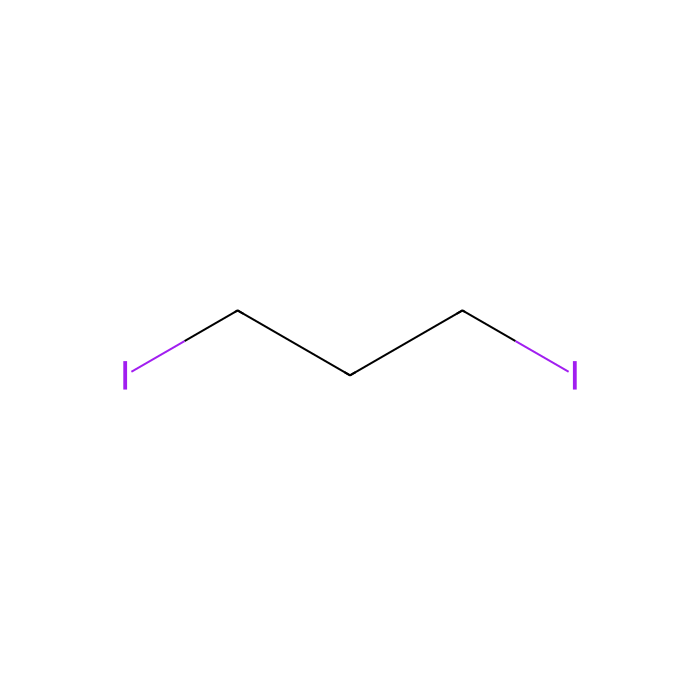
Linear three‑carbon chain bearing terminal iodides at C‑1 and C‑3 (I–CH2–CH2–CH2–I).
Functional groups: two primary alkyl iodides (excellent leaving groups; high polarizability).
No rings, no heteroatoms other than iodine; no stereocenters; achiral.
2D depiction (verbal): an unbranched propane backbone with iodide substituents at both ends; each terminal methylene is iodo‑substituted, middle methylene unsubstituted.
Implications of structure (general):
Strong SN2 reactivity at both termini enables di‑alkylation, tether formation, and macrocyclizations.
Compared to chloro/bromo analogs, iodides undergo substitution under milder conditions due to superior leaving‑group ability.
Synthetic Utility
Key functional features:
Two terminal primary iodides with exceptional leaving‑group ability; ideal for sequential or simultaneous SN2 reactions.
Linear C3 spacer defines a 3‑atom tether, commonly used to set conformational spacing between functional groups in macrocycles, ligands, and materials.
Bis‑alkylation of diamines, diols, and dithiols to produce propyl‑bridged secondary/tertiary amines, ethers, and thioethers.
Mono‑substitution followed by intramolecular cyclization to generate saturated heterocycles (e.g., thianes and morpholines from appropriate precursors).
Azide displacement (NaN3, DMF/MeCN) → 1,3‑diamino derivatives after Staudinger or catalytic hydrogenation.
Thiolate substitution (NaS–R, DMSO/DMF) → symmetrical/unsymmetrical sulfides; conditions milder than for bromo/chloro analogs.
Formation of di‑Grignard or organozinc intermediates for coupling chemistry (requires careful control to suppress Wurtz coupling and elimination).
Retrosynthetic value:
As a convergent linker, it allows assembly of complex targets from two nucleophilic fragments under minimal protecting‑group manipulations.
Iodide’s superior reactivity reduces temperature and base strength, improving chemoselectivity with sensitive motifs (e.g., aryl sulfonates, benzylic stereocenters).
Operational notes:
Use dry, oxygen‑free conditions with polar aprotic solvents to maximize SN2 rates and minimize side reactions.
Control concentration and dilution strategically for macrocyclizations vs. polymerization/crosslinking outcomes.
Monitor for adventitious iodine; aqueous thiosulfate washes can decolorize organic layers without harming many products.
Target Specificity
Not applicable. This product is a small‑molecule alkylating reagent, not a biological targeting agent, antibody, or probe. No antigen/epitope, clone, isotype, or species reactivity applies. For application‑specific selectivity in synthesis, refer to Reaction & Applications and Synthetic Utility.
Domande frequenti
What is the purity of this product?
This product is supplied at ≥98% purity (chemical assay). Lot-specific values are stated on the Certificate of Analysis.
What are the CAS number, molecular formula and molecular weight?
The CAS Number is 627-31-6, the molecular formula is I(CH2)3I, and the molecular weight is 295.89 g/mol. InChIKey AAAXMNYUNVCMCJ-UHFFFAOYSA-N.
How should this product be stored?
Store at 2–8 °C, protected from light. The material is light-sensitive — keep it in its original opaque or amber container.
How is this product shipped?
This product ships chilled on wet ice. Unpack on arrival and transfer it to the storage condition stated above.
What documentation is provided?
Available product documentation, including Certificates of Analysis (COA), Safety Data Sheets (SDS), and specification sheets, is shown in the product document area. Document availability and access follow the current site policy.
We use cookies to ensure the website functions properly and, where permitted, to improve your experience. You can manage your preferences at any time in Settings. Learn more in our Cookie Policy.
Shall we send you a message when we have discounts available?
Remind me later
Thank you! Please check your email inbox to confirm.
Products are supplied to verified businesses, institutions, and qualified professionals for research and development use only. Not for use in humans, animals, diagnosis, or therapy.

 A2507505