Determine the necessary mass, volume, or concentration for preparing a solution.
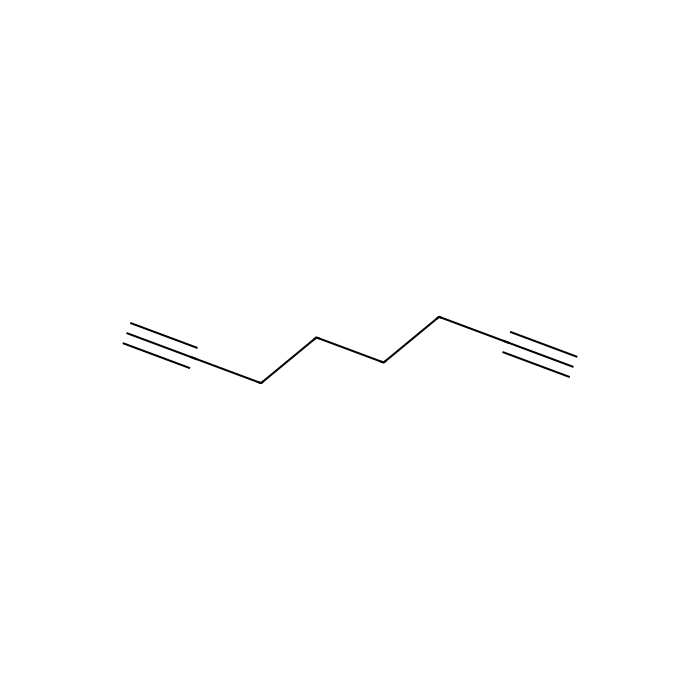
1,7-Octadiyne - ≥98% , CAS No.871-84-1
Disponibile su ordine
QUALITÀ & PUREZZA ≥98%
Storage
Store at 2-8°C
Shipped In
Wet ice

1,7-Octadiyne is a terminal bis-alkyne and participates in the formation of uranium(IV) vinyl complexes. It reacts with frustrated Lewis pair P(o-tolyl)3/B(C6F5)3 by acetylene C-C coupling to yield the zwitterionic product. It undergoes the reductive cyclization during reaction with Re2Cl4(μ-dppm)2 (dppm = Ph2PCH2PPh2) and affords quadruply bonded dirhenium(III) complex Re2Cl3(μ,η2-C8H7)(μ-dppm)2.
Taxonomy Tree
| Kingdom | Organic compounds |
|---|---|
| Superclass | Acetylides |
| Classe | Not available |
| Subclass | Not available |
| Intermediate Tree Nodes | Not available |
| Direct Parent | Acetylides |
| Alternative Parents | Unsaturated aliphatic hydrocarbons Acyclic acetylenes |
| Molecular Framework | Aliphatic acyclic compounds |
| Substituents | Acetylide - Unsaturated aliphatic hydrocarbon - Unsaturated hydrocarbon - Acyclic acetylene - Acetylene - Hydrocarbon - Aliphatic acyclic compound |
| Descrizione | This compound belongs to the class of organic compounds known as acetylides. These are compounds arising by replacement of one or both hydrogen atoms of acetylene (ethyne) by a metal or other cationic group. E.g. NaC#CH monosodium acetylide. By extension, analogous compounds derived from terminal acetylenes, RC#CH. The class is limited here to derivatives of acetylene where the hydrogen atom is replaced with an element with similar or lower electronegativity that carbon. |
| External Descriptors | Not available |
Find and download the COA for your product by matching the lot number on the packaging.
| Lot Number | Certificate Type | Data | Oggetto |
|---|---|---|---|
 E2310716 | Certificate of Analysis | Oct 09, 2026 | O110225 |
| E2310717 | Certificate of Analysis | Oct 09, 2026 | O110225 |
| E2310718 | Certificate of Analysis | Oct 09, 2026 | O110225 |
| E2310721 | Certificate of Analysis | Oct 09, 2026 | O110225 |
| E2310748 | Certificate of Analysis | Oct 09, 2026 | O110225 |
| E2310751 | Certificate of Analysis | Oct 09, 2026 | O110225 |
| Solubilità | Not miscible or difficult to mix. |
|---|---|
| Indice di rifrazione | 1.446 |
| Punto di infiammabilità (°F) | 73.4 °F |
| Punto di infiammabilità (°C) | 23 °C |
| Punto di ebollizione (°C) | 135-136°C |
| Peso molecolare | 106.16 |
| XLogP3 | 2.500 |
| Hydrogen Bond Donor Count | 0 |
| Hydrogen Bond Acceptor Count | 0 |
| Rotatable Bond Count | 3 |
| Exact Mass | 106.078 Da |
| Monoisotopic Mass | 106.078 Da |
| Topological Polar Surface Area | 0.000 Ų |
| Heavy Atom Count | 8 |
| Formal Charge | 0 |
| Complexity | 107.000 |
| Isotope Atom Count | 0 |
| Defined Atom Stereocenter Count | 0 |
| Undefined Atom Stereocenter Count | 0 |
| Defined Bond Stereocenter Count | 0 |
| Undefined Bond Stereocenter Count | 0 |
| The total count of all stereochemical bonds | 0 |
| Covalently-Bonded Unit Count | 1 |
H226:Flammable liquid and vapor
H304:May be fatal if swallowed and enters airways
H315:Causes skin irritation
H319:Causes serious eye irritation
H335:May cause respiratory irritation
P210:Keep away from heat, hot surface, sparks, open flames and other ignition sources. - No smoking.
P233:Keep container tightly closed.
P240:Ground/bond container and receiving equipment.
P241:Use explosion-proof [electrical/ventilating/lighting/.../] equipment.
P242:Use only non-sparking tools.
P243:Take precautionary measures against static discharge.
P261:Avoid breathing dust/fume/gas/mist/vapors/spray.
P264:Wash hands [and …] thoroughly after handling.
P271:Use only outdoors or in a well-ventilated area.
P280:Wear protective gloves/protective clothing/eye protection/face protection.
P321:Specific treatment (see ... on this label).
P331:Do NOT induce vomiting.
P302+P352:IF ON SKIN: wash with plenty of water.
P303+P361+P353:IF ON SKIN (or hair): Take off Immediately all contaminated clothing. Rinse SKIN with water [or shower].
P304+P340:IF INHALED: Remove person to fresh air and keep comfortable for breathing.
P305+P351+P338:IF IN EYES: Rinse cautiously with water for several minutes. Remove contact lenses if present and easy to do - continue rinsing.
P362+P364:Take off contaminated clothing and wash it before reuse.
P370+P378:In case of fire: Use ... to extinguish.
P405:Store locked up.
P403+P233:Store in a well-ventilated place. Keep container tightly closed.
P403+P235:Store in a well-ventilated place. Keep cool.
P501:Dispose of contents/container to an approved waste disposal plant.
P264+P265:Wash hands [and …] thoroughly after handling. Do not touch eyes.
P301+P316:IF SWALLOWED: Get emergency medical help immediately.
P337+P317:If eye irritation persists: Get medical help.
P332+P317:If skin irritation occurs: Get medical help.
P319:Get medical help if you feel unwell.