per flussi di lavoro cromatografici e analitici sensibili che richiedono un'interferenza minima della linea di base.
🌡
Stoccaggio e spedizione
Room temperature Spedizione Normal. Consultare il COA specifico del lotto per le specifiche esatte.
📋
Documenti di qualità
SDS, COA, scheda tecnica e scheda delle specifiche disponibili per il download. COA specifico del lotto accessibile tramite ricerca per numero di lotto.
📚
Prova documentale
Citato in 0 pubblicazioni peer-reviewed su cromatografia, sintesi organica e reazioni di accoppiamento incrociato.
This compound belongs to the class of organic compounds known as naphthalenes. These are compounds containing a naphthalene moiety, which consists of two fused benzene rings.
External Descriptors
Not available
1. Djoumbou Feunang Y, Eisner R, Knox C, Chepelev L, Hastings J, Owen G, Fahy E, Steinbeck C, Subramanian S, Bolton E, Greiner R, and Wishart DS. ClassyFire: Automated Chemical Classification With A Comprehensive, Computable Taxonomy. Journal of Cheminformatics, 2016, 8:61.
Surface activation: Clean slides (e.g., piranha or plasma/UV-ozone). Rinse with water, then ethanol. Dry at 120 C for 30 min.
Prepare silane solution: In a dry vessel, mix ethanol with 2–5% (v/v) water. Adjust to pH 4.5 with acetic acid. Add silane to 0.5–1.0% (v/v) under stirring. Use within 30 min.
Silanization: Immerse slides 10–20 min at room temperature with gentle agitation.
Rinse: Remove and rinse thoroughly with ethanol to remove physisorbed material.
Cure: Bake slides at 110–120 C for 30–60 min to promote siloxane crosslinking.
Storage: Store coated slides dry, protected from light and dust.
Notes
For anhydrous deposition, replace step 2 with 0.5–2% (v/v) silane in dry toluene; immerse 30–60 min under N2, then rinse with toluene and cure.
Film thickness and uniformity depend on water content, pH, temperature, and concentration. Optimize for your substrate.
Dispose of waste per institutional guidelines.
This protocol is provided as general guidance only and is not item-specific performance data.
Biological Roles
This compound is an organosilane coupling agent and does not have an intrinsic biological role or metabolic function.
Relevant intersections with biology (literature/general)
Biointerface engineering: Silanization of glass/oxide substrates can tailor surface hydrophobicity and π-surface character for adsorption of aromatic biomolecules, fluorescence quenching/energy transfer studies, or immobilization scaffolds (when combined with further functional layers).
Optical labels/materials: The naphthyl moiety possesses characteristic UV absorption and fluorescence (when not quenched by aggregation), which may be harnessed in hybrid silica materials for sensing studies. Any use remains strictly in vitro/instrumental research contexts.
No clinical or therapeutic claims are implied. For laboratory research use only, as stated in the Product Data.
Buffer Applications
Not typically applicable. (1-Naphthyl)triethoxysilane is not a buffering reagent and is generally incompatible with aqueous buffers due to hydrolysis. For work that involves aqueous phases (e.g., controlled hydrolysis before silanization), alcohol/water mixtures acidified to pH ~4–5 (acetic acid) are used as process media rather than as biological buffers.
Green Alternatives
Assessment (literature/general)
This aryl trialkoxysilane is moisture-sensitive and often applied from volatile organic solvents (VOCs) such as toluene, THF, or heptane. Greener practice focuses on solvent substitution, process intensification, and minimizing hydrolysis byproducts.
Options and trade-offs
Solvent substitution: Ethanol or isopropanol (with controlled water, pH ~4–5) can replace toluene/heptane for many silanization tasks, reducing VOC toxicity and improving worker safety. Trade-off: faster bulk condensation and shorter pot life; careful dilution (0.5–1% v/v) and temperature control are required.
Aqueous processing: Some trialkoxysilane systems tolerate water-rich formulations (with surfactants or acetic acid catalysis). Benefits include reduced VOCs; drawbacks include increased oligomer formation and potential non-uniform films.
Alternative silanes: Aminosilanes or short-chain alkylsilanes may achieve similar hydrophobicity/adhesion with lower aromatic content, but they lack the naphthyl group’s π-character and optical properties.
Energy use: Lower-temperature curing or UV-assisted condensation can reduce energy consumption versus thermal cures at 110–120 C.
Comparison snapshot (literature)
Toluene-based, anhydrous silanization: excellent control over polymerization; higher VOC burden; longer process time.
EtOH/H2O, pH 4.5 silanization: greener solvent system; rapid hydrolysis and deposition; requires immediate use and strict timing.
Practical greener tips
Dry alcohols over sieves to extend pot life; prepare minimal volumes just-in-time. Use closed vessels and cold traps to reduce emissions. Implement solvent recovery where feasible.
Pharmaceutical Uses
This material is not a pharmaceutical ingredient. Typical roles for related organosilanes are in materials and surface engineering rather than drug formulation.
Silanization of glassware, vials, or chromatographic supports to adjust surface polarity or reduce adsorption during analytical quality control.
Fabrication of hybrid silica coatings for device components or analytical columns where hydrophobic/aromatic surfaces are beneficial.
No pharmacopeial status, excipient role, or clinical use is specified for this item; refer to your internal regulatory assessments if device or diagnostics-related applications are contemplated.
Physical Properties
Item-specific values
Boiling point: Not specified for this item; refer to CoA/Spec Sheet.
Melting point: Not specified for this item; refer to CoA/Spec Sheet.
Density: Not specified for this item; refer to CoA/Spec Sheet.
Refractive index: Not specified for this item; refer to CoA/Spec Sheet.
UV cutoff/absorbance: Not specified for this item; refer to CoA/Spec Sheet.
Physical state: typically colorless to pale yellow liquid (literature for analogous aryltrialkoxysilanes).
Hydrolytic behavior: hydrolyzes in the presence of water to the corresponding silanols with release of ethanol; subsequently condenses to siloxanes.
Solubility: generally insoluble in water; miscible with many aprotic organic solvents (e.g., toluene, THF, dichloromethane, hexanes) and lower alcohols (literature).
Vapor pressure: expected low at ambient temperature due to aryl substitution and triethoxy functionality (literature trend).
Because of hydrolysis sensitivity, observed properties (viscosity, RI) can drift upon moisture exposure; use freshly opened, dry material for reproducible performance.
If precise properties are critical (e.g., refractive index for process control), verify against the product’s Certificate of Analysis (CoA).
Quality and Grades
Item-specific details
Grade/Purity: Not specified for this item; refer to CoA/Spec Sheet.
Stabilizers/additives: Not specified for this item; refer to CoA/Spec Sheet.
Context for this class of materials (literature/general)
Research grade organosilanes are typically supplied with low hydrolyzable chloride content and controlled alkoxy content. Trace water content and pre-condensed siloxanes can affect performance in surface treatments.
If HPLC or spectrophotometric grade is offered for some silanes, it usually indicates minimized UV-absorbing impurities and low particulate matter for sensitive optical or chromatographic applications.
What to verify on receipt (best practices)
CoA parameters commonly reported for trialkoxysilanes: assay (%), GC purity, water (Karl Fischer), color (APHA), and sometimes refractive index and density. For surface modification, hydrolyzable alkoxy content and acidity are also relevant.
If your application is monolayer formation or precise sol–gel co-condensation, request or consult the Spec Sheet for: water content, residual ethanol, and any stabilizer (e.g., trace acid) that could influence hydrolysis rate.
Performance notes
Freshness matters: hydrolysis and self-condensation during storage can increase viscosity and reduce reactivity. For reproducible silanization, use recently opened material or filter through a 0.2 µm PTFE membrane before use to remove incipient gels (if compatible).
Reaction and Applications
Key application domains (literature/general)
Surface modification (silanization): The triethoxysilyl group hydrolyzes to silanols that condense with hydroxylated substrates (SiO2, glass, Al2O3, TiO2, metal oxides) to form robust Si–O–M bonds. The pendant 1-naphthyl group imparts hydrophobicity, π-rich surface character, and potential photophysical properties.
Sol–gel and ORMOSILs: Co-condensation with tetraalkoxysilanes (e.g., TEOS) embeds naphthyl functionality in hybrid silica networks for optical materials, sorbents, and sensor platforms.
Cross-coupling chemistry: Aryl trialkoxysilanes are competent partners in Hiyama–Denmark couplings. After fluoride activation, the Si–C(aryl) fragment can transfer the naphthyl unit to aryl/vinyl halides or triflates under Pd catalysis, enabling late-stage naphthylation with good chemoselectivity.
Practical considerations
Moisture control: Trace water triggers hydrolysis; for monolayer formation, use either strictly anhydrous conditions (neat silane or in dry toluene) or deliberately controlled hydrolysis in alcohol/water at pH ~4–5.
Surface prep: Thorough cleaning/activation (piranha, oxygen plasma, UV-ozone, or base/acid washes) increases surface –OH density and improves grafting density; rinse and dry completely before silanization.
Silane concentration: 0.5–2% v/v in solvent is typical for monolayers; higher loadings favor thicker, possibly polymeric films.
Cross-coupling tips: Use fluoride sources (TBAF, CsF) with Pd(0/II) catalysts in polar aprotic solvents; water or alcohol as co-solvents can enhance transmetalation. Protect moisture-sensitive functional groups as necessary.
Reaction Conditions
Guidance below is based on literature for aryl trialkoxysilanes and surface silanization; adjust to your system and consult primary sources.
A. Surface silanization (oxide substrates)
Substrate prep: Clean/activate surface (e.g., base bath, piranha, UV-ozone), rinse thoroughly, dry at 110–150 C.
Anhydrous route: 0.5–2% v/v silane in dry toluene or heptane. Immerse or flow-coat 30–120 min at RT–80 C. Rinse with solvent, then cure 100–120 C for 10–60 min to promote siloxane crosslinking.
Controlled hydrolysis route: Prepare 0.5–1% v/v silane in ethanol with 1–5% water; adjust to pH 4.5 with acetic acid. Age 5–15 min (onset of hydrolysis), apply for 5–30 min, rinse with ethanol, then cure 100–120 C.
Film control: Lower concentration and shorter contact favor monolayers; higher concentration/time yield thicker, possibly polymeric coatings.
B. Hiyama-type cross-coupling (aryl transfer)
Catalyst: Pd(PPh3)4 (1–5 mol%) or Pd(dba)3 + ligand.
Activator: TBAF (1.0–2.0 equiv, 1.0 M in THF) or CsF (2–3 equiv).
Solvent: THF, DMF, or MeCN; optional H2O or alcohol co-solvent can accelerate transmetalation.
Electrophile: aryl/vinyl iodides or bromides; triflates also viable.
Temperature/time: 50–90 C for 2–12 h (monitor by TLC/GC).
Atmosphere: nitrogen or argon.
Workup: quench with water, extract with organic solvent, purify by chromatography.
Expected outcomes (literature)
Biaryl formation with good to excellent yields when fluoride activation is optimized; sterically hindered partners may require higher temperatures or stronger ligands.
Note: Exact conditions depend on substrate electronics/sterics; perform small-scale scouting to optimize.
Safety and Handling
Authoritative safety information must be taken from the product-specific SDS. The following are general precautions for trialkoxysilanes with aryl substituents and are not a substitute for the SDS.
General hazards (literature/generic)
Irritation: vapors/liquid may cause eye and skin irritation. Hydrolysis releases ethanol, which is flammable and an irritant.
Flammability: many organosilanes and released ethanol are combustible; keep away from ignition sources.
Reactivity: moisture-sensitive; undergoes hydrolysis and condensation forming gels/oligomers. Avoid contact with water during storage and handling unless controlled.
PPE and engineering controls
Wear safety glasses or chemical splash goggles, lab coat, and suitable chemical-resistant gloves (e.g., nitrile). Handle in a fume hood to control vapors and ethanol formed during hydrolysis.
Handling and storage practices
Keep container tightly closed under dry air or inert gas. Use dry syringes/pipettes or positive-displacement dispensers. Purge headspace with nitrogen after use when possible.
Small spill: absorb with inert material (silica, vermiculite), avoid water addition, collect for disposal.
Skin/eye contact: rinse immediately with plenty of water for at least 15 minutes; remove contaminated clothing. Seek medical attention if irritation persists.
Inhalation: move to fresh air; seek medical attention if symptoms occur.
Waste
Collect organosilane residues and ethanol-containing hydrolysates as flammable organic waste per institutional and regulatory guidelines.
Solvent Selection
This product is a reagent, not a solvent. Selection of the working solvent influences silane stability, hydrolysis, and substrate coverage.
General solvency profile (literature)
Polarity: behaves as a moderately nonpolar organosilane; readily soluble in common aprotic organics (toluene, heptane/hexanes, DCM, THF) and lower alcohols; immiscible with water.
Hydrolysis medium: ethanol/water or isopropanol/water blends (acidified to pH ~4–5) are commonly used for controlled hydrolysis before silanization.
Choosing solvents by objective
Water-free deposition on hydroxylated oxides: anhydrous toluene or heptane minimizes premature polymerization; reflux or 60–110 C cures enhance condensation to surface silanols.
Solution-phase coupling (e.g., Hiyama coupling): polar aprotic solvents like THF, DMF, or acetonitrile with fluoride activators (TBAF, CsF) are typical.
Sol–gel co-condensation: alcohol-rich media (EtOH, i-PrOH) with controlled water content allow homogeneous mixing with TEOS/Si alkoxides while moderating gelation.
Comparison (literature)
Toluene vs hexanes: toluene enhances solubility of aromatic silanes and reduces precipitation; hexanes provide lower polarity for monolayer self-assembly but risk phase separation.
Alcohols vs aprotic solvents: alcohols facilitate pre-hydrolysis but can accelerate bulk condensation; aprotic media give longer pot-life but slower surface reaction.
Practical tips
Dry all solvents (molecular sieves) when water-free handling is required. Avoid chlorinated solvents during base-catalyzed hydrolysis (risk of HCl formation).
Storage and Reconstitution
Item-specific storage
Storage Conditions: Room temperature (per Product Data).
Shipped in: Normal (per Product Data).
Best practices for this class of materials (literature/general)
Moisture protection: Store tightly sealed in original container in a dry place. If available, blanket headspace with dry nitrogen and include desiccant in the outer secondary container.
Light/heat: Store away from direct sunlight and heat sources to minimize premature hydrolysis/condensation and color change.
After opening: Minimize air exposure time; promptly recap. For extended storage, consider transferring to septum-sealed bottles for inert-gas access.
Crystallization/gelation: Trialkoxysilanes can gradually self-condense; if increased viscosity or particulates are observed, filtration through a 0.2 µm PTFE syringe filter may restore handling (verify this is compatible with your application).
Reconstitution
Not applicable; supplied neat. If a working solution is needed, prepare fresh dilutions in dry solvent (e.g., toluene, ethanol) immediately before use. For controlled hydrolysis, use alcohol/water at pH ~4–5 and apply promptly.
Shelf-life
Not specified for this item; refer to CoA/Spec Sheet. As a general guideline, use freshly opened material for critical surface-modification applications to ensure reproducibility.
Structure and Identity
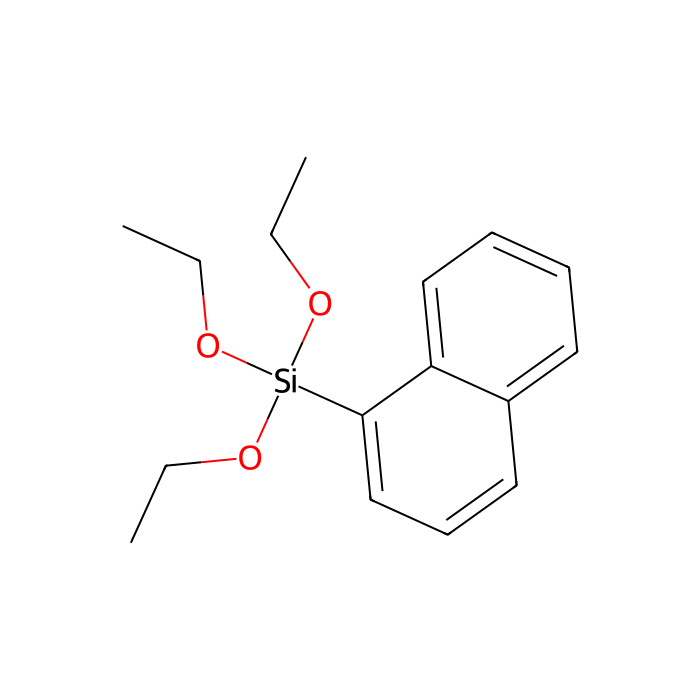
Brief description: (1-Naphthyl)triethoxysilane is an aryltrialkoxysilane featuring a naphthalene ring bound to silicon bearing three ethoxy substituents. It is used as a surface-coupling agent and as an aryl–silicon partner in Si–C transformations.
Structural features: one naphthalene polycyclic aromatic system (10 π electrons) bonded through C-1 to a tetra-coordinate silicon bearing three –OEt groups. Silicon is tetrahedral; no stereocenters.
A fused bicyclic aromatic (naphthalene) ring is attached at position 1 to a silicon atom. The silicon carries three ethoxy substituents (–O–CH2–CH3), enabling hydrolysis/condensation to silanols and siloxanes while retaining the pendant naphthyl group on the substrate.
Synthetic Utility
Functional group perspective
Si(OEt)3: Hydrolyzable alkoxy group set that converts to silanols and participates in siloxane bond formation to inorganic surfaces and within sol–gel matrices.
Aryl–Si bond (1-naphthyl): Stable toward many conditions; can be leveraged in cross-coupling (Hiyama/Denmark) after activation by fluoride or strong base/silanolate formation.
Use cases (literature/general)
Surface tethering of naphthyl groups: Enables preparation of π-rich, hydrophobic monolayers or thin films on silica, alumina, titania, and glass. Useful for tailoring wettability, π–π interactions, and fluorescence properties of interfaces.
ORMOSIL synthesis: Co-condensation with TEOS or other alkoxysilanes yields organically modified silicas embedding naphthalene for optics or sorption.
Cross-coupling partner: In Pd-catalyzed Hiyama couplings, the triethoxysilyl naphthyl group can transfer to electrophiles (Ar–X, vinyl–X) under fluoride activation, furnishing biaryl or aryl–vinyl naphthylated products with high selectivity and tolerance to polar functionality.
Select advantages
Bench stability relative to Grignard or boron reagents; often compatible with air/moisture during handling prior to activation.
Lower toxicity and better shelf life than many organostannanes used in Stille couplings.
Considerations
Transmetalation is typically slower than with boron/boronate systems; fluoride activators and elevated temperatures (50–90 C) may be required. Protect moisture-labile groups during silanization workflows.
Target Specificity
Not applicable. This product is a small-molecule organosilane reagent and does not have antigen/epitope targets, species reactivity, clones, or isotypes.
Utilizziamo i cookie per garantire il corretto funzionamento del sito web e, ove consentito, per migliorare la tua esperienza. Puoi gestire le tue preferenze in qualsiasi momento nelle Impostazioni. Per saperne di più, consulta la nostra Cookie Policy.
Desidera che le inviamo un messaggio quando avremo sconti disponibili?
Ricordamelo più tardi
Grazie! Controlli la sua casella di posta per confermare.
Products are supplied to verified businesses, institutions, and qualified professionals for research and development use only. Not for use in humans, animals, diagnosis, or therapy.