This compound belongs to the class of organic compounds known as medium-chain hydroxy acids and derivatives. These are hydroxy acids with a 6 to 12 carbon atoms long side chain.
External Descriptors
Hydroxy fatty acids
1. Djoumbou Feunang Y, Eisner R, Knox C, Chepelev L, Hastings J, Owen G, Fahy E, Steinbeck C, Subramanian S, Bolton E, Greiner R, and Wishart DS. ClassyFire: Automated Chemical Classification With A Comprehensive, Computable Taxonomy. Journal of Cheminformatics, 2016, 8:61.
1.Yuying Li, Junle Zhang, Yaxuan Shi, Yuancheng Zhang, Ge Shi, Xiaomeng Zhang, Zhe Cui, Peng Fu, Minying Liu, Xiaoguang Qiao, Yanjie He, Yudong Wang, Haitao Zhao, Wenjie Zhang, Xinchang Pang. (2023) Robust Strategy to Improve the Compatibility between Incorporated Upconversion Nanoparticles and the Bulk Transparent Polymer Matrix. ACS Omega, [PMID:37692212][10.1021/acsomega.3c04613]
2.Shixuan Su, Shanshan Li, Jing Hu, Ting Yu, Lingchen Tao, Fuliang Hu, Yunlei Xianyu. (2021) A colorimetric sensing strategy for detecting 10-hydroxy-2-decenoic acid in royal jelly based on Ag(I)-tetramethylbenzidine. SENSORS AND ACTUATORS B-CHEMICAL, [PMID:][10.1016/j.snb.2021.131241]
3.Lu Chunxia, Tang Zonggui, Gao XiaoXu, Ma Xiaomei, Liu Changbin. (2018) Computer-aided design of magnetic dummy molecularly imprinted polymers for solid-phase extraction of ten phthalates from food prior to their determination by GC-MS/MS. MICROCHIMICA ACTA, 185 (8):(1-11). [PMID:30003399][10.1007/s00604-018-2892-5]
4.Dan He, Yan Chen, Junfeng Shen, Han Yu, Jay D. Keasling, Xiaozhou Luo. (2025) Biosynthesis of 10-Hydroxy-2-Decenoic Acid in Escherichia coli. METABOLIC ENGINEERING, [PMID:39842502][10.1016/j.ymben.2025.01.006]
5.Shuai Zhuang, Huihui Ming, Wenjie Yu, Liping Luo. (2024) Identification of freshness and metabolite changes of royal jelly during storage using Nano-ESI-MS and UPLC-Q/TOF-MS. JOURNAL OF FOOD COMPOSITION AND ANALYSIS, [PMID:][10.1016/j.jfca.2024.107092]
Calcolatori di soluzioni
Molarity Calculator
Determine the necessary mass, volume, or concentration for preparing a solution.
Dilution Calculator
Determine the dilution needed to prepare a stock solution.
Reconstitution Calculator
Recensioni
Recensioni dei clienti
Application Protocols
No vendor‑validated biological assay protocols are provided for this item. For synthetic and materials workflows, general starting points include:
Esterification screen: 0.1–0.2 M substrate in dry CH2Cl2 or EtOAc; DCC (1.1 eq), alcohol (1.5 eq), DMAP (0.1 eq), 0 °C → rt, monitor by TLC; filter DCU, wash, concentrate, and purify by silica gel.
Oxidation to diacid: Biphasic H2O/EtOAc, TEMPO (5 mol%), KBr (10 mol%), NaOCl (1.5 eq active), pH 10 buffer; then Pinnick oxidation if needed; isolate by acidification/extraction or crystallization as diacid.
Lactone formation: Toluene, catalytic p‑TsOH, Dean–Stark, 110–120 °C; monitor by GC/LC; neutralize and isolate lactone by extraction.
Adjust stoichiometry and conditions to your scale and EHS policies. Always confirm identity/purity by NMR/IR/MS.
Biological Roles
This compound is an ω‑hydroxy saturated fatty acid analog. While item‑specific biological testing is not provided, general biochemical context for ω‑hydroxy fatty acids includes:
Lipid metabolism: ω‑Hydroxy acids can arise via ω‑oxidation of fatty acids, forming intermediates en route to diacids through subsequent oxidation of the terminal alcohol.
Structural roles: ω‑Hydroxy fatty acids are key components of plant cutin/suberin biopolymers and occur in some lipid‑derived polymers, contributing to barrier properties via polyester crosslinking.
Amphiphilicity: The dual polar termini enable interactions with membranes and proteins distinct from simple monocarboxylic acids; ionization state (pH‑dependent carboxylate) modulates these interactions.
Derivatization handle: The ω‑OH provides a convenient site for conjugation (e.g., to fluorophores, affinity tags) for biochemical assays on lipid–protein interactions.
No pharmacology or clinical claims are made. For research use only, as stated in the Product Data.
Buffer Applications
Not typically used as a classical buffer component. As a monocarboxylic acid, it can form salts and contribute buffering capacity near its carboxyl pKa (~4.8–5.0, literature), but its low aqueous solubility at neutral pH limits practical buffer formulation.
Practical note: In aqueous systems, the sodium/potassium carboxylate can solubilize the molecule for studies of amphiphile behavior or micellization, but for robust buffering prefer dedicated systems (e.g., acetate, citrate, MES).
Green Alternatives
As a substrate, 10‑hydroxydecanoic acid itself is compatible with many green solvents and catalytic protocols. Selection of greener media and reagents can reduce EHS footprint without compromising performance.
Greener media options (general guidance):
Switch chlorinated solvents → EtOAc, 2‑MeTHF, CPME for esterifications and acylations.
Use MeOH/EtOH (bio‑based) for Fischer esterifications and salt manipulations.
For oxidations of the ω‑OH, consider TEMPO/NaOCl in water/AcOEt biphasic or O2/NOx‑free catalytic systems where applicable.
Trade‑off summary:
CH2Cl2 vs EtOAc/CPME: similar solubilizing power for this amphiphile; greener options have higher boiling points aiding separation but may slow some reactions.
DMF/DMSO vs Cyrene/GBL: greener dipolar aprotics can substitute in coupling steps; check base compatibility and workup.
Carbodiimides (DCC) vs EDC·HCl in aqueous/EtOAc media to reduce urea waste persistence.
Suitability here | Excellent solubility | Good, greener | Good, water tolerant
Note: Optimize solvent/reagent selection against your unit operations (extraction, crystallization) to minimize energy and solvent swaps.
Pharmaceutical Uses
No pharmacopeial status or specific excipient grade is provided for this item. In formulation science (general context):
Fatty acid derivatives are sometimes used as excipients (e.g., emulsifiers or penetration enhancers) after esterification or salt formation; ω‑hydroxy functionality enables further tailoring of hydrophilic–lipophilic balance (HLB).
Prodrug chemistry: Carboxylic acids can be masked as esters; the terminal alcohol enables additional conjugation strategies in research. Any such uses require appropriate grade/validation not specified here.
This listing is for research and laboratory use only and does not imply suitability for human or veterinary applications.
Physical Properties
Appearance: Not specified for this item; refer to CoA/Spec Sheet.
Melting point / Boiling point: Not specified for this item; refer to CoA/Spec Sheet. (ω‑hydroxy C10 acids are typically low‑melting solids/waxes; literature reports solid-state at ambient conditions.)
Density / Refractive index: Not specified for this item; refer to CoA/Spec Sheet.
pKa (carboxyl, literature): ~4.8–5.0 typical for saturated aliphatic monocarboxylic acids; terminal OH is non‑ionizable under neutral conditions.
LogP (literature, qualitative): Moderately hydrophobic due to C10 chain; amphiphilic with increased polarity vs decanoic acid from the ω‑OH.
Solubility (general/literature):
Water: low solubility at neutral pH; higher as the carboxylate salt (basic pH)
Organic: soluble in polar protic (MeOH, EtOH), polar aprotic (DMSO, DMF), and many nonpolar solvents (EtOAc, CHCl3); exact values not specified for this item.
Hygroscopicity: Generally low; may form hydrogen-bonded aggregates; handle dry to minimize adventitious moisture during synthesis.
Notes: Quantitative item-specific physical constants are not provided in the Product Data; consult the SDS/CoA for definitive specifications if required for process design.
Quality and Grades
Grade/Purity: Not specified for this item; refer to CoA/Spec Sheet.
Discussion for professionals:
For synthetic applications (esterification, oxidations, polymerizations), typical purity expectations are ≥95–98% with tight control of moisture and volatile impurities; confirm by NMR/GC/HPLC on receipt when critical.
If using in catalysis or polymerization, trace water and acids/bases can alter rates and selectivity; consider Karl Fischer moisture verification if your process is water‑sensitive.
For analytical workflows, low UV background is generally not critical for this material; however, residual solvents (alcohols, chlorinateds) can interfere in LC/GC—consult CoA for residuals.
Stabilizers: None are indicated in the Product Data. If a stabilizer or inhibitor is important to your workflow (e.g., to suppress lactonization), verify on the CoA.
Documentation: CoA/Spec Sheet will provide batch-specific analytical data (assay, impurities profile, residual solvents, appearance, and where applicable, water content).
Reaction and Applications
As an ω‑hydroxy fatty acid, 10‑hydroxydecanoic acid is a versatile bifunctional building block for polymers, surfactants, and intermediates.
Polymer building block:
Intramolecular lactonization to a 10‑membered ω‑lactone under acidic or dehydrating conditions; the lactone can undergo ring‑opening polymerization to aliphatic polyesters.
Polycondensation via the alcohol and acid termini to yield linear polyesters; di‑functionalization (e.g., diacid/diol derivatization) expands polymer architectures.
Functional group interconversions:
Oxidation of the terminal –CH2OH to the diacid (decanedioic acid, sebacic acid) using TEMPO/bleach, Dess–Martin, or Jones (select oxidant per EHS constraints).
Halogenation/activation of the ω‑OH (e.g., Appel to iodide, tosylation/mesylation) to generate ω‑functionalized decanoates for nucleophilic substitution and further coupling.
Surface/modifier uses: Anchoring on inorganic/organic surfaces via carboxylates; hydrophobic spacing with terminal functionality enhances compatibilization in coatings and composites.
Biobased routes (context): ω‑Hydroxy acids are accessible from renewable feedstocks; this scaffold serves as a handle for sustainable materials development.
For selective reactions at the ω‑OH vs –CO2H, protect the acid (e.g., methyl/benzyl ester) or perform reactions under buffered/basic conditions to keep the acid deprotonated.
Reaction Conditions
General literature-guided conditions for common manipulations of ω‑hydroxycarboxylic acids (optimize per substrate and EHS constraints):
Temp/time: 0 °C to rt, 2–18 h; monitor by TLC/LC–MS
Fischer esterification:
Solvent: MeOH or EtOH (neat or with toluene co‑solvent)
Catalyst: catalytic H2SO4 or p‑TsOH; Dean–Stark if using toluene
Notes: Competes with lactonization; protect ω‑OH if needed
Oxidation of ω‑OH → diacid:
TEMPO (2–10 mol%), NaOCl (bleach), NaBr, pH ~9–10 (buffered biphasic H2O/EtOAc) followed by Pinnick oxidation (NaClO2) of the resulting aldehyde/acid; 0–25 °C
Lactonization (macro‑lactone):
Acid catalysis (p‑TsOH, CSA) in toluene/benzene with azeotropic water removal; or Yamaguchi macrolactonization (2,4,6‑trichlorobenzoyl chloride, DMAP) in toluene
Alcohol activation:
MsCl or TsCl, Et3N, DMAP in CH2Cl2 (0–25 °C) to form sulfonates; Appel (PPh3/CX4) for halides in CH2Cl2/THF
Reported yields vary widely with chain length and conditions; perform small‑scale scouting and include controls for lactone formation versus intermolecular coupling.
Safety and Handling
GHS classification, signal word, H‑statements, pictograms: Not specified for this item; refer to SDS for authoritative safety information.
Likely hazards (general for fatty acids/aliphatic hydroxy acids): May cause skin/eye irritation; ingestion/inhalation of dusts or aerosols should be avoided. Not volatile; low acute inhalation risk under normal handling.
PPE (good laboratory practice):
Safety glasses or face shield; lab coat; chemical-resistant gloves (e.g., nitrile)
Use in a fume hood for weighing, charging, and whenever heating or generating mists/aerosols
Handling tips:
Avoid contact with strong oxidizers (primary alcohol can be oxidized)
Avoid strong bases/acids when not intended; can form soaps/salts or catalyze lactonization/esterification
Dry solids can accumulate static; ground equipment when transferring powders
First aid (overview; see SDS):
Skin/eye contact: rinse with water for ≥15 min; remove contaminated clothing
Inhalation: move to fresh air; seek medical attention if symptoms persist
Ingestion: rinse mouth; do not induce vomiting; seek medical advice
Fire safety: Combustible organic solid; use CO2, dry chemical, or foam. Thermal decomposition can generate irritating fumes.
Waste: Dispose in accordance with local regulations; avoid release to environment.
Solvent Selection
10‑Hydroxydecanoic acid is amphiphilic: a C10 hydrophobic chain with terminal –OH and –CO2H. Solvent choice depends on ionization state and target transformation.
Polarity/miscibility (general):
Good solubility in polar protic solvents (MeOH, EtOH, i‑PrOH) and polar aprotics (DMSO, DMF, NMP)
Soluble in moderately nonpolar solvents (EtOAc, CHCl3, toluene) owing to C10 chain
Sparingly soluble in water at neutral pH; forms soluble carboxylate salts in aqueous base
When to choose what:
Esterifications/acid chloride routes: use dry CH2Cl2, THF, toluene, or EtOAc with molecular sieves
Oxidations of the ω‑OH: employ MeCN, CH2Cl2, or AcOH depending on oxidant (e.g., TEMPO/bleach, PDC) while controlling acid compatibility
Salt formation/extraction: partition as sodium/potassium carboxylate in aqueous base; re‑acidify to recover free acid
Dielectric considerations (literature/typical): reaction rates for ionic transformations improve in higher‑ε solvents (DMSO, DMF), but workup simplifies in EtOAc/MTBE systems.
Comparison (general):
EtOAc: greener, easy workup; good for esterifications with DCC/DMAP.
CH2Cl2: excellent for Steglich/Mitsunobu type reactions; not green.
MeOH/EtOH: convenient for Fischer esterification or solubilizing as carboxylate salts.
Storage and Reconstitution
Storage conditions (Product Data): Room temperature. Protect from moisture and strong oxidants. Store tightly closed in a desiccator or dry cabinet for optimal stability.
Shipping (Product Data): Normal conditions; no cold chain indicated.
Long‑term handling: Under dry, ambient conditions 10‑hydroxydecanoic acid is typically stable. Avoid prolonged heating which can promote lactonization or decomposition.
Reconstitution/dissolution:
Readily dissolves in MeOH, EtOH, i‑PrOH, acetone, EtOAc, CHCl3, and DMSO (qualitative). Warm gently (25–40 °C) and sonicate if needed.
For aqueous work, dissolve by forming the sodium/potassium salt (adjust to pH 8–9) and, if required, re‑acidify to precipitate the free acid.
Freeze–thaw: Not applicable to solids; if preparing stock solutions, store aliquots to minimize repeated freeze–thaw of DMSO/alcoholic stocks.
Specification note: Any item‑specific limits (water content, residual solvents, assay) are Not specified for this item; refer to CoA/Spec Sheet.
Structure and Identity
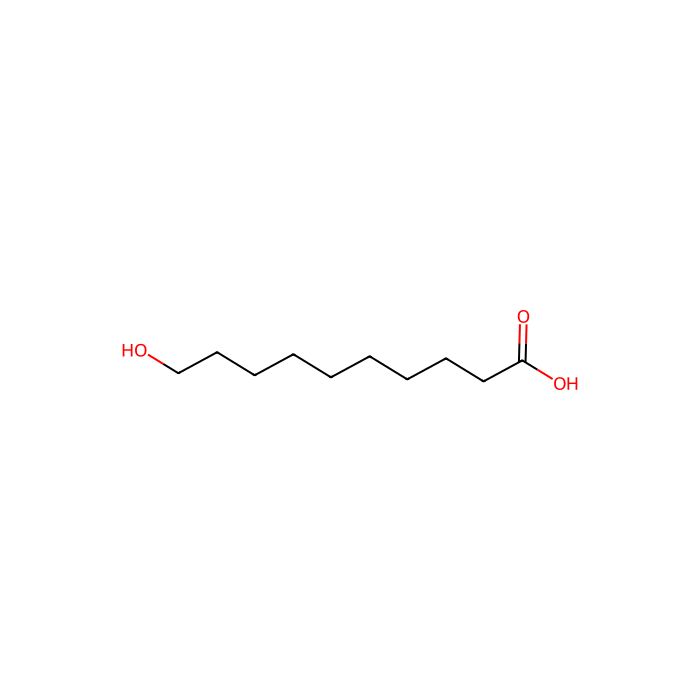
A linear ω-hydroxy fatty acid bearing a terminal primary alcohol and a terminal carboxylic acid on a 10‑carbon aliphatic chain (HO–CH2–(CH2)8–C(=O)OH).
InChIKey: Not specified for this item; refer to CoA/Spec Sheet. (Product Data field provided is non-standard)
SMILES (literature/typical): OCCCCCCCCC(=O)O
Molecular formula (literature): C10H20O3
Molecular weight (literature): ~188.27 g/mol
Structural features:
One terminal primary alcohol (–CH2OH)
One carboxylic acid (–C(=O)OH)
Saturated aliphatic C10 backbone; no rings, no stereocenters
Amphiphilic character: polar termini separated by a hydrophobic methylene spacer
2D description in words: a straight, saturated 10‑carbon chain with a carboxyl group at one end and a hydroxymethyl group at the opposite end (an ω‑hydroxy monocarboxylic acid).
Synthetic Utility
Key reactivity derives from orthogonal termini (primary alcohol and carboxylic acid) on a hydrophobic spacer:
Selective protection strategies:
Protect –CO2H as methyl/benzyl esters (MeI/K2CO3; BnBr/NaH; or Fischer) to enable ω‑OH functionalization (e.g., silylation, tosylation).
Protect –CH2OH as silyl ethers (TBS/TBDPS) to enable acyl activation/coupling at –CO2H.
Transformations:
Oxidize –CH2OH → –CO2H to give decanedioic acid (sebacic acid) using TEMPO/NaOCl/NaClO2 sequences or greener electrochemical methods.
Convert –CO2H to acid chloride (SOCl2, Ghosez’s reagent) for downstream amide/ester formation; or use Steglich esterification (DCC/DMAP) under mild, anhydrous conditions.
Activate ω‑OH via tosylation/mesylation or Appel iodination, enabling nucleophilic substitution (e.g., azide, thiol) to introduce end‑group functionality.
Intramolecular esterification to macrocyclic lactone; equilibria can be driven by azeotropic water removal or coupling agents.
Retrosynthetic value: Serves as a masked C10 spacer with dual handles for convergent assembly, surface immobilization, and polymer end‑group engineering.
Target Specificity
Not applicable. This product is a small‑molecule chemical reagent, not a biological targeting reagent (e.g., antibody, ligand with defined receptor selectivity). No target specificity data are provided in the Product Data.
We use cookies to ensure the website functions properly and, where permitted, to improve your experience. You can manage your preferences at any time in Settings. Learn more in our Cookie Policy.
Shall we send you a message when we have discounts available?
Remind me later
Thank you! Please check your email inbox to confirm.
Products are supplied to verified businesses, institutions, and qualified professionals for research and development use only. Not for use in humans, animals, diagnosis, or therapy.

 H2505084