≥95% for sensitive chromatographic and analytical workflows requiring minimal baseline interference.
🌡
Storage & shipping
Room temperature Ships Check lot-specific COA for exact specifications.
📋
Quality documents
SDS, COA, datasheet, and spec sheet available for download. Lot-specific COA accessible via lot number lookup.
📚
Literature proof
Cited in 0 peer-reviewed publications across chromatography, organic synthesis, and cross-coupling reactions.
Panoramica
Description
This coupling agent is an "hydrophobic ether" and gives very good results in the non-covalent immobilization (hydrophobic and pi stacking interactions) of proteins like antibodies.
Certificati (CoA, COO, BSE/TSE e tabella di analisi)
C of A & Other Certificates(BSE/TSE, COO):
Analytical Chart:
Proprietà chimiche e fisiche
Punto di infiammabilità (°F)
Not applicable
Punto di infiammabilità (°C)
Not applicable
Calcolatori di soluzioni
Molarity Calculator
Determine the necessary mass, volume, or concentration for preparing a solution.
Dilution Calculator
Determine the dilution needed to prepare a stock solution.
Reconstitution Calculator
Recensioni
Recensioni dei clienti
Application Protocols
No item-specific, validated application protocols were provided. The following is general, non-binding guidance for surface modification using trialkoxysilanes:
Glass/SiO2 silanization (solution phase):
Clean substrates (plasma or oxidizing wet clean), rinse, and dry at 120 °C for 15–30 min.
Prepare 1% (w/v) silane in anhydrous toluene under N2. Optionally pre-equilibrate solvent over 3 Å sieves.
Immerse substrates 30 min at RT with gentle agitation in a dry environment.
Rinse with toluene, then IPA. Blow dry with N2.
Cure at 110–120 °C for 30–60 min.
Vapor-phase silanization:
Place dried substrates in a desiccator with an open vial of neat silane.
Evacuate and backfill with dry N2 three times, then hold under vacuum or slow N2 flow at 80–100 °C for 1–2 h.
Vent with dry N2, remove, and cure at 110 °C for 30 min.
Optional SNAr post-functionalization of surface aryl group:
Immerse coated substrate in 0.05–0.5 M amine (or thiol) in dry DMF with 1–2 equiv base.
React at 60–80 °C for 2–6 h.
Rinse with DMF, MeOH, and acetone; dry with N2.
Adapt concentrations/times to substrate geometry and performance metrics. Verify outcomes by contact angle/XPS. For definitive, lot-specific instructions, consult the product CoA.
Biological Roles
This compound is an engineered organosilane for materials/surface science. It has no known natural biological role, metabolic pathway, or enzymatic function.
General considerations relevant to bio-facing applications (non-clinical):
Surface interactions: Fluorinated aryl termini typically present low surface energy and can reduce nonspecific protein adsorption on modified substrates relative to hydrocarbon-terminated silanes. The exact effect depends on film density, roughness, and medium composition; verify with protein adsorption assays (e.g., QCM-D, SPR, BCA wash tests).
Post-functionalization: The pentafluorophenyl ring can be derivatized by nucleophiles (amines/thiols) via SNAr, enabling covalent immobilization of biomolecules after appropriate linker design. Reaction conditions must be biocompatible if performed on bio-sensitive devices (e.g., buffered DMF co-solvent at moderate temperature).
Biostability: Siloxane bonds to oxide surfaces are generally robust in neutral/weakly acidic aqueous media but can hydrolyze under strong base or at high temperatures. Aryl-ether termini are typically stable in aqueous buffers.
No medical, diagnostic, or therapeutic uses are claimed or supported for this product. It is intended strictly for research and laboratory applications, including preparation of surfaces used in bioanalytical instrumentation.
Buffer Applications
Not typically applicable. This product is not a buffering reagent and is moisture-reactive, making it unsuitable for direct use in aqueous buffer preparation.
Practical note:
If performing post-functionalization of the perfluoroaryl terminus on a silanized surface, reactions may be conducted in mixed organic/aqueous systems with careful control (e.g., DMF with small amounts of aqueous buffer) after the silane layer is immobilized and cured. Maintain conditions that do not compromise the siloxane linkage (avoid strong base, prolonged exposure to pH > 10).
For buffer preparation needs, select appropriate buffering agents (e.g., phosphate, HEPES, MOPS) unrelated to this product.
Green Alternatives
Assessment context: This product is a trimethoxy silane coupling agent used primarily for surface modification. Greenness considerations focus on solvent choice, hydrolysis byproducts, and alternative silane chemistries.
Intrinsic profile (general): Trimethoxysilanes hydrolyze to methanol (a lower-toxicity alcohol) and silanols, which condense to Si–O–Si. This is generally preferable to trichlorosilanes, which release HCl and can generate chlorinated wastes.
Greener process options (literature/practice):
Solvent selection:
Prefer biorenewable ethers/hydrocarbons such as 2-methyltetrahydrofuran (2-MeTHF) or cyclopentyl methyl ether (CPME) over toluene/CH2Cl2 when compatible with film quality.
Heptane (normal or iso-) can substitute for hexane with similar performance but reduced volatility.
Deposition mode:
Vapor-phase silanization can reduce solvent use and waste generation while improving uniformity; ensure efficient off-gas treatment for methanol.
Alternative chemistries:
Alkoxysilanes (this product) vs trichlorosilanes: choose alkoxy for reduced corrosivity and safer handling.
Aqueous/ethanolic deposition is generally not recommended here due to rapid hydrolysis/polymerization; if pursued, tightly control water content and temperature to minimize waste.
Tradeoffs:
2-MeTHF/CPME may alter hydrolysis/condensation kinetics and wetting; pilot tests are needed to confirm monolayer quality.
Lower-volatility solvents reduce emissions but may require higher temperatures or longer times.
Documentation:
Track solvent volumes, recovery, and emissions; implement molecular-sieve drying and solvent recycling to further improve process sustainability.
Pharmaceutical Uses
This product is not an API and has no pharmacopeial monograph specified. It is not intended for human or animal use in therapeutic, diagnostic, or clinical applications.
Relevant non-clinical/industrial roles (general):
As a surface primer/coupling agent in device or component manufacturing to tailor adhesion, wettability, and contamination resistance on oxide-containing substrates.
Potential use in microfluidic and analytical instrumentation surfaces where controlled surface energy is critical (research/manufacturing contexts only).
Compliance and documentation:
If used in regulated manufacturing settings, qualification requires internal validation and supplier documentation (CoA, TSE/BSE statements if applicable, residual solvent profiles). None are specified here—consult the CoA/Spec Sheet.
No claims are made regarding GMP status, biocompatibility standards, or medical device approvals for this item.
Physical Properties
Item-specific specifications:
Appearance: Not specified for this item; refer to CoA/Spec Sheet.
Molecular Formula: Not specified for this item; refer to CoA/Spec Sheet. (See computed value under Structure & Identity.)
Molecular Weight: Not specified for this item; refer to CoA/Spec Sheet. (See computed value under Structure & Identity.)
Boiling point, melting point, density, refractive index, UV cutoff, water/peroxide/metal content: Not specified for this item; refer to CoA/Spec Sheet.
General/literature guidance for similar trialkoxysilanes (non-specification):
Physical state: typically colorless to pale yellow liquids of moderate viscosity.
Solubility: miscible with common anhydrous organic solvents (toluene, hexane, heptane, CH2Cl2, THF). Reacts/hydrolyzes in water and alcoholic media, especially with added acid/base.
Hydrolytic behavior: Si–OCH3 groups hydrolyze to silanols with trace moisture, liberating methanol; subsequent silanol condensation forms siloxane networks.
Volatility: lower than short-chain trialkoxysilanes due to C11 spacer and aryl terminus; suitable for solution- or vapor-phase deposition with controlled conditions.
Practical implications:
Handle and measure under dry atmosphere to minimize premature hydrolysis.
Pre-dry solvents (molecular sieves) if quantitative monolayer control is required.
Avoid reporting the above as specifications; consult the CoA/SDS for authoritative values.
Quality and Grades
Item-specific grade/purity and stabilizer information:
Grade/Purity: Not specified for this item; refer to CoA/Spec Sheet.
Stabilizers/inhibitors: Not specified for this item; refer to CoA/Spec Sheet.
General guidance for this class (trialkoxysilane coupling agents):
Typical grading: “reagent grade” or “surface modification grade.” High-purity silanes minimize adventitious silanols and oligomers that can cause non-uniform films or particle bridging.
Moisture content: Low water content is critical; hydrolyzed material leads to pre-condensed siloxanes. Vendors may package under inert gas and include desiccants. Always verify by CoA.
UV/LC suitability: If using in analytical contexts (e.g., as derivatization reagent), opt for material verified by NMR/GC and low-UV background; HPLC-grade solvents are recommended for solution processing, but this product is not itself an HPLC solvent.
Stabilizers: Some alkoxysilanes are shipped with traces of acid or methanol to improve shelf life. Presence/absence and type of stabilizer significantly affect curing kinetics and film quality; confirm on the CoA.
Practical QA tips:
Inspect for haze/gel or increased viscosity—indicators of partial condensation. Perform quick 1H/29Si NMR or GC to assess integrity if critical.
Filter working solutions (0.2 µm PTFE) immediately before use to remove particulates/oligomers.
Record batch/lot and humidity/temperature history during critical surface-modification campaigns.
Reaction and Applications
Focus: Surface modification/coupling chemistry on oxide-bearing substrates.
Key application domains (materials science):
Silanization of SiO2, glass, Al2O3, TiO2, and metal oxides to create low-surface-energy, fluorinated aryl ether–terminated monolayers and thin films.
Anti-fouling and low-adhesion coatings; perfluoroaryl terminus reduces surface energy and can mitigate nonspecific adsorption in analytical devices (general observation; verify in your system).
Post-deposition derivatization via SNAr: the pentafluorophenyl ring retains fluorine atoms (typically para most activated) that can be displaced by nucleophiles (amines, thiols), enabling modular attachment of functionalities after silane anchoring.
Practical tips (general):
Substrate preparation: aggressive cleaning (oxygen plasma or freshly prepared oxidizing solutions) increases surface Si–OH density. Exercise extreme caution with strong oxidants, and thoroughly rinse/dry.
Deposition: 0.5–2% silane in anhydrous toluene/heptane; 15–60 min immersion or recirculation; maintain low humidity. Gentle heating (40–70 °C) can improve ordering.
Curing: 100–120 °C for 15–60 min to drive siloxane condensation and increase film robustness.
Rinsing: sequential rinses in the deposition solvent and a polar rinsing solvent (e.g., isopropanol) remove physisorbed material; final dry under N2.
Avoid over-concentration or prolonged times that foster polymeric siloxane deposition (haze, particulates).
Beyond surfaces:
Primer in composite manufacturing where oxide fillers require organophilic interfaces.
Patternable layers via microcontact printing or masked vapor-phase deposition.
Note: No manufacturer-specific application notes were provided; adapt these general practices to your equipment and substrate, and verify with contact angle, XPS/ToF-SIMS, and ellipsometry.
Reaction Conditions
General conditions for surface silanization (literature/practice; non-specification):
Substrate activation: Oxygen plasma (30–120 s) or oxidizing wet clean to increase –OH density. Rinse thoroughly and dry at 110–150 °C to remove adsorbed water while retaining reactive surface hydroxyls.
Solution-phase deposition: 0.5–2% (w/v) silane in anhydrous toluene or heptane; optional 0.05–0.2% controlled water content to initiate hydrolysis. Immerse 15–60 min at RT to 70 °C under dry N2. Agitation improves uniformity.
Vapor-phase deposition: Place substrates with a small reservoir of neat silane in a dry chamber; 60–120 °C for 0.5–2 h under reduced pressure or flowing dry N2. Minimizes polymeric byproducts.
Curing: 100–120 °C for 15–60 min in dry oven to strengthen Si–O–surface bonds and crosslink adjacent silanols.
Post-treatment: Rinse with deposition solvent followed by IPA/acetone; dry with N2. Characterize by static/dynamic contact angles, XPS (F 1s ~688–689 eV, Si 2p), and ellipsometry.
Post-functionalization of perfluoroaryl terminus (SNAr; general guidance):
Nucleophiles: primary/secondary amines, thiols.
Solvent: dry DMF, DMSO, or NMP; for surface reactions, co-solvents (THF/MeCN) can aid wetting.
Base: triethylamine or inorganic base (K2CO3) as appropriate.
Temperature/time: 40–100 °C, 1–24 h depending on nucleophile and desired substitution degree.
Workup: rinse thoroughly with polar and nonpolar solvents to remove physisorbed reagents.
Cautions:
Excess water or prolonged times promote bulk polymerization/particle formation.
Strong base or high-temperature aqueous environments can degrade siloxane linkages—optimize to preserve the film.
Safety and Handling
Item-specific hazard information (from Product Data):
Signal word: Not specified for this item; refer to SDS.
H-statements: Not specified for this item; refer to SDS.
GHS classification/pictograms: Not specified for this item; refer to SDS.
General safety guidance for trialkoxysilanes with methoxy groups (literature/practice; not product-specific):
Primary hazards: flammable organic liquid (many trialkoxysilanes are flammable); moisture-reactive—hydrolysis liberates methanol (toxic, flammable). Vapors may irritate eyes and respiratory tract.
PPE: chemical-resistant gloves (e.g., nitrile), splash goggles, lab coat; use in fume hood.
Handling: minimize exposure to ambient humidity. Open only in dry environment (desiccator/Ar glovebox or quickly under dry N2). Wipe threads and recap tightly. Use dry syringes or positive-displacement pipettes.
First aid (overview; defer to SDS):
Inhalation: move to fresh air; seek medical attention if symptoms persist.
Skin/eye contact: rinse immediately with water for ≥15 minutes; remove contaminated clothing; obtain medical attention.
Ingestion: rinse mouth; do not induce vomiting; seek medical attention.
Fire: use CO2, dry chemical, or foam. Combustion/thermal decomposition may release SiOx, COx, HF (from perfluoroaryl) and methanol.
Spills: contain with inert absorbent, avoid water additions that can accelerate hydrolysis/condensation; collect for disposal.
Always consult the product SDS for authoritative hazard classifications and response procedures.
Solvent Selection
Applicability: This is a hydrophobic, moisture-sensitive trialkoxysilane. Solvent choice strongly influences hydrolysis rate, film morphology, and surface coverage.
General miscibility/polarity (literature/practice):
Alcohols (MeOH, EtOH, i-PrOH): promote hydrolysis; occasionally used deliberately with controlled water for solution-phase silanization but reduce shelf-life of stock solutions.
Water: not a solvent—causes rapid hydrolysis and condensation.
Selection guidance for common use-cases:
Dense monolayers on silica/glass: anhydrous toluene or heptane with controlled adventitious water; 0.5–2% (w/v) silane, room temp to 70 °C.
Vapor-phase deposition: neat or diluted silane under reduced pressure or dry N2 at 60–120 °C for uniform coverage and minimal polymerization.
Post-functionalization SNAr on the perfluoroaryl terminus: polar aprotic media (DMF, DMSO, NMP) after surface immobilization, using nucleophiles (amines/thiols).
Comparison notes (literature/general):
Toluene vs heptane: toluene increases hydrolysis rate slightly and solvates byproducts; heptane slows hydrolysis and can yield smoother films on sensitive substrates.
CH2Cl2: good wetting on microstructures; faster evaporation can cause non-uniformities without controlled humidity.
Always dry solvents thoroughly (3 Å molecular sieves) and store over inert gas. Validate solvent effects empirically on your substrate geometry.
Storage and Reconstitution
Item-specific instructions from Product Data:
Storage conditions: Room temperature.
Shipped in: Not specified for this item; refer to CoA/Spec Sheet.
General best practices for this moisture-sensitive alkoxysilane (non-specification):
Keep container tightly closed under dry inert gas (N2/Ar). Store in a desiccator or dry cabinet away from humidity and direct sunlight.
After opening, promptly recap; consider aliquoting into dry, amber vials to minimize headspace moisture ingress. Use septum-sealed bottles for syringe transfer when possible.
If increased viscosity, haze, or gel appears, material may have partially condensed—evaluate before critical use.
Do not refrigerate in humid environments without secondary containment; condensation on warming can ruin material.
No reconstitution is required; use neat or prepare anhydrous solutions immediately prior to deposition. Discard aged solutions, especially in alcoholic media.
Disposal: Treat as organic silicon-containing waste; quench small residues by controlled hydrolysis in a fume hood, then follow institutional hazardous-waste procedures.
Always refer to the product CoA and SDS for definitive storage, stability, and handling information.
Structure and Identity
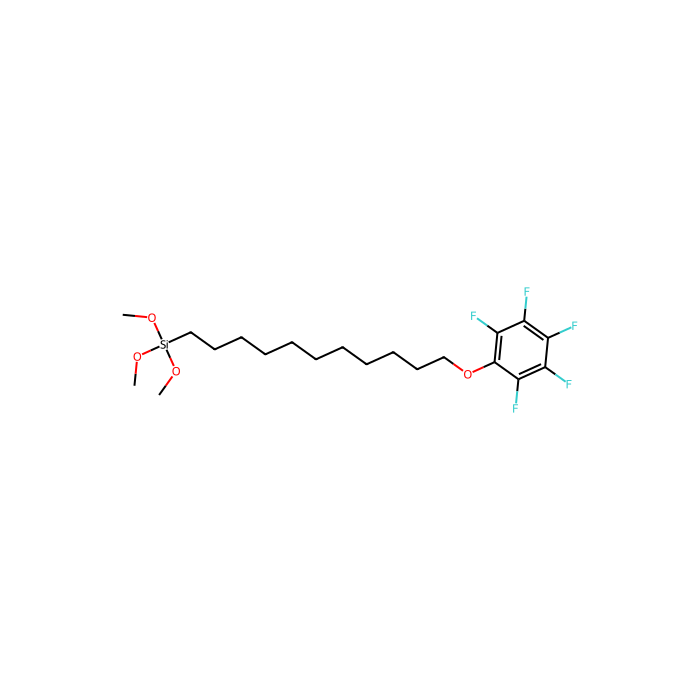
Overview: 11-Pentafluorophenoxyundecyltrimethoxysilane is a trialkoxysilane coupling agent comprising a trimethoxysilyl headgroup connected via an eleven‑carbon alkyl spacer to a terminal pentafluorophenoxy moiety. Designed for covalent attachment to oxide surfaces (e.g., SiO2, glass, metals with native oxides), it furnishes a fluorinated aryl ether terminus that imparts low surface energy and enables post-functionalization by SNAr.
2D description: A trimethoxysilyl group at one end, bonded to a linear undecamethylene chain (–(CH2)11–) that terminates in an ether oxygen attached to a pentafluorophenyl ring (five F substituents on the phenyl). No stereocenters.
Notes:
No item-specific spectral or structural certifications are provided here; consult the product CoA for definitive identifiers.
Synthetic Utility
Chemotype-driven reactivity (general):
Silane anchoring: The Si(OCH3)3 group hydrolyzes to silanols that condense with surface –OH groups on oxides, forming covalent Si–O–surface linkages. This is the foundation of its utility in building monolayers and interphases.
Spacer design: The C11 alkyl spacer provides conformational flexibility and distance from the surface, reducing steric hindrance and allowing the terminal aryl ether to express its properties at the interface.
Perfluoroaryl terminus: Electron-deficient aryl ring activates the remaining C–F bonds toward nucleophilic aromatic substitution (SNAr). After immobilization, one or more ring fluorines (often para to the –O– linkage) can be selectively displaced by amines or thiols, enabling secondary functionalization while preserving the underlying siloxane bond.
Use cases in synthesis/materials:
Construction of fluorinated self-assembled monolayers (SAMs) on silica/glass for contact-angle patterning and microfabrication.
Fabrication of reactive platforms for post-grafting of amines/thiols (e.g., tethering of fluorophores, affinity ligands) via SNAr on the pentafluorophenyl group.
Primer layers to compatibilize inorganic fillers with fluorinated or hydrocarbon matrices in composites.
Advantages vs alternatives:
Trimethoxy variant offers milder byproducts (methanol) and broader solvent compatibility than trichlorosilanes (which evolve HCl and demand stricter anhydrous handling).
The perfluoroaryl end-group combines low surface energy with chemical reactivity, unlike perfluoroalkyl-terminated silanes that are largely inert.
Target Specificity
Not applicable. This product is a small-molecule surface modifier, not a biological affinity reagent. No antigen/epitope/clone/isotype information is associated with this item.
We use cookies to ensure the website functions properly and, where permitted, to improve your experience. You can manage your preferences at any time in Settings. Learn more in our Cookie Policy.
Shall we send you a message when we have discounts available?
Remind me later
Thank you! Please check your email inbox to confirm.
Products are supplied to verified businesses, institutions, and qualified professionals for research and development use only. Not for use in humans, animals, diagnosis, or therapy.