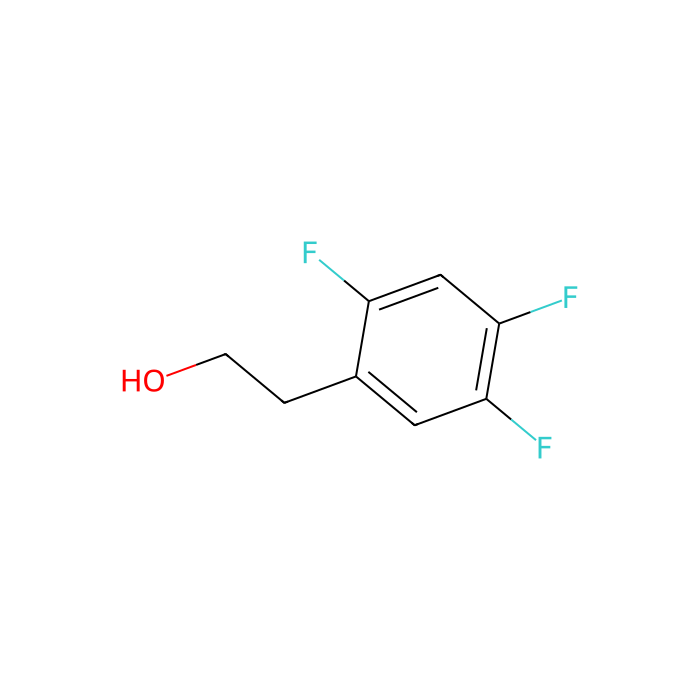
This compound belongs to the class of organic compounds known as fluorobenzenes. These are compounds containing one or more fluorine atoms attached to a benzene ring.
External Descriptors
Not available
1. Djoumbou Feunang Y, Eisner R, Knox C, Chepelev L, Hastings J, Owen G, Fahy E, Steinbeck C, Subramanian S, Bolton E, Greiner R, and Wishart DS. ClassyFire: Automated Chemical Classification With A Comprehensive, Computable Taxonomy. Journal of Cheminformatics, 2016, 8:61.
Certificati (CoA, COO, BSE/TSE e tabella di analisi)
C of A & Other Certificates(BSE/TSE, COO):
Analytical Chart:
Proprietà chimiche e fisiche
Peso molecolare
176.140 g/mol
XLogP3
1.800
Hydrogen Bond Donor Count
1
Hydrogen Bond Acceptor Count
4
Rotatable Bond Count
2
Exact Mass
176.045 Da
Monoisotopic Mass
176.045 Da
Topological Polar Surface Area
20.200 Ų
Heavy Atom Count
12
Formal Charge
0
Complexity
142.000
Isotope Atom Count
0
Defined Atom Stereocenter Count
0
Undefined Atom Stereocenter Count
0
Defined Bond Stereocenter Count
0
Undefined Bond Stereocenter Count
0
The total count of all stereochemical bonds
0
Covalently-Bonded Unit Count
1
Calcolatori di soluzioni
Molarity Calculator
Determine the necessary mass, volume, or concentration for preparing a solution.
Dilution Calculator
Determine the dilution needed to prepare a stock solution.
Reconstitution Calculator
Recensioni
Recensioni dei clienti
Application Protocols
No bioassay or immunoassay protocols are associated with this small-molecule reagent. For synthetic use, see the Reaction Conditions, Reaction & Applications, and Synthetic Utility sections for detailed guidance. For analytical method development, typical starting points include:
NMR preparation: 10–30 mg/mL in CDCl3 or DMSO-d6; acquire 1H, 13C, and 19F spectra.
HPLC/LC–MS: C18 column, starting 50:50 water/acetonitrile (0.1% formic acid if compatible), gradient to high organic; detect by UV (typically 210–230 nm and 254 nm) and MS (ESI+/-). Adjust conditions to your detector and purity needs.
Item-specific tested applications/dilutions: Not specified for this item; refer to CoA/Spec Sheet.
Biological Roles
This product is intended for research use only and is not a biological buffer or metabolite standard.
General notes (literature context; no clinical claims)
Structural motif: Aryl–CH2–CH2–OH fragments occur in bioactive scaffolds; multiple ring fluorines can tune lipophilicity, membrane permeability, and metabolic stability via C–F effects.
Metabolism (conceptual): Primary aliphatic alcohols are commonly oxidized by alcohol/aldehyde dehydrogenases to aldehydes/acids in vivo; however, fluorination of the aromatic ring can affect binding and clearance. No specific biological role is established for this compound.
Use in discovery: Serves as a fluorinated handle for late-stage derivatization toward esters, ethers, carbamates, or ureas that probe ADME properties in medicinal chemistry campaigns.
Item-specific biological activity data: Not specified for this item; refer to primary literature if needed.
Note: Not for human or veterinary use. For laboratory research only.
Buffer Applications
This compound is a hydrophobic benzylic alcohol and is not used as a buffering agent. It does not form classical conjugate acid/base pairs with suitable pKa near physiological pH.
Practical guidance
If aqueous handling is required (e.g., biological assays), use appropriate cosolvents (DMSO, ethanol) and dilute into buffer with vigorous mixing to avoid precipitation.
For pH-sensitive derivatizations, select standard buffers (e.g., phosphate, acetate) appropriate to the reaction chemistry; the compound itself is not a buffer component.
Green Alternatives
While the compound itself is a specific fluorinated building block (no direct “green substitute”), greener choices can be made around its use—particularly solvent selection and oxidation/activation chemistry.
Greener choices (literature guidance)
Solvents:
Prefer ethyl acetate, 2-MeTHF, or CPME over dichloromethane and DMF when feasible (e.g., for extractions and some coupling/protection steps).
Use ethanol or isopropanol for recrystallization/processing when compatible; avoid chlorinated solvents for routine workups.
Oxidations:
TEMPO/bleach (NaOCl) or O2/TEMPO systems in biphasic water/EtOAc or MeCN can replace chromium(VI) reagents for ROH → RCHO/RCO2H.
Catalytic IBX/DMP mimics or electrochemical oxidations reduce waste vs stoichiometric reagents.
Alcohol activation:
Carbonate formation (e.g., using organic carbonates) or enzymatic esterifications can be lower-impact alternatives to sulfonyl chlorides.
DCM vs EtOAc: EtOAc rated greener (lower toxicity, biodegradable), but may offer lower solvency; evaporates more slowly.
DMF/DMSO vs MeCN/2-MeTHF: MeCN and 2-MeTHF often score better on EHS metrics; check solubility and reaction performance.
Trade-offs
Some green solvents may alter chemoselectivity or rates (e.g., Mitsunobu often optimized in THF/PhMe). Pilot small-scale trials are recommended before process adoption.
Pharmaceutical Uses
No pharmacopeial/excipient listing is provided for this item; it is supplied for research use as a synthetic building block.
General formulation/manufacturing relevance (literature guidance; no therapeutic claims)
Medicinal chemistry intermediate: The primary alcohol enables rapid generation of prodrugs (esters, carbonates) or polarity-modulating ethers. The 2,4,5-trifluoro aryl ring can modulate potency and metabolic stability in candidate series.
Linker chemistry: The –CH2–CH2–OH side chain supports attachment to carriers or tags (e.g., PEGylation via carbonate formation) for assay probes.
Analytical standards: May serve as a reference material for method development in LC–MS when studying fluorinated aryl alcohols (matrix-dependent; purity and stability should be verified on CoA/SDS).
Item-specific pharma/excipient status: Not specified for this item; refer to CoA/Spec Sheet and applicable pharmacopeias if needed for regulated work.
Physical Properties
Item-specific properties
Appearance: Not specified for this item; refer to CoA/Spec Sheet.
Grade/Purity: Not specified for this item; refer to CoA/Spec Sheet.
Computed/literature values (typical; for reference only unless otherwise stated on the CoA)
Physical state: likely a colorless liquid at RT (literature expectation for analogous phenethyl alcohols), but this item’s state is Not specified for this item; refer to CoA/Spec Sheet.
Molecular weight: ~176.13 g/mol (computed from C8H7F3O).
Boiling point: Not specified for this item; refer to CoA/Spec Sheet. (Literature for similar trifluorophenethyl alcohols often falls in the 200–230 °C range at ambient pressure.)
Melting point: Not specified for this item; refer to CoA/Spec Sheet.
Density: Not specified for this item; refer to CoA/Spec Sheet.
Refractive index (nD): Not specified for this item; refer to CoA/Spec Sheet.
Vapor pressure: Not specified for this item; refer to CoA/Spec Sheet.
Solubility: miscible with many polar aprotic organics (e.g., DMSO, DMF, acetone) and moderately soluble in alcohols/ethers; low aqueous solubility typical for aryl alcohols with multiple fluorines (literature, qualitative).
LogP: expected moderate lipophilicity due to aryl F substitution (literature/estimation). Specific value Not specified for this item; refer to CoA/Spec Sheet.
pKa (ROH): primary aliphatic alcohols typically pKa ~16–18 in water and ~29–31 in DMSO (literature); fluorinated aryl ring has minimal impact on ROH acidity.
Note: Use the product’s CoA/Spec Sheet for authoritative specifications in regulated or quantitative work.
Quality and Grades
Item-specific grade/purity: Not specified for this item; refer to CoA/Spec Sheet.
How to interpret common grades (general guidance)
Research grade: suitable for most synthetic and discovery workflows; impurity profile adequate for general lab use.
Purified/assay-specified (e.g., ≥95%, ≥98%): indicates chromatographic or NMR/GC-assayed purity suitable for structure–activity work, method development, and building-block synthesis.
HPLC grade (for solvents) / Low-UV grade: emphasizes minimal UV-absorbing impurities for chromatographic detection; not typically applicable to a neat building block.
Stabilizers/inhibitors: If present (e.g., BHT), they should be declared on the label/CoA; none are specified for this item.
What to check on receipt
Verify CAS (883267-70-7), appearance, and assay method on the CoA.
Review residual solvent levels, water content (Karl Fischer), and any specified metals/halide/byproduct limits if reported. If no limits are listed: Not specified for this item; refer to CoA/Spec Sheet.
For sensitive applications (e.g., catalysis, medicinal chemistry SAR), consider in-house QC: 1H/13C/19F NMR, LC–MS, GC, and water by KF.
Note: Do not infer unstated specifications. Use the supplied CoA as the controlling document for quality release.
Reaction and Applications
This benzylic primary alcohol is a versatile building block; the electron‑withdrawing 2,4,5‑trifluoro substitution modulates both ring reactivity and benzylic transformations.
PCC, Dess–Martin periodinane (DMP), or Swern oxidation to give 2-(2,4,5-trifluorophenyl)acetaldehyde; further oxidation (e.g., NaClO2, Jones) affords the acid.
Activation of the alcohol:
Sulfonylation (TsCl/MsCl) or halogenation (PBr3, SOCl2) to access benzylic electrophiles for SN2/SN1 reactions or for subsequent cross-couplings via displacement.
Mitsunobu reactions:
Inversion-enabled substitution with O/N/S nucleophiles to generate ethers, esters, or amines under DEAD/DIAD and PPh3 conditions.
Protection strategies:
Silyl ethers (TBSOTf/TBDPSCl) for compatibility with bases; benzyl or p-methoxybenzyl ethers as alternative protecting groups.
Oxidative coupling / C–C formation:
Oxidative benzylic C–C couplings (e.g., with hypervalent iodine) or conversion to aldehyde followed by Wittig/olefination.
Metalation on the ring:
Directed ortho-metalation is deactivated by multiple fluorines, but halogen–lithium exchange or magnesium insertion on pre-halogenated analogs can be leveraged (fluorines influence regioselectivity and stability of intermediates).
Applications
Medicinal chemistry: fluorinated phenethyl motifs probe potency/metabolic stability; alcohol serves as a convergent handle (ester/ether/urea linkages).
Materials/fluorous influence: multiple C–F bonds can impact polarity, refractivity, and thermal behavior of derived polymers or small molecules.
Practical tips
Dry conditions improve yields in sulfonylation/halogenation; scrub acid halide byproducts with base washes.
19F NMR is a powerful diagnostic for regioisomer verification and monitoring transformations.
Reaction Conditions
General literature guidance for typical transformations of benzylic primary alcohols; adjust to your substrate/scope and verify experimentally.
Oxidation to aldehyde (Swern):
Solvent: anhydrous DCM.
Reagents: oxalyl chloride, DMSO (−78 °C), then Et3N.
Temperature: −78 → 0 °C.
Notes: minimal overoxidation; work cold to control exotherm. Typical yields: 70–90% (substrate-dependent).
Oxidation (Dess–Martin periodinane):
Solvent: DCM or acetonitrile, 0–25 °C.
Stoichiometry: 1.3–1.6 eq DMP; 1–3 h.
Tips: Add NaHCO3 to quench; avoid excess base to prevent side reactions.
Alcohol activation (tosylation):
Solvent: DCM or DMF.
Reagents: TsCl (1.1–1.5 eq), pyridine or Et3N (2–3 eq), 0–25 °C.
Time: 1–6 h.
Notes: Ensure dryness; scavenge HCl with base; typical yields 80–95%.
Halide formation (PBr3):
Solvent: ether or DCM, 0–25 °C.
Stoichiometry: 0.33–0.50 eq PBr3 (relative to ROH), base-free.
Outcome: benzylic bromide; sensitive to hydrolysis—use immediately or store cold/inert.
TLC: hexane/EtOAc 3:1 to 1:1 typical; visualize under UV and KMnO4.
NMR: 1H, 13C, and 19F NMR to confirm clean conversion and integrity of aryl F pattern.
Safety and Handling
GHS status (item-specific)
Signal word / H-statements / Pictograms / Classification: Not specified for this item; refer to the SDS for authoritative information.
General safety guidance for aromatic primary alcohols (literature-based; not a substitute for the SDS)
Hazards: May cause irritation to skin/eyes/respiratory tract. Organic liquids may form combustible vapors; keep away from ignition sources.
PPE: Wear lab coat, safety glasses or face shield, and appropriate chemical-resistant gloves (e.g., nitrile). Use in a fume hood to avoid vapor/aerosol exposure.
Handling: Minimize skin contact; avoid breathing vapors/mist. Use dry techniques when moisture-sensitive downstream steps are planned.
Storage: Product Data indicates storage at room temperature under argon (argon-charged). Keep tightly closed, protected from moisture and strong oxidizers. Segregate from strong bases and acid chlorides/anhydrides that may react with alcohols.
Incompatibilities: Strong oxidizers (risk of exothermic oxidation), strong dehydrating agents (formation of ethers/olefins), alkali metals (can react with ROH to form alkoxides and evolve H2).
Spill/first aid (overview): In case of skin/eye contact, rinse with water for 15 minutes; remove contaminated clothing. If inhaled, move to fresh air. If ingested, rinse mouth; do not induce vomiting; seek medical attention. Follow site SOPs.
Always consult the product SDS prior to first use and for emergency response information.
Solvent Selection
Compound role: This substance is itself an organic reagent/building block (primary benzylic alcohol). Solubility behavior should be considered when choosing solvents for reactions or analytics involving it.
Polarity and interactions (general):
Capable of hydrogen bonding (donor and acceptor), increasing solubility in polar protic and many polar aprotic media.
Aryl trifluoro substitution increases hydrophobicity relative to non-fluorinated phenethyl alcohols; water solubility is limited.
Limited: alkanes (hexane/heptane); cosolvent may be needed for crystallizations.
Aqueous systems: typically requires cosolvent or surfactant for significant concentrations.
Selection tips by operation:
NMR: CDCl3 or DMSO-d6 capture both aliphatic CH2 and 19F-coupled aromatic signals; consider 19F NMR in CDCl3/acetone-d6 for ring fluorines.
Oxidations/derivatizations: choose DCM or acetonitrile for Dess–Martin/Swern; pyridine/CH2Cl2 or DMF for sulfonylations (TsCl, MsCl).
Purification: normal-phase silica with gradient hexane/EtOAc or hexane/MTBE; polarity adjustable by converting to esters/tosylates if necessary.
Comparison (qualitative):
DCM vs EtOAc: DCM offers better volatility and solvency; EtOAc is greener with higher safety margin.
MeOH/EtOH enable rapid dissolution but may participate in transesterifications during protection steps.
Always confirm compatibility with downstream steps (e.g., base/acid sensitivity, oxidants) before final solvent selection.
Storage and Reconstitution
Item-specific instructions (from Product Data)
Storage conditions: Room temperature, argon charged (store tightly sealed under inert atmosphere to limit oxidative or moisture-related changes).
Shipped in: Normal (ambient conditions).
General handling guidance
Neat liquid/solid handling: If material partially solidifies or shows phase separation at low temperature, gently warm to ambient and mix thoroughly before dispensing.
Inerting: Maintain argon or nitrogen blanket after first opening; consider septum-cap bottles for repeated microsampling.
Moisture control: Although primary alcohols are not highly hydrolyzable, dry handling improves reproducibility for downstream reactions (e.g., sulfonylation, carbamate formation).
Light/air: Store in amber glass if long-term storage is anticipated; minimize headspace oxygen.
Freeze–thaw: Not required; avoid unnecessary refrigeration/ freezing unless specified on the CoA. If refrigerated for stability studies, allow to equilibrate to RT before opening to prevent moisture ingress.
Reconstitution: Not applicable—supplied as a neat compound. For solution preparation, dissolve in a suitable dry solvent (e.g., anhydrous DCM, THF, MeCN, or DMSO) at the desired concentration and use promptly.
Always follow the product label and CoA/SDS for definitive storage and handling instructions.
Structure and Identity
A fluorinated benzylic alcohol building block featuring a 2,4,5-trifluorophenyl ring attached to a two‑carbon ethanol side chain.
Item-specific identifiers (from Product Data):
SKU: T137716
CAS: 883267-70-7
InChIKey: Not specified for this item; refer to CoA/Spec Sheet.
SMILES: Not specified for this item; refer to CoA/Spec Sheet.
Computed/literature identifiers (for reference; verify against CoA if critical):
Molecular formula: C8H7F3O (computed from structure)
Molecular weight: ~176.13 g/mol (computed)
Structural features (general description):
Aromatic ring: monosubstituted phenyl bearing three ring fluorines at the 2-, 4-, and 5-positions (relative to the benzylic side chain).
Side chain: –CH2–CH2–OH (primary alcohol), conferring hydrogen-bond donor/acceptor capability and enabling derivatization (e.g., oxidation, esterification, sulfonate formation).
Functional groups: primary alcohol (aliphatic), aryl C–F bonds (electron-withdrawing, deactivating toward electrophilic aromatic substitution; can direct metalation under strong bases).
Stereochemistry: none (achiral primary alcohol with no stereocenters).
2D description in words: a benzene ring bearing F substituents at positions ortho (2), para (4), and meta (5) to a two-carbon chain terminating in a hydroxyl group.
Synthetic Utility
Key functional elements and reactivity (literature)
Primary alcohol (benzylic): amenable to oxidation (Swern, DMP), activation (tosylation/mesylation), substitution (SN2 with halide/azide after activation), etherification/esterification, and protection (TBS/TBDPS).
Aryl C–F bonds: strongly deactivating toward EAS; influence regioselectivity and acidity of adjacent C–H bonds; enhance stability of the aryl core. Provide distinct 19F NMR handles for characterization and mixture analysis.
Retrosynthetic value
Serves as a convergent point for constructing fluorinated phenethyl derivatives: derive from coupling of a 2,4,5-trifluoroaryl synthon with a C2 alcohol fragment or reduction of the corresponding acid/ester/aldehyde.
Grignard/organolithium: addition of a C2 synthon (e.g., HO–(CH2)2–MgX to 2,4,5-trifluorobenzaldehyde equivalents) followed by workup/protection.
Catalytic hydrogenation: selective reduction of benzylic carbonyl precursors (Raney Ni, Pd/C) to alcohol.
Utility in SAR and materials
The alcohol can be diversified into libraries (esters/carbamates/ethers); the trifluoro pattern allows fine-tuning of electronics and polarity for binding and stability assessments.
Analytical notes
19F NMR provides three distinct aromatic F resonances (often meta/para/ortho-separated), aiding verification of substitution pattern.
Target Specificity
Not an antibody, enzyme, or biological probe with defined target specificity. No antigen/epitope/clone/isotype information applies to this small-molecule building block.
Utilizziamo i cookie per garantire il corretto funzionamento del sito web e, ove consentito, per migliorare la tua esperienza. Puoi gestire le tue preferenze in qualsiasi momento nelle Impostazioni. Per saperne di più, consulta la nostra Cookie Policy.
Desidera che le inviamo un messaggio quando avremo sconti disponibili?
Ricordamelo più tardi
Grazie! Controlli la sua casella di posta per confermare.
Products are supplied to verified businesses, institutions, and qualified professionals for research and development use only. Not for use in humans, animals, diagnosis, or therapy.