Certificati (CoA, COO, BSE/TSE e tabella di analisi)
C of A & Other Certificates(BSE/TSE, COO):
Analytical Chart:
Proprietà chimiche e fisiche
Peso molecolare
173.160 g/mol
XLogP3
1.200
Hydrogen Bond Donor Count
1
Hydrogen Bond Acceptor Count
4
Rotatable Bond Count
3
Exact Mass
173.065 Da
Monoisotopic Mass
173.065 Da
Topological Polar Surface Area
35.300 Ų
Heavy Atom Count
12
Formal Charge
0
Complexity
134.000
Isotope Atom Count
0
Defined Atom Stereocenter Count
0
Undefined Atom Stereocenter Count
0
Defined Bond Stereocenter Count
0
Undefined Bond Stereocenter Count
0
The total count of all stereochemical bonds
0
Covalently-Bonded Unit Count
1
Calcolatori di soluzioni
Molarity Calculator
Determine the necessary mass, volume, or concentration for preparing a solution.
Dilution Calculator
Determine the dilution needed to prepare a stock solution.
Reconstitution Calculator
Recensioni
Recensioni dei clienti
Application Protocols
No tested biological assay protocols (e.g., WB, IHC, IF, FC) are provided for this item. As a small-molecule amine, application protocols depend on the intended synthetic transformation.
General synthetic handling example (illustrative; not item-specific)
Amide coupling setup: To a dry flask under N2, charge carboxylic acid (1.0 eq), Oxyma (1.2 eq), and DMF. Cool to 0–5 °C, add EDCI (1.2 eq) and stir 10 min. Add a solution of the amine (1.2 eq) and DIPEA (3 eq) in DMF, warm to rt, and stir 4–16 h. Quench with sat. NaHCO3, extract with EtOAc, wash, dry, and purify.
Please refer to primary literature and your internal SOPs for detailed, use‑case‑specific procedures.
Biological Roles
Item relevance
This product is a small-molecule building block intended for research and synthesis. No inherent biological function is assigned in the Product Data.
Aryloxyalkylamines appear widely in chemical biology and medicinal chemistry as motifs that engage aminergic GPCRs, transporters, and enzymes; the basic amine interacts via salt bridges/H-bonds while the aryl ether contributes hydrophobic and conformational properties.
Fluorine substituents can modulate pKa, lipophilicity, and metabolic stability by altering C–H acidity and blocking oxidative sites (literature trend). In this scaffold, two aryl fluorines typically reduce electron density of the ring and may impact binding and clearance.
The terminal primary amine can be derivatized into amides/ureas/sulfonamides to probe SAR across protein targets.
Use limitation
Any biological exploration using this compound or its derivatives must be for research use only. No clinical, diagnostic, or therapeutic use is implied or permitted.
Buffer Applications
This compound is not a dedicated buffering reagent. While primary amines can act as weak bases, 2-(2,4-difluorophenoxy)ethanamine is not commonly employed as a buffer component.
Practical notes (general)
For aqueous workups or assays, pH control can be achieved by forming a salt (e.g., hydrochloride) to increase water solubility and maintain protonation state.
If a buffered environment is required during conjugation (e.g., NHS ester coupling), use standard buffer systems (phosphate, HEPES, bicarbonate) and dissolve this amine in a compatible co-solvent (DMSO/MeCN) before addition.
Green Alternatives
Because this product is a reagent/building block (not a process solvent), greener considerations focus on reaction media and coupling systems chosen when using it.
Solvent choices (general guidance)
Favor bio-based or safer solvents where feasible: 2-MeTHF or CPME can replace THF/MTBE in many acylations and reductions; EtOAc can replace DCM for extractions and some couplings; MeOH/EtOH preferred over IPA/AcN for reductive aminations if solubility allows.
Coupling systems
Prefer OxymaPure or ethyl(hydroxyimino)cyanoacetate with EDCI/DIC over HOBt/HOAt (safety concerns with explosive energetics). Employ catalytic DMAP judiciously.
Carbonyl activation via CDI for ureas/carbamates avoids phosgene derivatives; if phosgene equivalents are required, triphosgene is preferred to COCl2, but still handle with extreme caution.
Workup/purification
Salt formation/crystallization may reduce reliance on silica chromatography (lower solvent consumption). Choose counterions with benign EHS profiles (e.g., HCl, p-TsOH depending on context).
Comparison snapshot (literature-based)
THF vs 2-MeTHF: Similar polarity; 2-MeTHF (greener, higher bp, partially bio-derived) often provides comparable outcomes in amide couplings and reductions.
DCM vs EtOAc: EtOAc is less persistent/toxic and often substitutes for DCM in extractions and some reactions; check solubility/kinetics.
General note
Always validate greener swaps on small scale; difluorinated aryl ethers typically tolerate a wide solvent set, giving latitude for greener optimization.
Pharmaceutical Uses
Item-specific
No pharmacopeial grade or excipient status is stated. This product is supplied for research use only.
General/formulation context (not a clinical claim)
As a primary amine building block, 2-(2,4-difluorophenoxy)ethanamine may be converted into amide/urea/sulfonamide intermediates during small-molecule API discovery campaigns.
Salt selection can dramatically affect solid-state properties of derived actives. Formation of simple mineral acid salts (HCl, HBr) or organic acid salts (mesylate, tosylate) is common for improving crystallinity and handling.
In pre-formulation studies, pKa and lipophilicity guide selection of counterions and co-formers for salts/cocrystals (general practice). The difluorophenyl ether can increase hydrophobic interactions, potentially influencing permeability and plasma protein binding of derivatives (literature trend).
Operational guidance
For library synthesis toward ADME screening, convert the free base to diverse amides via parallel coupling (HATU/EDC) in green(er) solvents where possible. Purify by crystallization or minimal chromatography.
Compliance note
This material is not produced or qualified to any pharmacopoeial monograph unless explicitly stated on the CoA/Spec Sheet. No therapeutic or diagnostic use is permitted.
Physical Properties
Item-specific specifications
Appearance: Not specified for this item; refer to CoA/Spec Sheet.
Grade/Purity: Not specified for this item; refer to CoA/Spec Sheet.
Computed/literature values (typical for this structure; not item-specific)
Molecular formula: C8H9F2NO (literature)
Molecular weight: ~173.16 g/mol (calculated from atomic weights)
Acid–base: primary aliphatic amine; conjugate acid pKaH typically ~9–11 (literature range for primary amines). Free base is basic and nucleophilic.
LogP: primary amines on fluorinated aryl ethers often show moderate lipophilicity (estimated cLogP ~1–2; modeling-dependent, literature/computed values vary).
Solubility profile (qualitative): free base is usually miscible with polar organic solvents (MeOH, EtOH, i-PrOH, acetone, CH3CN, DMF, DMSO) and sparingly to moderately soluble in water; protonated salts (e.g., HCl) are freely water-soluble (general amine behavior, literature).
Boiling/melting points and density: Not specified for this item; typical values are not established here; refer to primary literature or CoA for the specific lot.
Refractive index/UV cutoff: Not specified for this item; refer to CoA/Spec Sheet.
General notes
The difluorophenyl ether moiety increases thermal and oxidative stability relative to non-fluorinated analogs, while the terminal –NH2 imparts basicity and hydrogen-bonding capacity (literature trend). Drying over K2CO3 or molecular sieves can reduce adventitious moisture before moisture-sensitive transformations.
Quality and Grades
Item-specific
Grade/Purity: Not specified for this item; refer to CoA/Spec Sheet for assay method, residual solvent profile, and related substances.
Stabilizers/Inhibitors: Not specified for this item; refer to CoA/Spec Sheet.
Guidance on interpreting grades (general; not item-specific)
Research/biochemical grade: Typically indicates high assay and low inorganic/organic impurities suitable for synthetic and discovery workflows.
HPLC/LC–MS grade (if applicable): Solvents and reagents labeled HPLC grade emphasize low UV background and low nonvolatile residue; for amines, low amine-oxidation products is relevant.
Pharmaceutical/compendial grade (USP/EP/JP): Includes defined tests/limits per monographs; not implied for this item unless explicitly stated in CoA/spec.
Analytical control recommendations (general)
Identity confirmation: 1H/13C NMR (amine and ethylene signals; aromatic pattern influenced by F), 19F NMR (two distinct aromatic F), IR (NH2 stretches ~3300–3500 cm−1), MS (M+H+ consistent with literature MW ~174), and HPLC purity.
Residual water/peroxides/metals/UV cutoff: Not specified for this item; refer to CoA/Spec Sheet.
Salt content: Free base versus salt form materially affects solubility and assay—verify the form on the CoA.
Practical notes
If LC–MS quantitation is critical, ensure low residual basic impurities that may coelute. For peptide coupling or API intermediate work, check amine value (titration) and residual inorganic salts.
Reaction and Applications
Use profile (general; extend/modify per project needs)
Versatile primary amine building block for medicinal chemistry and materials functionalization; the aryloxyethyl motif is common in GPCR ligands and agrochemical scaffolds (literature).
Amide formation: With carboxylic acids or acid chlorides using HATU/EDC/DIC + additives (HOAt/HOBt/Oxyma) or acyl chlorides with base (DIPEA, TEA). Enables libraries of benzamides, heteroaryl amides, and peptide-like conjugates.
Urea/carbamate/sulfonamide synthesis: Reaction with carbonyl diimidazole (CDI) or triphosgene (for ureas), chloroformates (carbamates), or sulfonyl chlorides (sulfonamides).
Reductive amination: Condensation with aldehydes/ketones followed by reduction (NaBH3CN/NaBH(OAc)3 or catalytic hydrogenation). Ether oxygen is benign; aryl fluorines are retained under these conditions.
Alkylation: SN2 on activated electrophiles (alkyl halides, epoxides) to give secondary/tertiary amines; control over mono- vs dialkylation via base, stoichiometry, and protecting strategies (Boc).
Protect–deprotect: Boc, Cbz, Fmoc protection to modulate reactivity; deprotections via acid (Boc), hydrogenolysis (Cbz), or base (Fmoc) without cleaving the aryl ether.
Conjugation/linking: The terminal amine enables attachment to resins, dyes, crosslinkers (e.g., NHS esters) for probe synthesis.
Reactivity notes
The difluorophenyl ether is generally stable to bases and nucleophiles; aromatic fluorides typically do not undergo SNAr without a strong –I/–M activator (e.g., NO2) ortho/para to F, which is absent here. Electrophilic aromatic substitution is deactivated by F; metalation requires strong bases/low temperatures.
Practical tips
Use dry conditions to avoid competing ammonium salt formation in acid chloride couplings; pre-base with DIPEA. Monitor by LC–MS (M+H+ ~174, literature).
Reaction Conditions
General conditions (literature guidance; adjust per substrate and scale)
Amide coupling: Carboxylic acid (1.0 eq), amine (1.1–1.5 eq), HATU (1.0–1.2 eq) or EDCI (1.2–1.5 eq) + Oxyma (1.2–1.5 eq); base DIPEA (2.0–3.0 eq); solvent DMF, MeCN, DCM, 2-MeTHF; 0–25 °C, 1–4 h (HATU) or 4–16 h (EDCI). Typical isolated yields 70–95% (literature ranges).
Sulfonamide formation: Sulfonyl chloride (1.0–1.2 eq), base (2–3 eq TEA/DIPEA), DCM/MeCN/EtOAc, 0–25 °C, 1–3 h; often high yields with minimal side reactions.
Urea synthesis: CDI (1.1–2.0 eq) with amine nucleophile in MeCN/DMF, 25–50 °C; or triphosgene (0.5–0.6 eq) with careful temperature control and base.
Reductive amination: Carbonyl (1.0 eq), amine (1.2–2.0 eq), NaBH(OAc)3 (2–3 eq) in MeOH/AcOH or MeCN/AcOH; 0–25 °C, 2–18 h. Alternatively, NaBH3CN in MeOH buffered with AcOH.
N-alkylation: Alkyl halide (1.1–1.5 eq), K2CO3/Na2CO3 (2–3 eq), MeCN/acetone, 25–60 °C, 2–16 h. For selective monoalkylation, protect as Boc-carbamate, then deprotect with TFA in DCM.
Compatibility notes
The aryl ether tolerates bases, many acids (short exposure), and hydrogenation; aryl fluorides persist under these conditions. Avoid strong electrophiles (e.g., neat sulfonylating agents) at elevated temperatures without base.
Workup and isolation
After couplings, wash with aqueous bicarbonate and brine; concentrate and purify by crystallization as HCl salt or by flash chromatography (amine-friendly eluents, e.g., 0.1–1% NH3 in MeOH/CH2Cl2).
Safety and Handling
Authoritative safety data must be taken from the product’s SDS. No GHS details are provided in the Product Data for this item.
Item-specific (from Product Data)
GHS classification, pictograms, signal word, H-statements: Not specified for this item; refer to SDS.
Storage: Room temperature.
General safety guidance for primary aliphatic amines and aryl ethers (literature-based; not item-specific)
Hazards: Primary amines are typically skin/eye irritants and can be harmful if swallowed or inhaled. They may cause respiratory irritation and can be sensitizers in some cases. Avoid contact and inhalation of vapors/aerosols.
PPE: Use chemical-resistant gloves (e.g., nitrile), lab coat, and safety goggles. Handle in a fume hood.
Incompatibilities: Strong oxidizers; acid chlorides, anhydrides, isocyanates (violent exotherms possible); aldehydes/ketones (can undergo imine formation); CO2 can form ammonium carbamates on prolonged exposure to air; cupric and other metals may corrode in presence of amines.
First aid (summary; see SDS for details): If on skin/eyes, rinse with plenty of water for at least 15 minutes; remove contaminated clothing. If inhaled, move to fresh air. If ingested, rinse mouth; seek medical attention.
Spill/Fire: Absorb small spills with inert material. Most amines are combustible; use CO2, dry chemical, or foam. Cool containers with water spray.
Waste: Collect as organic amine waste per local regulations; neutralize only with appropriate controls.
Use restriction
For research use only (per Product Data). Not for human or animal diagnostic or therapeutic use.
Solvent Selection
Compound class considerations
Functional profile: Primary aliphatic amine on an aryloxyethyl scaffold; basic, nucleophilic, and moderately polar with an aromatic lipophilic domain.
Variable/limited: Water for the free base (often modest at neutral pH); the protonated salt (e.g., HCl) is water-soluble.
Partitioning: The difluorophenyl ether increases organic phase affinity; protonation (pH < pKaH) drives the compound into aqueous phase.
Selection guidance by use case
Reaction medium for acylation/sulfonylation/carbamoylation: Use dry DCM, THF, 2-MeTHF, EtOAc, or MeCN with a non-nucleophilic base (DIPEA, i-Pr2NEt) or coupling reagents (see Reaction Conditions).
Reductive amination: MeOH/EtOH or MeCN are common; DMSO/DMF if substrates demand higher polarity.
Salt formation/purification: Dissolve in minimum EtOAc/MTBE, add HCl in dioxane or gaseous HCl to precipitate the amine salt, which can then be filtered.
Workups: Adjust pH to partition the free base (basic wash) vs salt (acidic extraction) as needed.
Comparison points
Versus more hydrophobic arylamines, this substrate is more polar and easier to handle in polar organics.
Versus polyfunctional amino alcohols, absence of free OH avoids self-acylation; ether oxygen remains inert under many coupling conditions.
Storage and Reconstitution
Item-specific
Storage conditions: Room temperature (per Product Data).
Shipped in: Not specified for this item; refer to CoA/Spec Sheet.
Appearance: Not specified for this item; refer to CoA/Spec Sheet.
General handling advice for primary amines (literature; not item-specific)
Store tightly closed in a dry place, preferably under inert gas for long-term stability. Limit exposure to CO2 and moisture to avoid salt/carbamate formation.
If forming a stable solid salt aids storage/handling (e.g., HCl salt), generate and store the salt in sealed containers with desiccant.
Reconstitution/dissolution: Readily dissolves in polar organics (DMSO, DMF, MeOH, EtOH, MeCN). For aqueous applications, dissolve as a protonated salt or prepare acidic aqueous stock and adjust pH immediately before use.
Freeze–thaw: Not generally necessary for small molecules; if preparing concentrated DMSO stocks for screening, aliquot and store at appropriate temperature to minimize freeze–thaw cycles.
Light/oxidation: Aryloxyethylamines are typically stable; store away from strong oxidants. If prolonged storage is expected, amber containers are prudent.
Compliance
For research use only. Consult the SDS for detailed stability, incompatibilities, and transport information.
Structure and Identity
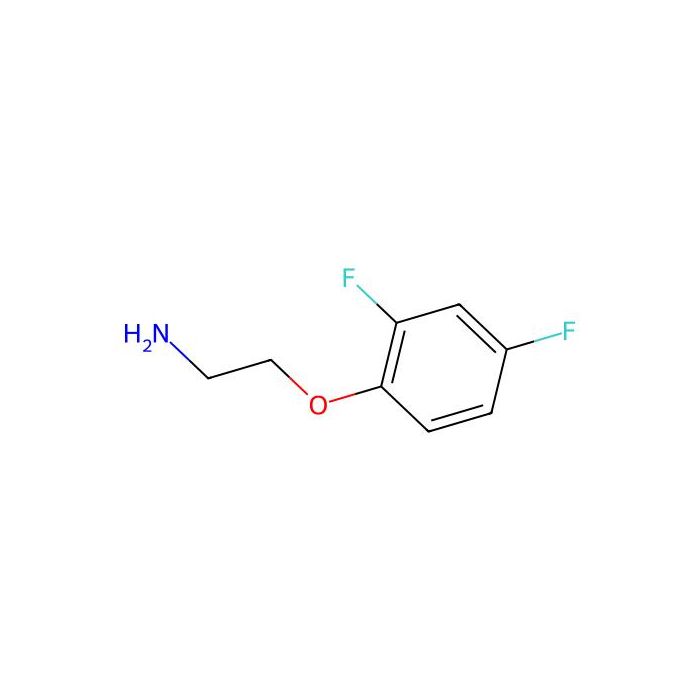
Brief description: 2-(2,4-Difluorophenoxy)ethanamine is an aryloxyethyl primary amine featuring a difluorinated phenyl ring linked through an ether to a two‑carbon chain terminating in –NH2. The molecule combines a nucleophilic, basic amine with a relatively lipophilic, fluorinated aryl ether.
Item-specific identifiers (from Product Data)
Product name: 2-(2,4-Difluorophenoxy)ethanamine
CAS: 762228-01-3
PubChem CID: 16793581
InChIKey: 88998 (as provided)
Storage: Room temperature
Computed/literature structural information (for reference; not item-specific specs)
Core structural features: difluorophenyl ring (F at 2- and 4-positions), phenoxy ether linkage (Ar–O–), ethylene spacer (–CH2–CH2–), terminal primary amine (–NH2).
Stereochemistry: none (achiral; no stereocenters).
2D description in words: a benzene ring bearing F substituents ortho and para to an ether oxygen; the oxygen connects to a –CH2–CH2–NH2 side chain.
SMILES / InChI
SMILES: Not specified for this item; refer to CoA/Spec Sheet.
InChI: Not specified for this item; refer to CoA/Spec Sheet.
Synthetic Utility
Key functional handles
Primary amine (–NH2): nucleophilic, basic; engages in acylation, sulfonylation, carbamoylation, alkylation, reductive amination, and protection chemistry.
Ether linkage (Ar–O–CH2–): generally inert under many coupling conditions; provides a spacer that separates the amine from the aromatic ring, reducing intramolecular side reactions.
Difluoroaryl ring: deactivated toward electrophilic substitution; aryl F atoms are robust leaving groups only under strongly activating SNAr conditions (not typically met here).
Strategic uses (literature/general)
Rapid amide library generation from carboxylic acids (HATU/Oxyma or EDCI/Oxyma) for SAR around an aryloxyethyl headgroup.
Urea/carbamate exploration using CDI or carbonyl diimidazole–derived reagents to tune H-bonding and polarity while maintaining the ether-linked aryl pharmacophore.
Alkylation/manifold expansion: Mono-alkylate under buffered conditions (Na2CO3, MeCN, room temp) or use Boc protection to prevent dialkylation, then deprotect.
Reductive amination to append diverse aldehyde/ketone fragments; NaBH(OAc)3 in AcOH/MeCN or MeOH is a common, mild system compatible with aryl fluorides and ethers.
Conjugation to activated esters (NHS) or isothiocyanates to install tags, linkers, or handles for immobilization.
Downstream diversification
Orthogonal protection allows sequential installation of two distinct functionalities onto the nitrogen, furnishing secondary/tertiary amines or cyclic ureas without perturbing the aryl ether.
Target Specificity
Not applicable. This product is a small-molecule reagent, not a biological macromolecule or antibody. No target, epitope, clone, isotype, or species reactivity data are associated with this item in the Product Data.
We use cookies to ensure the website functions properly and, where permitted, to improve your experience. You can manage your preferences at any time in Settings. Learn more in our Cookie Policy.
Shall we send you a message when we have discounts available?
Remind me later
Thank you! Please check your email inbox to confirm.
Products are supplied to verified businesses, institutions, and qualified professionals for research and development use only. Not for use in humans, animals, diagnosis, or therapy.