≥98% per flussi di lavoro cromatografici e analitici sensibili che richiedono un'interferenza minima della linea di base.
🌡
Stoccaggio e spedizione
Room temperature Spedizione . Consultare il COA specifico del lotto per le specifiche esatte.
📋
Documenti di qualità
SDS, COA, scheda tecnica e scheda delle specifiche disponibili per il download. COA specifico del lotto accessibile tramite ricerca per numero di lotto.
📚
Prova documentale
Citato in 0 pubblicazioni peer-reviewed su cromatografia, sintesi organica e reazioni di accoppiamento incrociato.
This compound belongs to the class of organic compounds known as phenylpropanoic acids. These are compounds with a structure containing a benzene ring conjugated to a propanoic acid.
External Descriptors
Not available
1. Djoumbou Feunang Y, Eisner R, Knox C, Chepelev L, Hastings J, Owen G, Fahy E, Steinbeck C, Subramanian S, Bolton E, Greiner R, and Wishart DS. ClassyFire: Automated Chemical Classification With A Comprehensive, Computable Taxonomy. Journal of Cheminformatics, 2016, 8:61.
Certificati (CoA, COO, BSE/TSE e tabella di analisi)
C of A & Other Certificates(BSE/TSE, COO):
Analytical Chart:
Proprietà chimiche e fisiche
Peso molecolare
186.150 g/mol
XLogP3
2.200
Hydrogen Bond Donor Count
1
Hydrogen Bond Acceptor Count
4
Rotatable Bond Count
2
Exact Mass
186.049 Da
Monoisotopic Mass
186.049 Da
Topological Polar Surface Area
37.300 Ų
Heavy Atom Count
13
Formal Charge
0
Complexity
186.000
Isotope Atom Count
0
Defined Atom Stereocenter Count
0
Undefined Atom Stereocenter Count
1
Defined Bond Stereocenter Count
0
Undefined Bond Stereocenter Count
0
The total count of all stereochemical bonds
0
Covalently-Bonded Unit Count
1
Calcolatori di soluzioni
Molarity Calculator
Determine the necessary mass, volume, or concentration for preparing a solution.
Dilution Calculator
Determine the dilution needed to prepare a stock solution.
Reconstitution Calculator
Recensioni
Recensioni dei clienti
Application Protocols
Not applicable. No validated biological assay protocols (e.g., WB, IHC, IF, FC) are associated with this small-molecule building block. For chemical applications, see the Reaction & Applications and Reaction Conditions sections.
Biological Roles
No biological activity data are provided for this specific item. The following points are general, literature-based observations for arylpropionic acids and difluorophenyl analogs, intended for research context only (no clinical/medical claims):
Structural class: 2-arylpropionic acids are common motifs in biochemical probe design due to their acidic headgroup (carboxylate) and hydrophobic aryl portion, enabling interactions in enzyme active sites in vitro.
Ionization/transport (general): At physiological pH, the carboxylate is largely deprotonated (based on literature pKa ~4–5), influencing membrane transport and protein binding in model systems.
Fluorine effects: Ortho-fluorination modulates pKa, lipophilicity, and conformational preferences; fluorine can enhance metabolic stability of the aryl ring, affecting microsomal stability studies in vitro.
Applications in chemical biology: The acid can be converted to esters, amides, or photoaffinity tags to generate tool compounds for target engagement assays, proteomics pulldowns, or reporter conjugates (research use only).
Metabolism studies: As a reference scaffold, arylpropionic acids are used to explore β-oxidation mimics, phase II conjugation (glucuronidation) tendencies, and transporter interactions in cell-free systems.
Buffer Applications
This compound is not typically used as a laboratory buffer. As a monocarboxylic acid with pKa in the ~4–5 range (literature), it lacks an appropriate conjugate base/acid pair breadth and auxiliary functionalities for robust buffering.
Practical notes (if pH adjustment is needed):
The sodium or ammonium salt can transiently increase aqueous solubility for analytical sample prep, but this is not a substitute for a true buffer system.
For buffers near pH 4–5, prefer acetate or citrate systems; for pH 7–8, use phosphate, HEPES, or MOPS.
Recommendation: Use this compound as a substrate/standard/building block. Select established buffering systems for pH control.
Green Alternatives
Opportunities to improve the sustainability of typical transformations with this acid focus on solvent and coupling reagent choices.
Greener solvent swaps (literature guidance):
Replace dichloromethane with 2-MeTHF or CPME for Steglich or DMTMM couplings; both offer lower toxicity and better safety metrics while maintaining performance.
Use ethanol or isopropanol for Fischer esterification rather than toluene/benzene; leverage azeotropic removal of water or molecular sieves in greener media.
For stock solutions and chromatography, prefer EtOAc/hexanes over chlorinated solvents; for RP-HPLC, use water/ACN with formic acid or ammonium formate buffers.
Coupling reagent considerations:
DMTMM or CDI can reduce hazardous waste relative to HATU/HBTU, avoiding PF6– or uronium byproducts; EDCI in water/MeCN with catalytic DMAP is another lower-impact option.
Energy/minimizing waste:
Room-temperature couplings and photoredox decarboxylative steps can reduce heating demands.
In-process salt formation (e.g., triethylammonium carboxylate) can enhance solubility and avoid excess polar aprotic solvent use.
Trade-offs:
2-MeTHF/CPME may change solubility and reaction rates; minor optimization of base and temperature is often required.
Greener coupling agents can have narrower substrate scopes; confirm on small scale before scale-up.
Pharmaceutical Uses
No pharmacopeial status or excipient role is provided in the Product Data. The following reflects general R&D context only (no therapeutic claims):
Role in drug discovery chemistry (general):
2-arylpropionic acids are prevalent scaffolds in medicinal chemistry. This difluoro analog can serve as a synthetic intermediate for structure–activity relationship (SAR) exploration or as a reference material/impurity standard.
Formulation R&D considerations:
Free acid vs salt: Forming sodium, potassium, or organic amine salts can enhance aqueous solubility for in vitro assays. Co-crystals with neutral coformers may alter physicochemical properties.
Solid form: Polymorph screening may be relevant if the compound is used as an intermediate in preformulation studies (no item-specific solid-form data provided).
Regulatory note: This catalog item is sold for research use only; no clinical, diagnostic, or therapeutic use is intended or implied.
Physical Properties
Item-specific specifications are not provided in the Product Data; consult the CoA/Spec Sheet for guaranteed values.
Appearance (item-specific): Not specified for this item; refer to CoA/Spec Sheet.
Molecular formula (item-specific): Not specified for this item; refer to CoA/Spec Sheet. (Literature: C9H8F2O2)
Molecular weight (item-specific): Not specified for this item; refer to CoA/Spec Sheet. (Literature: ~186.15 g/mol)
Melting point: Not specified for this item; refer to CoA/Spec Sheet. (Arylpropionic acids are typically crystalline solids; literature values vary by substitution.)
Boiling point: Not applicable for a carboxylic acid solid without decomposition; specific BP not typically reported. (Literature: often decomposes before boiling at atm pressure.)
Density: Not specified for this item; refer to CoA/Spec Sheet.
Refractive index: Not applicable/Not specified for this solid.
LogP (octanol/water, literature): Arylpropionic acids generally exhibit moderate lipophilicity; difluoro substitution typically yields logP ~2–3 (literature, indicative only).
pKa (carboxyl, literature): ~4.2–4.5 for substituted arylpropionic acids; ortho-fluoro groups can slightly lower pKa relative to phenylpropionic acid.
Solubility profile (general behavior):
Water: low at neutral/acidic pH; increases markedly in basic media as the carboxylate salt.
Organic solvents: soluble in polar aprotics (DMF, DMSO, NMP) and alcohols; variable in esters and chlorinated solvents depending on temperature.
Hygroscopicity: Typically low for carboxylic acid solids (general observation); protect from prolonged moisture to avoid clumping.
Quality and Grades
Grade/Purity (item-specific): Not specified for this item; refer to CoA/Spec Sheet for assay, impurity profile, and any stabilizers.
What to expect for research-grade aryl carboxylic acids (general guidance):
Assay often reported by qNMR or HPLC area %; residual solvents and loss on drying may be specified on the CoA.
Metal content is typically low for small-molecule organics; if catalysis-sensitive, request ICP data.
UV-Vis background: Aryl acids absorb in UV; for chromatographic uses, HPLC grade would emphasize low UV impurities (not specified for this item).
Chiral quality considerations: 2-arylpropionic acids possess a stereogenic center. Unless an enantiomeric excess is specified, materials are usually racemic. If the project requires a single enantiomer, confirm ee by chiral HPLC and request enantio-controlled lots or resolve in-house.
Documentation: CoA/Spec Sheet should include identity confirmation (1H/13C NMR, MS), assay, and key physical constants. Contact us for batch-specific data and analytical support.
Reaction and Applications
This substrate is a versatile aryl carboxylic acid building block with a stereogenic α-center and two ortho fluorines influencing electronics and sterics.
Esterification: Acid-catalyzed Fischer (ROH/H+; Dean–Stark) or Steglich (DCC/DMAP) to access esters for protection or derivatization.
Amide formation: EDCI/HOBt, HATU, or DMTMM-mediated coupling with amines; useful for library synthesis and probe attachment.
Acid chloride generation: SOCl2 or (COCl)2, then further acylation chemistry (Friedel–Crafts acylations on activated arenes are possible with the acyl chloride of reduced derivatives).
Curtius/Schmidt pathways via acyl azides to generate amines/urethanes while potentially preserving the aryl–F pattern.
Decarboxylative functionalization: Convert to NHP ester for photoredox/nickel-catalyzed decarboxylative coupling (borylation, arylation, alkylation) to access α-arylpropane motifs (literature).
Enantioenriched derivatives: Resolution via diastereomeric salt formation or asymmetric synthesis (e.g., enantioselective α-arylation routes) if a single enantiomer is needed.
Electronic/steric effects of 2,6-difluoro (general insights):
Ortho-F substituents increase acidity slightly and can restrict conformations, sometimes enhancing selectivity in downstream coupling or chiral recognition.
The aryl–F bonds are strongly deactivating to electrophilic aromatic substitution but can enable SNAr under forcing or metal-mediated conditions at the ring if additional activation is present.
Use cases in research:
Synthesis of analogs of arylpropionic acid frameworks for SAR studies.
Preparation of labeled/derivatized esters and amides as analytical standards or affinity probes (research use only).
Reaction Conditions
The following literature-style conditions are provided as general guidance for this class of substrates; optimize per project. No item-specific validated procedures are provided.
Convert to NHP ester (DIC, NHPI, DMAP in DCM), then couple with B2pin2 under Ir(ppy)3 or 4CzIPN and Ni catalyst, blue LEDs, MeCN/DMF, rt–40 °C; 4–24 h.
Purification tips:
Free acids may tail on silica; add 0.5–2% AcOH in eluent or use reverse-phase methods with volatile buffers (e.g., 0.1% formic acid).
Analysis:
Track reactions by TLC (UV 254 nm) and LC/MS; carboxylic acids show characteristic M–H– signals in ESI–.
All conditions above are literature-style guidance and require optimization for this specific substrate and scale.
Safety and Handling
Safety classifications are not provided in the Product Data; always review the SDS before use.
GHS/CLP (item-specific): Not specified for this item; refer to SDS.
Likely hazards (general for aryl carboxylic acids): irritant to skin, eyes, and respiratory tract. Avoid dust generation and inhalation.
Signal word, H/P statements, pictograms (item-specific): Not specified for this item; refer to SDS.
Skin/eye contact: Rinse with water for several minutes; remove contaminated clothing; seek medical attention if irritation persists.
Inhalation: Move to fresh air; monitor for respiratory irritation.
Ingestion: Rinse mouth; do not induce vomiting; seek medical advice.
Fire safety: Organic solid; combustible. Use CO2, dry chemical, or foam. Thermal decomposition may release HF-containing fumes from aryl–F groups under harsh conditions; firefighters should wear SCBA.
Solvent Selection
As a moderately lipophilic aryl carboxylic acid, this compound dissolves best in polar organic media or as its base-generated salt.
Moderately soluble: ethyl acetate, acetonitrile, dichloromethane (may require warming or small base addition).
Sparingly soluble: water at neutral pH; becomes highly soluble in water upon neutralization to the carboxylate with NaOH, K2CO3, or triethylamine.
Choosing a solvent by application:
Reaction medium: DMF, DCM, 2-MeTHF, or toluene depending on transformation (e.g., amide couplings in DMF/DCM; esterifications in toluene with Dean–Stark if using alcohols).
Analytical prep: For LC/MS stocks, use MeOH, ACN, or DMSO; adjust pH with a volatile base (e.g., NH4OH) if aqueous solubility is required.
Purification: Normal-phase silica works for neutral/esterified derivatives; for the free acid, add a small % acetic acid to eluent or use buffered reverse-phase to mitigate tailing.
Comparison (literature-informed):
DMSO vs DMF: DMSO offers broader solubility and lower volatility; DMF favors many coupling reactions but requires careful workup.
ACN vs MeOH (stocks): ACN gives better LC compatibility; MeOH can aid dissolution but may esterify under strongly acidic conditions.
Storage and Reconstitution
Storage conditions (item-specific from Product Data): Room temperature.
Shipped in: Not specified for this item; refer to CoA/Spec Sheet.
Stability (general): Carboxylic acid solids are typically stable at ambient conditions when kept dry and protected from prolonged light/heat. Avoid extended exposure to strong bases or oxidants.
Container: Store tightly closed in an inert container. For hygroscopicity control and to prevent caking, keep desiccated.
Reconstitution/preparation of solutions (general guidance):
Stock solutions: Prepare at 10–100 mM in DMSO, DMF, methanol, or acetonitrile. For aqueous use, dissolve in a small volume of organic solvent then dilute into buffered aqueous base (e.g., 10–50 mM NH4HCO3 or with 0.01–0.1 equiv NH4OH) to form the carboxylate.
Filtration: 0.22 μm PTFE or nylon filters are suitable for most organic solutions.
Storage of solutions: Use fresh when possible. For short-term storage, keep at 2–8 °C protected from light. For longer storage, aliquot and freeze (–20 °C) if solvent permits; avoid repeated freeze–thaw cycles.
Research use note: For research use only (as stated in Product Data).
Structure and Identity
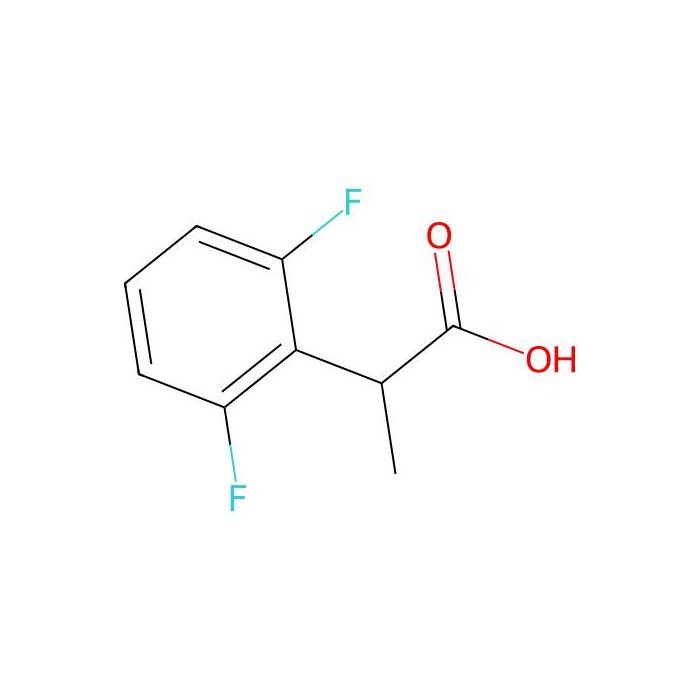
Arylpropionic acid building block featuring a 2,6-difluorophenyl ring and a 2-propionic acid side chain (chiral α-carbon).
2D structure description: A benzene ring bearing fluorine substituents at the 2- and 6-positions; the 1-position is bonded to the stereogenic α-carbon of a propanoic acid unit (–CH(CH3)–CO2H). Functional groups include a carboxylic acid and two aryl–F substituents.
Stereochemistry: The α-carbon is prochiral/chiral; commercial material is commonly racemic unless otherwise stated (no enantiomeric info specified for this item).
Synthetic Utility
Key functional elements: a carboxylic acid (handles: acyl activation, protection, coupling, decarboxylation) and a 2,6-difluorophenyl ring (handles: electronic tuning, potential SNAr/metalation under specific conditions). The α-carbon is stereogenic, enabling chiral derivatization.
Protection/activation:
Protect as methyl/benzyl/tert-butyl esters depending on stability and deprotection needs (Bn deprotect by hydrogenolysis; tBu by acidolysis).
Convert to acid chloride (SOCl2) or mixed anhydride (isobutyl chloroformate) for rapid acyl transfer.
Couplings and derivatizations:
Amide coupling with amines (HATU/EDC/DMTMM) for library generation.
Reductive couplings after Weinreb amide formation to access ketones at the carbonyl carbon.
Curtius rearrangement of the acyl azide to reach amines/isocyanates for urea/urethane synthesis.
Decarboxylative chemistry (literature):
NHPI-ester formation followed by photoredox/Ni catalysis to forge C–B, C–C, or C–N bonds, replacing the acid with diverse functionalities.
Aryl fluoride leveraging:
Ortho-F atoms can direct lithiation under carefully controlled, cryogenic halogen–metal exchange on suitably protected derivatives; they also modulate aryl C–H activation selectivity in transition-metal catalysis.
Chiral access:
Resolution via diastereomeric salts (e.g., with chiral amines) or asymmetric synthesis routes to obtain single-enantiomer material when required.
Target Specificity
Not applicable. This product is a small-molecule building block, not a biological macromolecule or affinity reagent. No antigen/epitope/clone/isotype information applies.
Utilizziamo i cookie per garantire il corretto funzionamento del sito web e, ove consentito, per migliorare la tua esperienza. Puoi gestire le tue preferenze in qualsiasi momento nelle Impostazioni. Per saperne di più, consulta la nostra Cookie Policy.
Desidera che le inviamo un messaggio quando avremo sconti disponibili?
Ricordamelo più tardi
Grazie! Controlli la sua casella di posta per confermare.
Products are supplied to verified businesses, institutions, and qualified professionals for research and development use only. Not for use in humans, animals, diagnosis, or therapy.