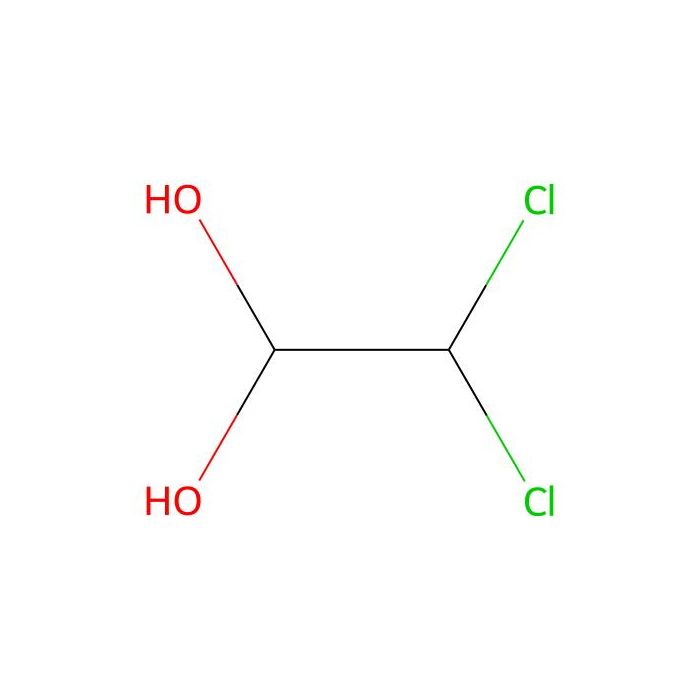
This compound belongs to the class of organic compounds known as chlorohydrins. These are alcohols substituted by a chlorine atom at a saturated carbon atom otherwise bearing only hydrogen or hydrocarbyl groups.
External Descriptors
organochlorine compound - alcohol
1. Djoumbou Feunang Y, Eisner R, Knox C, Chepelev L, Hastings J, Owen G, Fahy E, Steinbeck C, Subramanian S, Bolton E, Greiner R, and Wishart DS. ClassyFire: Automated Chemical Classification With A Comprehensive, Computable Taxonomy. Journal of Cheminformatics, 2016, 8:61.
Certificati (CoA, COO, BSE/TSE e tabella di analisi)
C of A & Other Certificates(BSE/TSE, COO):
Analytical Chart:
Proprietà chimiche e fisiche
Peso molecolare
130.949 g/mol
XLogP3
0.400
Hydrogen Bond Donor Count
2
Hydrogen Bond Acceptor Count
2
Rotatable Bond Count
1
Exact Mass
129.959 Da
Monoisotopic Mass
129.959 Da
Topological Polar Surface Area
40.500 Ų
Heavy Atom Count
6
Formal Charge
0
Complexity
36.500
Isotope Atom Count
0
Defined Atom Stereocenter Count
0
Undefined Atom Stereocenter Count
0
Defined Bond Stereocenter Count
0
Undefined Bond Stereocenter Count
0
The total count of all stereochemical bonds
0
Covalently-Bonded Unit Count
1
Calcolatori di soluzioni
Molarity Calculator
Determine the necessary mass, volume, or concentration for preparing a solution.
Dilution Calculator
Determine the dilution needed to prepare a stock solution.
Reconstitution Calculator
Recensioni
Recensioni dei clienti
Application Protocols
Not applicable
No immunoassay or bioanalytical “tested applications” (WB, IHC, IF, FC, etc.) are relevant to this small-molecule reagent. Protocols will be reaction‑specific; see Reaction Conditions and Synthetic Utility for practical guidance.
Biological Roles
Applicability note
This product is a small-molecule research chemical; no biological role is provided in the Product Data.
Literature/general context
2,2-Dichloroethane-1,1-diol is the hydrate of 2,2-dichloroacetaldehyde, a highly electrophilic aldehyde. Such species do not have established physiological roles and are generally considered reactive electrophiles that can modify biomolecules in vitro.
In aqueous biological environments, gem-diol/aldehyde equilibria are influenced by pH and ionic strength. Electron-withdrawing substituents can increase hydrate population, potentially lowering membrane permeability while maintaining electrophilic potential upon dehydration.
Laboratory relevance
In biochemical studies, aldehyde hydrates and related chlorinated aldehydes may be used as model electrophiles for probing nucleophile reactivity (e.g., with thiols or amines) under controlled conditions. These applications should be strictly in vitro and mechanistic in nature.
Caution
Avoid extrapolating any in vitro reactivity to biological activity. No claims of therapeutic or diagnostic utility are made or implied. For all biological handling, consult institutional safety protocols and the SDS.
Buffer Applications
Not typically applicable
This compound is not a buffering agent and does not define a conjugate acid–base pair with a useful buffering range.
Practical note (literature/general)
If used in aqueous experiments, select a buffer that is compatible with aldehyde/gem-diol equilibria and avoids nucleophilic components that could react with the aldehyde (e.g., avoid Tris and primary amine buffers when aldehyde reactivity must be preserved). Phosphate or acetate buffers (pH ~5.5–7.5) are commonly used for minimizing unwanted Schiff base formation.
Maintain consistent ionic strength and pH to keep the hydrate–aldehyde equilibrium reproducible.
Green Alternatives
Assessment (literature/general)
The molecule contains two chlorines and can liberate or form chlorinated byproducts during synthesis or downstream transformations. From a green chemistry perspective, consider whether non‑chlorinated aldehyde equivalents or safer protecting/activating strategies can be substituted.
Potential alternatives and tradeoffs
Non‑chlorinated aldehyde hydrates (e.g., acetaldehyde derivatives): greener halogen profile but altered reactivity and stability; may lack the electron‑withdrawing effect useful in certain transformations.
In situ generation from less hazardous precursors: using catalytic chlorination under flow or electrochemical halogenation to minimize inventory of chlorinated intermediates.
Solvent choices: prefer water, ethanol, or 2‑MeTHF over chlorinated solvents when feasible; for dehydration, use molecular sieves rather than azeotropes with hazardous solvents.
Cons: reactions requiring anhydrous conditions may be slower; added workup for water removal.
Option: Generate aldehyde in situ in greener aprotic solvent (2‑MeTHF)
Pros: lower toxicity vs DCM; good balance of polarity.
Cons: need to manage water content; potential side reactions due to basic impurities.
Practical steps
Apply catalytic processes, minimize halogenated solvent usage, implement in‑line scavenging of HCl/byproducts, and design for telescoped sequences to reduce waste.
Pharmaceutical Uses
Item-specific note
No pharmacopeial status, excipient role, or formulation grade is specified for this item. For research use only (per Product Data).
Literature/general context
Chlorinated aldehyde hydrates are not typical pharmaceutical excipients due to reactivity. However, in medicinal chemistry research, such compounds can serve as reactive intermediates for building dichloroacetyl motifs or probing structure–reactivity relationships in vitro.
Any handling within GMP or preclinical settings would require rigorous impurity control (residual aldehyde, chloride release, related substances) and validated analytical methods (qNMR, GC/HPLC with derivatization) — none of which are specified for this catalog item.
Compliance reminder
This product is supplied strictly for research and laboratory use. It is not approved for human or veterinary use, clinical diagnostics, or as a drug substance/excipient.
Physical Properties
Item-specific (from Product Data)
Appearance: Not specified for this item; refer to CoA/Spec Sheet.
Grade/Purity: Not specified for this item; refer to CoA/Spec Sheet.
Molecular Weight (item spec): Not specified for this item; refer to CoA/Spec Sheet.
Literature/general values (context, not item specifications)
Empirical formula (from name interpretation): C2H4Cl2O2 (see Structure & Identity).
Formula weight (calculated from above): ~131.96 g/mol (literature calculation).
Expected physical state: low-molecular‑weight chlorinated diol; such gem-diols can be liquids or low‑melting solids and may exist as an equilibrium mixture with the corresponding aldehyde (literature, general behavior of carbonyl hydrates).
Solubility: gem-diols typically exhibit high water miscibility; chlorination can reduce polarity; mixed miscibility with polar organics (MeOH, EtOH, MeCN) is likely (literature/generic).
Boiling/melting points, density, refractive index, pKa, logP: Not readily established in common references for this specific hydrate; values are condition‑dependent due to equilibrium with 2,2-dichloroacetaldehyde (literature gap).
Practical implications
Handle and measure under consistent temperature and solvent conditions to minimize composition drift if the hydrate–aldehyde equilibrium is relevant to your application.
For definitive specifications, consult the product’s CoA/SDS; do not treat literature values above as item specifications.
Quality and Grades
Item-specific details (from Product Data)
Grade/Purity: Not specified for this item; refer to CoA/Spec Sheet.
How to interpret grade for this molecule (general guidance)
For reactive carbonyl hydrates, grade definitions often include controls on aldehyde content, water content, residual solvents, and halide impurities. In absence of a declared grade, consult the CoA for assay method (e.g., quantitative NMR, GC after derivatization) and limits on related species (parent aldehyde, over‑chlorinated/under‑chlorinated congeners).
UV/LC suitability: For analytical applications, HPLC/LC–MS suitable material typically specifies low nonvolatile residue and low UV background; if such a claim is not present, assume general reagent grade.
Stabilizers and additives
No stabilizer information provided for this item. If additives are present (e.g., trace acid or water to favor hydrate), they will be listed on the CoA; verify compatibility with your application.
Best practices
On receipt, verify identity and purity by orthogonal methods suitable for hydrate/aldehyde systems (e.g., 1H/13C NMR in D2O/CD3CN; GC or HPLC after immediate derivatization).
If your workflow is moisture‑sensitive or base‑sensitive, prequalify a lot for aldehyde content and stability under your reaction conditions.
Reaction and Applications
General synthetic roles (literature/general)
Precursor to 2,2-dichloroacetaldehyde: the hydrate can serve as a safer, more manageable form, releasing the aldehyde under dehydrating conditions for nucleophilic additions (e.g., formation of acetals/hemiacetals, imines/oximes) and for oxidation to the corresponding acid.
Access to 2,2-dichloroacyl chemistry: oxidation (e.g., with nitric acid variants or TEMPO/bleach systems under controlled conditions) can yield 2,2-dichloroacetic derivatives; Baeyer–Villiger or Pinnick-like oxidations may be explored with suitable controls (literature, analogous systems).
Halide chemistry: the geminal dichloro moiety can undergo substitution with strong nucleophiles (e.g., thiolates, amines) or elimination to vinyl chloride derivatives under basic conditions (E2), though such conditions risk side reactions.
Named/related transformations
Acetalization/ketalization: use of diols or orthoesters to trap the aldehyde as an acetal after in situ dehydration.
Imine formation with amines (often requiring removal of water) followed by reduction (Reductive amination route).
Wittig/HWE reactions on the aldehyde (generated in situ) to build vinyl dichloro motifs.
Practical notes
Control water activity: molecular sieves or azeotropic removal can tune aldehyde release; conversely, additional water/protic solvent suppresses free aldehyde.
Monitor speciation: 1H NMR can track aldehydic proton (~9–10 ppm) vs. hydrate signals; IR (C=O ~1720 cm−1 vs broad O–H) can help optimize conditions.
Temperature: mild heating accelerates dehydration and nucleophile addition; avoid strong base that may cause dehydrohalogenation.
Reaction Conditions
General guidance (literature; not item specifications)
Dehydration to aldehyde: conduct in aprotic solvent (e.g., acetonitrile, dichloromethane, toluene) with 3Å molecular sieves or gentle heating (25–60 °C). Monitor by 1H NMR (appearance of ~9–10 ppm aldehydic proton) or IR (C=O ~1720 cm−1).
Imine formation: combine with amine (1.0–1.2 equiv) and catalytic acid (e.g., 0.1 equiv p‑TsOH) in toluene or 2‑MeTHF; remove water using a Dean–Stark trap or sieves; 25–80 °C, 2–16 h. Reduce in situ with NaBH3CN or H2/Pd as required.
Acetalization: treat with diol (ethylene glycol, pinacol) and acid catalyst (0.05–0.2 equiv) in DCM or 2‑MeTHF; 0–25 °C to control exotherm; remove water continuously.
Wittig/HWE: perform with stabilized ylides or phosphonates in THF/DMF at 0–25 °C; employ mild base (NaH, K2CO3) and minimize exposure to strong base to avoid dehydrohalogenation; 2–6 h typical.
Oxidation to acid: TEMPO (2–5 mol%), NaClO (1.5–2.0 equiv active Cl) in biphasic CH2Cl2/H2O with pH 8–9 buffer at 0–5 °C; or Pinnick oxidation variants for aldehydes. Carefully validate to prevent chlorination side reactions.
Notes
Times, temperatures, and yields are highly substrate- and setup-dependent; the above ranges are representative for aldehyde chemistry in general and should be optimized.
Maintain rigorous control of water content to steer the hydrate–aldehyde equilibrium for consistent performance.
Safety and Handling
Item-specific hazard data (from Product Data)
Signal Word: Not specified for this item; refer to SDS.
H-Statements: Not specified for this item; refer to SDS.
GHS Classification/Pictograms: Not specified for this item; refer to SDS.
General safety considerations (literature/general)
Chemical class: chlorinated, polyfunctional small molecule (gem-diol/aldehyde hydrate). Chlorinated aldehydes and their hydrates can be irritants to skin, eyes, and respiratory tract. Avoid inhalation and contact.
Potential instability: geminal diols may dehydrate to the corresponding aldehyde under drying, heating, or in less polar media. The aldehyde form may be more volatile and can have stronger irritancy—use local exhaust ventilation.
Incompatibilities: strong bases (risk of dehydrohalogenation), strong oxidizers/reductants (redox reactivity), acid or base catalysis may shift hydrate–aldehyde equilibrium. Avoid reactive metals and strong nucleophiles that may displace chloride.
Recommended PPE and handling
Use chemical-resistant gloves (e.g., nitrile), lab coat, splash goggles. Work in a fume hood.
Keep containers tightly closed; minimize headspace and moisture/heat fluctuations to control equilibrium speciation.
First-aid overview (always defer to SDS)
Skin/eye contact: rinse with water for ≥15 min; remove contaminated clothing; seek medical attention.
Inhalation: move to fresh air; monitor breathing; seek medical attention if symptoms persist.
Ingestion: rinse mouth; do not induce vomiting; seek medical attention.
Waste
Collect halogenated organic waste separately; dispose according to institutional and regulatory requirements.
Solvent Selection
Relevance for this compound type
2,2-Dichloroethane-1,1-diol is a polar, hydrogen-bonding small molecule (gem-diol), often in equilibrium with a more hydrophobic aldehyde form. Solvent choice strongly influences this equilibrium and the compound’s effective reactivity.
General guidance (literature/general)
Hydrate favored in: water, alcohols, and other protic/polar media; acid catalysis can further shift toward the carbonyl hydrate for electron‑withdrawing substrates.
Aldehyde favored in: aprotic, less polar, and dehydrating media (e.g., molecular sieves, acetonitrile, dichloromethane) and at elevated temperature.
Miscibility and handling
Expect good miscibility with water and lower alcohols; also soluble in polar organics (MeCN, DMF, DMSO). In nonpolar solvents, solubility may drop and aldehyde fraction may increase (literature trend for gem‑diols).
When to choose vs alternatives
If your chemistry needs a controlled release of 2,2-dichloroacetaldehyde, using the hydrate in a protic solvent can moderate reactivity and improve safety/handling.
If the aldehyde reactivity is required immediately, operate in an aprotic solvent and consider mild heating or drying agents to promote dehydration in situ.
Practical tips
Avoid strongly basic solvents (risk of elimination/substitution on the dichloro carbon).
Document solvent composition, water content, and temperature in your procedure, as these variables influence speciation.
Storage and Reconstitution
Item-specific (from Product Data)
Storage Conditions: Room temperature.
Shipped In: Not specified for this item; refer to CoA/Spec Sheet.
General handling guidance (literature/general)
Store tightly closed in an inert atmosphere if possible to limit oxidative or hydrolytic changes. Minimize headspace and temperature fluctuations to keep the hydrate–aldehyde equilibrium consistent.
Protect from strong bases and acids unless intentionally adjusting equilibrium; segregate from oxidizers and reactive metals.
If the material crystallizes or stratifies, warm gently to ambient and homogenize before use; verify composition by rapid NMR/IR if critical.
Reconstitution
If supplied as a liquid, use as received. If supplied as a solid/semi‑solid, dissolve in a compatible solvent (water, MeOH, EtOH, MeCN) immediately before use. For aldehyde‑forward reactions, prepare solutions in dry aprotic solvent with molecular sieves.
Avoid repeated freeze–thaw cycles; aliquot solutions for short‑term use. Prepare fresh solutions for moisture‑sensitive transformations.
Shelf-life
Not specified for this item; refer to CoA/Spec Sheet. Periodically re‑assay reactive content (hydrate vs aldehyde) for long-term projects.
Structure and Identity
Item-specific (from Product Data)
SKU: D1045592
Product Name: 2,2-Dichloroethane-1,1-diol
CAS: 85275
CID: 85275
InChIKey: 326608
SMILES: Not specified for this item; refer to CoA/Spec Sheet.
Molecular Formula: Not specified for this item; refer to CoA/Spec Sheet.
Molecular Weight: Not specified for this item; refer to CoA/Spec Sheet.
Literature/Computed identity (for context; not item specifications)
Structural interpretation of the name: an ethane backbone with a geminal diol at C1 (–C(OH)2–) and a geminal dichloro at C2 (–CCl2–), i.e., HO–C(H)(OH)–CCl2–H. This species is the hydrate (1,1-diol) of 2,2-dichloroacetaldehyde.
Putative molecular formula (literature-based): C2H4Cl2O2.
Core functional groups: geminal diol (carbonyl hydrate), vicinal dichloro substituents on the adjacent carbon.
2D description: two-carbon chain; the first carbon bears two hydroxyl groups and one hydrogen (tetrahedral center without defined stereochemistry); the second carbon bears two chlorine atoms and one hydrogen.
General notes
Geminal diols are often in equilibrium with their parent carbonyl compounds. In this case, equilibrium with 2,2-dichloroacetaldehyde hydrate is expected (literature). The degree of hydration depends on medium, temperature, and substituent effects.
Synthetic Utility
Functional group leverage (literature/general)
Gem-diol unit serves as a masked/tempered form of an aldehyde, enabling staged release of 2,2-dichloroacetaldehyde for carbonyl transformations.
Gem-dichloro substituents provide handles for further functionalization: nucleophilic substitution (SN1/SN2/E1cB pathways depending on conditions), reduction to mono‑chloro/alkyl derivatives, or elimination to generate vinyl chloride motifs.
Transformations
Nucleophile additions to the aldehyde (after dehydration): hemiacetal/acetal formation; imine/oxime/hydrazone formation; cyanohydrin analogs (with care due to safety of cyanide systems).
Oxidation to acids/esters/amides: via Pinnick‑type oxidation (hypochlorite-free variants recommended due to halogen content), or TEMPO/bleach with careful control to avoid overchlorination.
As a linchpin, it connects aldehyde chemistry with gem‑dichloro elaboration, allowing divergent synthesis of chlorinated building blocks, dichloroacetals, and vinyl chloride precursors.
Practical considerations
Track the hydrate/aldehyde ratio under reaction conditions; employ molecular sieves or azeotropic drying to drive carbonyl chemistry; keep bases mild to avoid dehydrohalogenation.
Analyze promptly to avoid composition drift; derivatize carbonyls on sampling for GC/LC quantitation.
Target Specificity
Not applicable
This product is a small organic reagent, not a biological targeting reagent (e.g., antibody, ligand standard). No antigen/epitope/clone/isotype information is provided in the Product Data or applicable to this compound.
We use cookies to ensure the website functions properly and, where permitted, to improve your experience. You can manage your preferences at any time in Settings. Learn more in our Cookie Policy.
Shall we send you a message when we have discounts available?
Remind me later
Thank you! Please check your email inbox to confirm.
Products are supplied to verified businesses, institutions, and qualified professionals for research and development use only. Not for use in humans, animals, diagnosis, or therapy.