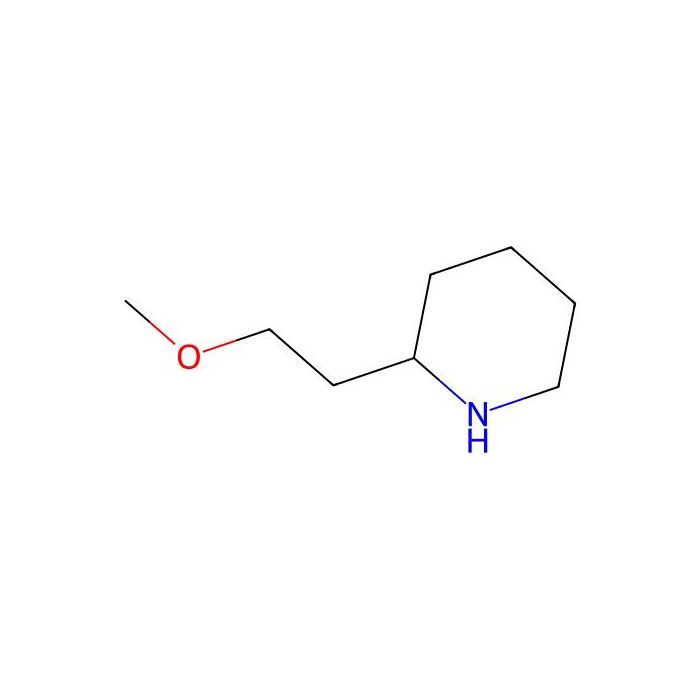
This compound belongs to the class of organic compounds known as piperidines. These are compounds containing a piperidine ring, which is a saturated aliphatic six-member ring with one nitrogen atom and five carbon atoms.
External Descriptors
Not available
1. Djoumbou Feunang Y, Eisner R, Knox C, Chepelev L, Hastings J, Owen G, Fahy E, Steinbeck C, Subramanian S, Bolton E, Greiner R, and Wishart DS. ClassyFire: Automated Chemical Classification With A Comprehensive, Computable Taxonomy. Journal of Cheminformatics, 2016, 8:61.
Certificati (CoA, COO, BSE/TSE e tabella di analisi)
C of A & Other Certificates(BSE/TSE, COO):
Analytical Chart:
Proprietà chimiche e fisiche
Peso molecolare
143.230 g/mol
XLogP3
0.900
Hydrogen Bond Donor Count
1
Hydrogen Bond Acceptor Count
2
Rotatable Bond Count
3
Exact Mass
143.131 Da
Monoisotopic Mass
143.131 Da
Topological Polar Surface Area
21.300 Ų
Heavy Atom Count
10
Formal Charge
0
Complexity
85.300
Isotope Atom Count
0
Defined Atom Stereocenter Count
0
Undefined Atom Stereocenter Count
1
Defined Bond Stereocenter Count
0
Undefined Bond Stereocenter Count
0
The total count of all stereochemical bonds
0
Covalently-Bonded Unit Count
1
Calcolatori di soluzioni
Molarity Calculator
Determine the necessary mass, volume, or concentration for preparing a solution.
Dilution Calculator
Determine the dilution needed to prepare a stock solution.
Reconstitution Calculator
Recensioni
Recensioni dei clienti
Application Protocols
Not applicable as a bioassay reagent. There are no validated protocols such as WB, IHC, IF, or FC for this small‑molecule reagent. For synthetic use, see the Reaction Conditions, Synthetic Utility, and Solvent Selection sections for practical guidance.
Biological Roles
This product is supplied strictly for research use. No biological or clinical activity is claimed.
General context (literature)
Piperidine is a common motif in natural products and bioactive small molecules, valued for basicity and conformational preferences. Substitution at C‑2 can influence lipophilicity, pKa, and permeability.
The 2‑(2‑methoxyethyl) side chain introduces an ether oxygen that can modulate hydrogen‑bond acceptor count and polarity, often explored in medicinal chemistry to adjust solubility and reduce basicity relative to unsubstituted analogs.
Biochemical considerations (qualitative)
As a secondary amine, it will be protonated near physiological pH (conjugate acid pKa for piperidines typically ~10–11, literature), increasing aqueous solubility of salt forms.
Metabolic soft spots in analogs bearing this motif often include N‑dealkylation (if tertiary), N‑oxidation, and O‑dealkylation of ether side chains; these are general trends for amines/ethers, not claims for this specific item.
For any biological testing, ensure appropriate controls and adhere to regulatory and institutional guidelines. Research use only.
Buffer Applications
This compound is a reactive secondary amine building block and is not used as a designated buffering agent in analytical or biological buffers. If pH control is needed during reactions or workups involving this amine, employ standard buffer systems (e.g., acetate, phosphate) or adjust with mineral acids/bases. For aqueous handling, forming a defined ammonium salt (e.g., hydrochloride) can improve solubility and pH manageability.
Green Alternatives
While the compound itself is a target reagent (not readily “replaced”), greener choices can be made for solvents and reagents when using 2-(2‑Methoxyethyl)piperidine.
Greener media for common steps (literature/general)
Amide couplings: EtOAc, 2‑MeTHF, CPME, or propylene carbonate can replace DCM/DMF in some protocols.
N‑Alkylations: 2‑MeTHF or MeTHF/EtOH blends can substitute for acetonitrile/DMF when substrates permit.
Workup: Favor aqueous biphasic systems and CO2‑free aqueous acids for salt toggling; minimize chlorinated solvents.
Reagent choices
Swop POCl3/oxalyl chloride with greener acid activation (CDI, EDC) where compatible.
Use polymer‑supported scavengers to reduce solvent volumes during purifications.
Comparison snapshot (general)
| Use case | Conventional | Greener alternative | Trade‑offs |
| --- | --- | --- | --- |
| Amide coupling medium | DMF/DCM | 2‑MeTHF/EtOAc | Solubility may limit scale; adjust base and temperature |
| N‑Alkylation | MeCN/DMF | 2‑MeTHF or aqueous PTC | Reaction rates can drop; optimize base/phase transfer agent |
| Extraction | DCM | EtOAc/MTBE | Partitioning may change; adjust pH and volumes |
Always verify performance and impurity profile when changing media; document equivalency for scale‑up.
Pharmaceutical Uses
Scope of use
For research use only. No therapeutic or clinical use is claimed.
Role in development and manufacturing (general)
Serves as a heterocyclic amine building block for the synthesis of intermediates and candidate APIs in discovery chemistry.
Can act as a base or nucleophile in process steps (e.g., amide formation, quaternization to generate phase‑transfer intermediates), though dedicated process bases are more common.
Considerations for formulation chemistry (general)
Salt selection: Hydrochloride, mesylate, or fumarate salts of amine derivatives are frequently explored to tune crystallinity and stability of intermediates; salt form of the starting amine itself may be preferred for handling and dosing on plant scale.
Residuals control: If used in excess as a reagent, establish effective quench and purge strategies (acid washes, ion‑exchange scavengers) to meet residual amine limits in intermediates.
Compendial status
No pharmacopeial monograph is implied for this specific amine. Verify any regulatory specifications case‑by‑case.
Physical Properties
Item-specific (from Product Data)
Appearance: Not specified for this item; refer to CoA/Spec Sheet.
Grade/Purity: Not specified for this item; refer to CoA/Spec Sheet.
Molecular formula: Not specified for this item; refer to CoA/Spec Sheet.
Molecular weight: Not specified for this item; refer to CoA/Spec Sheet.
Literature/general expectations for this class of compounds (secondary piperidines bearing an ether side chain)
Physical state: Typically low‑viscosity liquids at ambient temperature, with amine odor.
Acid–base: Basic secondary amine; conjugate acid pKa commonly ~10–11 for piperidines (literature, approximate range). This implies quantitative protonation under moderately acidic conditions and efficient salt formation with mineral or sulfonic acids.
Polarity: Moderately polar due to tertiary ether and amine functionalities; strong H‑bond acceptor, weak donor (via ammonium when protonated).
Solubility: Miscible with many organic solvents (alcohols, ethers, chlorinated solvents); variable solubility in water that increases markedly on protonation to the ammonium salt (literature, qualitative).
Volatility: Lower volatility than acyclic secondary amines of similar MW; amines may exhibit noticeable vapor pressure and odor (literature, qualitative).
Refractive index, density, BP/MP, logP: Not specified for this item; consult primary literature or the CoA/Spec Sheet for definitive values.
Note: Do not treat literature ranges as specifications. For method validation or regulatory work, use the item’s CoA/Spec Sheet.
Quality and Grades
Item-specific (from Product Data)
Grade/Purity: Not specified for this item; refer to CoA/Spec Sheet.
Stabilizers/additives: Not specified for this item; refer to CoA/Spec Sheet.
Guidance on interpreting grades for amine building blocks (general)
Research grade: Suitable for most synthetic transformations. UV absorbance and trace metals may be unspecified.
Purified/≥98%: Lower impurity burden improves reproducibility in catalytic couplings, amide formations, and medicinal chemistry SAR work.
Low-water/anhydrous variants: Beneficial for moisture‑sensitive steps (e.g., acid chloride couplings, isocyanate formation). Verify Karl Fischer values on CoA when critical. If not specified, assume standard water content.
Salt forms vs free base: Some suppliers offer HCl or other salts to improve stability and handling. Salt form affects solubility and base availability; choose appropriately for your workflow.
What to check on receipt (practical tips)
Confirm identity (NMR, MS) and assay from CoA.
Review specific limits (water, residual solvents, UV cutoff, trace metals) if method development depends on them. If not listed: “Not specified for this item; refer to CoA/Spec Sheet.”
Note storage and shipping statements; match to your intended use (e.g., moisture‑sensitive steps).
Reaction and Applications
Role in synthesis (general)
Versatile secondary amine nucleophile for N‑acylation (amides, carbamates, ureas), sulfonylation (sulfonamides), and N‑alkylation to access tertiary amines or quaternary ammonium salts.
Piperidine motifs are ubiquitous in agrochemicals and medicinal chemistry; the 2‑(2‑methoxyethyl) substituent introduces polarity and ether functionality helpful for tuning ADME properties in discovery research.
Amide formation: Acid chlorides/anhydrides (Schotten–Baumann), or coupling agents (EDC/HATU/HBTU) with carboxylic acids.
Carbamate/urea: Reaction with chloroformates or isocyanates; CDI for ureas.
N‑Alkylation: SN2 with primary halides/tosylates in MeCN/DMF; phase‑transfer options for less soluble salts.
Reductive alkylation: Condensation with aldehydes/ketones followed by NaBH(OAc)3 or catalytic hydrogenation.
Salt formation: Stable crystalline hydrochloride or mesylate salts for handling and purification.
Practical tips
Use dry glassware/solvents for acylations and isocyanate chemistry; amine’s basicity scavenges adventitious acids, but moisture still leads to side reactions.
If chromatographing the free base, condition silica with base (e.g., 1–2% Et3N) to minimize streaking.
For regioselective derivatization at nitrogen vs carbon, note that the carbon‑2 position is already substituted; reactions predominantly occur at N under standard conditions.
Application areas (non-clinical)
Building block for SAR libraries, linkers, and heterocycle‑containing intermediates in research and process development.
Reaction Conditions
General guidance below reflects literature precedents for secondary piperidine derivatives. Optimize for your substrate set.
N‑Acylation (amide formation)
Solvent: DCM, THF, 2‑MeTHF, or DMF (literature)
Base: Triethylamine or DIPEA (1.5–2.0 equiv)
Electrophile: Acid chloride/anhydride or EDC/HATU with carboxylic acid
Temperature/time: 0–25 °C, 1–4 h (monitor by TLC/LC‑MS)
Generate HCl salt with HCl in dioxane or gaseous HCl in Et2O; isolate crystalline salt. Regenerate free base by basification (Na2CO3/NaOH) and extraction.
Purification
Use basic modifiers (0.5–2% Et3N) in silica eluents; or employ crystallization of acid salts for high purity.
All parameters above are literature‑style guidance, not specifications for this item. Verify on small scale before scale‑up.
Safety and Handling
Item-specific (from Product Data)
GHS signal word, H‑statements, pictograms, classification: Not specified for this item; refer to SDS.
Storage conditions: Room temperature (per Product Data).
General safety considerations for secondary amines (literature/general guidance; defer to SDS)
Hazards: May cause skin and eye irritation; vapors can irritate the respiratory tract. Amines often have low odor thresholds. Some may be flammable; verify flash point on the SDS.
PPE: Use chemical‑resistant gloves (e.g., nitrile), lab coat, and safety goggles. Handle in a fume hood to control vapors and odors.
Incompatibilities: Strong oxidizers; acyl/alkyl halides (vigorous acylation/alkylation); acid chlorides/anhydrides; CO2 (amines can absorb CO2 to form carbamates on surfaces); strong acids/bases as relevant to intended chemistry.
First aid (overview; follow SDS): Eye/skin contact—rinse with water for ≥15 minutes; remove contaminated clothing. Inhalation—move to fresh air. Ingestion—rinse mouth; seek medical attention.
Spill/cleanup: Contain with inert absorbent, avoid ignition sources, ventilate area. Neutralize residues cautiously (e.g., dilute acid for free base) per institutional protocols.
Waste: Collect as organic amine waste; consult local regulations.
Always consult the product’s SDS for authoritative hazard, toxicological, and regulatory information.
Solvent Selection
This compound is a reactive secondary amine building block, not a bulk solvent. Solvent selection here refers to choosing appropriate media for reactions, workups, and purifications involving 2-(2‑Methoxyethyl)piperidine.
Polarity and miscibility (general)
Expected to dissolve well in polar aprotic solvents (THF, MeCN, DMF, DMSO), alcohols, and many ethers/chlorinated solvents. Aqueous solubility increases upon protonation (e.g., HCl salt).
Choosing media by transformation (guidance)
N‑Acylation/amide formation: DCM, THF, EtOAc, or toluene with base (TEA, DIPEA) or in situ activation (HATU/HOAt) in DMF/MeCN.
Carbamate/sulfonamide formation: DCM/THF with phosgene equivalents (TCF, triphosgene) or sulfonyl chlorides under basic conditions.
N‑Alkylation: Polar aprotic media (MeCN, DMF) favor SN2 with alkyl halides; add inorganic base (K2CO3, Cs2CO3) if using the ammonium salt.
Reductive amination (to derivatize): Alcohols or MeOH/THF mixtures; catalytic hydrogenation in EtOH/EtOAc.
Workup/purification
Acid–base extraction is effective: Extract as ammonium salt into aqueous acid, then basify and re‑extract organics.
Silica chromatography: Tailing is common; add 0.5–2% Et3N or use pre‑treated basic silica/alumina. Alternatively, isolate as a crystalline salt.
Comparison notes (literature/general)
Greener media (2‑MeTHF, CPME, EtOAc) often substitute for DCM/THF with comparable performance in amide couplings and SN2 alkylations.
Storage and Reconstitution
Item-specific (from Product Data)
Storage conditions: Room temperature.
Shipped in: Not specified for this item; refer to CoA/Spec Sheet.
Appearance: Not specified for this item; refer to CoA/Spec Sheet.
General handling for secondary amines (guidance)
Store tightly sealed under air‑free conditions if possible (nitrogen/argon headspace) to limit CO2 uptake and oxidative discoloration.
Protect from strong oxidizers and acids. Keep away from moisture if using in moisture‑sensitive steps.
If odor control or stability is a concern, consider storing as a crystalline salt (e.g., HCl), then regenerate free base prior to use.
Reconstitution
Typically supplied neat (no reconstitution required). If received as a solid salt, dissolve in suitable solvent (e.g., MeOH, EtOH, MeCN, or water depending on salt and application).
Shelf life
Not specified for this item; refer to CoA/Spec Sheet. Periodically confirm identity/assay (e.g., 1H NMR) for materials kept long‑term.
Research Use Note: For research use only.
Structure and Identity
Overview: 2-(2-Methoxyethyl)piperidine is a secondary amine featuring a saturated six‑membered piperidine ring bearing a 2‑(2‑methoxyethyl) substituent at the carbon adjacent to nitrogen. The nitrogen is part of the ring (not N-alkylated), leaving it nucleophilic and basic.
Item-specific (from Product Data)
Product name: 2-(2-Methoxyethyl)piperidine
CAS: 858523-63-4
PubChem CID: 17805893
InChIKey: Not specified for this item; refer to CoA/Spec Sheet. (Product Data lists: "196641", which is not a complete InChIKey.)
SMILES: Not specified for this item; refer to CoA/Spec Sheet.
Molecular formula: Not specified for this item; refer to CoA/Spec Sheet.
Molecular weight: Not specified for this item; refer to CoA/Spec Sheet.
Structural features (general/literature description)
Ring system: Piperidine (saturated six‑membered N-heterocycle)
Substitution pattern: Carbon-2 (α to N) bears a –CH2–CH2–O–CH3 side chain (2‑methoxyethyl)
Functional groups: Secondary amine (basic, nucleophilic); ether (–O–) within the side chain (moderately polar, H‑bond acceptor)
Stereochemistry: As named, no stereochemistry is specified; the 2‑substituted center can be chiral if prepared asymmetrically, but the commercial material may be racemic unless otherwise stated (not specified for this item).
2D structure in words: A chair-like piperidine ring with the ring nitrogen and, on the adjacent carbon (C‑2), a two‑carbon tether terminating in a methoxy group (–CH2–CH2–O–CH3).
Synthetic Utility
Functional group reactivity (general)
Secondary amine: Undergoes N‑acylation (amides, carbamates), N‑sulfonylation (sulfonamides), N‑alkylation (tertiary amines), and quaternization (ammonium salts). Efficient nucleophile in SN2 reactions with activated electrophiles.
Ether side chain: Generally inert under many conditions; can be leveraged for tethered functionalization (e.g., tosylation of the terminal alcohol after demethylation or via oxidative routes) in multistep sequences.
Named/standard transformations (literature)
Schotten–Baumann acylation with acid chlorides/anhydrides.
Urea/carbamate formation via CDI, DSC, or chloroformates.
Reductive amination to elaborate the amine (if temporarily converted to tertiary amine derivatives, then deprotect/demethyl as needed in a sequence).
Mitsunobu alternatives avoided due to basic amine; protect as Boc to engage alcohols via nucleophilic displacement.
Protecting group strategy
Boc protection (Boc2O, base) affords neutral, less nucleophilic carbamate, improving compatibility with electrophiles and chromatography.
Deprotection under TFA or HCl in dioxane regenerates the amine as a salt.
Retrosynthetic value
The 2‑substituted piperidine scaffold is a privileged motif; this substrate can serve as a branching point to libraries by N‑acylation/alkylation, or by manipulating the side chain (e.g., oxidation at the terminal ether after functional group interconversions).
Target Specificity
Not applicable. This product is a small‑molecule amine building block and has no antibody/biomolecular target specificity. No antigen, epitope, species reactivity, clone, or isotype information applies.
We use cookies to ensure the website functions properly and, where permitted, to improve your experience. You can manage your preferences at any time in Settings. Learn more in our Cookie Policy.
Shall we send you a message when we have discounts available?
Remind me later
Thank you! Please check your email inbox to confirm.
Products are supplied to verified businesses, institutions, and qualified professionals for research and development use only. Not for use in humans, animals, diagnosis, or therapy.