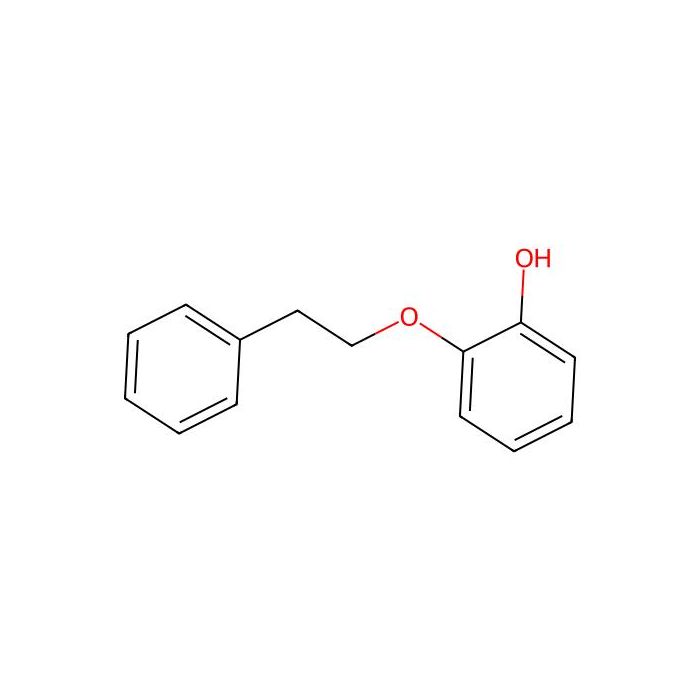
This compound belongs to the class of organic compounds known as phenol ethers. These are aromatic compounds containing an ether group substituted with a benzene ring.
External Descriptors
Not available
1. Djoumbou Feunang Y, Eisner R, Knox C, Chepelev L, Hastings J, Owen G, Fahy E, Steinbeck C, Subramanian S, Bolton E, Greiner R, and Wishart DS. ClassyFire: Automated Chemical Classification With A Comprehensive, Computable Taxonomy. Journal of Cheminformatics, 2016, 8:61.
Certificati (CoA, COO, BSE/TSE e tabella di analisi)
C of A & Other Certificates(BSE/TSE, COO):
Analytical Chart:
Proprietà chimiche e fisiche
Peso molecolare
214.260 g/mol
XLogP3
3.300
Hydrogen Bond Donor Count
1
Hydrogen Bond Acceptor Count
2
Rotatable Bond Count
4
Exact Mass
214.099 Da
Monoisotopic Mass
214.099 Da
Topological Polar Surface Area
29.500 Ų
Heavy Atom Count
16
Formal Charge
0
Complexity
187.000
Isotope Atom Count
0
Defined Atom Stereocenter Count
0
Undefined Atom Stereocenter Count
0
Defined Bond Stereocenter Count
0
Undefined Bond Stereocenter Count
0
The total count of all stereochemical bonds
0
Covalently-Bonded Unit Count
1
Calcolatori di soluzioni
Molarity Calculator
Determine the necessary mass, volume, or concentration for preparing a solution.
Dilution Calculator
Determine the dilution needed to prepare a stock solution.
Reconstitution Calculator
Recensioni
Recensioni dei clienti
Application Protocols
Not applicable. No immunoassay or bioassay protocols (e.g., WB, IHC, IF, FC) are associated with this small-molecule building block. For synthetic or analytical use, refer to the Reaction Conditions and Synthetic Utility sections and develop protocols appropriate to your laboratory and project.
Biological Roles
No item-specific biological roles are provided for this product, and it is supplied strictly for research use.
General context (phenolic/aryl ether motifs):
Phenolic groups participate in hydrogen bonding and can influence membrane partitioning and protein binding in small molecules; ortho-hydroxyaryl ethers appear in natural products and ligand frameworks.
Deprotonation to phenoxide increases nucleophilicity and metal-binding propensity, which is exploited in coordination chemistry and biophysical model studies.
Aromatic ethers are typically metabolically stable relative to alkyl ethers; phenols, however, are subject to phase II conjugation (e.g., glucuronidation, sulfation) in biological systems (literature background).
No biological activity or therapeutic properties are claimed or implied for this catalog item. For any biological testing, establish your own controls and reference standards.
Buffer Applications
This compound is not a buffering agent and is not typically used to prepare biological or analytical buffer systems. Its phenolic OH is weakly acidic (phenolic pKa range typically ~9–10 in literature), but the molecule is not designed for buffering capacity.
For work in aqueous systems requiring solubilization:
Temporary solubilization can be achieved by forming the phenoxide with mild base; return to neutral conditions to precipitate/isolate.
Consider co-solvents (MeCN, DMSO, EtOH) at low percentages in buffered systems if compatibility permits.
Refer instead to the Reaction & Applications and Synthetic Utility sections for relevant uses.
Green Alternatives
This product is a building block rather than a solvent. Greener considerations focus on the media used to handle and transform it.
Preferred greener solvents (relative to chlorinated/aromatic solvents):
Ethyl acetate and 2-methyltetrahydrofuran (2-MeTHF) as alternatives to dichloromethane or THF when solubility allows.
CPME as a replacement for ether/toluene in extractions and certain reactions (higher boiling, low peroxide tendency relative to THF; still monitor peroxides as good practice).
Propylene carbonate or Cyrene for select substitution/oxidation reactions where strong polar aprotic solvents are needed, acknowledging viscosity and base compatibility tradeoffs.
Tradeoffs and selection:
2-MeTHF vs THF: improved safety profile (bio-based option, less miscible with water facilitating workups) but different polarity; solubility of phenolic ethers can be lower.
EtOAc vs DCM: eliminates halogenated waste; may require larger volumes for equivalent solubility; watch for transesterification under strong base.
MeCN vs DMF/DMSO: lower boiling point eases removal; waste profile often preferable; however, solvating power is less than DMF/DMSO for salts.
Process tips:
Use solvent selection guides (e.g., CHEM21/ACS GCI) to rank options early.
Optimize mixed green solvent systems (e.g., EtOAc/MeCN) to match solubility and chromatographic behavior of this phenolic ether.
Pharmaceutical Uses
No pharmacopeial status, excipient role, or formulation-grade details are specified for this item; refer to the CoA/Spec Sheet if such information becomes available.
General context (non-clinical, research/manufacturing only):
Phenolic/aryl ether building blocks are used in medicinal chemistry campaigns to explore hydrogen-bond donors/acceptors and tune lipophilicity.
The ortho-hydroxyaryl ether motif can serve as a handle for late-stage functionalization (e.g., prodrug ester formation at the phenol) during lead optimization workflows.
Not for human or veterinary use. No therapeutic claims are made for this material.
Physical Properties
Item-specific specifications were not provided for this listing. Values below are general/literature guidance and should not be used as acceptance criteria.
Appearance: Not specified for this item; refer to CoA/Spec Sheet.
Molecular formula: C14H14O2 (literature/computed from name)
Boiling point, melting point, density, refractive index, UV cutoff, water/peroxide/metal content: Not specified for this item; refer to CoA/Spec Sheet.
Likely low solubility in water due to two phenyl rings and an ether; increased solubility in moderately polar organic solvents (e.g., EtOAc, acetone, MeCN) and good solubility in nonpolar/aprotic media (e.g., toluene, DCM, THF).
Phenolic OH enables solubility enhancement in basic aqueous media via deprotonation to the phenoxide.
Phenolic pKa typically in the 9–10 range for o-hydroxyaryl ethers; actual value for this compound not confirmed here. Use base to form phenoxide for O-alkylation/acylation.
Always consult the SDS and the item’s CoA/Spec Sheet for definitive physical data when designing processes or specifications.
Quality and Grades
Item-specific grade/purity: Not specified for this item; refer to CoA/Spec Sheet.
Context for quality considerations (general guidance):
Analytical/Reagent grades: Typically define assay purity and residue limits suitable for research and quality control. For aromatic ethers, additional quality indicators may include residual solvents, UV absorbance profile, and trace metal content when used in catalysis research.
Stabilizers: Not specified for this item. Phenolic materials are sometimes shipped without stabilizers; if stabilizers are present, they can influence downstream reactions (e.g., radical chemistry, oxidations). Always review the CoA for any added inhibitors.
Chromatography suitability: If intended for kinetic/photophysical studies, low UV background and absence of fluorescent impurities are important; HPLC or spectrophotometric grade materials minimize baseline drift.
Trace impurities relevant to synthesis: Unprotected phenolic OH may contain small amounts of water or form phenoxide salts depending on handling; dry prior to moisture-sensitive transformations.
Acceptance criteria and test methods (water content, metal limits, UV cutoff, residual solvents) are product- and lot-specific and must be verified on the CoA/Spec Sheet.
Reaction and Applications
As an o-hydroxyaryl ether, 2-(2-Phenylethoxy)phenol serves as a versatile intermediate and ligand-like motif.
Representative applications (literature/general):
Phenol derivatization: Efficient substrate for O-acylation (esters), O-alkylation (ether libraries), and carbonate/urethane formation under mild base.
Chelation/coordination: The ortho arrangement of –OH and –O–R can chelate main-group or transition metals (salicylate-like binding) and be incorporated into salen/salophen-type frameworks after condensation with aldehydes.
Directed functionalization: The phenolic OH can be protected (TBS, Bn, MOM) to enable electrophilic aromatic substitution or cross-couplings elsewhere on the ring.
Oxidative cyclization: Analogous o-hydroxyaryl ethers undergo oxidative cyclizations to benzodioxin/dibenzofuran-like frameworks under DDQ or metal-catalyzed conditions (literature-dependent on substitution and conditions).
Polymer/additive precursor: Phenolic ethers serve as fragments in antioxidant/resin systems after further functionalization (general industrial chemistry context).
Practical tips:
Generate the phenoxide in situ with K2CO3/Cs2CO3 in polar aprotic solvents for clean O-functionalization; avoid over-alkylation by controlling base and electrophile stoichiometry.
For acylations, DMAP catalysis in DCM/EtOAc at 0–25 °C gives high selectivity to O-acyl products.
Phenolic OH can hydrogen-bond; ensure rigorous drying (azeotrope or vacuum) before moisture-sensitive steps (e.g., acid chlorides, isocyanates).
Note: The specific use cases depend on your synthesis plan; verify compatibility with your catalysts and protecting groups.
Reaction Conditions
General literature guidance for typical transformations of o-hydroxyaryl ethers. These are not item-specific specifications; optimize for your system.
O-Acylation of the phenol:
Solvent: DCM, EtOAc, or MeCN.
Base/catalyst: Pyridine or triethylamine; DMAP (5–10 mol%) often accelerates.
Temperature/time: 0–25 °C, 0.5–4 h.
Workup: Aqueous bicarbonate wash to remove acids and DMAP salts.
O-Alkylation (Williamson ether synthesis):
Solvent: Acetone, MeCN, or DMF.
Base: K2CO3 or Cs2CO3 (1.2–2.0 equiv) or NaH for hindered systems.
Electrophile: Alkyl bromides/iodides or sulfonates.
Temperature/time: rt to reflux, 2–18 h.
Halogenation/cross-coupling on the aryl ring (after introducing a leaving group):
Bromination: NBS in DMF or CHCl3 at 0–25 °C; monitor to avoid over-bromination.
Suzuki–Miyaura coupling: Pd(PPh3)4 (1–3 mol%), base (K2CO3, K3PO4), solvent (dioxane/H2O or toluene/EtOH/H2O), 60–100 °C.
Oxidative annulation (method-dependent):
Reagents: DDQ, hypervalent iodine, or Cu/Ag catalysis; solvent often DCM, toluene, or MeCN.
Conditions are substrate-specific; bench trials required.
Notes:
Dry the substrate prior to base-sensitive steps (overnight vacuum or azeotrope with toluene/EtOH as appropriate).
Monitor reactions by TLC/HPLC; phenolic products can tail on silica—use 0.5–1% TEA in eluent if needed.
Safety and Handling
Item-specific GHS details were not provided. Follow prudent laboratory practices for phenolic ethers.
GHS classification, signal word, hazard (H) statements, pictograms: Not specified for this item; refer to SDS.
Likely hazards (general for phenolic compounds): skin/eye irritation; harmful if swallowed. Avoid inhalation of dust/aerosols. Handle in a fume hood.
Personal protective equipment (PPE):
Safety glasses or splash goggles, lab coat, and appropriate chemically resistant gloves (e.g., nitrile). Use respiratory protection if aerosolization is possible and engineering controls are inadequate.
Handling guidance:
Avoid contact with strong oxidizers and strong bases/acids that may lead to undesired reactions (e.g., ether cleavage under strongly acidic conditions, phenoxide formation under strong base).
Prevent prolonged exposure to elevated temperatures that could promote oxidation or polymerization of phenolic species.
First aid (general):
Skin/eye contact: Rinse with plenty of water for several minutes; remove contaminated clothing; seek medical attention if irritation persists.
Inhalation: Move to fresh air; seek medical attention if symptoms occur.
Ingestion: Rinse mouth; do not induce vomiting; seek medical attention.
Storage incompatibilities (general): Segregate from strong oxidizers, acid chlorides/anhydrides, and strong bases unless intended for reaction.
Always defer to the product-specific SDS for authoritative safety, toxicological, and disposal information.
Solvent Selection
This compound is a neutral aryl ether bearing a phenolic OH, with overall moderate-to-high hydrophobicity.
Polarity and miscibility (general expectations):
Poor water solubility at neutral pH; phenoxide formation in basic media increases aqueous solubility.
Good solubility in common organic solvents: dichloromethane, chloroform, toluene, THF, ethyl acetate, acetone, and acetonitrile.
Choosing a solvent by operation:
O-alkylation/acylation of the phenol: polar aprotic solvents (DMF, DMSO, MeCN, acetone) with a base (e.g., K2CO3) often provide clean conversions.
Metal-catalyzed cross-coupling on an aryl halide derivative of this scaffold: toluene, dioxane, or DMAc under typical Pd/Ni catalysis.
Purification: normal-phase silica gel using hexanes/EtOAc or toluene/EtOAc systems; the phenolic OH can tail—add a small % of TEA to the eluent if necessary.
Comparison with alternatives:
For greener processing, consider 2-MeTHF or CPME as replacements for THF/Et2O in extractions or reactions; EtOAc or Me-THF often replace DCM in workups, subject to solubility.
Final solvent choice should consider solubility, reactivity of the phenolic OH (acid/base sensitivity), and downstream environmental/ESG constraints.
Storage and Reconstitution
Item-specific storage: Room temperature (per Product Data).
Shipping: Not specified for this item; refer to CoA/Spec Sheet.
Form and reconstitution: Delivered as a neat organic compound (appearance not specified). No reconstitution is typically required. If preparing stock solutions, dissolve in a suitable anhydrous organic solvent (e.g., DMSO, MeCN, DCM, EtOAc, THF) based on intended use.
Best practices:
Protect from moisture and prolonged light exposure; store in a tightly closed container under inert atmosphere if long-term storage is anticipated to minimize oxidation of phenolic functionalities.
If hygroscopic behavior is observed, dry under vacuum before moisture-sensitive reactions.
For solution storage, use dry, oxygen-limited vials; label solvent, concentration, and date. Avoid repeated freeze–thaw of solutions; prepare aliquots as needed.
Always consult the product’s CoA and SDS for any lot-specific storage or stability guidance.
Structure and Identity
Brief overview: 2-(2-Phenylethoxy)phenol is an ortho-hydroxyaryl ether featuring a salicyl-type phenolic OH and an O-phenethyl substituent.
Item-specific (Product Data):
CAS: 33130-24-4
CID: 20269729
InChIKey: 312549 (as provided)
SMILES: Not specified for this item; refer to CoA/Spec Sheet.
Research use: For research use only.
Computed/literature identifiers and composition (for reference; not item-specific specifications):
Molecular formula (derived from name): C14H14O2 (literature/computed)
Core ring system: A benzene ring bearing two oxygen-containing substituents in ortho relationship.
Functional groups: One free phenolic OH (acidic, capable of H-bonding and metal chelation) and one aryl–O–(CH2)2–Ph ether (neutral, lipophilic linker to a second phenyl ring).
2D topology (in words): Starting from the phenolic oxygen (position 1), the ring carries an –OH; at the adjacent ortho position (position 2), the ring oxygen of an ether connects to a –CH2–CH2–phenyl group. The pendant phenyl is unsubstituted.
Stereochemistry: None (achiral, no stereocenters).
Synthetic Utility
Key reactivity stems from the juxtaposition of a phenolic OH and an aryl–O–(CH2)2–Ph ether.
Transformations of the phenolic OH:
O-Acylation to salicylate esters; mild conditions (acyl chloride/anhydride + base, or EDCI/DMAP) typically high yielding.
O-Alkylation to dialkyl or diaryl ethers using alkyl halides or sulfonates (K2CO3/Cs2CO3 in polar aprotic solvent). Mitsunobu etherifications are also applicable when alcohol electrophiles are preferred.
Protection strategies: TBS, TBDPS, MOM, benzyl; selection driven by planned downstream steps (e.g., hydrogenolysis vs fluoride deprotection).
Arene functionalization:
Electrophilic substitution on the phenyl rings can be directed by the phenolic OH (activating/ortho,para-directing). The existing ortho ether blocks one ortho site, often favoring para-substitution.
Cross-coupling after halogenation (e.g., bromination of the free ring) enables diversification via Suzuki, Buchwald–Hartwig (after conversion to suitable leaving group), or Kumada couplings.
Linker and ether manipulation:
Ether cleavage under strong Lewis/Brønsted acids (BBr3, AlCl3, HBr) is feasible for demasking strategies (literature-dependent, handle with caution).
Oxidative/cyclization chemistry: o-Hydroxyaryl ethers may undergo oxidative annulation to benzodioxin/dibenzofuran scaffolds under appropriate conditions (e.g., DDQ or metal-catalyzed protocols).
Overall, the scaffold is a versatile platform for building polyaryl, heteroatom-rich, or chelating ligands and small-molecule libraries.
Target Specificity
Not applicable. This product is a small-molecule chemical and is not an antibody, enzyme, or other targeted biological reagent. No antigen/epitope, clone, isotype, or species reactivity data apply.
We use cookies to ensure the website functions properly and, where permitted, to improve your experience. You can manage your preferences at any time in Settings. Learn more in our Cookie Policy.
Shall we send you a message when we have discounts available?
Remind me later
Thank you! Please check your email inbox to confirm.
Products are supplied to verified businesses, institutions, and qualified professionals for research and development use only. Not for use in humans, animals, diagnosis, or therapy.